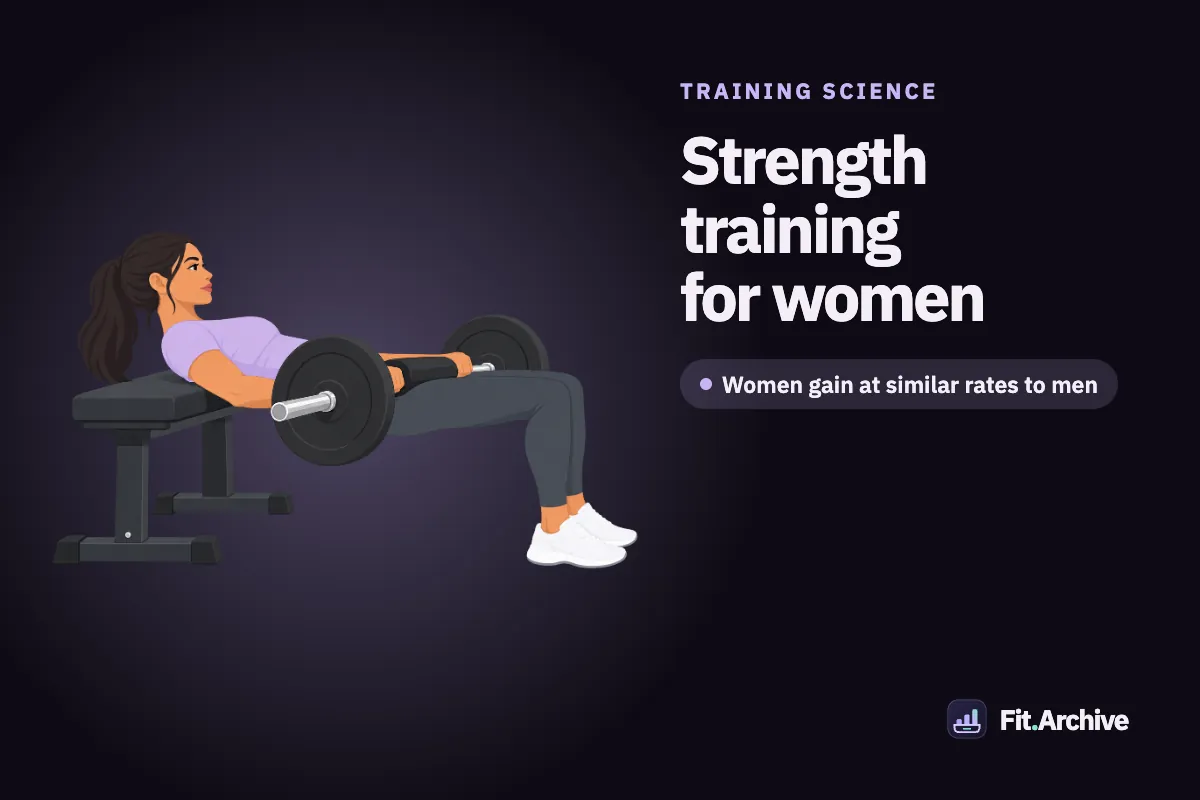
Women build muscle and strength at similar relative rates to men when they follow the same program, so the same principles apply: a few hard sets per muscle each week, ended close to failure, with weight or reps added over time. “Getting bulky” is not a realistic accidental outcome. Visible muscle gain is slow and takes deliberate training and eating for months to years. A good schedule for women is simply a good schedule: two or three full body days, or four or five days split into upper and lower body, trained consistently.
This guide tests the common myths against the research, then gives example 3, 4 and 5 day weekly schedules built from FitArchive’s templates and exercise library.
Do women respond to strength training differently from men?
Less than most people think. A 2020 meta-analysis by Roberts, Nuckols and Krieger compared young and middle-aged men and women doing the same training program:
- Muscle growth: 10 studies, no significant difference between sexes in relative gains.
- Lower-body strength: 23 studies, no significant difference.
- Upper-body strength: 17 studies, a moderate effect favouring women in relative gains.
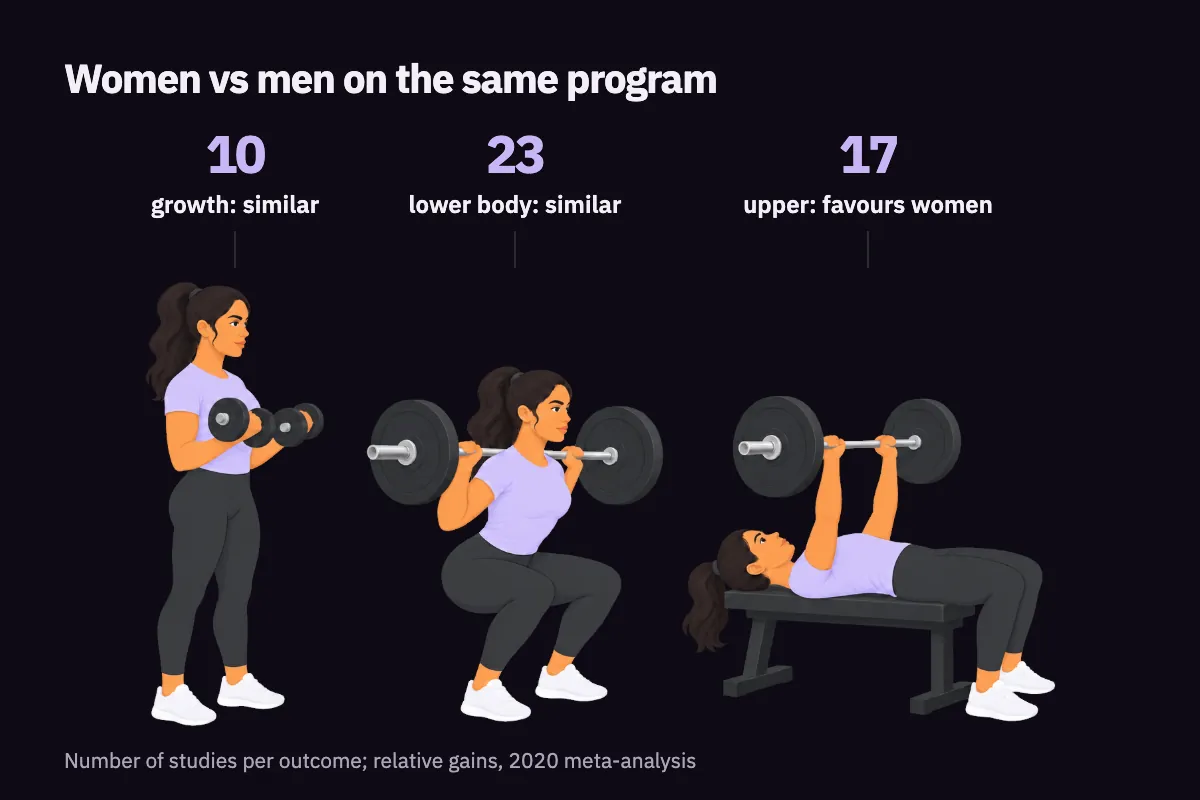
Same program, similar relative gains for women and men.
“Relative” matters. Men usually start with more muscle, so the same percentage gain is more kilograms of muscle. In a study of 585 people (342 women, 243 men) who trained one arm for 12 weeks, men gained only slightly more in relative biceps size, while women gained more relative strength. The range between individuals was huge, from slight losses to gains of nearly 60% in size.
Women also tend to be less fatigable than men in some tasks. A review by Hunter found this most clearly in sustained contractions at the same relative intensity, and noted it depends on the task. It is one reason a fixed percentage chart may not fit you, and judging effort by reps in reserve (RIR) usually works better. Our guide to logging RIR explains how.
One honest limit: most training research recruits men. In a 2026 meta-regression of 67 studies, 79% of participants were male. The findings above suggest the principles transfer, but women are under-studied.
Strength training myths for women, tested
| Popular claim | What the research shows |
|---|---|
| “Lifting makes women bulky.” | Relative gains are similar to men, but absolute gains are smaller and slow. Noticeable size takes deliberate effort over a long time. |
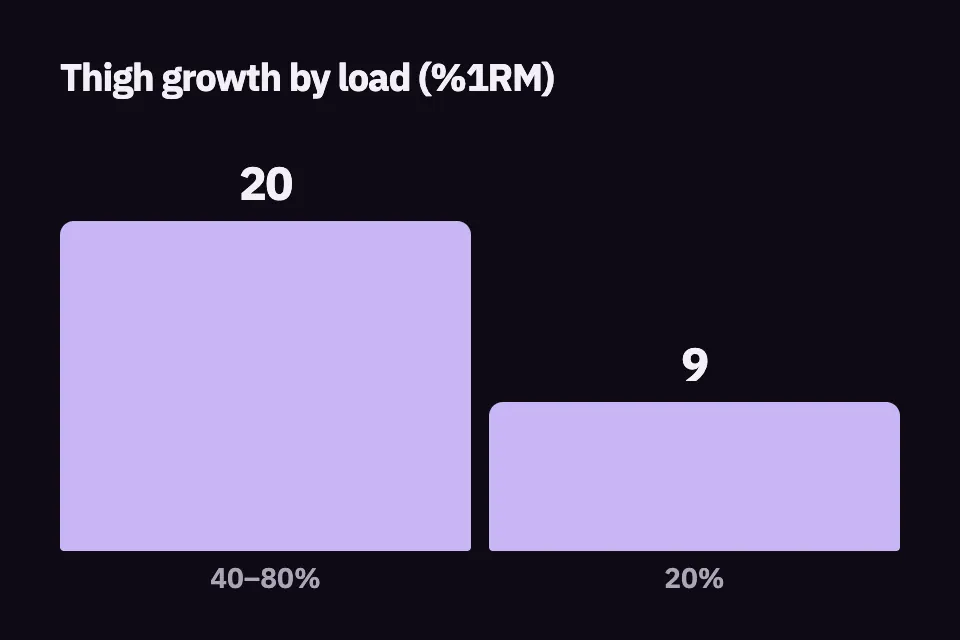
| “Women should lift light for toning.” | “Toning” means building some muscle. A meta-analysis of 21 studies found similar growth across light and heavy loads when sets went to failure; heavier loads built more strength. |
| “Women need a special program.” | The same program produced similar relative results in the 2020 meta-analysis above. |
| “You must train around your cycle.” | Effects of cycle phase on performance look trivial on average and vary by person (details below). |
| “Lifting is risky for older women’s bones.” | Supervised heavy lifting with impact training improved spine bone density in postmenopausal women with low bone mass in one trial (details below). |
How many days a week should women lift?
The 2026 ACSM position stand, an overview of 137 systematic reviews, found muscle growth was enhanced by about 10 or more sets per muscle each week, and strength by training at least twice a week and with heavier loads (80% of one-rep max or more). Most other prescription details, including equipment type, did not consistently change results. So the right number of days is the number you can keep doing. Our split comparison covers the choice in more depth.
Is there a special gym schedule for fat loss or toning?
No. The schedules below work whether your goal is muscle, strength or changing your body composition. Fat loss depends mostly on eating less energy than you use over time, and lifting helps you keep or build muscle while that happens. No schedule can promise a rate of fat loss, and personal calorie targets are best set with a dietitian or doctor. Our guides to body recomposition and keeping muscle while cutting summarise the research.
Example gym schedules for women: 3, 4 and 5 days
These are example schedules, not personal prescriptions. Each uses exercises from FitArchive’s library, with sets × reps and a target RIR in brackets. Weekly set counts use FitArchive’s rule: 1 set for the primary muscle, 0.5 for secondary muscles.
| Days | Mon | Tue | Wed | Thu | Fri | Sat | Sun |
|---|---|---|---|---|---|---|---|
| 3 | Full body A | Rest | Full body B | Rest | Full body C | Rest | Rest |
| 4 | Upper A | Lower A | Rest | Upper B | Lower B | Rest | Rest |
| 5 | Lower A | Upper A | Glutes and shoulders | Rest | Lower B | Upper B | Rest |
3 days: full body
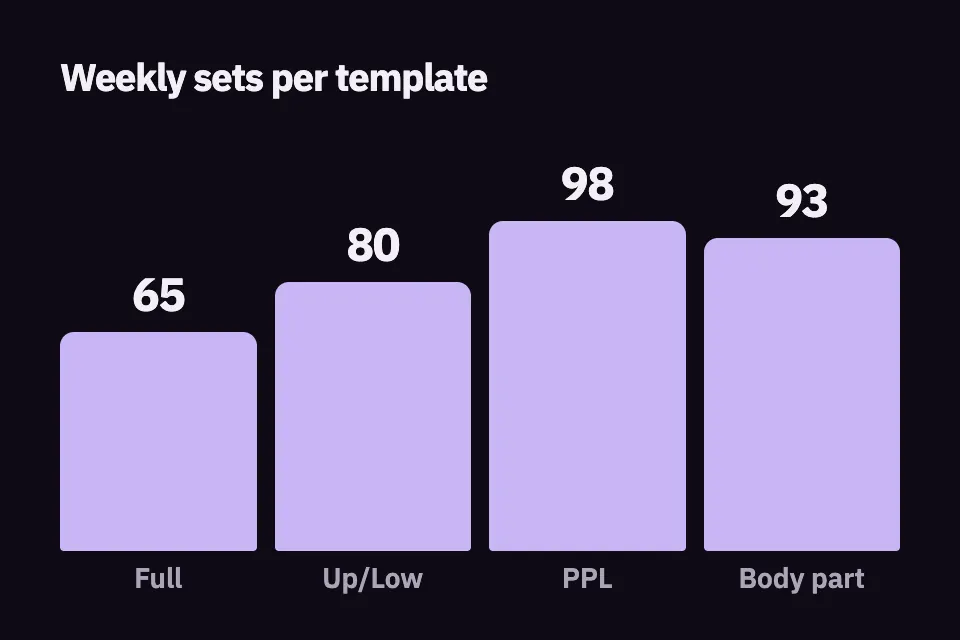
FitArchive’s Full body 3 day template trains everything three times a week (squat, bench press, rows, Romanian deadlift, overhead press, lat pulldown, leg press, hack squat and accessories). It has no hip thrust, so a common example change is adding barbell hip thrust 3 × 8 to 12 (2) to Full body A. That takes weekly glute sets from about 9 to 12 and the week from 65 to 68 working sets. Good for beginners and anyone with three free days.
4 days: upper/lower
FitArchive’s Upper/Lower 4 day template is used unchanged here. The lower days already include squats, Romanian deadlifts, hip thrusts and Bulgarian split squats, giving about 12.5 weekly glute sets, and the upper days give about 10 sets each for chest, lats and upper back. That is 80 working sets a week. The upper/lower guide lists every exercise.
5 days: upper/lower plus a glute and shoulder day
This example keeps the four upper/lower days and adds one custom session:
| Glutes and shoulders (example) | Sets × reps (target RIR) |
|---|---|
| Barbell hip thrust | 3 × 8 to 12 (2) |
| Hip abduction machine | 3 × 12 to 20 (1) |
| Cable glute kickback | 2 × 12 to 15 (1) |
| Dumbbell lateral raise | 3 × 12 to 20 (1) |
| Face pull | 3 × 12 to 20 (1) |
Weekly glute sets rise to about 20.5 and side delts to about 11.5, for 94 working sets in total. That is a lot of glute work; if you are new, start with 2 sets per exercise on the extra day. FitArchive’s Body-part split 5 day template is another option, but it trains each muscle once a week with a single leg day, which suits glute priorities less well.
For 6 days, the Push/Pull/Legs 6 day template trains each muscle twice a week in shorter sessions.
Glutes and upper body: keep both
Many women’s programs are mostly lower body. Glutes respond well to hip thrusts, squats, lunges and Romanian deadlifts, and there is nothing wrong with prioritising them. But skipping upper-body work, especially rows and pulldowns, leaves strength on the table, and the 2020 meta-analysis found women’s relative upper-body strength gains were, if anything, larger. A useful check is your weekly sets per muscle: if glutes get 15 and your back gets 3, the balance is off. Our guide to counting weekly sets shows how.
Should you train around your menstrual cycle?
The evidence says it is not necessary, and plans built around cycle phases are not well supported:
- A 2020 meta-analysis of 78 studies found performance might be trivially lower in the early follicular phase (around menstruation) on average. The authors rated the evidence quality as low and recommended a personal approach rather than general rules.
- A 2023 umbrella review found highly variable findings and poor cycle verification in many studies, and concluded it is premature to say cycle phase meaningfully affects strength performance or long-term gains.
- A 2022 review argued that training more in the follicular phase might help, but it rests on a few small studies.
Practically: train by how you feel that day, adjust load or sets if needed, and write a note. If you see a pattern over several months, you can plan around it. Periods that stop, become very heavy or very painful are worth raising with a doctor.
Pregnancy and postpartum
The American College of Obstetricians and Gynecologists says that without obstetric or medical complications, physical activity in pregnancy is safe and desirable, though some changes to routines may be needed. What changes, and when to return to lifting after birth, depends on your pregnancy and delivery. Ask your obstetric care provider, and consider a pelvic health physiotherapist after giving birth.
Strength training for women over 40 and 50
Lifting still works with age, and bone is part of the reason to do it:
- A meta-analysis of 49 studies in adults 50 and older found an average lean mass gain of 1.1 kg. Higher-volume programs gained more, and older participants gained somewhat less.
- A meta-analysis of 75 studies in 5,300 postmenopausal women found exercise had a small but significant effect on bone density at the spine and hip, with wide differences between programs.
- In the LIFTMOR trial, 101 postmenopausal women with low bone mass did either 8 months of supervised, twice-weekly heavy lifting (5 sets of 5 above 85% of one-rep max) with impact training, or a light home program. Spine bone density rose 2.9% in the heavy group and fell 1.2% in the light group, with one minor adverse event. Participants were screened and closely supervised.
If you have osteoporosis, osteopenia, a past fracture or a medical condition, ask your doctor first and learn heavy lifts with qualified supervision. Otherwise, the schedules above work at any age; progress may be slower and warm-ups longer.
Strength training for women at home
With a pair of adjustable dumbbells you can train every muscle: goblet squats, Romanian deadlifts, hip thrusts, floor presses, rows and lateral raises. Our dumbbell workout at home guide has full example plans.
Common mistakes
- Never adding weight. If a weight has felt the same for months, use double progression: add reps, then weight.
- Stopping sets far from failure. Light sets only build muscle when they end close to it.
- Lower body only. Keep rows, pulldowns and presses.
- Switching programs every few weeks. Run one for at least two or three months so you can see progress.
- Judging by the scale. Strength and reps in your log show progress sooner. See how long it takes to build muscle.
- Ignoring protein. Our protein guide summarises the research; a dietitian can set personal targets.
Running a women’s schedule in FitArchive
FitArchive includes the Full body 3 day, Upper/Lower 4 day and Push/Pull/Legs 6 day templates used above, and you can edit them or build your own, such as the glute and shoulder day. It logs weight, reps and RIR for each set and has a notes field for each workout, where you can record sleep, how you felt or cycle day if you find that useful. The Progress screen shows weekly hard sets by muscle, so you can check glute and back balance. Try it with sample data in the demo.