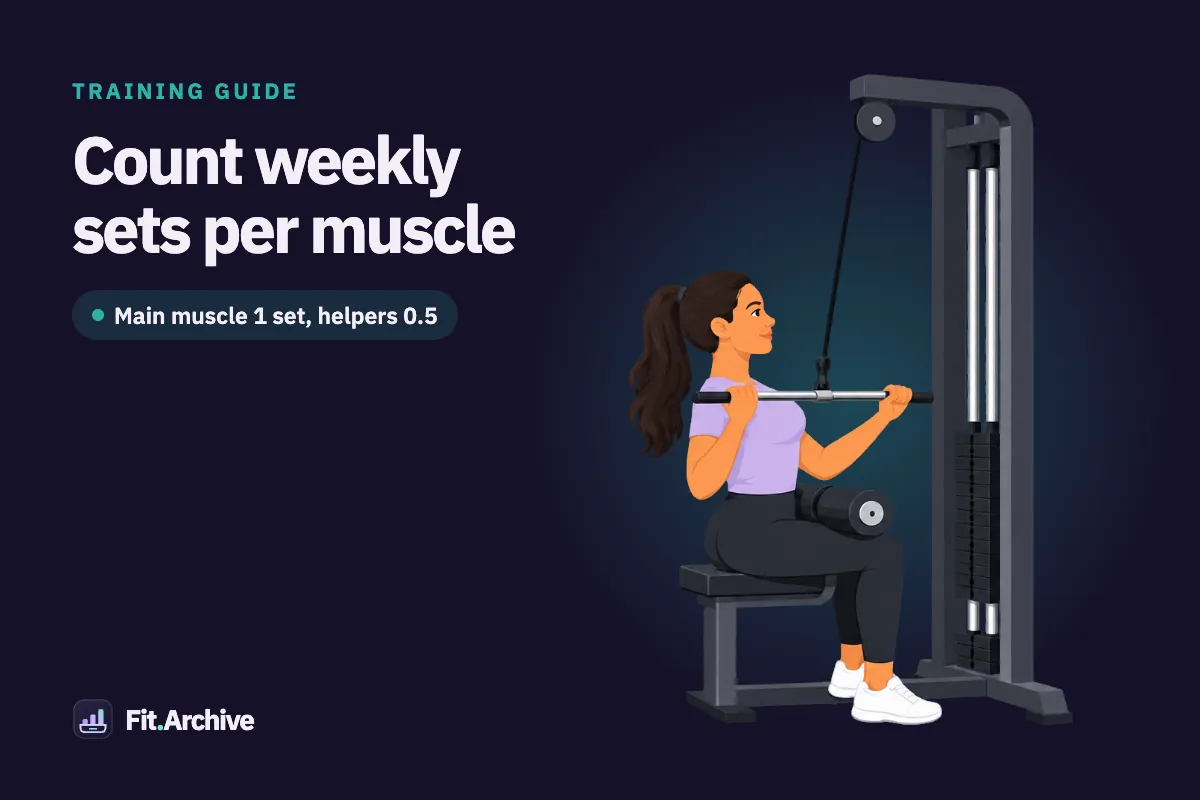
To count weekly sets per muscle, add up the completed hard working sets for that muscle over a fixed seven-day window. Count a set as 1 for the muscle an exercise mainly targets and 0.5 for muscles that only assist, and leave warm-ups out. Then use the same rule every week, so the total can be compared over time alongside your performance and recovery.
That is the whole method. The rest of this guide explains why each rule exists, shows a worked week, and covers what the research does and does not say about how many sets you need.
The 2026 ACSM resistance-training position stand, an overview of 137 systematic reviews, found that muscle growth was enhanced with higher weekly volumes (10 or more sets per week) in the evidence it reviewed. That is a population-level finding, not a personal prescription, and it does not mean more sets are always better.
What counts as one set for a muscle?
A weekly set count is a bookkeeping rule. It only works if every set in the total is roughly comparable. A practical definition has three parts:
- It is a working set, not a warm-up. Warm-up sets prepare you for the work; they are usually far from your limit and are not counted. Log them, but flag them as warm-ups so they stay out of the total.
- It was completed. A planned set you skipped does not count. A set you cut short still counts as a set, but note the reps you actually did.
- It was reasonably hard. Most counting systems only include sets taken fairly close to failure. If you log reps in reserve (RIR), you can make this explicit, for example counting sets that ended with about 4 or fewer reps left. A set of 15 easy reps with 10 left in the tank is not the same stimulus as a set that ended near your limit.
The exact RIR cut-off is a convention rather than a proven threshold. What matters is that you pick one and apply it the same way every week. If you want the evidence on how close to failure sets need to be, see training to failure vs leaving reps in reserve.
Do compound exercises count for every muscle they work?
This is where most double-counting happens. A bench press works the chest, but the triceps and front delts also do a lot of the work. If you count 3 sets of bench as 3 chest sets and 3 triceps sets and 3 shoulder sets, your weekly totals will look much higher than the direct work you actually did for the smaller muscles.
There are three common ways to handle it:
| Method | Indirect sets count as | Effect on the total |
|---|---|---|
| Direct only | 0 | Ignores real work from compound lifts; small muscles look undertrained |
| Total | 1 | Every muscle involved gets full credit; small muscles look overtrained |
| Fractional | 0.5 | A middle ground: helper muscles get half credit |
A 2025 dose-response meta-regression of 67 studies classified every set as direct or indirect and compared these three methods. The fractional method (indirect sets counted as 0.5) had the strongest relative evidence for predicting muscle growth and strength gains, and the authors concluded that distinguishing direct from indirect sets “appears essential”. That supports half credit as a sensible default. It does not prove that the triceps get exactly half the stimulus from every press; the 0.5 is a modelling choice that fit the group data best.
In practice:
- Primary muscle: the muscle the exercise is mainly chosen for (chest for bench press, lats and upper back for rows, quads for squats). Count 1 per hard set.
- Secondary muscle: a muscle that clearly assists (triceps on presses, biceps on rows and pull-downs, glutes on squats). Count 0.5 per hard set.
- Stabilisers: muscles that only hold position (for example, the abs during a standing press). Usually not counted.
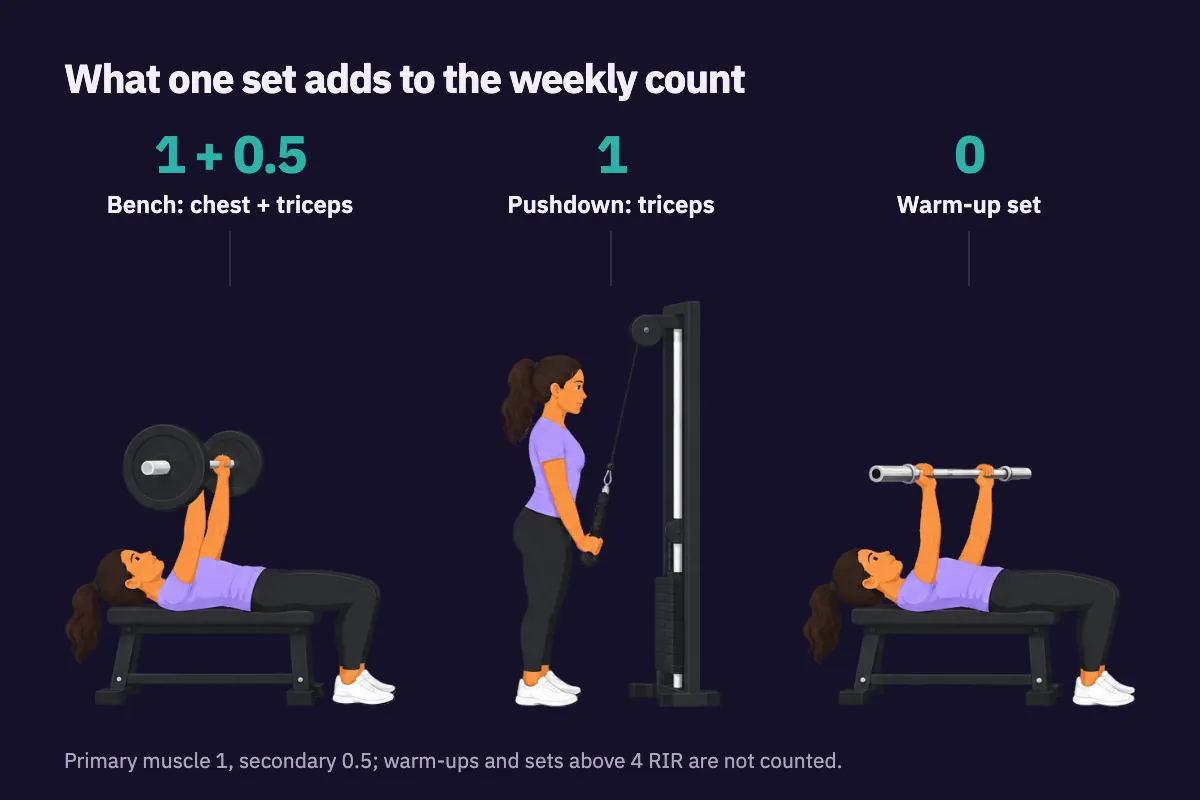
Use the same rule every week so totals stay comparable.
A worked week: chest and triceps
This is an illustrative log, not a recommended program. Every set listed is a completed working set at around 1 to 3 RIR; warm-ups are logged but excluded.
| Day | Exercise | Working sets | Chest | Triceps |
|---|---|---|---|---|
| Monday | Bench press | 3 | 3 | 1.5 |
| Monday | Triceps pushdown | 3 | 0 | 3 |
| Thursday | Incline dumbbell press | 3 | 3 | 1.5 |
| Thursday | Chest fly | 2 | 2 | 0 |
| Thursday | Overhead press | 3 | 0 | 1.5 |
| Week total | 14 | 8 | 7.5 |
A few things to notice:
- The 2 warm-up sets before the bench press are in the log but not in either column.
- The overhead press is a shoulder exercise. The upper chest helps a little, but most people do not credit the chest for it; the triceps get half credit.
- Under the “total” method, triceps would show 12 sets instead of 7.5. Under “direct only”, triceps would show 3. Same training, three different numbers. That is why you must note which rule you used before comparing totals across apps, coaches or programs.
How many sets per muscle per week?
This is the most searched question, and the honest answer is that the research gives a direction, not a personal number.
- A 2017 meta-analysis of 15 studies found a graded dose-response: each additional weekly set was associated with slightly greater muscle growth, and when volumes were grouped, 10 or more sets per muscle per week showed a trend toward larger gains than fewer than 5 or 5 to 9 sets.
- The 2025 meta-regression again found that gains increased with volume but with diminishing returns, and the returns for strength flattened out considerably faster than for muscle size.
- The ACSM position stand summarises the hypertrophy evidence as enhanced by higher volumes of 10 or more sets per week.
Many coaching guides quote ranges such as 10 to 20 sets per muscle per week. Treat those as a rough starting point, not a target to hit. The studies average many people over a few weeks to months; your own response depends on training history, sleep, total workload and how you count sets in the first place. A sensible approach is to start from what you currently do, change volume gradually, and judge the change by repeated performance and recovery, not by the total alone.
Does it matter how you split sets across the week?
The same meta-regression found that, once total volume was accounted for, training frequency had little identifiable effect on muscle growth, while strength gains did increase with frequency (again with diminishing returns). For counting purposes that means two things: the weekly total is more useful than per-session totals for size goals, and you should always count over the same seven-day window. Pick a start day and keep it, so a Monday-to-Sunday week is never compared with a Thursday-to-Wednesday one.
Reading the weekly total over time
Compare several weeks, not one. A jump from 8 to 12 chest sets is a change in your planned workload. It is not proof that the extra sets improved growth, and it is not a reason to ignore soreness, worse technique, or performance that keeps dropping. Look at the set count next to the lifts themselves; the progressive overload guide covers how to read those.
If a week includes deliberately lighter sessions, keep the actual sets in the log and label the week rather than changing your counting rule afterwards. The deload logging guide shows how. If progress has stalled for several weeks, check the set count as one input in a broader plateau audit before simply adding more.
Common counting mistakes
- Counting warm-ups. Two or three warm-up sets per exercise can make a week look far bigger than the work that actually challenged the muscle.
- Full credit for every muscle in a compound lift. This makes arms and shoulders look heavily trained when most of their work was indirect.
- Changing the rule mid-block. Switching from “total” to “fractional” counting halfway through makes the trend meaningless.
- Counting easy sets the same as hard ones. If a set ended far from failure, either leave it out or note it.
- Chasing the number. Adding sets to reach a quoted range while performance or recovery gets worse is the opposite of what the count is for.
- Ignoring pain. If an exercise hurts, stop it and get qualified advice; no weekly target is worth training through pain.
Counting sets in FitArchive
FitArchive lets you mark warm-up sets and record RIR per set. Its weekly review lists your most-trained muscles using the rule described here: warm-ups are excluded, primary muscles get 1 per set, secondary muscles get 0.5, and sets logged at more than 4 RIR are left out. You can open the demo to see the layout with sample data.