For muscle growth, there is no single best rep range. Studies show sets of roughly 5 to 30 reps build similar amounts of muscle when they end close to failure. Heavier loads (fewer reps) build more maximal strength. Light weights with high reps do work for muscle, but only if the sets are pushed hard, which feels much more uncomfortable than a heavy set of 8. The rep count matters less than how close each set ends to failure and how many hard sets you do.
This guide tests the popular “8 to 12 reps for hypertrophy” rule against the research, compares light and heavy training, and shows how to log sets so you can tell whether they counted.
What are rep ranges good for?
The table below is a rough guide, not a prescription. Reps refer to sets taken close to failure; the same weight stopped far short of failure is a different stimulus.
| Reps per set (rough guide) | Load | Good for | Trade-offs |
|---|---|---|---|
| 1 to 5 | Heavy | Maximal strength, practising heavy lifts | Builds muscle too when enough sets are done; long rests; higher joint and technique demands |
| 6 to 12 | Moderate to heavy | Muscle and strength together | A practical middle ground for most lifts |
| 13 to 20 | Moderate to light | Muscle, especially on isolation and machine exercises | More burning and breathing; harder to judge reps in reserve |
| 20 to 30 | Light | Muscle if taken close to failure; local muscular endurance | Very uncomfortable; easy to stop too early |
| Very high reps | Very light (about 20% of 1RM) | Little evidence for muscle growth | Grew about half as much in the one volume-matched study that tested it |
Is 8 to 12 reps the “hypertrophy zone”?
The traditional “repetition continuum” says heavy loads build strength, moderate loads build muscle and light loads build endurance. A 2021 review by Schoenfeld et al. re-examined it and concluded that the research does not support some of its assumptions: muscle can be built across a wide spectrum of loads. The strength end of the continuum holds up; the idea of a narrow hypertrophy zone does not.
There is nothing wrong with sets of 8 to 12. They are convenient: heavy enough that sets end before the burning becomes unbearable, light enough to be safe and to need moderate rests. But a set of 6 or a set of 20 taken close to failure is not a wasted set for muscle.
Light vs heavy weights: what studies show
| Study | People | Comparison | Result |
|---|---|---|---|
| Schoenfeld et al. 2017 | Meta-analysis of 21 studies, at least 6 weeks | Low (60% of 1RM or less) vs high load, all sets to failure | Similar muscle growth; greater 1RM strength with heavy loads |
| Lopez et al. 2021 | Network meta-analysis, 28 studies, 747 adults | Low (more than 15RM), moderate (9 to 15RM) and high (8RM or less), to failure | No difference in muscle growth; strength better with high and moderate than low loads |
| Morton et al. 2016 | 49 trained men, 12 weeks | 30 to 50% of 1RM for 20 to 25 reps vs 75 to 90% for 8 to 12 reps, to failure | Similar lean mass and muscle fibre growth; bench press gain larger with heavy (14 vs 9 kg), other lifts similar |
| Schoenfeld et al. 2015 | 18 trained men, 8 weeks | 25 to 35 reps vs 8 to 12 reps, to failure | Similar muscle thickness; squat strength rose about 20% heavy vs 9% light |
| Lasevicius et al. 2018 | 30 men, 12 weeks, one limb vs the other | 20, 40, 60 and 80% of 1RM, total volume load matched | 40 to 80% similar; 20% grew about half as much (thigh 9% vs 20%) |
| Lasevicius et al. 2022 | 25 untrained men, 8 weeks | 30% vs 80% of 1RM, to failure or stopping earlier, volume matched | Heavy grew either way; light grew only when taken to failure (about 8% vs 3%, the latter not significant) |
Two limits apply. First, nearly all of these studies took every set to failure, so they show what light loads can do at maximum effort, not what they do when stopped early. Second, the trials were 8 to 12 weeks long. Over that time the picture is consistent: muscle growth is similar across a wide load range, while maximal strength favours heavy loads. The 2026 ACSM position stand, an overview of 137 systematic reviews, reached the same split: strength was enhanced by heavier loads (80% of 1RM or more), while muscle growth was enhanced by higher weekly volume (10 or more sets per week), and load was not among the factors it found to enhance growth.
Why effort matters more with light weights
With a heavy weight, every rep is fairly hard and a set of 6 ends near failure whether you plan it or not. With a light weight, the first 15 or 20 reps can feel easy, and the reps that drive growth come near the end of the set.
The second Lasevicius study shows the risk. At 30% of 1RM, sets to failure averaged about 34 reps. Sets stopped earlier averaged about 20 reps, and that group’s quadriceps growth was small and not statistically significant. At 80% of 1RM, stopping short of failure made no clear difference.
The wider evidence is more nuanced. A 2023 meta-analysis by Refalo et al. found only a trivial overall advantage for training to failure, and in that analysis load did not clearly change the effect. A 2024 series of meta-regressions by Robinson et al. found muscle growth increased as sets ended closer to failure, while strength gains were similar across a wide range of reps in reserve; the authors called the analysis exploratory. So the safest reading is: light sets do not need literal failure, but they need to end close to it.
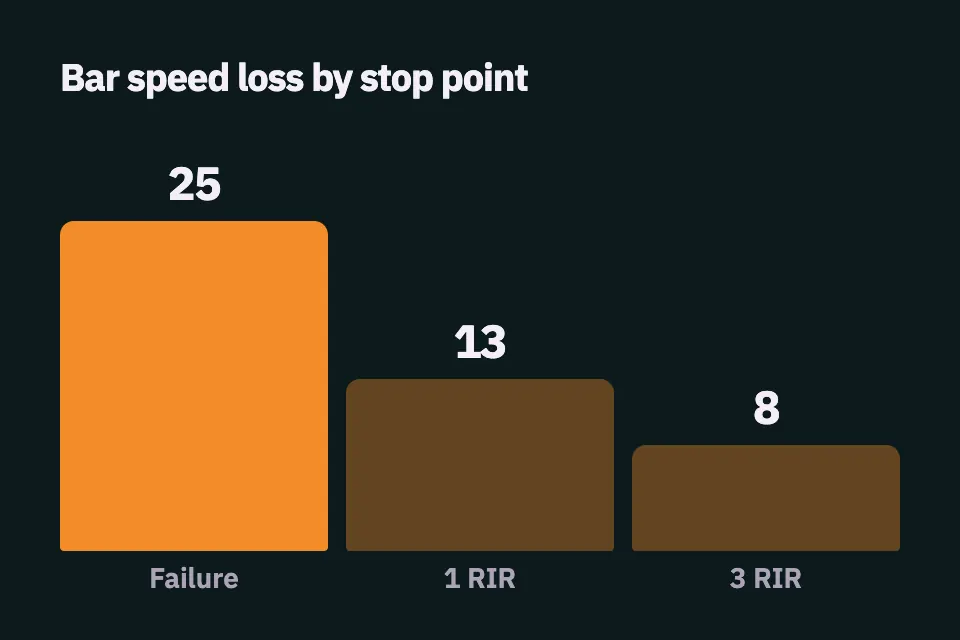
There is a measurement problem too. A meta-analysis by Halperin et al. found people underestimated how many reps they had left by about one rep on average, and predictions were less accurate in sets longer than 12 reps. On a set of 25, “I had 2 left” is more likely to be wrong than on a set of 6. For more on stopping points, see training to failure vs RIR.
How to choose rep ranges for each exercise
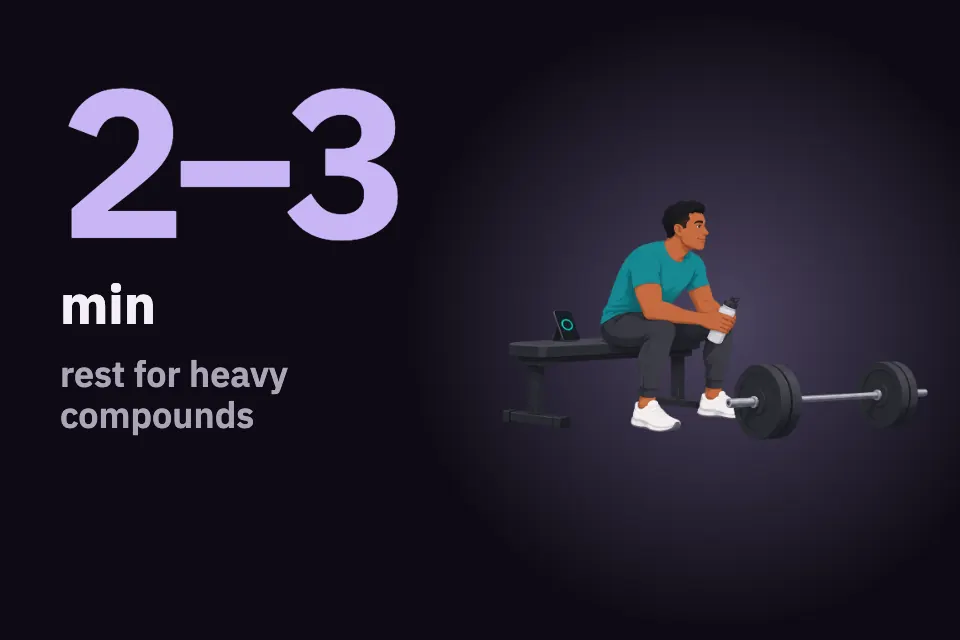
- Big compound lifts heavier. Squats, deadlifts, bench press and rows often suit 4 to 10 reps. Heavy loads build the strength you want on these lifts, and very long sets turn into a breathing and technique test before the target muscles give out.
- Isolation and machine work lighter. Curls, lateral raises, leg extensions and calf raises suit 10 to 20 or more reps. They are safer to push close to failure, and joints often tolerate them better.
- Use more than one range. Mixing heavy, moderate and light sets across the week is fine and may suit joints and motivation better than one range for everything.
- Progress inside a range. Double progression works with any range: add reps until you hit the top, then add weight.
- Count sets as well as reps. Growth seems to depend more on hard sets per week than on rep count. Our guide to counting weekly sets per muscle explains how.
How to track reps so the sets count
The rep count alone does not tell you whether a set was hard. Ten reps can be a warm-up or an all-out set. Log reps and reps in reserve (RIR) together:
| Set (example) | Weight × reps | RIR | Counts as a hard set? |
|---|---|---|---|
| Leg press, heavy | 140 kg × 8 | 2 | Yes |
| Leg press, light | 80 kg × 22 | 2 | Yes |
| Leg press, light, stopped at the burn | 80 kg × 15 | 9 | No, too far from failure |
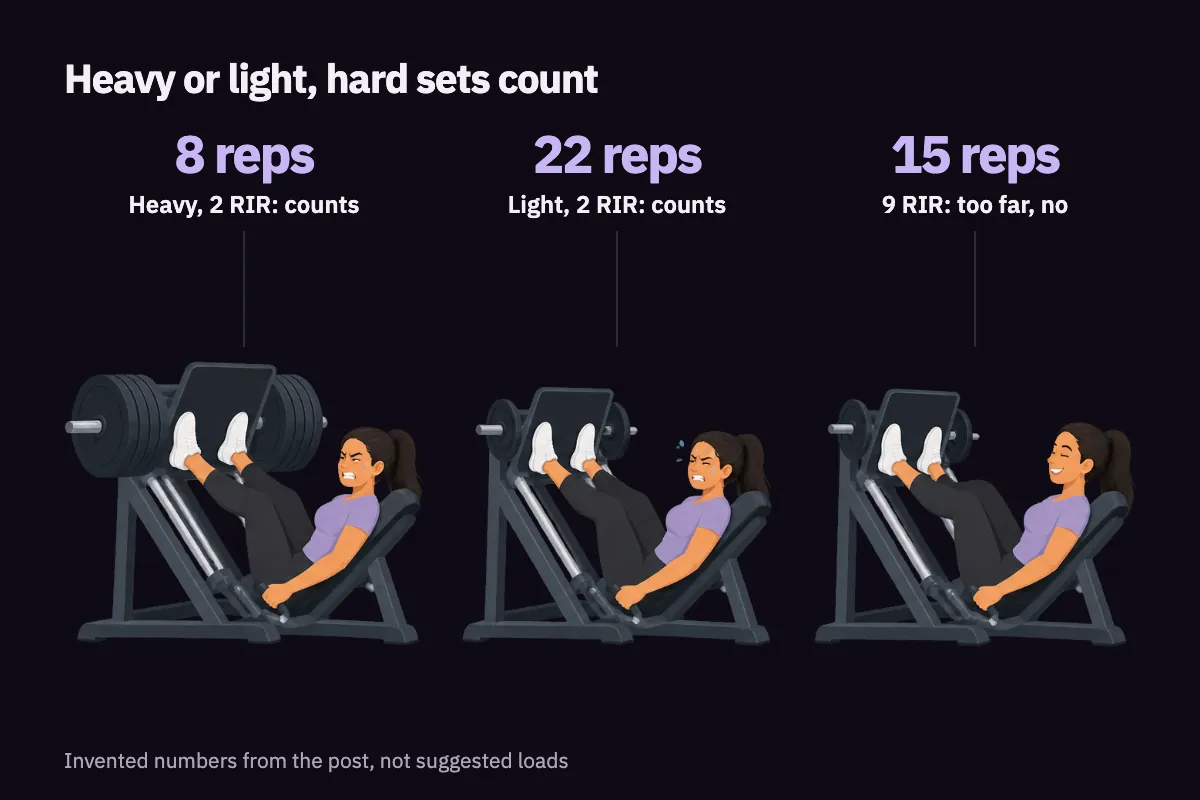
What makes a set count is how close it ends to failure, not the rep number.
These are invented numbers, not suggested loads. The first two sets are both reasonable muscle-building sets; the third, despite 15 reps, probably is not. Our guide to logging RIR covers how to estimate it honestly.
When you compare weeks, compare the same exercise in a similar rep range. A set of 20 and a set of 6 are not directly comparable, and 1RM estimates from high-rep sets are less reliable.
Common mistakes
- Stopping light sets when they start to burn. The burn arrives well before failure. If you log 8 or more reps in reserve, the set probably was not hard enough.
- Treating 8 to 12 as the only range that builds muscle. It is a convenient range, not a magic one.
- Avoiding heavy work when strength is a goal. Light loads build muscle but not the same maximal strength.
- Going extremely light. Loads around 20% of 1RM produced less growth in the volume-matched study above.
- Changing ranges every session. You lose clean comparisons. Change on purpose and note it.
- Counting warm-ups as hard sets. Mark warm-ups separately so weekly totals reflect real work.
Tracking reps and RIR in FitArchive
FitArchive logs weight, reps and RIR for every set and marks warm-up sets separately. Its weekly hard-set count per muscle includes working sets at 0 to 4 RIR, so a light set stopped far from failure does not inflate your total. Estimated 1RM appears only when reps plus RIR come to 15 or fewer, so long sets of 20 do not produce a misleading strength estimate. The demo shows sample data. If you train long-length partial reps as well, see how to log lengthened partials.