Body recomposition (“recomp”) means gaining muscle and losing fat over the same period, so your body changes while your weight may barely move. Studies show it happens, including in some trained lifters, but it is most likely in beginners, people returning after a break, people with more body fat and anyone whose training has just become more effective. If you are lean and have trained well for years, a deliberate bulk or cut is usually a clearer route. Whichever you choose, the scale alone will not tell you whether it is working.
This is general information, not personal nutrition advice, and it does not tell you how many calories to eat. For a personal target, ask a registered dietitian or doctor, especially if you have a medical condition, take medication that affects weight, are pregnant, are under 18 or have a history of disordered eating.
What does body recomposition mean?
On social media, “recomp” is often sold as a shortcut: build muscle and burn fat at once, with no bulk and no cut. The idea is real; the shortcut framing is misleading. Here is how the four common terms are usually used:
| Term | What it means | What body weight usually does |
|---|---|---|
| Bulk | Eating more than you burn to support muscle gain | Rises slowly |
| Cut | Eating less than you burn to lose fat while trying to keep muscle | Falls |
| Maintenance | Eating roughly what you burn | Stays about the same over weeks |
| Recomp | Gaining muscle and losing fat in the same period, usually near maintenance or in a small deficit | Stays flat or drifts a little |
These are coaching terms and they overlap: beginners often build some muscle during a cut.
Who is most likely to recomp?
A 2020 review in the Strength and Conditioning Journal by Barakat and colleagues examined the belief that recomposition only happens in untrained or overweight people. The authors found a substantial body of studies showing it in resistance-trained people too, and named two main drivers: progressive resistance training and evidence-based nutrition, with sleep and other factors playing a part. They also pointed out that body composition measurement has real limits, which matters when changes are small.
From that review and the trials below, recomposition is most likely when:
- You are new to lifting. Early gains are fastest, so muscle can grow even when energy intake is not generous.
- You have more body fat. There is more stored energy available, and fat loss is often the main goal anyway.
- Your training has just improved. Moving from unstructured workouts to a program with progressive overload is a new stimulus even for people who have lifted for a while.
- You are returning after a break. Coaches often expect faster regain. Human evidence is mixed: one small study found an epigenetic “memory” and larger gains on retraining, while another found a previously trained leg responded no faster than an untrained one.
It is least likely, and slowest, for lean lifters with years of good training behind them.
What does the research say?
Most of these studies are short, small and measure body composition with methods that carry some error. Treat them as evidence that recomposition can happen, not as a forecast for you. The numbers below are research findings, not targets.
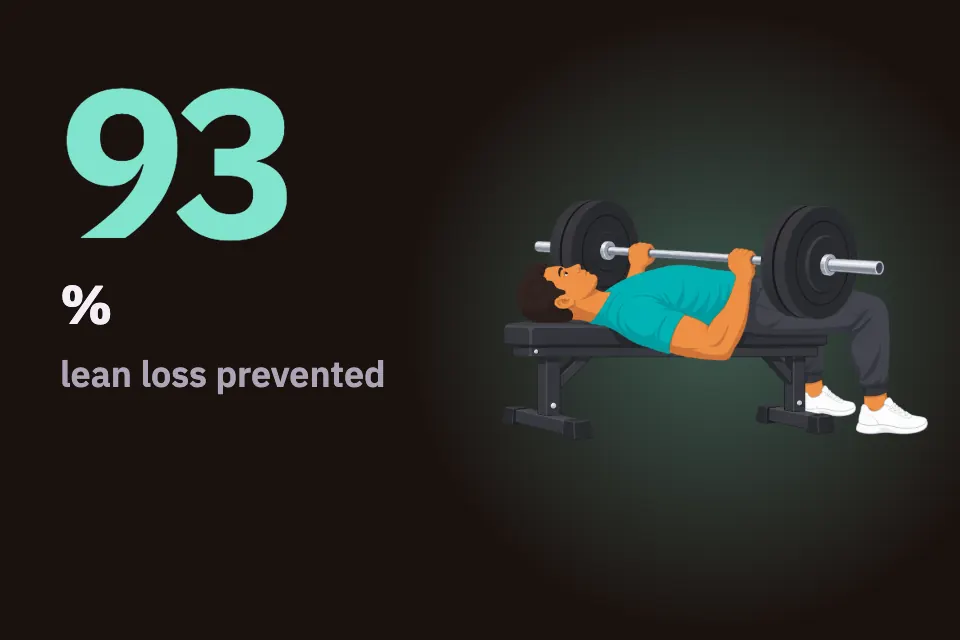
- Slow versus fast weight loss in athletes. In a 2011 randomized trial, 24 elite athletes who strength trained 4 times a week aimed to lose either 0.7% or 1.4% of body weight per week. Both groups lost about 5.5% of body weight. The slower group took longer (about 8.5 weeks versus 5.3) and increased lean body mass by about 2.1%, while lean mass in the faster group did not change.
- Higher protein in a large deficit. In a 2016 randomized trial, 40 young men ate about 40% less energy than they needed for 4 weeks while doing resistance training and interval training 6 days a week. The group eating 2.4 g of protein per kg a day gained about 1.2 kg of lean mass and lost 4.8 kg of fat; the group eating 1.2 g/kg gained about 0.1 kg of lean mass and lost 3.5 kg of fat. The researchers provided the food and the deficit was extreme, so this is a proof of principle, not a plan to copy.
- Women. In an 8-week trial in 17 aspiring female physique athletes, the group eating 2.5 g/kg of protein gained about 2.1 kg of fat-free mass and lost about 1.1 kg of fat, while the 0.9 g/kg group gained about 0.6 kg of fat-free mass with no significant fat change. A meta-analysis of sex differences found men and women gained muscle at similar relative rates on the same program, so “body recomposition for women” follows the same principles.
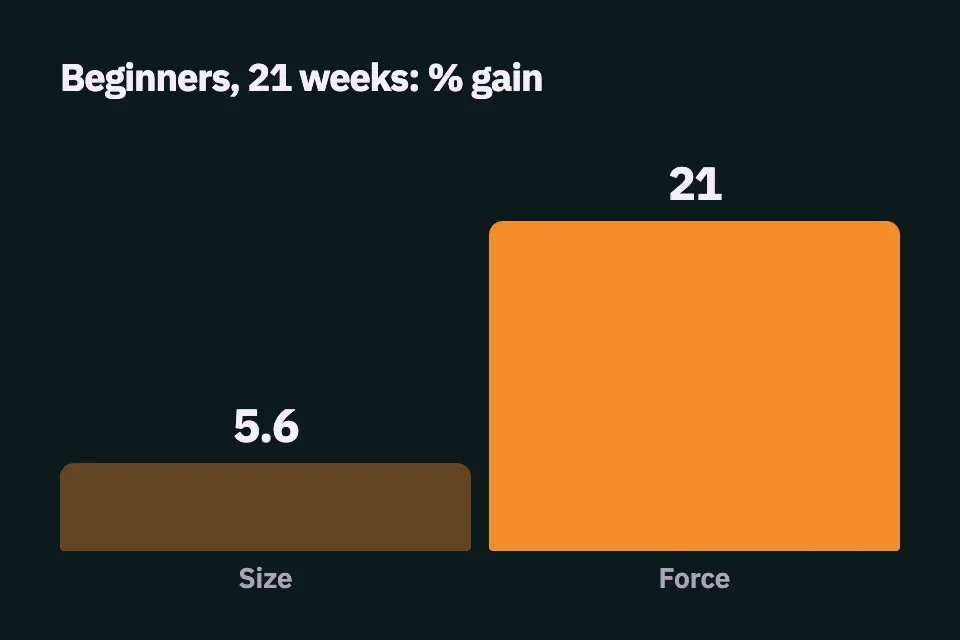
- Deficits slow muscle gain more than strength gain. A 2022 meta-analysis found lean mass gains were smaller when people trained in an energy deficit, while strength gains were similar. In its meta-regression, a deficit of about 500 kcal a day was associated with no lean mass gain on average.
- Bigger surpluses mostly added fat. In an 8-week study of trained lifters eating at maintenance, 5% above or 15% above, faster weight gain mainly predicted more skinfold thickness rather than more muscle or squat strength. Only 17 people finished, so the authors call the result limited.
Two reviews summarize what is commonly recommended for physique athletes, again as research context rather than a personal target. A review of off-season nutrition for bodybuilders suggests a surplus of about 10 to 20% with weight gain of about 0.25 to 0.5% of body weight a week for novice and intermediate natural bodybuilders, and more conservative gains for advanced lifters. A contest-preparation review suggests losing about 0.5 to 1% of body weight a week to help keep muscle.
How much protein does a recomp need?
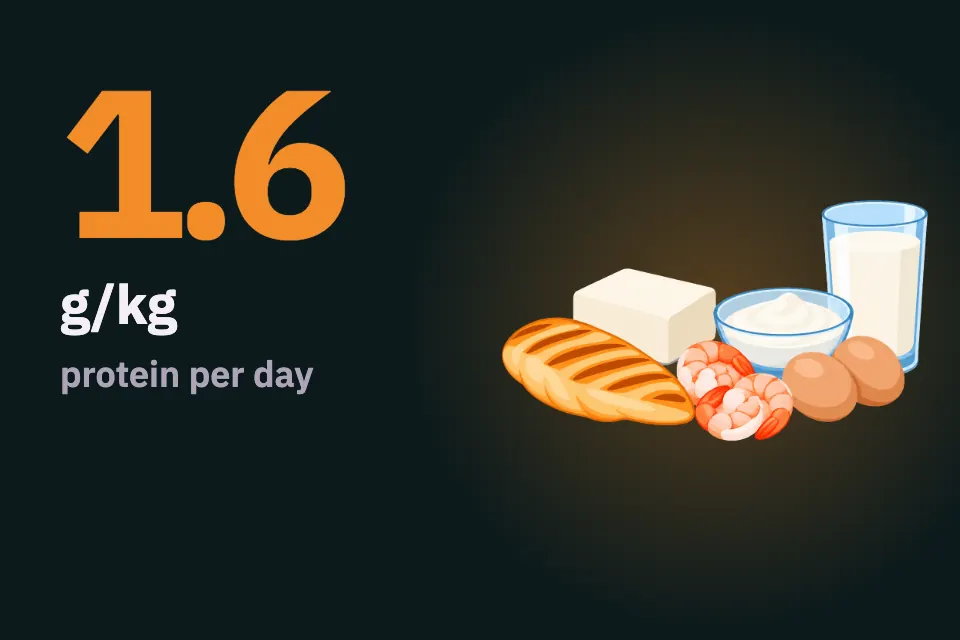
A 2018 meta-analysis of 49 trials found extra protein stopped adding lean mass gains at about 1.6 g per kg of body weight per day, with up to about 2.2 g/kg as a reasonable upper end. The deficit trials above used higher intakes, so studies of people losing fat often go above that range. Our protein guide explains the numbers with food examples. If you have kidney disease or another medical condition, follow your doctor’s or dietitian’s advice instead.
Bulk, cut or recomp: how do people choose?
There is no single correct answer. This table shows how the choice is commonly framed, as general examples:
| Your situation | Approach often discussed | Why |
|---|---|---|
| New to lifting, or back after a long break | Recomp near maintenance | Early gains are fast enough to see without a surplus |
| More body fat, and fat loss is the main goal | A cut, often with some recomp | Muscle can still grow early on if training and protein are good |
| Lean, trained for years, and size is the priority | A slow bulk | Gains are slow at this stage, and the surplus studies suggest a large one mainly adds fat |
| Lean, happy with your weight, want more muscle definition | Recomp or maintenance, with patience | Progress will be slow, so tracking matters more |
| Competing in a weight class or physique show | Follow your coach | The timeline is set by the event |
If unsure, keep training and food consistent for several weeks and watch the trends below before changing anything.
Why the scale stays flat, and what to track instead
“Can you lose fat and not lose weight?” Yes. A small gain in muscle and a small loss of fat can cancel out on the scale. Day-to-day weight also moves with water, glycogen, salt, food still in the gut and, for many women, the menstrual cycle. That is why a gain or “no change” on one morning tells you little.
Track a few signals together:
- Strength at the same effort. Compare reps at a fixed weight with the same reps in reserve (RIR), or an estimated 1RM trend. Strength can rise even in a deficit, so it shows that training is working, though not by itself that muscle is growing.
- Waist measurement. Measure at the same spot, at the same time of day, every week or two.
- Weekly average body weight. Average several weigh-ins, or use a smoothed trend, instead of reading one day.
- Photos, if you want them. They are optional, should be private, and only help when the lighting, pose and time of day match.
A flat average weight, a slowly shrinking waist and rising strength is the pattern recomposition tends to produce. Here is an invented example, not a predicted result:
| Week | Weekly average weight | Waist | Squat top set | Estimated 1RM |
|---|---|---|---|---|
| 1 | 70.2 kg | 82.0 cm | 60 kg × 8 at 2 RIR | 80 kg |
| 4 | 70.0 kg | 81.4 cm | 60 kg × 10 at 2 RIR | 84 kg |
| 8 | 70.3 kg | 80.8 cm | 65 kg × 9 at 2 RIR | 89 kg |
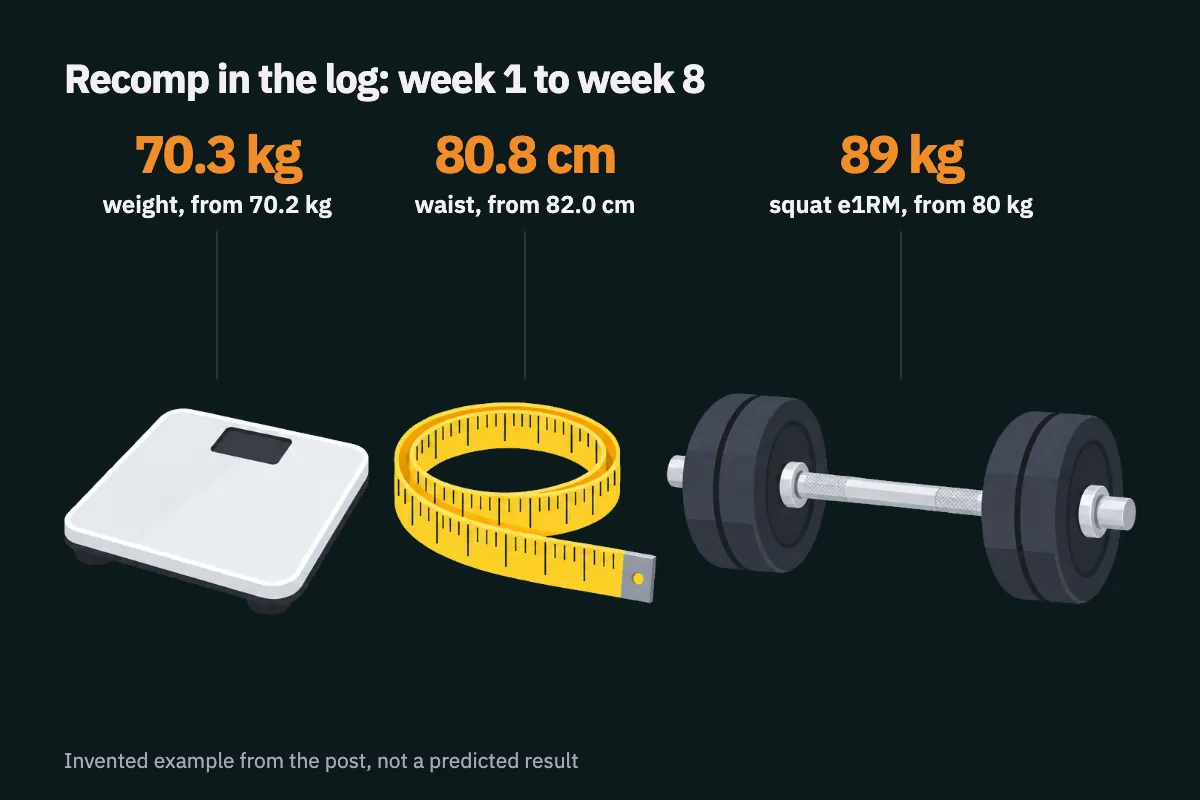
The scale barely moves while waist and strength change.
Home body-composition scales can help as one extra signal, but their readings move with hydration and their error can be larger than the change you are looking for over a few weeks.
Common mistakes
- Judging by one weigh-in. A heavy morning after a salty dinner is not fat gain.
- Switching plans every two weeks. Recomposition is slow. Give a plan long enough to show a trend in strength and waist.
- Cutting hard and hoping to recomp. The meta-analysis above suggests larger deficits make muscle gain less likely.
- Low protein. Several of the trials that showed recomposition used generous protein intakes.
- Training without progression. Recomp needs a reason for muscle to grow. If the weights and reps never change, check your log first.
- Recomping forever when you are lean and advanced. Progress may be so slow that a planned bulk, then a cut, gives clearer results.
If cardio is part of your plan, see whether cardio affects muscle gain. For how quickly muscle grows in the first place, see how long it takes to build muscle.
Tracking a recomp in FitArchive
FitArchive is a free, private training and food log that works in your browser and offline; your data stays on your device unless you sign in to sync. You can record one body weight reading a day and see a smoothed weight trend with the change per week, add optional body measurements in centimetres such as waist, chest, arm and hip, and log food with daily calories and protein. Workouts record weight, reps and RIR for each set, and the Progress screen shows an estimated 1RM trend for each exercise. Progress photos are optional and stay on that device: they are not synced or included in the JSON backup. To see how these fit together, see logging food and workouts together or open the demo with sample data.