To keep muscle while cutting, keep lifting with about the same loads and effort you used before the diet, keep protein intake high, lose weight slowly rather than quickly, and protect your sleep. Studies of people dieting link each of these to keeping more lean mass. None of them guarantees you lose no muscle at all, but together they tilt the odds a long way. The scale cannot tell you which tissue you are losing, so your training log matters more during a cut than at any other time.
This is general information, not personal nutrition advice, and it does not tell you how many calories to eat. For a personal target, ask a registered dietitian or doctor, especially if you have a medical condition, take medication that affects weight or appetite, are pregnant or breastfeeding, are under 18, or have a history of disordered eating.
Does cutting make you lose muscle?
It can, and resistance training is the main thing that changes the answer. Most of the clearest data come from older adults with overweight, not lean lifters, so read them as direction rather than precise numbers:
- A systematic review of 52 studies in middle-aged and older adults found that 81% of diet-only groups lost at least 15% of their weight as fat-free mass, compared with 39% of groups that dieted and exercised. The exercise was mostly aerobic.
- A meta-analysis of 6 randomized trials in older adults with obesity found that adding resistance training three times a week prevented about 93% of the lean mass lost with dieting alone, a difference of about 0.8 kg, with similar fat loss.
- In a study of 20 older men, muscle protein synthesis fell after two weeks of eating less and recovered once resistance training was added.
In lean, trained people the margin is thinner. A systematic review of protein intake in dieting athletes found that fat-free mass fell in 9 of the 13 study groups. Keep in mind that “lean mass” on a scan also includes water and stored carbohydrate, so part of an early drop is not muscle.
Should you lift heavy when cutting?
Yes, if heavy means the loads you already handle well. The popular advice to switch to light weights and high reps “to tone” while dieting removes the signal that built the muscle. Keep the same main exercises, rep ranges and effort, measured as reps in reserve (RIR), and treat holding your numbers as a win.
Volume is where you have some room. In a 32-week trial, young adults who had trained for 16 weeks kept their muscle size while doing one third, or even one ninth, of their previous weekly training. That study did not involve dieting, so it is not proof for a cut, but it shows that the stimulus to keep muscle is smaller than the one needed to build it.
A 2022 review of 15 studies found that programs with at least 10 weekly sets per muscle showed little or no lean mass loss during a diet (mostly in women), and that studies cutting volume over time tended to show more loss. The authors said the data were too incomplete to conclude that higher volume is better. A practical reading: keep the load and effort, and if recovery suffers, drop a set or two rather than the weight.
What to watch in the log:
| What you see at the same RIR | What it may mean |
|---|---|
| Same load and reps, or more | Training is doing its job |
| One flat session | Normal noise: sleep, stress, food timing |
| Reps falling for two or three weeks on several lifts | Fatigue, fast loss, low protein or short sleep; check the log before changing the plan |
A 2022 meta-analysis found strength gains were similar with or without an energy deficit, even though lean mass gains were smaller. So steady strength is a good sign, not proof that muscle is being kept.
How fast should you lose weight on a cut?
These are research findings, not targets:
- A review of contest preparation for natural bodybuilders suggested losing about 0.5 to 1% of body weight per week to keep as much muscle as possible.
- In a 2011 randomized trial, 24 elite athletes who lifted four times a week aimed to lose 0.7% or 1.4% of body weight per week. Both groups lost about 5.5% of body weight. The slower group took about 8.5 weeks instead of 5.3 and gained about 2.1% lean mass; lean mass in the faster group did not change.
- The 2022 meta-analysis above found that a deficit of around 500 kcal a day was associated with no lean mass gain on average, and the authors suggested people trying to keep lean mass avoid larger deficits.
Slower loss gives training a better chance. What that means for your own food depends on your size, activity and health, which is a question for a dietitian.
How much protein do you need when cutting?
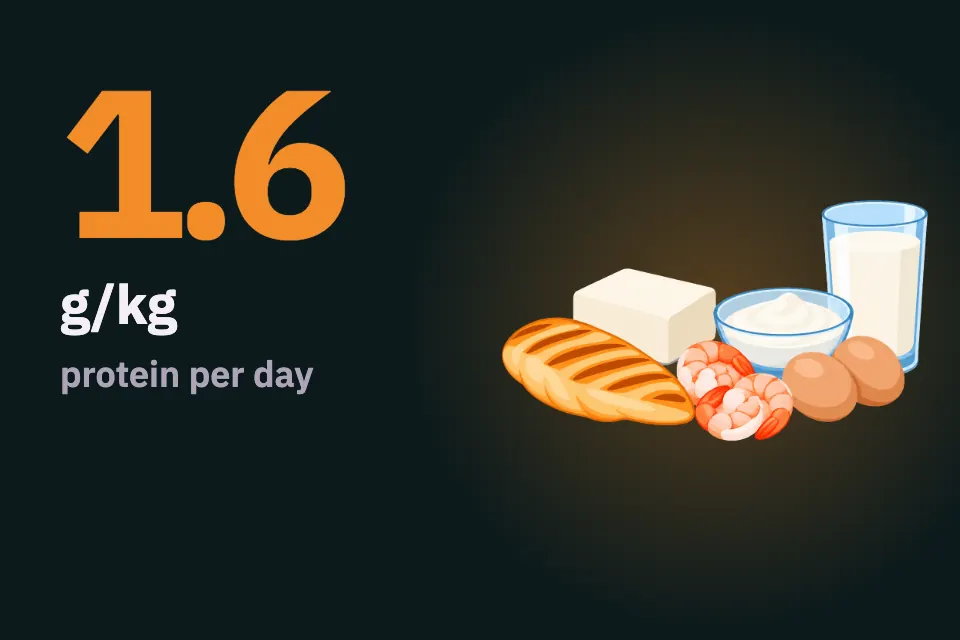
Needs appear to rise during a diet. The systematic review of dieting athletes proposed about 2.3 to 3.1 g per kg of fat-free mass per day, higher with a larger deficit and lower body fat. That is per kg of fat-free mass, not total body weight, so it is lower than it first sounds.
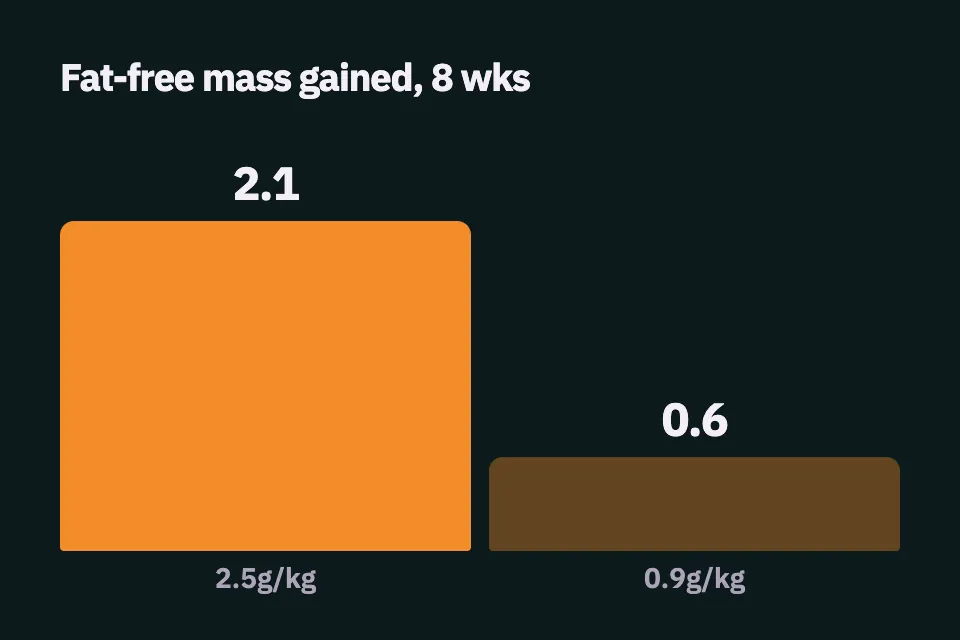
In a 2016 randomized trial, 40 young men ate about 40% less energy than they needed for 4 weeks while doing resistance and interval training six days a week. The group eating 2.4 g of protein per kg of body weight gained about 1.2 kg of lean mass and lost 4.8 kg of fat; the 1.2 g/kg group gained about 0.1 kg of lean mass and lost 3.5 kg of fat. The food was supplied and the deficit was extreme, so treat it as a proof of principle. The older-men study above also found that spreading protein evenly across four meals supported muscle protein synthesis better than eating most of it at dinner.
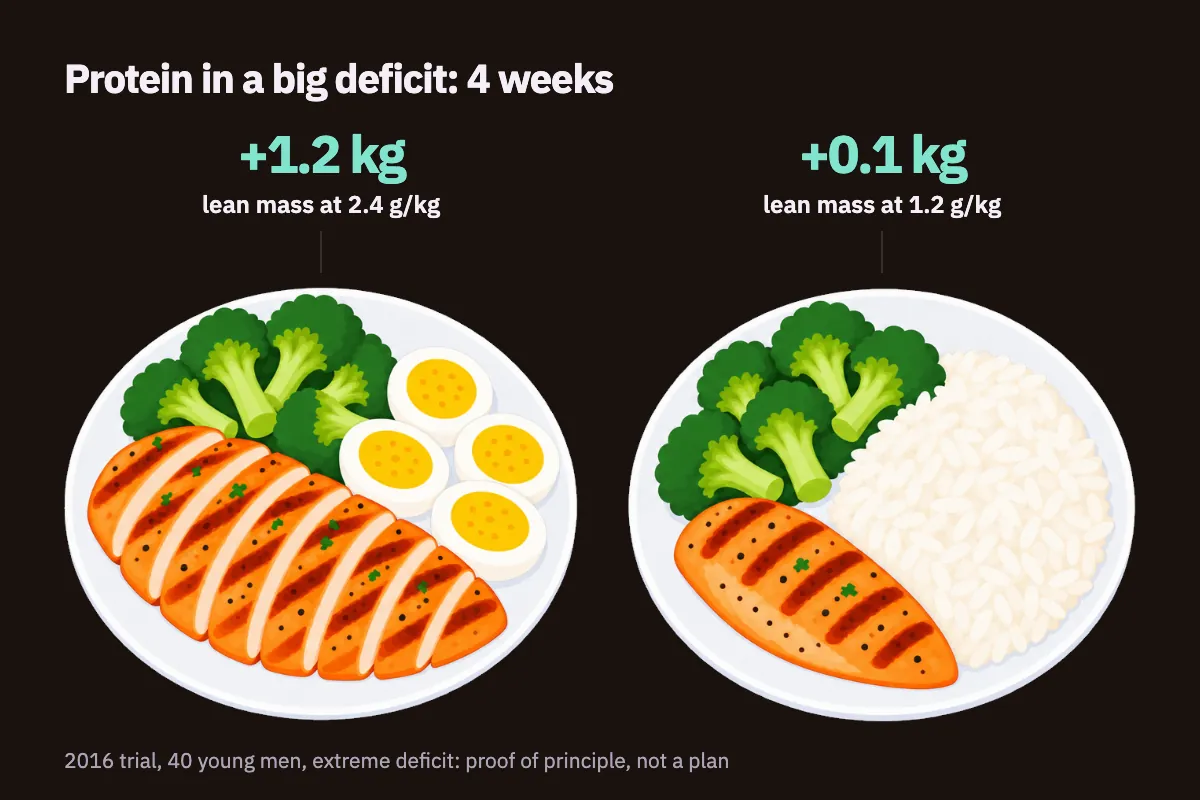
Higher protein kept more lean mass in a hard cut.
See the protein guide for everyday ranges and food examples. If you have kidney disease or another medical condition, follow your doctor’s advice instead.
What to eat when cutting
Meals that give more protein per calorie make a protein goal easier to reach in a deficit. These are FitArchive recipe estimates for one regular portion of each dish, at the stated recipe weight:
| Dish | Recipe weight | Calories | Protein |
|---|---|---|---|
| Pho with rare beef (phở bò tái) | 785 g | 390 kcal | 33 g |
| Boiled chicken (gà luộc) | 170 g | 321 kcal | 35 g |
| Chicken and cabbage salad (gỏi gà) | 253 g | 328 kcal | 28 g |
| Chicken rice porridge (cháo gà) | 393 g | 372 kcal | 26 g |
| Sour fish soup (canh chua cá) | 208 g | 148 kcal | 14 g |
| Grilled pork with noodles (bún thịt nướng) | 407 g | 614 kcal | 32 g |
| Broken rice with pork chop and egg (cơm tấm sườn trứng) | 450 g | 741 kcal | 42 g |
| Bubble milk tea (trà sữa trân châu) | 375 g | 322 kcal | 1 g |
Restaurant portions vary a lot: the fat in the broth, the amount of meat, the noodles or rice, cooking oil, sauces and sugar can all move the real numbers. The point is the pattern, not the exact figures. More Vietnamese dishes are in the Vietnamese food calorie table.
Should you do cardio when cutting?
Cardio raises energy use, so a deficit needs less food restriction. Moderate amounts do not meaningfully blunt muscle or strength on average; very large amounts and running in the same session as leg work are where interference shows up, as the cardio and gains article explains. In a cut the practical risk is fatigue: if lifting drops after you add cardio, the log will show it.
Do diet breaks or refeeds help keep muscle?
The evidence is mixed:
- In the ICECAP trial, 61 resistance-trained adults dieted for 12 weeks either continuously or in blocks of 3 weeks with a 1-week break at maintenance (15 weeks in total). Fat loss and fat-free mass were similar. The diet-break group reported less hunger and desire to eat.
- In a 7-week trial of 27 trained adults, a group with two higher-carbohydrate refeed days each week lost about 0.4 kg of fat-free mass, compared with 1.3 kg in the continuous group, with similar fat loss. The study was small and short.
Breaks may make a diet easier to stick with, but they lengthen it, and there is no strong evidence that they protect muscle on their own.
Does sleep affect muscle loss in a cut?
It may. In a 14-day crossover study, 10 adults with overweight ate the same reduced diet with either 8.5 or 5.5 hours in bed. With short sleep they lost 0.6 kg of fat instead of 1.4 kg, and 2.4 kg of fat-free mass instead of 1.5 kg. The study was tiny and short; the sleep article covers the wider evidence.
How to read your log during a cut
Look at several signals together, week by week, never one day. This is an invented example, not a predicted result:
| Week | Weekly average weight | Bench top set | Estimated 1RM | Waist |
|---|---|---|---|---|
| 1 | 72.0 kg | 70 kg × 8 at 2 RIR | 93 kg | 84.0 cm |
| 4 | 71.0 kg | 70 kg × 8 at 2 RIR | 93 kg | 83.0 cm |
| 8 | 70.1 kg | 70 kg × 7 at 2 RIR | 91 kg | 82.1 cm |
| 10 | 69.3 kg | 70 kg × 6 at 2 RIR | 89 kg | 81.5 cm |
Weeks 1 to 8 look like a steady cut: weight and waist falling slowly, strength roughly flat. Week 10 shows reps slipping. If other lifts do the same for two or three weeks, check sleep, protein and the rate of loss with the plateau checklist before changing anything. For how a cut differs from a recomp, see body recomposition vs bulking and cutting.
When to see a professional
See a doctor or registered dietitian before or during a cut if you have a medical condition or take medication, are pregnant, breastfeeding or under 18, have a history of disordered eating, or notice dizziness, missed periods, persistent fatigue, low mood or weight falling much faster than you expected. Competitors with a weigh-in date should plan with a qualified coach.
Common mistakes
- Switching to light “toning” workouts. Heavy work is what tells your body to keep muscle.
- Crash dieting. Slower loss kept more lean mass in the trials above.
- Letting protein slide as total food drops.
- Judging by one weigh-in. Water, salt and gut contents move the scale daily.
- Piling on cardio until lifting suffers.
- Changing program and diet at once, which makes the log unreadable.
- Cutting sleep to fit everything in.
Tracking a cut in FitArchive
FitArchive is a free, private training and food log that works in your browser, including offline; data stays on your device unless you sign in to sync. Log each set’s weight, reps and RIR, and the Progress screen shows an estimated 1RM trend per exercise, so you can see whether strength is holding. Record one body weight reading a day to see a smoothed weight trend with the change per week, add waist measurements in centimetres, and log meals with daily calories and protein, including about 263 Vietnamese dishes. Try it with sample data in the demo.