The best workout split is the one that fits the days you can actually train: full body for 2 to 3 days a week, upper/lower for 4, and push/pull/legs for 5 to 6. When total weekly sets are matched, studies find similar muscle and strength gains from split and full-body routines, so the number of hard sets each muscle gets per week matters more than the name of the split. Pick a schedule you can repeat for months, then track your sets and your lifts.
This guide explains each split with an example week, compares them side by side, covers how many sets per muscle the evidence points to, and gives labelled beginner weeks for 3, 4 and 6 days.
What does the research say about workout splits?
- A 2024 meta-analysis by Ramos-Campo and colleagues pooled 14 studies (392 participants) comparing split and full-body routines. With training volume equated, gains in bench press and lower-body strength and in muscle size were similar. The authors concluded people can choose a routine based on personal preference.
- A 2016 meta-analysis of 10 studies by Schoenfeld, Ogborn and Krieger found that training a muscle twice a week produced more growth than once a week. Whether three times beats twice was left open.
- Their 2019 update with 25 studies found no significant difference between higher and lower frequencies when weekly volume was equated. In studies where volume was not equated, higher frequency had a modest edge, which fits the idea that spreading sets across more days mainly helps you do more total work.
- A 2026 dose-response meta-regression of 67 studies found muscle size and strength rose with weekly sets, with diminishing returns. Once volume was accounted for, frequency had little identifiable effect on growth, but strength gains did increase with frequency.
- The 2026 ACSM position stand, an overview of 137 systematic reviews, reports strength was enhanced with 2 or more sessions a week and hypertrophy with 10 or more sets a week.
The practical reading: frequency is mostly a tool for fitting enough good-quality sets into your week. Training each muscle about twice a week is a sensible default, because ten or more hard sets are easier to do well across two sessions than in one.
What each split looks like: an example week
This is an example layout using the day names from FitArchive’s four plan templates. Rest days can move to fit your week.
| Day | Full body (3 days) | Upper/lower (4 days) | Push/pull/legs (6 days) | Body-part split (5 days) |
|---|---|---|---|---|
| Mon | Full Body A | Upper A | Push A | Chest |
| Tue | Rest | Lower A | Pull A | Back |
| Wed | Full Body B | Rest | Legs A | Legs |
| Thu | Rest | Upper B | Push B | Shoulders |
| Fri | Full Body C | Lower B | Pull B | Arms |
| Sat | Rest | Rest | Legs B | Rest |
| Sun | Rest | Rest | Rest | Rest |
- Full body: every session trains the whole body with fewer exercises per muscle. Each muscle gets direct work 2 to 3 times a week.
- Upper/lower: two upper-body and two lower-body sessions. Each muscle gets direct work twice a week.
- Push/pull/legs (PPL): push days train chest, shoulders and triceps; pull days train back, rear delts and biceps; leg days train the lower body. Run twice through in six days, each muscle gets direct work twice a week. A push pull legs 3 day split runs it once, so each muscle gets direct work only once a week.
- Body-part (“bro”) split: one muscle group per session. Each muscle gets direct work about once a week, with more sets in that one session.
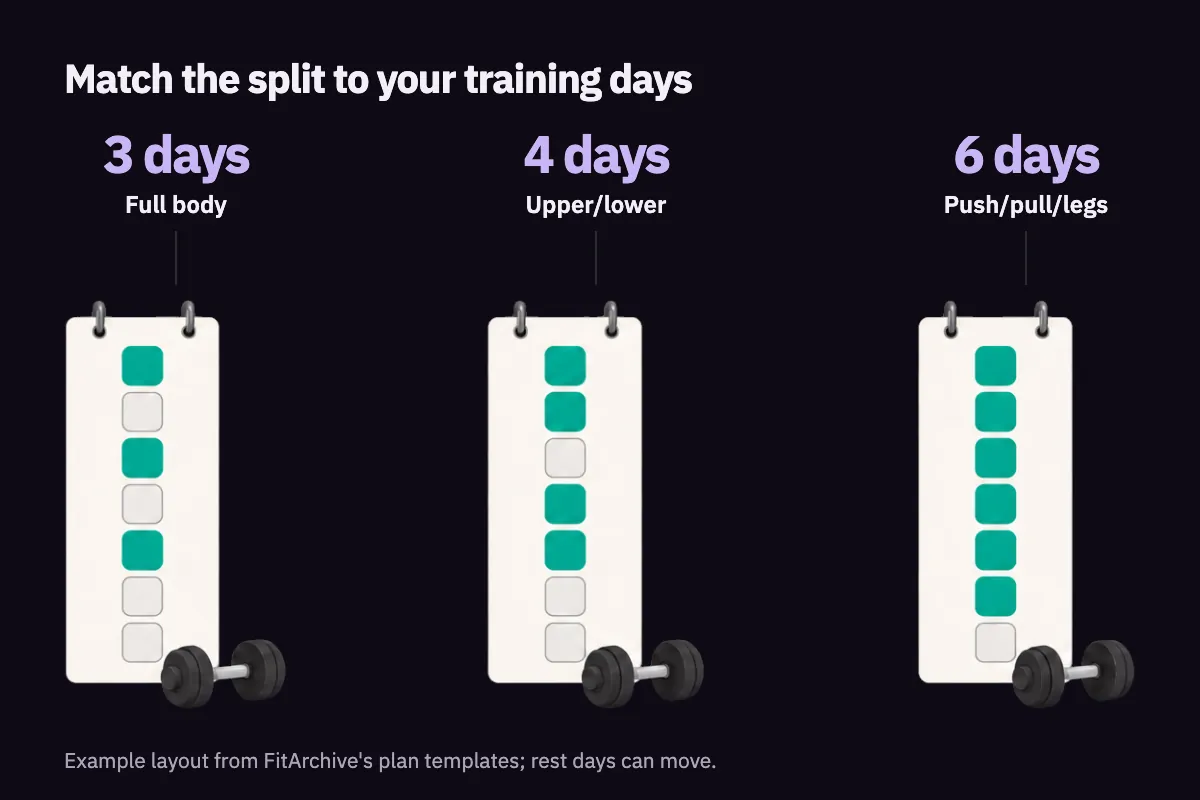
With weekly sets matched, studies find similar gains from each split.
Push pull legs vs upper lower vs full body compared
The set counts below come from FitArchive’s templates, counted with the app’s rule: warm-ups excluded, 1 set for the main muscle, 0.5 for helper muscles. They are example programs, not targets.
| Full body | Upper/lower | Push/pull/legs | Body-part | |
|---|---|---|---|---|
| Days per week | 2 to 3 | 4 | 6 (3 if run once) | 5 |
| Direct work per muscle per week | 2 to 3 times | 2 times | 2 times (1 if 3 days) | About once |
| Working sets per session (template) | 20 to 23 | 18 to 22 | 15 to 18 | 15 to 23 |
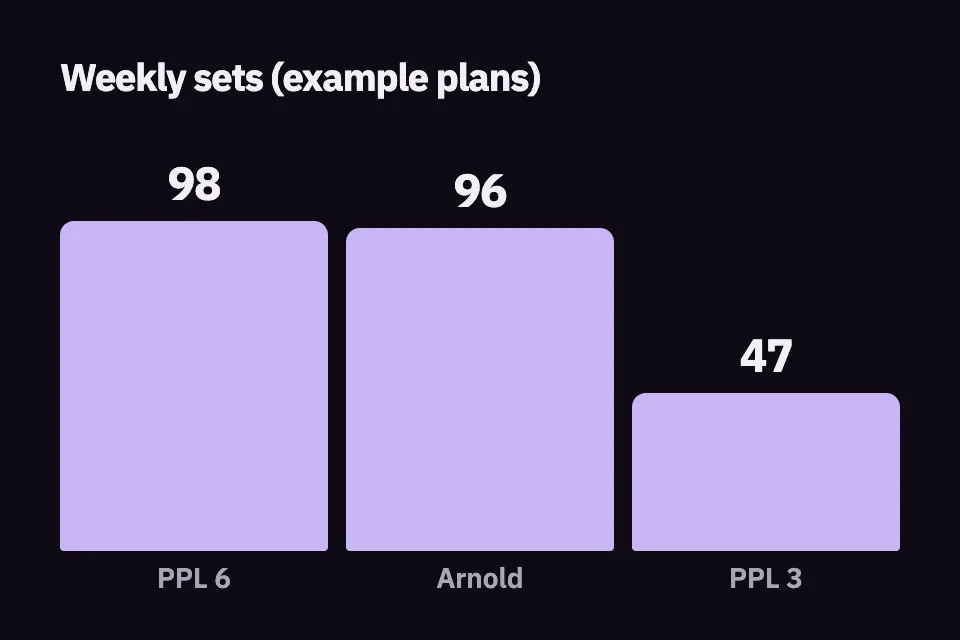
| Total working sets per week (template) | 65 | 80 | 98 | 93 |
| Cost of a missed session | Low: everything gets trained again soon | Moderate | Higher: a muscle group can wait several days | High: a muscle can wait a week |
| Often suits | Beginners, busy weeks, alternate-day training | Most people with 4 days | People who can train most days and recover well | People who prefer one muscle per day |
Notice that the PPL template has more total sets than the full-body one. If one program grows more muscle than another, the extra weekly sets are a more likely reason than the split itself.
How many sets per muscle per week?
- A 2017 meta-analysis of 15 studies found a graded dose-response: each extra weekly set was associated with slightly more growth, and 10 or more sets per muscle per week trended toward larger gains than fewer than 5 or 5 to 9.
- The 2026 meta-regression and the ACSM overview above point the same way, with diminishing returns as volume climbs.
Here is how the templates land for a few muscles if every set is completed at the planned effort (example totals):
| Muscle | Full body 3 | Upper/lower 4 | PPL 6 | Body-part 5 |
|---|---|---|---|---|
| Chest | 10 | 10 | 12 | 16.5 |
| Quads | 9 | 11 | 13 | 10 |
| Lats | 11 | 10.5 | 14.5 | 14 |
| Hamstrings | 6 | 10.5 | 10.5 | 6 |
| Side delts | 8.5 | 8.5 | 9 | 10 |
Treat ranges quoted online, such as 10 to 20 sets, as a starting area rather than a quota. Start near what you can recover from, change volume gradually, and judge it by repeated performance. The weekly sets guide explains the counting rules.
How to choose your split
- Count the days you can train in a normal week, not your best week. If it is 3, a 6-day plan will leave muscles skipped.
- Check session length. Fewer days means more sets per session. The full-body template has 20 to 23 working sets per session; the PPL one has 15 to 18 but needs six days.
- Think about recovery and other sport. If you also play a sport or run, plan where the hardest leg sessions fall in your week.
- Pick what you will keep doing. The evidence supports choosing by preference when volume is similar.
- For strength goals, practise the main lifts at least twice a week, which upper/lower, full body and twice-through PPL all do.
The studies above do not set separate splits for men and women. Most participants were men (79% in the 2026 meta-regression), so the evidence for women is thinner, but the same choice rules apply.
Sample beginner weeks for 3, 4 and 6 days
These are labelled examples taken from FitArchive’s templates (sets × rep range). Compound lifts aim for about 2 reps in reserve (RIR) and most isolation exercises about 1. If a template feels like too much at first, you can do fewer sets per exercise and build up.
3 days: full body (for example Mon, Wed, Fri)
| Day | Exercises |
|---|---|
| Full Body A | Back squat 3×6–10, bench press 4×6–10, barbell row 4×8–12, dumbbell lateral raise 4×12–20, cable curl 3×10–15, triceps pushdown 2×10–15 |
| Full Body B | Romanian deadlift 3×8–12, overhead press 3×6–10, lat pulldown 4×8–12, leg press 3×10–15, cable fly 3×12–15, reverse pec deck 3×12–20, standing calf raise 4×10–15 |
| Full Body C | Hack squat 3×8–12, incline dumbbell press 3×8–12, seated cable row 3×8–12, lying leg curl 3×10–15, cable lateral raise 3×12–20, seated calf raise 4×12–20, hanging knee raise 3×10–15 |
4 days: upper/lower (for example Mon, Tue, Thu, Fri)
| Day | Exercises |
|---|---|
| Upper A | Bench press 4×6–10, barbell row 3×8–12, seated dumbbell shoulder press 3×8–12, lat pulldown 3×8–12, dumbbell lateral raise 4×12–20, EZ-bar curl 2×10–15, overhead cable triceps extension 2×10–15 |
| Lower A | Back squat 3×6–10, Romanian deadlift 3×8–12, leg extension 3×10–15, lying leg curl 3×10–15, standing calf raise 4×10–15, cable crunch 3×10–15 |
| Upper B | Incline dumbbell press 3×8–12, chest-supported row 3×8–12, pull-up 3×6–10, cable fly 3×12–15, cable lateral raise 3×12–20, reverse pec deck 3×12–20, hammer curl 2×10–15, triceps pushdown 2×10–15 |
| Lower B | Leg press 3×10–15, hip thrust 3×8–12, Bulgarian split squat 2×8–12, seated leg curl 3×10–15, seated calf raise 4×12–20, hanging leg raise 3×8–15 |
6 days: push/pull/legs (for example Mon to Sat)
| Day | Exercises |
|---|---|
| Push A | Bench press 3×6–10, seated dumbbell shoulder press 3×8–12, incline dumbbell press 2×8–12, dumbbell lateral raise 3×12–20, triceps pushdown 3×10–15, overhead cable triceps extension 2×10–15 |
| Pull A | Pull-up 3×6–10, barbell row 3×8–12, seated cable row 2×8–12, face pull 3×12–20, EZ-bar curl 3×8–12, hammer curl 2×10–15 |
| Legs A | Back squat 3×6–10, Romanian deadlift 3×8–12, leg press 2×10–15, lying leg curl 3×10–15, standing calf raise 4×10–15 |
| Push B | Overhead press 3×6–10, incline barbell bench press 3×8–12, cable fly 3×12–15, cable lateral raise 3×12–20, skull crusher 3×8–12, triceps dip 2×8–12 |
| Pull B | Lat pulldown 3×8–12, chest-supported row 3×8–12, dumbbell row 2×8–12, reverse pec deck 3×12–20, incline dumbbell curl 3×10–15, cable curl 2×10–15 |
| Legs B | Hack squat 3×8–12, hip thrust 3×8–12, Bulgarian split squat 2×8–12, leg extension 3×10–15, seated leg curl 3×10–15, seated calf raise 4×12–20 |
With 5 days, you can run the body-part template (chest, back, legs, shoulders, arms; the arms day also has calves and cable crunches), or keep each muscle at twice a week by adding a fifth session to upper/lower. Use double progression within each rep range: add reps first, then weight. The double progression guide explains how.
When should you switch splits?
Switch for a reason you can name: your schedule changed, sessions run too long, or a muscle needs more weekly sets than your current days allow. If progress stalls, run a plateau audit first; sleep, rest times, effort or food are often the cause, and a new split will not fix those. When you do switch, keep your main exercises the same for a while so your numbers stay comparable, and note the change in your log.
Common mistakes
- Choosing a 6-day PPL with 4 free days. Missed sessions skip whole muscle groups. Upper/lower would fit better, or an anterior/posterior split if you prefer to divide the body front and back.
- Program hopping every few weeks. You never get enough comparable sessions to see what works.
- Judging the split instead of the sets. Two “upper/lower” plans can differ by many sets per muscle.
- Counting warm-ups and easy sets. They inflate weekly totals; see training to failure vs RIR for how hard sets need to be.
- Never tracking. Without logs, you cannot tell whether a split is working. The progressive overload guide shows what to compare.
To see whether your lifts are moving, an estimated one-rep max is a handy number to follow; the 1RM calculator and chart explains it.
Using a split in FitArchive
FitArchive includes four plan templates: Full body 3 days, Upper/Lower 4 days, Push/Pull/Legs 6 days and Body-part split 5 days, with the exercises and set and rep ranges shown above. You can edit them or build your own. The Progress screen shows weekly hard sets by muscle (1 for the primary muscle, 0.5 for secondary, working sets at 0 to 4 RIR) and training days per muscle per week, so you can check what your split actually delivers. Try it with sample data in the demo.