Yes, you can build muscle and strength after 40, 50 and well beyond. Meta-analyses of adults over 50 found reliable gains in lean mass and strength gains of about 24 to 33% on common machine exercises, and even frail people around 90 got stronger. Gains may come a little slower than at 25, and recovery and joints deserve more attention, so a good start is two or three full body sessions a week, stopping each set with 2 to 4 reps in reserve, and adding weight gradually.
A few beliefs keep people out of the weights room: that muscle cannot grow after 50, that lifting wears out older joints, and that walking is all you need. This guide looks at what the research shows, who should talk to a doctor first, and how to start with a simple plan you can log.
Can you build muscle after 50?
The evidence is consistent. Older adults respond to resistance training, though somewhat less than younger adults on average:
| Study | Who | Main finding |
|---|---|---|
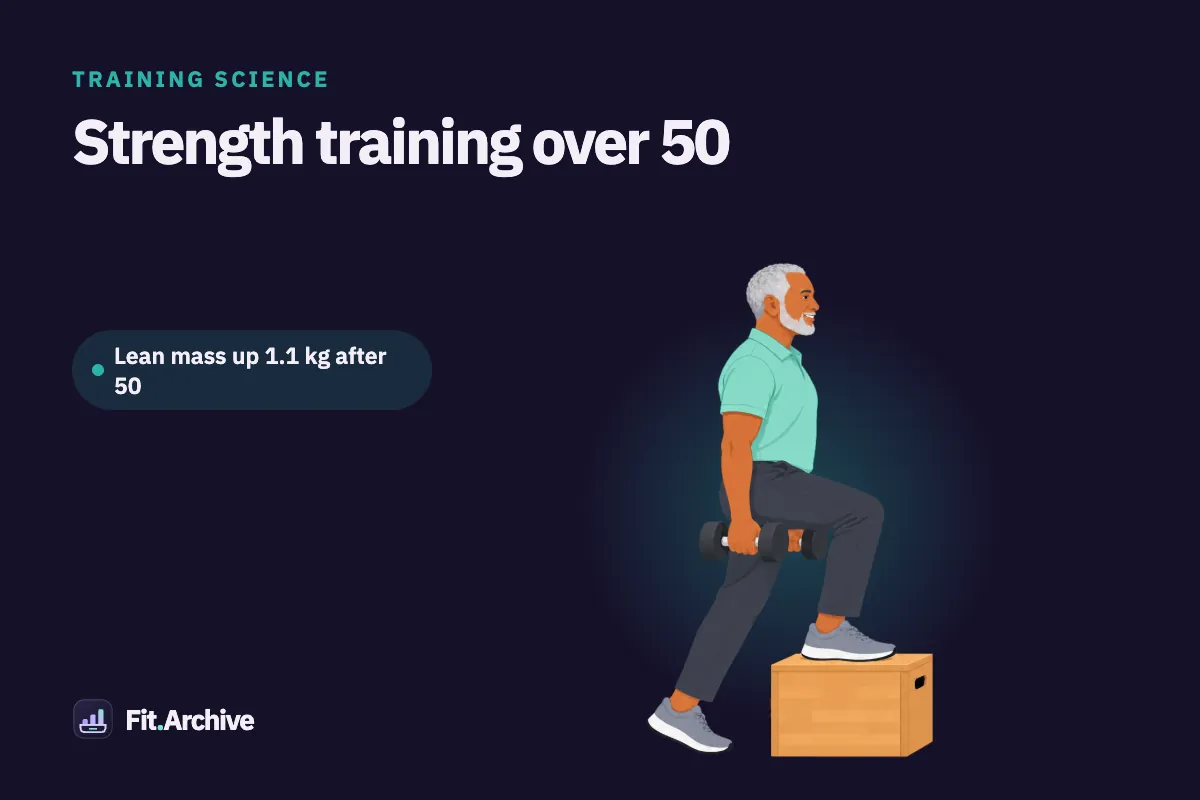
| Peterson et al. 2011, meta-analysis | 49 studies, 1,328 adults aged 50 and over | Average lean mass gain of 1.1 kg; higher volume programs gained more; older participants gained somewhat less |
| Peterson et al. 2010, meta-analysis | 47 studies, 1,079 adults aged 50 and over | Strength rose about 24 to 33% across leg press, chest press, knee extension and lat pulldown; higher intensity training gave larger gains |
| Fiatarone et al. 1990 | 10 frail nursing home residents, average age 90, 8 weeks | Strength rose 174% on average in the 9 who finished; thigh muscle area rose 9% and walking speed in a heel to toe test rose 48% |
| ACSM position stand 2026 | Overview of 137 systematic reviews in healthy adults | Resistance training improved strength, muscle size, power, walking speed, balance and physical function |
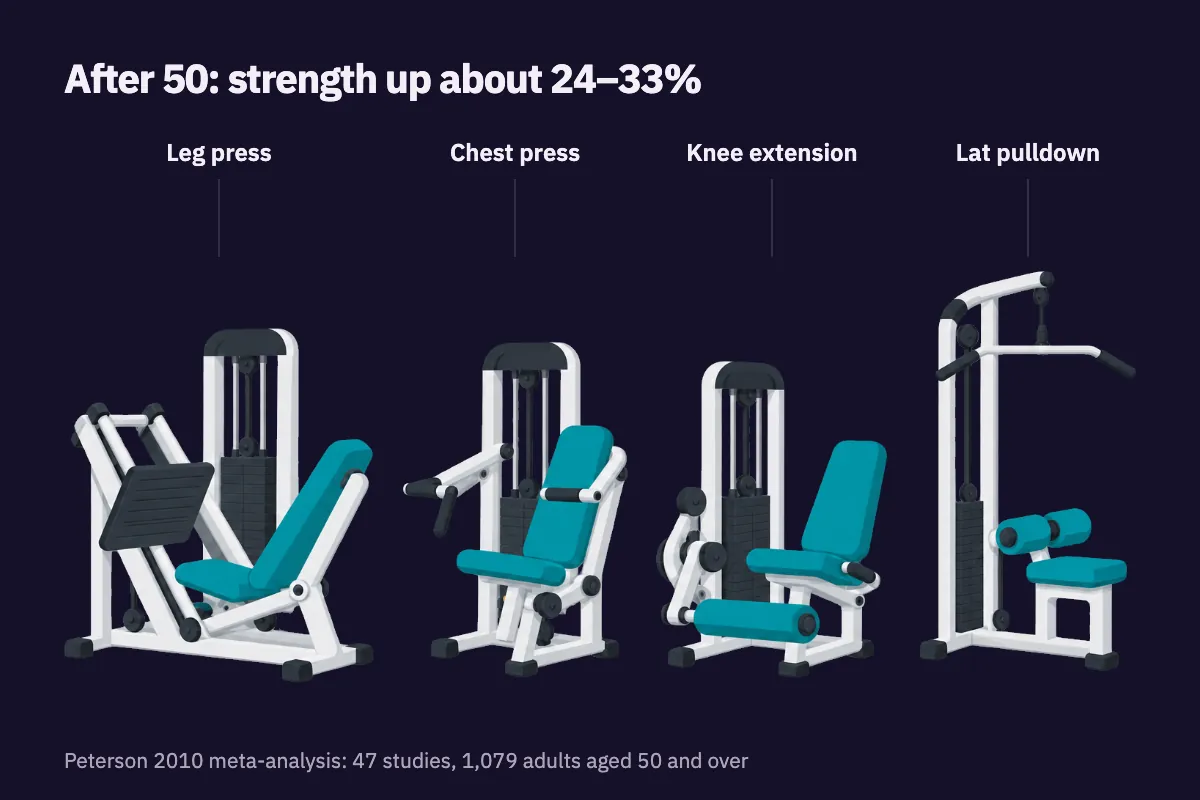
Older adults still get clearly stronger on common machines.
How strong is this? The meta-analyses pooled many small, short trials with mostly untrained participants, and results varied a lot between studies. The 1990 study had only 10 people. But the direction is the same everywhere: muscle and strength respond at every age that has been tested. The 2011 analysis also found that starting earlier helps, which is a good reason to start in your 40s rather than wait.
Why it matters: the European consensus on sarcopenia (EWGSOP2) defines this age related muscle disease mainly by low muscle strength, confirmed by low muscle quantity or quality, and notes that it can begin earlier in life. Its clinical cut offs include a grip strength under 27 kg for men and under 16 kg for women, or taking more than 15 seconds to rise from a chair five times. Those are diagnostic thresholds for clinicians, not training targets, but they show why strength itself is the thing to protect.
Strength training over 50 for men and for women
The principles are the same for both: train every major muscle group, push sets reasonably close to failure, and add load or reps over time. The meta-analyses above pooled men and women.
Bone is the extra reason many women start. A meta-analysis of 75 studies in 5,300 postmenopausal women found a small but significant effect of exercise on bone density at the spine and hip, with big differences between programs. In the LIFTMOR trial, 101 postmenopausal women with low bone mass did 8 months of supervised, twice weekly heavy lifting with impact work, or a light home program. Spine bone density rose 2.9% in the lifting group and fell 1.2% in the home group, with one minor adverse event. Participants were screened and closely supervised, so this is not a reason to try heavy lifts alone if you have osteoporosis. Our guide to strength training for women covers more.
For men, the same plan works. Men often start with more muscle and may be tempted to lift as they did at 25; the bigger risk is usually doing too much too soon rather than too little.
Who should check with a doctor before starting?
Exercise is safe for most people, and the ACSM’s screening guidance says that for decisions about medical clearance, the key factors are how active you are now, whether you have known heart, metabolic or kidney disease or symptoms that suggest it, and how hard you plan to train. In practice, talk to your doctor first if any of these apply:
- Heart disease, or symptoms such as chest pain or pressure, unusual breathlessness, fainting or palpitations during effort.
- High blood pressure that is not controlled.
- Recent surgery, including joint, hernia, eye or heart procedures.
- New, sharp or unexplained pain in a joint or your back.
- Osteoporosis with a previous fracture, especially of the spine or hip.
- Diabetes, kidney disease, or medicines that affect heart rate, blood pressure or blood sugar.
A physiotherapist or qualified coach can adapt exercises around arthritis, a joint replacement or past injuries. This article is general information, not medical advice.
How to start: an example plan for the first months
Two or three full body sessions a week is enough to start. The WHO 2020 guidelines recommend muscle strengthening on two or more days a week for all adults, and for adults over 65, varied activity that emphasises balance and strength on three or more days. The NSCA position statement on older adults describes resistance training as a powerful way to counter loss of strength, muscle and function, with programs adapted to the person.
FitArchive’s Full body 3 day template is a good base: three sessions (A, B and C) with squats or leg presses, presses, rows, pulldowns, a hip hinge, leg curls and smaller arm, shoulder and calf exercises. As written, it has 3 to 4 sets per exercise at 1 to 2 reps in reserve (RIR), which is a lot for a first month. Below is an example edit for weeks 1 to 4: fewer sets, a few joint friendly swaps from the exercise library, and RIR 3 to 4.
| Example, weeks 1 to 4 | Exercises: sets × reps (target RIR) |
|---|---|
| Full body A | Goblet squat 2 × 8 to 12 (3); machine chest press 2 × 8 to 12 (3); chest supported machine row 2 × 8 to 12 (3); dumbbell lateral raise 2 × 12 to 15 (3); cable curl 2 × 10 to 15 (3); cable triceps pushdown 2 × 10 to 15 (3) |
| Full body B | Romanian deadlift, light, 2 × 8 to 12 (4); seated dumbbell shoulder press 2 × 8 to 12 (3); lat pulldown 2 × 8 to 12 (3); leg press 2 × 10 to 15 (3); reverse pec deck 2 × 12 to 15 (3); standing calf raise 2 × 10 to 15 (3) |
| Full body C | Dumbbell step up 2 × 8 to 10 each leg (3); incline dumbbell press 2 × 8 to 12 (3); seated cable row 2 × 8 to 12 (3); lying leg curl 2 × 10 to 15 (3); dead bug 2 × 8 each side (3); seated calf raise 2 × 12 to 15 (3) |
Rest one day between sessions, for example Monday, Wednesday and Friday. Each session is about 12 working sets and should take well under an hour with warm ups.
From about week 5, if your joints feel fine and you recover between sessions, move gradually towards the template: add a third set to the main exercises, bring main lifts to RIR 2 to 3, and swap back to barbell squats, bench press or rows if they suit you. There is no age at which you must avoid them, but there is no need to use them either: the 2026 ACSM overview found equipment type did not consistently change results. It also linked about 10 or more sets per muscle a week with more muscle growth, which the full template reaches over time. If RIR is new to you, see how to log RIR.
How to progress after 50
Use double progression: when you reach the top of the rep range on every set at your target RIR, add the smallest weight step and work back up. Expect slower progress than a younger lifter, and expect some weeks to stall. That is normal. Two habits help:
- Change one thing at a time. Add weight or a set, not both, so you know what your joints are reacting to.
- Plan easier weeks when fatigue builds or life gets busy. See how to log a deload week.
Warm ups, balance and power
Warm ups. A few minutes of easy cardio, then one to three lighter sets of your first exercise, is usually enough. Our guide to warm up sets before lifting explains how to build them.
Balance. A Cochrane review of 108 trials with 23,407 people aged 60 and over found that exercise reduced the rate of falls by 23% (high certainty evidence). Programs built mainly on balance and functional exercises worked, and combining them with resistance training probably reduced falls by about a third. The effect of resistance training alone on falls was uncertain. Simple options are standing on one leg near a support, heel to toe walking and step ups.
Power. Power, the ability to produce force quickly, tends to fall faster with age than strength. The ACSM overview found power improved with moderate loads (30 to 70% of one rep max) lifted with a fast upward phase, and that power training improved physical function. In practice: on leg press, chest press or step ups, use a moderate weight, lift with intent to move quickly, lower under control, and stop well short of failure.
Protein needs rise with age
Older muscles respond less to the same amount of protein. The PROT-AGE group recommends that people over 65 eat at least 1.0 to 1.2 g of protein per kg of body weight a day, at least 1.2 g/kg if they exercise, and 1.2 to 1.5 g/kg for most older adults with acute or chronic illness. People with severe kidney disease who are not on dialysis may need to limit protein. Our guide to protein per day for building muscle covers younger lifters and per meal amounts. A dietitian or doctor can set personal targets.
Common mistakes
- Starting at your old weights. Begin with RIR 3 to 4 and build up over weeks.
- Staying light forever. Gains need progressive overload; a weight that never changes stops being a stimulus.
- Skipping legs and balance. Leg strength and balance matter most for daily life and falls.
- Walking only. Walking is excellent, but it does not replace strength training.
- Training through new pain. Stop that exercise, swap it, and get it checked if it persists.
- Quitting after a break. Illness and travel happen. Restart lighter; muscle memory helps you regain lost ground.
Tracking your training in FitArchive
FitArchive is a free, private training log that works in your browser, including offline, with data kept on your device unless you sign in to sync. It includes the Full body 3 day template, which you can edit (fewer sets, swapped exercises) or replace with your own plan. Each set records weight, reps and RIR, warm up sets are marked, and each workout has a notes field for sleep, joint feedback or balance work. The Progress screen shows estimated one rep max per exercise and weekly hard sets per muscle, so slow progress is visible. Try it with sample data in the demo.