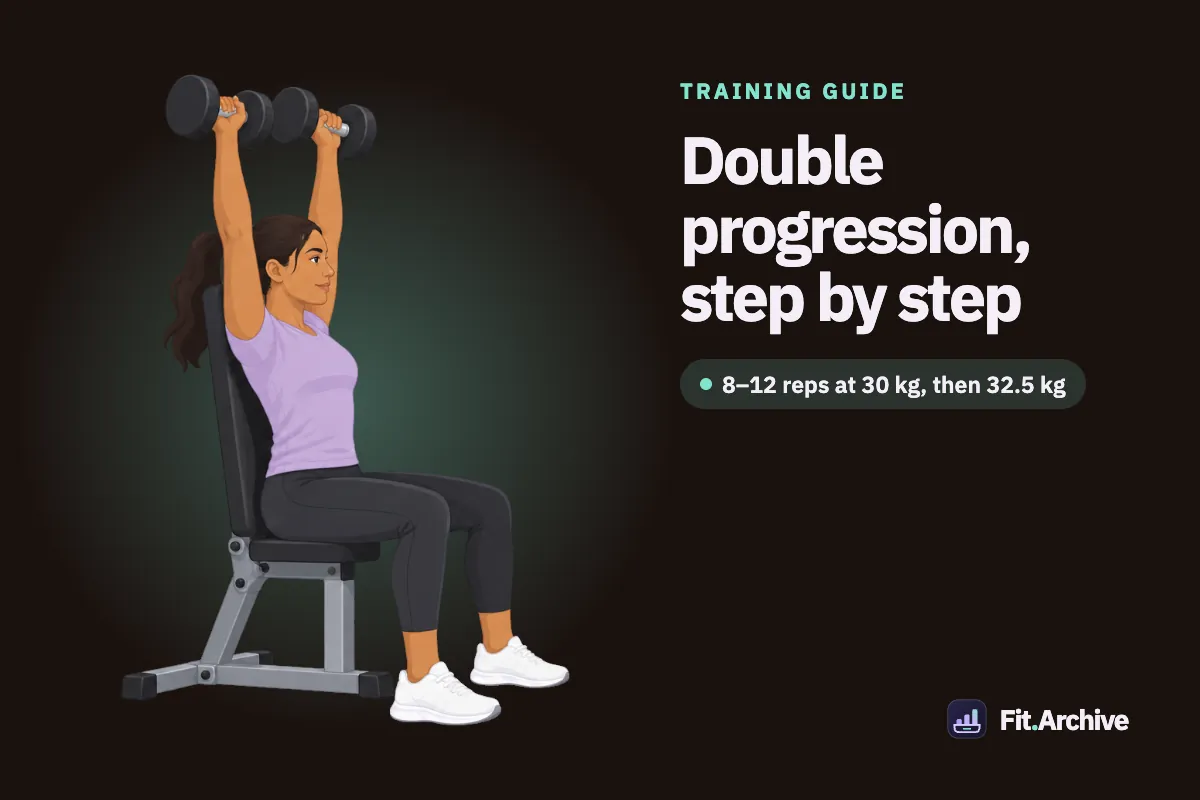
Double progression is a simple rule: keep the same load and add reps within a chosen range, then increase the load once you meet a top-of-range condition you set in advance, with acceptable technique. It answers “Do I try another rep or add weight next time?” without requiring the plates to go up every session.
The 2026 ACSM position stand supports progressive resistance training, but it does not establish double progression as the only or best method. The earlier 2009 ACSM progression stand described a similar idea: increase load by 2–10% once you can do one to two reps more than your target. Treat the rule below as a transparent way to organize a log, not a guaranteed growth formula.
What is double progression?
The name comes from the two things that progress in turn: first reps, then load. You pick a rep range, such as 8–12, and a load you can lift for the bottom of that range with a couple of reps in reserve. Each session you try to add reps at that load. When you reach the top of the range under your chosen rule, you add a small amount of weight, your reps fall back toward the bottom, and the cycle repeats.
It differs from simple linear progression, where you add load every session for a fixed number of reps. Once adding load every session is no longer possible, double progression still gives you a planned next step: one more rep.
Adding reps is a legitimate way to progress, not just a waiting room. In an 8-week trial with trained lifters, Plotkin and colleagues found that a group adding reps at a fixed load and a group adding load at fixed reps both improved, with small differences between them. That was one study of lower-body exercises, so read it as support, not a final answer. For more on reading those changes, see how to track progressive overload.
How to set up double progression, step by step
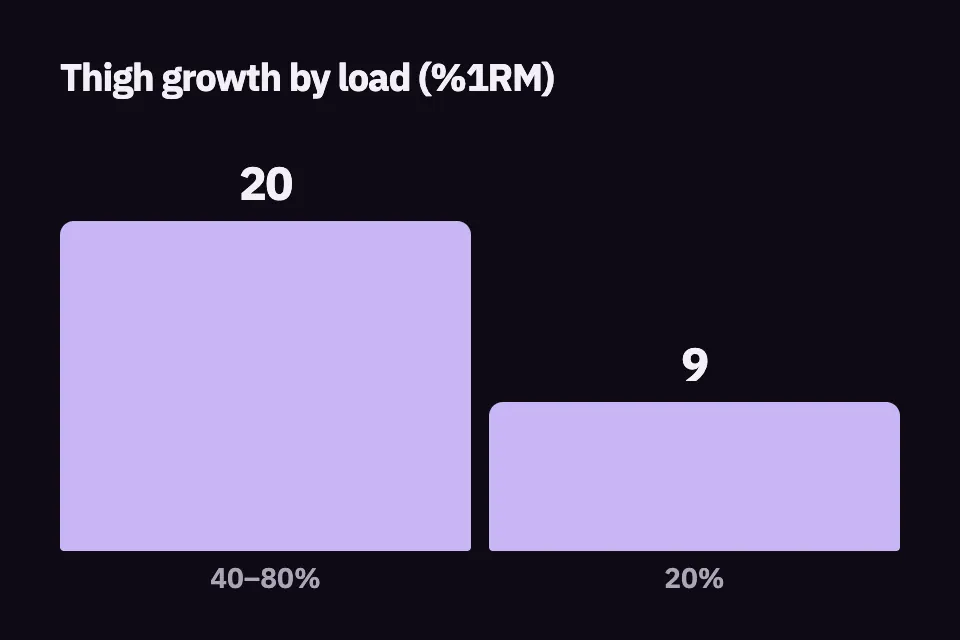
- Pick the exercise and a rep range. 8–12 and 6–10 are common choices. The 2009 ACSM stand recommended loads around 8–12 repetition maximum for novices, and a meta-analysis of low- vs high-load training found similar muscle growth across a wide range of loads when sets were taken to failure, while heavier loads produced greater one-rep-max strength gains. If a heavier max is your goal, choose a lower range for that lift.
- Pick a starting load you can lift for at least the bottom of the range with good technique and about 2–3 reps in reserve (RIR).
- Write the top-of-range rule before the session, for example “every working set reaches 12 at about 2 RIR.”
- Hold the load and add reps wherever you can, even one rep on one set.
- When the rule is met, add the smallest practical load at the next session.
- Rebuild reps at the new load, then repeat.
A worked double progression log
Here is an example rule: 8–12 clean reps on each of two working sets. These are invented entries, not a recommended load or pace of progress:
| Session | Set 1 | Set 2 | Next choice |
|---|---|---|---|
| A | 30 kg × 10 @ 2 RIR | 30 kg × 9 @ 2 RIR | Keep load; work within range. |
| B | 30 kg × 12 @ 2 RIR | 30 kg × 11 @ 2 RIR | Keep load; set 2 has not reached the top. |
| C | 30 kg × 12 @ 2 RIR | 30 kg × 12 @ 2 RIR | Rule met; try a small load increase next time. |
| D | 32.5 kg × 9 @ 2 RIR | 32.5 kg × 8 @ 2 RIR | New load, reps back near the bottom; keep load. |
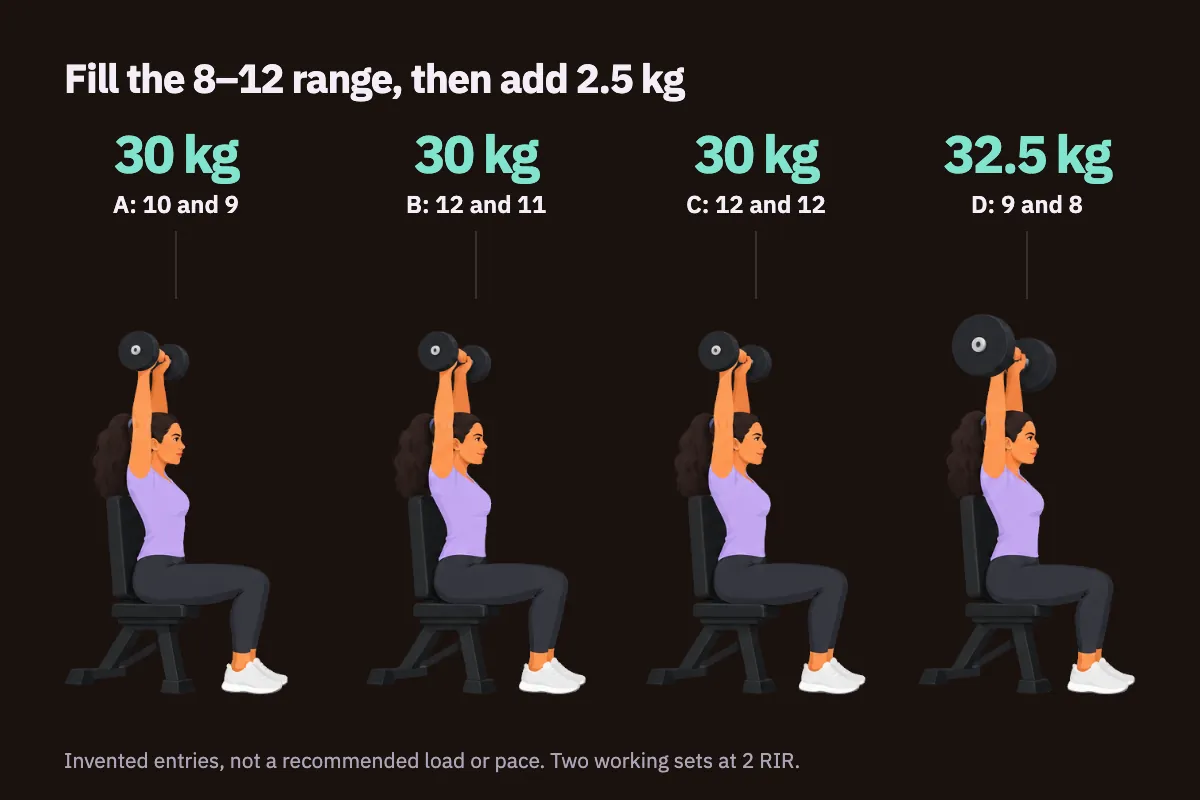
Session D is not a step back; it starts the next cycle.
If C had needed a much shorter range of motion or 0 RIR when earlier sessions were around 2 RIR, the “same standard” condition would not really have been met. Session D is not a step backwards: 32.5 kg for 8–9 reps is the expected start of the next cycle.
How many sets need to hit the top of the range?
Coaches use different versions, and no study shows one is clearly best. Choose one and keep it:
| Rule | How it works | Trade-off |
|---|---|---|
| All sets | Every working set reaches the top before load goes up. | Stricter; load rises more slowly. |
| First set | Load goes up when the first set reaches the top. | Faster; later sets may sit low in the range for longer. |
| Total reps | Load goes up at a total, e.g. 36 reps across 3 sets of 8–12. | Flexible when fatigue varies between sets. |
The rule matters less than applying it the same way each time. Changing it mid-session because the day felt good makes the log harder to read.
How much weight should you add?
The 2009 ACSM stand suggested 2–10% increases. In practice, the smallest step your equipment allows decides a lot. Some simple arithmetic:
| Current load | +2.5 kg | Share of the load |
|---|---|---|
| 100 kg | 102.5 kg | 2.5% |
| 30 kg | 32.5 kg | about 8% |
| 10 kg | 12.5 kg | 25% |
When the smallest jump is a large share of the load, as with many dumbbell isolation exercises, a wider range (for example 10–15) gives you more reps to bridge the gap, or you can use smaller increments if your gym has them.
What if your reps drop below the range after adding weight?
A drop toward the bottom of the range is expected. Falling below it, for example 32.5 kg × 6 when the range starts at 8, means the jump was larger than your current capacity at that rep range. Reasonable options:
- Return to the previous load and push one rep beyond the top on all sets before trying again.
- Use a smaller increment if one is available.
- Hold the new load for a session or two if you only missed by one rep and effort was where you intended.
Record actual reps and RIR even when you miss the target. Those entries are what tell you which option fits.
When double progression doesn’t fit, and common mistakes
- Grinding to failure to earn the jump. If reaching 12 needs 0 RIR when your standard was 2, the rule was not met. The 2026 ACSM overview found training to momentary failure did not consistently change outcomes; see training to failure vs RIR for the evidence.
- Moving the goalposts. Decide the rule before the workout, not after a good set.
- A narrow range with a large jump. A two-rep range like 8–10 leaves little room to absorb a 25% jump; widen the range or reduce the increment.
- Using it where reps are not the goal. Fast, low-rep power work or technique practice is usually judged by speed or quality, not by adding reps.
- Ignoring a stall. Several flat sessions are a reason to inspect rest, setup, and weekly workload before changing the plan; audit the log for a plateau and consider whether a deload week is due.
- Training through pain. No rule is a reason to keep going through pain. Stop the exercise if it hurts, and get advice from a qualified professional if it persists.
Logging double progression in FitArchive
FitArchive stores load, reps, and RIR for each working set, so your previous attempt is visible at the next session and you can check whether your rule was met before choosing the load. A strength workout log template shows the same layout on paper.