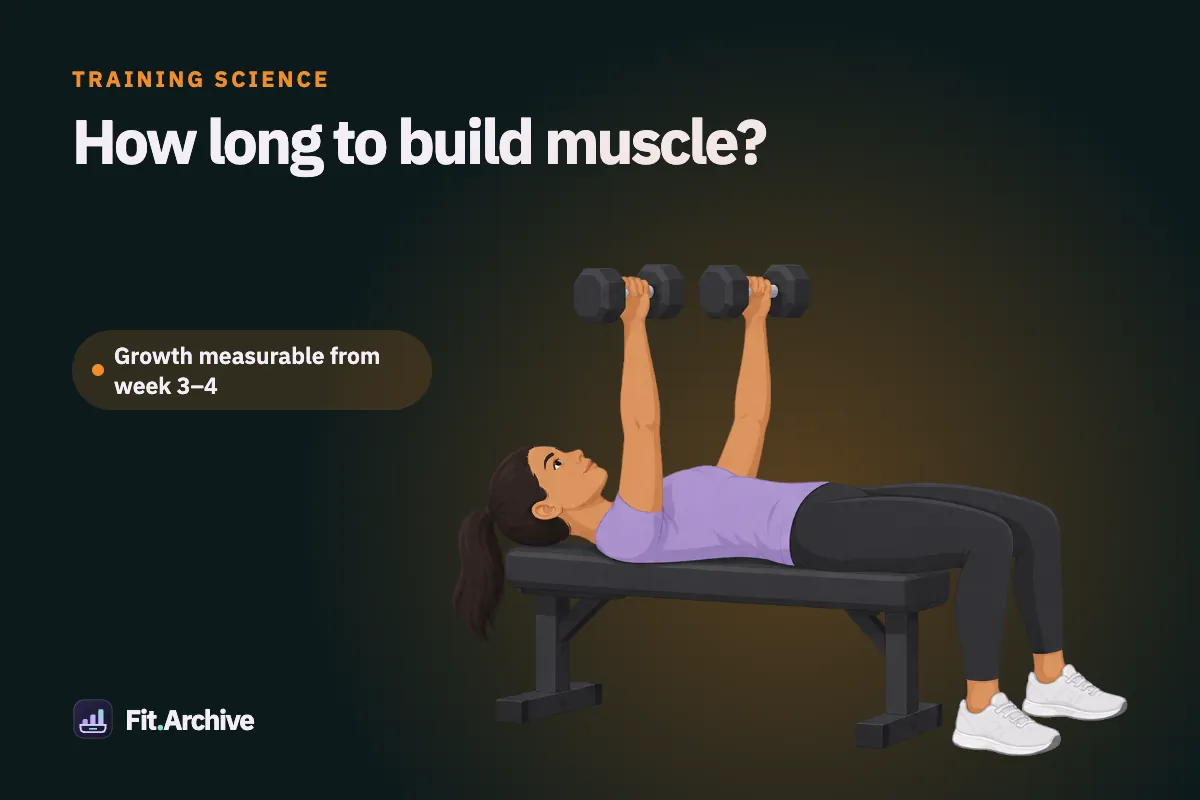
If you are new to lifting, your strength usually rises within the first few weeks, mostly because your nervous system gets better at the movements. Studies can detect muscle growth from about the third or fourth week, although some of that early change is swelling. Growth you can see in the mirror usually takes a couple of months or more of consistent training, and the rate slows each year you keep lifting. How fast it happens for you depends on your training, your starting point and a large amount of individual variation.
This article lays out a realistic timeline, explains why the scale and mirror lag behind, and shows how to see progress in your training log long before your shirt fits differently.
How fast can you build muscle?
Social media tends to offer two opposite claims: “you’ll see gains in two weeks” and “it takes a year before anything happens”. Neither matches the research well.
Most studies of the early weeks are small, use untrained young adults, and last 5 to 12 weeks. They measure muscle with ultrasound, CT or MRI scans, which pick up changes of a few percent that you would never notice by eye. With that in mind, here is what they found:
- Strength comes first. In a classic 8-week study of 15 young adults, neural factors explained most of the early strength gain, and muscle growth became the main contributor only after the first 3 to 5 weeks. A review of neural adaptation describes how training teaches the nervous system to activate and coordinate the working muscles more fully.
- Size changes can be measured within weeks. In a study of 7 people doing leg extensions 3 times a week, thigh muscle size had increased by 3.5 to 5.2% after 20 days and by 6.5 to 7.4% after 35 days. In 25 untrained men scanned weekly, the authors judged that real growth likely began around weeks 3 to 4, reaching about 9.6% more thigh muscle area by week 8.
- But early “growth” is partly swelling. In 10 untrained men followed for 10 weeks, thigh muscle area was up about 2.7% at week 3, but scans and blood markers showed swelling from muscle damage at the same time; by week 10 the gain was about 10.4%. A companion study in the same men found muscle fibre size increased only by week 10, and protein building tracked growth only once the damage had settled.
- Upper body may respond sooner. In a 12-week study of 37 men and women training 3 days a week, chest and triceps thickness increased significantly by week 6. After 12 weeks, upper-body muscle thickness was up about 10 to 31% and thigh thickness about 7 to 9%. Men and women followed a similar time course.
A realistic muscle-building timeline
This table summarizes the studies above and below. It describes typical findings in people starting from scratch, not a promise for anyone:
| Time training | What usually changes | What you might notice |
|---|---|---|
| Weeks 1 to 4 | Strength and technique rise quickly; muscle may swell after new exercises | Lifts feel steadier; weights go up; soreness eases |
| Months 1 to 3 | Measurable muscle growth in the trained muscles, often a few percent to around 10% in studies | Reps at the same weight keep rising; some people see upper-body changes first |
| Months 3 to 12 | Steady growth for most beginners, with large differences between people | Clothes fit differently; photos taken months apart may show change |
| Years 2 and beyond | Gains continue but more slowly; strength rises more slowly too | Progress is easier to see in a long log than week to week |
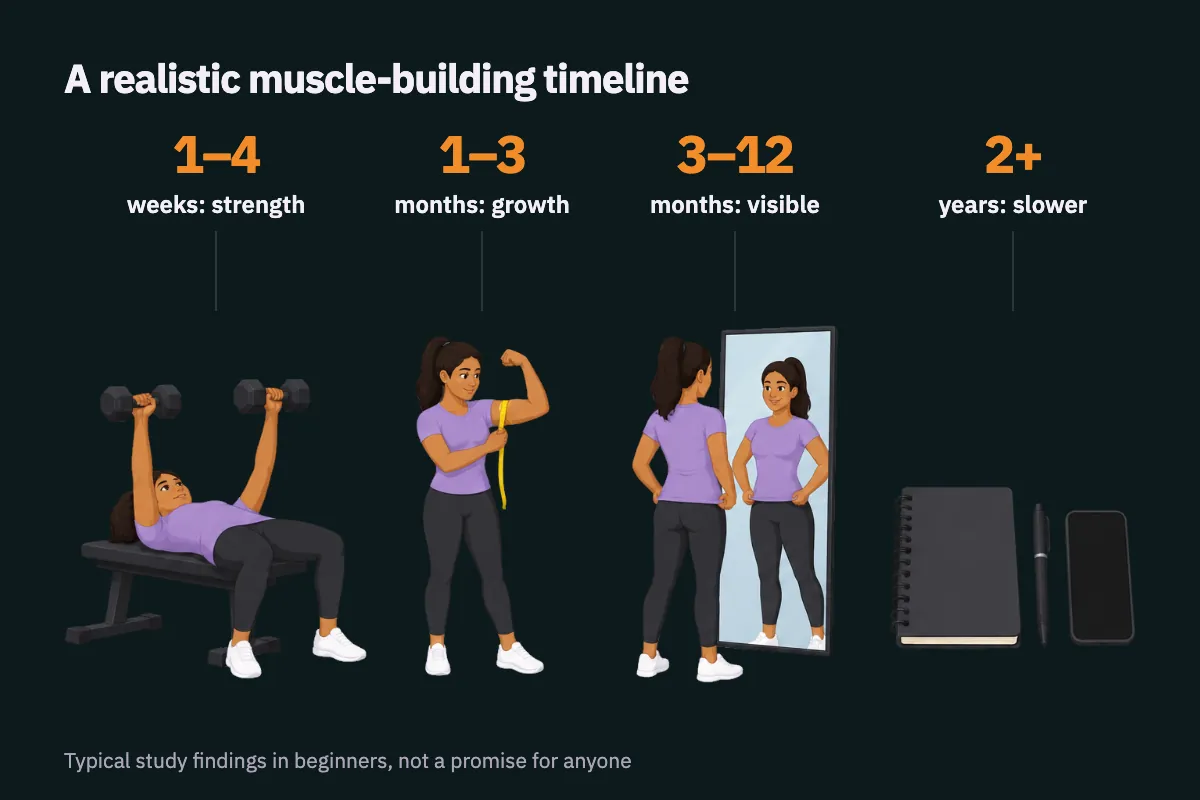
Strength comes first; visible change takes months, and progress slows after the first year.
How much muscle can you gain in a month or a year?
There is no reliable research figure for “muscle per month” for an individual. What studies offer instead:
- A 2020 meta-analysis of 111 studies in healthy adult men found resistance training increased whole-body muscle or lean mass by about 1.5 kg on average, across programs lasting from 2 weeks to a year. Whole-body lean mass includes water and stored glycogen, so short-term changes are not all new muscle tissue.
- In a study of 585 men and women who trained one arm for 12 weeks, biceps size changes ranged from about minus 2% to plus 59%. Some people gained almost nothing in that time and others gained a lot on the same program.
- Experience slows things down. Over 21 weeks of training, untrained men increased quadriceps size by about 5.6% and maximal leg force by about 21%, while experienced strength athletes improved far less on both.
Rules of thumb that circulate online often suggest a beginner man might gain up to about 1 kg of muscle a month in the first year, less for women and less every year after. These are coaching heuristics, not research results. They can help set expectations, but no study has validated them for individuals, and many beginners in short studies gain much less than that.
Why the scale and the mirror lag behind
- The changes are small at first. A few percent more thickness in a muscle is a few millimetres, spread over a whole body you see every day.
- Scale weight moves for many reasons. Water, glycogen, salt and food in the gut can shift your weight by more than a month of muscle gain. If you are also losing fat, the two can cancel out. Our article on body recomposition explains how to read that.
- Early swelling can mislead. Muscles may look fuller in the first weeks of a new program, then settle as the swelling goes, which can feel like a loss.
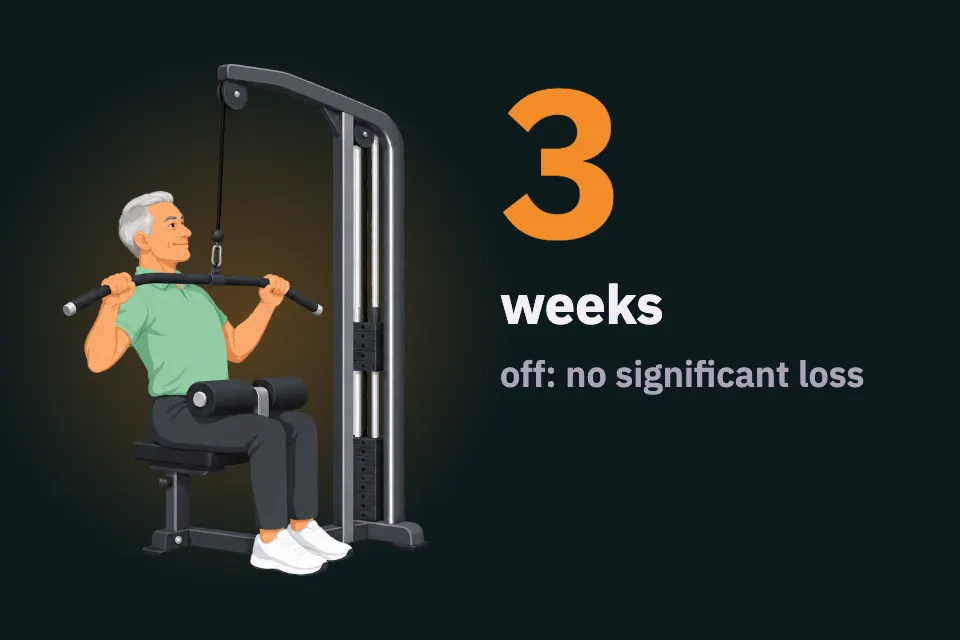
- Strength runs ahead of size. In a detraining study, leg muscle size returned to baseline after 20 weeks without training, yet most of the strength gain remained, a sign of how much of strength is skill.
What speeds up or slows down muscle growth?
- Consistency. Every study above involved regular sessions over weeks. Weeks you miss are weeks without the stimulus.
- Effort. A 2024 meta-regression found muscle growth increased as sets were ended closer to failure, while strength gains were similar across a wide range of reps in reserve. The authors call it exploratory because effort had to be estimated. See training to failure vs leaving reps in reserve.
- Volume. A 2017 meta-analysis of 15 studies found a graded relationship: more weekly sets per muscle tended to produce more growth. The counting guide shows how to track it.
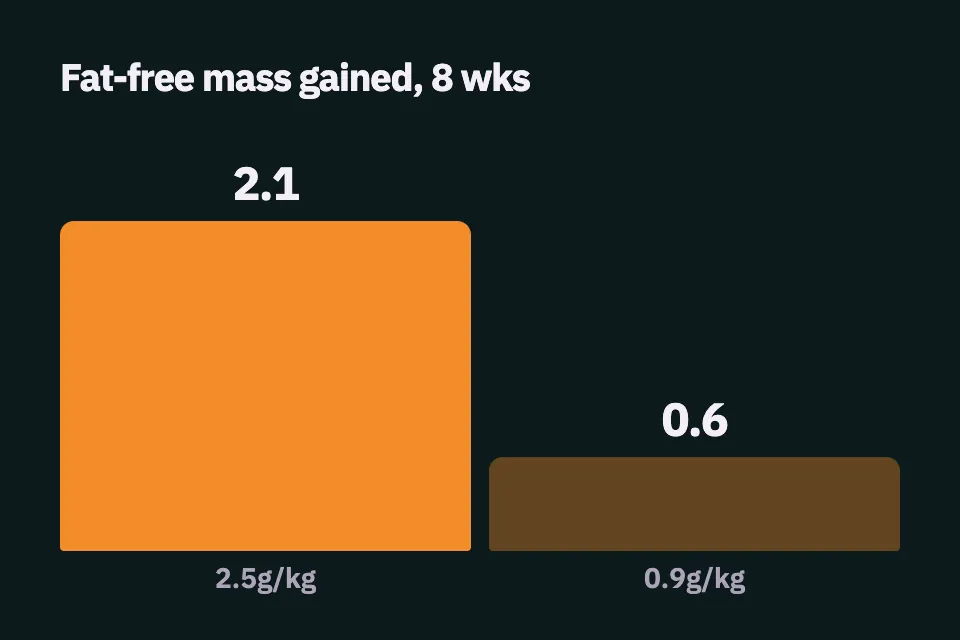
- Protein. A meta-analysis of 49 trials found protein added modest gains on top of training, levelling off around 1.6 g per kg of body weight a day. See the protein guide.
- Energy intake. A 2022 meta-analysis found lean mass gains were smaller when people trained in an energy deficit, though strength gains were similar.
- Sleep. In a small crossover study, one night without sleep lowered muscle protein building the next day by about 18% in 13 young adults. That is a short-term effect, not a measure of long-term growth, but it suggests sleep is worth protecting.
- Age. A meta-analysis of 49 studies in adults over 50 found an average lean mass gain of about 1.1 kg, with smaller gains in older participants. Older adults still respond.
- Sex. A 2020 meta-analysis found men and women gained muscle at similar relative rates on the same program. Men usually gain more in absolute terms, partly because they tend to start with more muscle.
How to see progress early in your log
Because the mirror is slow, your training log is the best early signal. Look at three things:
- Reps at a fixed weight and effort. If you did 8 reps with 2 reps in reserve and now do 10 at the same effort, you have progressed. The double progression guide uses exactly this.
- Estimated 1RM trend. An estimated one-rep max lets you compare sets with different weights and reps on one line.
- Weekly sets per muscle. Check that the training you think you are doing is the training you actually logged.
Here is an invented example for one exercise, not a predicted result:
| Week | Dumbbell press (per hand) | Effort | Estimated 1RM | Weekly chest sets |
|---|---|---|---|---|
| 1 | 20 kg × 8 | 2 RIR | 27 kg | 10 |
| 4 | 20 kg × 10 | 2 RIR | 28 kg | 10 |
| 8 | 22 kg × 9 | 2 RIR | 30 kg | 12 |
Rising numbers in the first weeks are mostly skill and strength, but they show the program is moving. Over months, steady progress at similar effort is consistent with growth, especially alongside changes in measurements.
Common mistakes
- Judging progress after two weeks. Early weeks are mostly strength and skill.
- Using the mirror or scale as the only test. Both lag behind and both are noisy.
- Switching programs whenever results feel slow. Constant changes make it hard to compare anything. Use the progressive overload guide to judge a plan over several weeks.
- Comparing yourself with someone else’s timeline. Responses vary widely even on identical programs.
- Treating rules of thumb as targets. A “kilogram a month” heuristic is not a standard you are failing.
Tracking muscle gain in FitArchive
FitArchive is a free, private training and food log that works in your browser and offline; your data stays on your device unless you sign in to sync. It records the weight, reps and RIR of every set, marks warm-up sets, and shows an estimated 1RM per exercise using kg × (1 + (reps + RIR) / 30) when reps plus RIR is 15 or fewer. The Progress screen also counts weekly hard sets by muscle. You can log body weight with a smoothed trend, optional measurements in centimetres, and daily calories and protein. If you already log in Strong or Hevy, you can import that history. Try it with sample data in the demo.