If you lift weights to build muscle, research points to about 1.6 g of protein per kg of body weight per day, with up to about 2.2 g/kg as a reasonable upper end. That is roughly double the 0.8 g/kg recommended for adults in general. Spread it over three or four meals and make sure your total for the day is there; the exact timing matters less. For a 70 kg person, 1.6 g/kg works out to about 112 g a day.
This guide explains where those numbers come from, what changes when you are eating less to lose weight, how much protein to put in one meal, and how much protein is in eggs, chicken, tofu and popular Vietnamese dishes.
This is general information, not personal medical or nutrition advice. If you have kidney disease or another medical condition, are pregnant, or are under 18, follow the advice of your doctor or dietitian rather than the numbers here.
How much protein do I need to build muscle?
Three reference points are worth knowing:
- 0.8 g/kg a day is the adult Recommended Dietary Allowance set by the US Institute of Medicine. A meta-analysis of nitrogen balance studies put the figure at 0.83 g/kg of good-quality protein. It is meant to cover the basic needs of nearly all healthy adults, not to maximize muscle gain.
- 1.4 to 2.0 g/kg a day is what the International Society of Sports Nutrition position stand calls sufficient for most exercising people who want to build or keep muscle.
- About 1.6 g/kg a day is where gains in lean mass levelled off in a 2018 meta-analysis of 49 trials with 1,863 participants who did resistance training. The 95% confidence interval for that point ran from 1.03 to 2.20 g/kg, which is why the authors suggested about 2.2 g/kg may be prudent for people trying to maximize gains.
Here is what those rates mean in grams. These are arithmetic examples, not prescriptions:
| Body weight | 0.8 g/kg (RDA) | 1.6 g/kg | 2.2 g/kg |
|---|---|---|---|
| 50 kg | 40 g | 80 g | 110 g |
| 60 kg | 48 g | 96 g | 132 g |
| 70 kg | 56 g | 112 g | 154 g |
| 80 kg | 64 g | 128 g | 176 g |
Protein does not build muscle on its own. The meta-analysis found that extra protein added modest gains on top of training: on average about 0.3 kg more fat-free mass and 2.5 kg more on a one-rep max than training without it. Training with progressive overload does most of the work, and protein supports it.
Does more than 1.6 g/kg help?
Probably not much for most people, but the line is not sharp. In the same meta-analysis, the levelling-off point was an estimate, not a hard ceiling, and the break-point model was not statistically significant (p = 0.079). The wide interval means some people may benefit up to about 2.2 g/kg. Above that, the meta-analysis offers little support for extra muscle gain.
Two other findings from that analysis are useful. Protein supplements helped people who were already resistance trained more than untrained people, and the benefit became smaller with age. Older adults are a separate case: the PROT-AGE group recommends that people over 65 eat at least 1.0 to 1.2 g/kg a day, and at least 1.2 g/kg if they exercise, while people with severe kidney disease may need to limit protein.
How much protein when cutting?
When you eat fewer calories than you burn, protein needs seem to go up, especially for lean, trained lifters. A systematic review by Helms and colleagues suggested 2.3 to 3.1 g per kg of fat-free mass, scaled upwards with a bigger deficit and lower body fat. The ISSN position stand gives a similar 2.3 to 3.1 g/kg range for keeping lean mass in resistance-trained people during low-calorie periods.
Note the evidence behind the Helms figure is thin: the review included only six studies of lean, trained adults. Fat-free mass is also hard to measure accurately at home. A practical reading is that if you are cutting, aim towards the higher end of the ranges above rather than the lower end, keep training hard, and avoid very aggressive deficits.
How much protein per meal?
Total daily protein matters most, but how you split it can help. The ISSN suggests about 0.25 g/kg of high-quality protein per serving, or 20 to 40 g, spaced every 3 to 4 hours. Schoenfeld and Aragon (2018) went further: to maximize muscle building, aim for about 0.4 g/kg per meal across at least four meals, which reaches 1.6 g/kg a day. Using the 2.2 g/kg upper end over four meals gives up to 0.55 g/kg per meal.
For 70 kg, 0.4 g/kg is about 28 g per meal. The old idea that the body “can only absorb 30 g at once” is too simple. That review found that larger doses are not all burned for energy; some of the extra is still used to build tissue.
The study behind the “100 g of protein in one meal” videos makes the same point more strongly. In a 2023 laboratory tracer study, 100 g of protein after a workout raised muscle protein synthesis more, and for longer (more than 12 hours), than 25 g, with little extra burned for energy. It measured protein use over one day in a small group, not muscle growth over months, so it does not mean one huge meal beats spreading protein out. It does mean an occasional large protein meal is not wasted, and your daily total still matters most.
How much protein is in eggs, chicken and other foods?
Values below are from the FitArchive food catalogue, based on USDA data, rounded to whole numbers. Weights are cooked unless marked raw.
| Food | Protein per 100 g | Typical serving | Protein per serving | kcal per serving |
|---|---|---|---|---|
| Chicken breast, cooked | 31 g | 1 fillet, 120 g | 37 g | 198 |
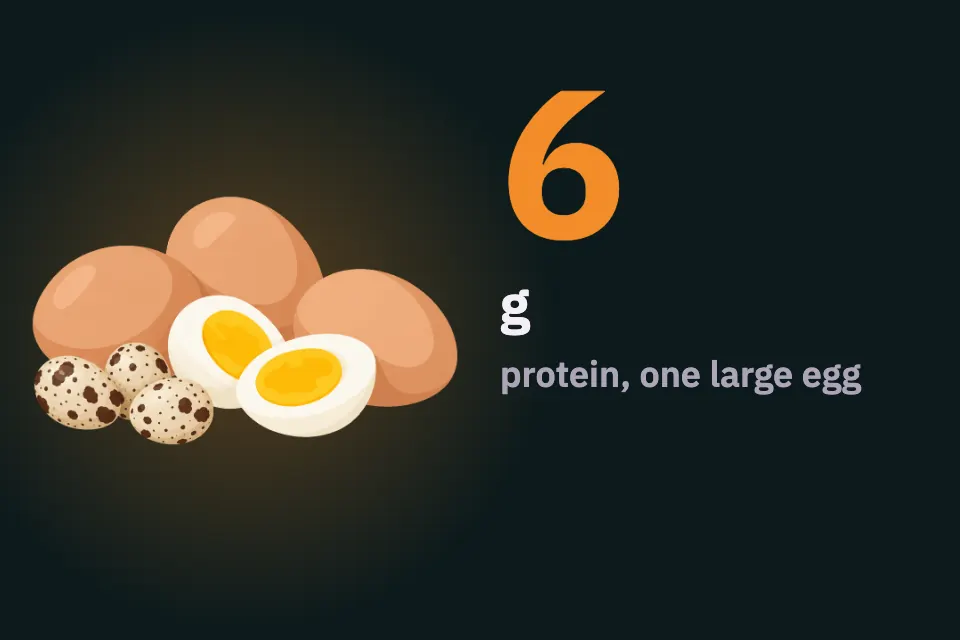
| Egg, hard-boiled | 13 g | 1 large egg, 50 g | 6 g | 78 |
| Lean beef, cooked | 30 g | 85 g | 25 g | 133 |
| Beef shank (bắp bò), cooked | 34 g | 100 g | 34 g | 201 |
| Lean pork, boiled | 26 g | 85 g | 22 g | 122 |
| Pork belly, raw weight | 9 g | 113 g | 11 g | 585 |
| Tilapia, cooked | 26 g | 1 fillet, 87 g | 23 g | 111 |
| Shrimp, cooked | 23 g | 85 g | 19 g | 101 |
| Firm tofu | 17 g | 1 block, 150 g | 26 g | 216 |
| Soft tofu (đậu hũ non) | 7 g | 120 g | 9 g | 73 |
| Whole milk | 3 g | 1 cup, 244 g | 8 g | 149 |
| Plain yogurt | 4 g | 1 pot, 170 g | 6 g | 104 |
| Greek yogurt, nonfat | 10 g | 170 g | 17 g | 100 |
| Roasted peanuts | 24 g | small handful, 28 g | 7 g | 164 |
| Cooked white rice | 3 g | 1 bowl, 150 g | 4 g | 195 |
| Cooked rice noodles (phở) | 2 g | 200 g | 4 g | 216 |
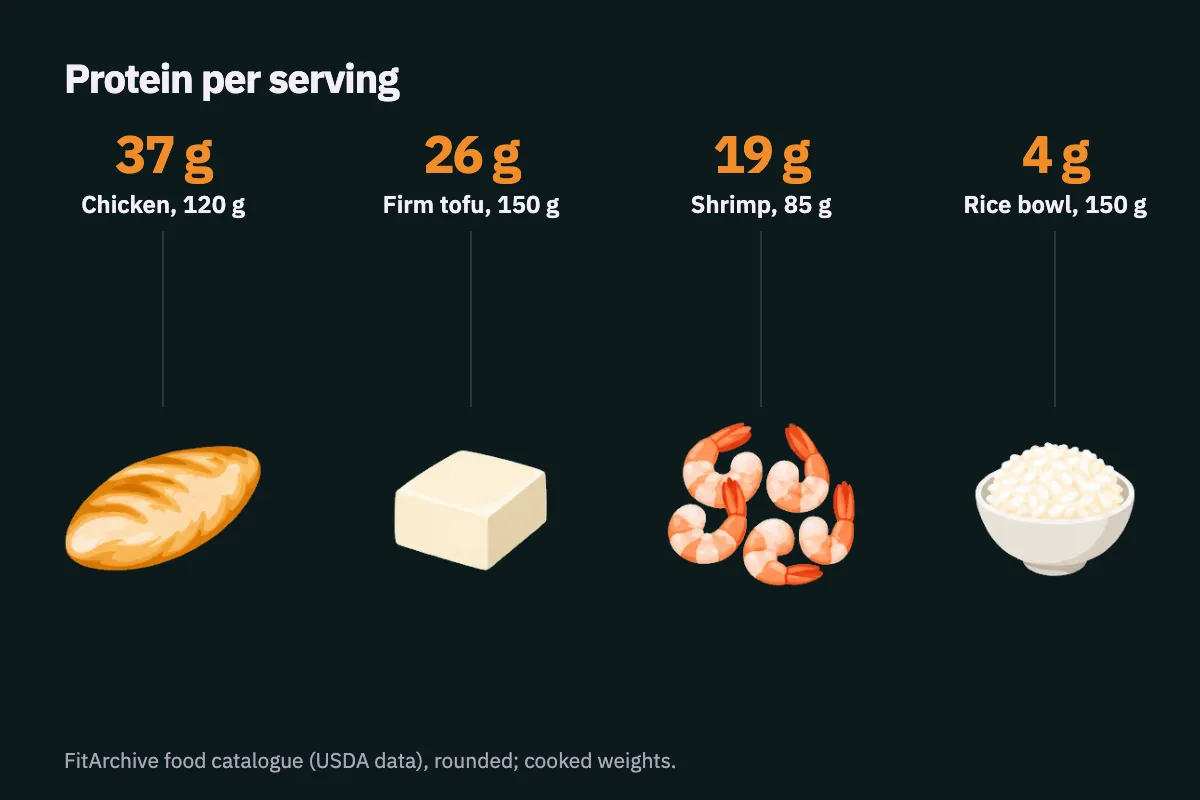
A big bowl of rice adds energy but little protein.
Protein powders vary a lot between brands, so log them from the label on your own tub rather than a generic entry.
So, how much protein in an egg? About 6 g in one large hard-boiled egg. In a chicken breast? About 31 g per 100 g cooked, or 37 g for a 120 g fillet. Rice and noodles are included for contrast: a big bowl adds energy but not much protein.
Which Vietnamese dishes have the most protein?
These are FitArchive recipe estimates for the regular size of each dish, built from weighed ingredients with USDA data. Real portions vary with how much meat goes in, the amount of noodles or rice, the fat in the broth, cooking oil and sauces, so treat them as estimates for the stated weights.
| Dish (regular size) | Weight | Protein | kcal |
|---|---|---|---|
| Bò bít tết (Vietnamese steak plate) | 308 g | 54 g | 732 |
| Bún bò giò heo (beef noodle soup with pork knuckle) | 795 g | 51 g | 646 |
| Cơm gà xối mỡ (crispy chicken rice) | 398 g | 46 g | 692 |
| Cơm bò lúc lắc (shaking beef rice) | 435 g | 43 g | 634 |
| Cơm tấm sườn trứng (broken rice, pork chop, egg) | 450 g | 42 g | 741 |
| Bún bò Huế | 815 g | 42 g | 571 |
| Cá chiên (fried fish) | 172 g | 40 g | 302 |
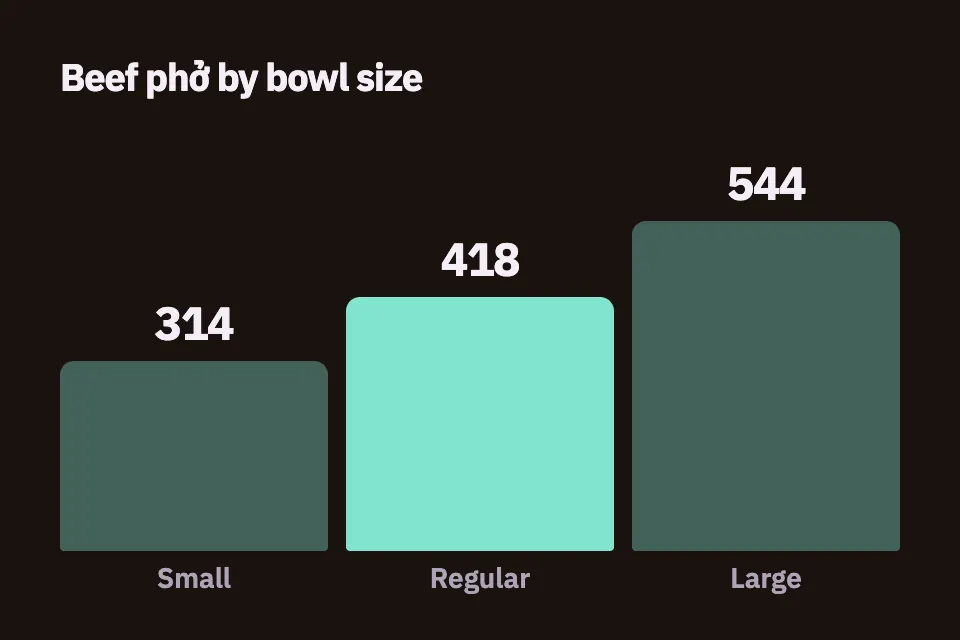
| Phở bò | 785 g | 38 g | 418 |
| Gà luộc (boiled chicken) | 170 g | 35 g | 321 |
| Thịt kho trứng (braised pork and eggs) | 218 g | 17 g | 634 |
| Xôi xéo (sticky rice with mung bean) | 235 g | 7 g | 309 |
The last two rows are for contrast: rich or rice-heavy dishes can be high in energy without much protein. For more detail on single dishes, see how much protein is in phở and bánh mì calories and protein, or browse the Vietnamese food calories and protein table.
An example day with about 120 g of protein
This is an example, not a meal plan. Values are FitArchive estimates at regular size.
| Meal | Food | Protein | kcal |
|---|---|---|---|
| Breakfast | Bánh mì trứng (egg bánh mì) | 23 g | 464 |
| Lunch | Cơm gà xào sả ớt (lemongrass chilli chicken rice) | 36 g | 596 |
| Afternoon | 2 hard-boiled eggs and 1 cup whole milk | 21 g | 304 |
| Dinner | Cơm cá kho (braised fish with rice) and canh chua cá (sour fish soup) | 39 g | 629 |
| Total | 119 g | 1,993 |
For a 70 kg person that is about 1.7 g/kg. Breakfast is the light meal here. Swapping to a bánh mì gà (29 g in the FitArchive estimate) would bring it closer to 0.4 g/kg. Your calories, portions and preferences will be different.
Do you need protein powder?
No. The ISSN notes that active people can meet their protein needs from whole foods, and the example day above has none. Powder is a convenience: an easy way to add protein with few calories when meals fall short, or when you train a lot. Choose a product with a clear label and count it like any other food.
Common mistakes
- Counting food weight as protein. 100 g of chicken breast has about 31 g of protein, not 100 g.
- Mixing raw and cooked weights. Raw chicken breast has about 23 g of protein per 100 g in the catalogue; cooked has 31 g because water is lost. Match the entry to how you weighed it.
- Assuming a big plate means a lot of protein. Rice, noodles and fatty cuts add calories quickly. Check the meat or tofu part.
- Putting all your protein in dinner. A light breakfast and lunch make a high daily target hard to reach.
- Chasing ever-higher intakes. Above about 2.2 g/kg, the evidence for extra gains is weak. Training, total calories and sleep usually matter more.
- Judging from one day. Look at your weekly average, not one low day.
Tracking protein in FitArchive
FitArchive has a food log with about 263 Vietnamese dishes, each built from weighed parts using USDA ingredient data, plus USDA foods and your own foods. You can log a dish small, regular or large, and set the main part such as rice or noodles to less or more. It shows your calories and protein for the day, and you can set your own optional nutrition targets, including protein. The same app logs your sets, reps and RIR, so you can look at food and training together, as described in how to log food and workouts together. To look around first, open the demo with sample data.