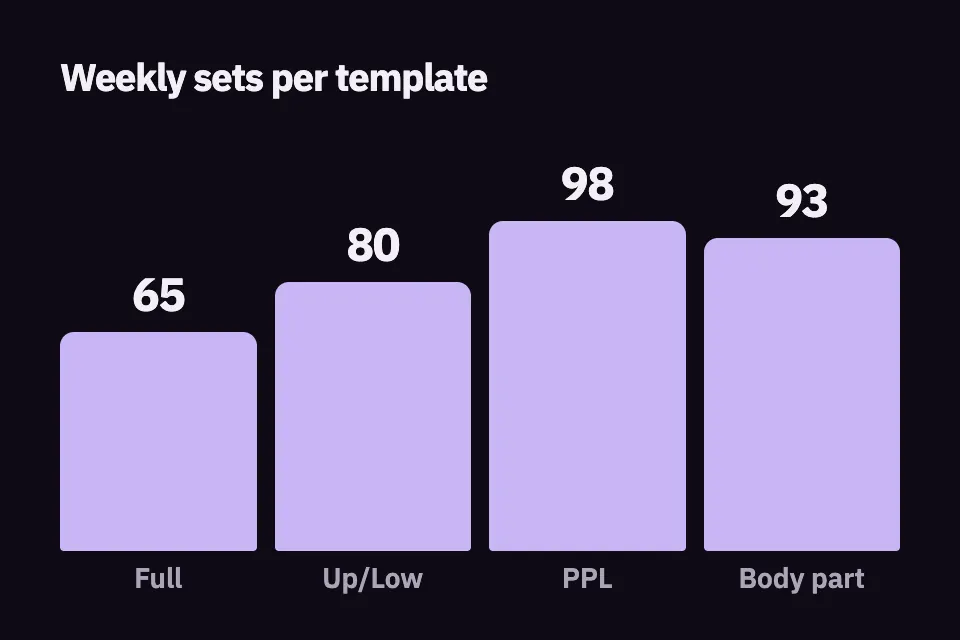
An upper/lower split divides your training into upper-body days (chest, back, shoulders, arms) and lower-body days (quads, hamstrings, glutes, calves), usually four sessions a week, so each muscle is trained twice. A common week is Upper, Lower, rest, Upper, Lower, rest, rest. Twice a week per muscle matches the most widely supported default in the frequency research, and four days leaves three for recovery. Results then depend on how many hard sets each muscle gets and whether you add reps or weight over time.
The split comparison guide puts upper/lower next to full body and push/pull/legs. This article goes deeper on upper/lower alone: weekly layouts, why 1 or 2 sets per exercise is enough, whether to run one version or A and B, a full example plan with set counts per muscle, and how to progress.
What is an upper lower split?
An upper/lower split alternates two kinds of session:
- Upper days train the chest, back, shoulders, biceps and triceps, typically with a horizontal press, a horizontal pull, a vertical press or pull, and arm and shoulder accessories.
- Lower days train the quads, hamstrings, glutes and calves, typically with a squat pattern, a hip hinge, leg curls or extensions, calves and often abs.
You can repeat the same Upper and Lower days, or use two versions of each (Upper A, Upper B, Lower A, Lower B). The tradeoff is covered below.
Upper lower split 4 days a week: weekly layouts
These are example layouts. Any arrangement works if you keep roughly one rest day before repeating the same half of the body.
| Layout | Mon | Tue | Wed | Thu | Fri | Sat | Sun |
|---|---|---|---|---|---|---|---|
| 4 days, classic | Upper | Lower | Rest | Upper | Lower | Rest | Rest |
| 4 days, spread out | Upper | Lower | Rest | Upper | Rest | Lower | Rest |
| 5-day rotation, week 1 | Upper | Lower | Upper | Rest | Lower | Upper | Rest |
| 5-day rotation, week 2 | Lower | Upper | Lower | Rest | Upper | Lower | Rest |
The classic layout is the most common because it keeps the weekend free. The spread-out version suits people who prefer never to train lower body two days after a hard upper day. The 5-day rotation keeps the order running across weeks, so each muscle is trained about 2.5 times a week. That is 25% more sessions, and 25% more weekly sets if the workouts stay the same, so check how you recover before adopting it.
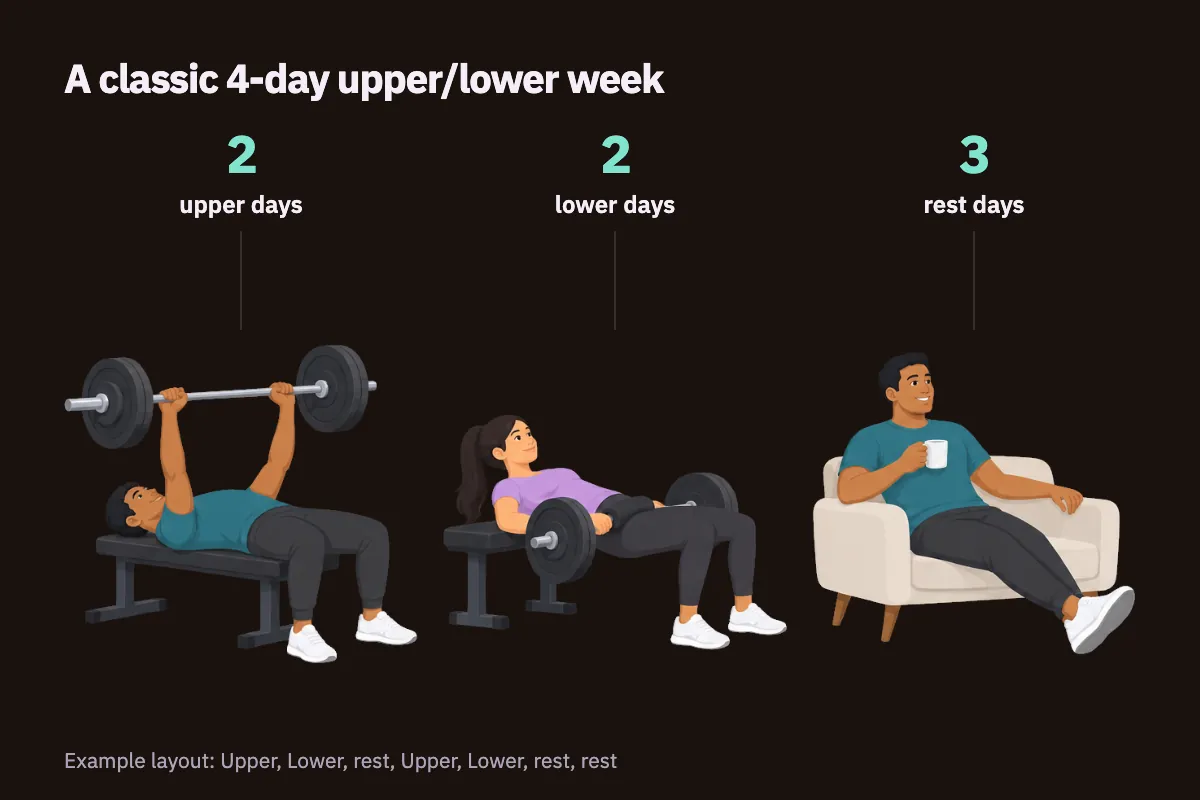
Four sessions train each muscle twice and leave three days to recover.
With only 3 days, a full-body plan usually fits better than upper/lower, which would train each muscle just 1.5 times a week.
Fewer sets per exercise
Twice a week is already high frequency compared with a body-part split, so each exercise needs less work: 1 or 2 hard sets, not 3 or 4. Stop about 1 to 2 reps short of failure on heavy compound lifts and 0 to 1 short on machines and isolation exercises. If you want more work for a muscle, add a different exercise before a third set. This is a practical way to keep sessions short and sets hard, not a proven optimum: the studies below compare weekly volume and frequency, not 2-set exercises.
One version or A and B?
You have two good options, and they differ in what you can track:
- One Upper and one Lower, each done twice a week. Every exercise comes back twice a week, so you get more chances to beat your last numbers and can see quickly whether a lift is progressing. This is the simplest default.
- Upper A, Lower A, Upper B, Lower B. You get more exercise variety and more angles for each muscle. The tradeoff is that each exercise comes back only once a week, so progress on any one exercise is slower and harder to see.
Choose variety if it keeps you training. Choose one version if seeing your numbers go up is what motivates you.
Example upper lower workout plan
This is an example program with one version of each day. Numbers in brackets are target RIR (reps in reserve). Use a machine or free-weight version, whichever you can load safely close to failure.
| Day | Exercises (sets × reps, target RIR) |
|---|---|
| Upper | Chest press 2 × 6-10 (1), incline press or fly 1 × 8-12 (1), upper back row 2 × 8-12 (1), lat pulldown or lat row 2 × 8-12 (1), shoulder press 1 × 8-12 (1), lateral raise 2 × 12-20 (1), biceps curl 2 × 10-15 (1), triceps extension 2 × 10-15 (1) |
| Lower | Romanian deadlift 2 × 8-12 (2), leg curl 2 × 10-15 (1), squat or leg press 2 × 6-10 (2), leg extension 1 × 10-15 (1), adductor machine 2 × 10-15 (1), calf raise 2 × 10-15 (1), abs 2 × 10-15 (1) |
That is 14 working sets on Upper and 13 on Lower, or 54 a week. Warm up before the first heavy lift, then rest as long as you need to make the next set hard. Expect about 35 to 45 minutes a session.
Direct sets per muscle if every set is completed at the planned effort (example totals, counting exercises where the muscle is the main target):
| Muscle | Weekly sets | Muscle | Weekly sets |
|---|---|---|---|
| Chest | 6 | Quads | 6 |
| Back (rows and pulldowns) | 8 | Hamstrings | 8 |
| Shoulder press | 2 | Adductors | 4 |
| Side delts | 4 | Calves | 4 |
| Biceps | 4 | Abs | 4 |
| Triceps | 4 | Glutes | Worked by hinges and squats |
Pressing also trains the shoulders and triceps, and rows also train the rear delts and biceps, so those muscles get more work than the table shows. These direct totals sit below the 10 weekly sets the 2026 ACSM position stand associates with more growth for several muscles. If a muscle is a priority or stops progressing, add an exercise for it. The weekly sets guide explains the counting rule.
If you prefer the A and B version, here is an example:
| Day | Exercises (sets) |
|---|---|
| Upper A | Chest press 2, shoulder press 2, triceps extension 2, upper back row 2, lat row 2, biceps curl 2 |
| Lower A | Romanian deadlift 2, leg curl 2, squat or leg press 1, leg extension 1, adductor machine 2, calf raise 2, abs 2 |
| Upper B | Upper back row 2, lat pulldown 2, hammer curl 2, incline press 2, lateral raise 2, overhead triceps extension 2 |
| Lower B | Squat or leg press 2, leg extension 1, adductor machine 2, back extension 2, leg curl 2, abs 2 |
That is 12, 12, 12 and 11 working sets, or 47 a week.
Strength days and hypertrophy days
Some popular upper/lower programs make the first upper and lower days heavier, with lower reps, and keep the second pair in moderate rep ranges. This “power and hypertrophy” style needs two versions of each day. An example adjustment of the A days, leaving the B days as above:
| Day | Main lifts changed (sets × reps, target RIR) |
|---|---|
| Upper A (heavy) | Chest press 2 × 4-6 (2), upper back row 2 × 5-8 (2) |
| Lower A (heavy) | Squat 2 × 4-6 (2), Romanian deadlift 2 × 6-8 (2) |
The ACSM overview lists heavier loads (at least 80% of one-rep max) among the factors that enhanced strength, so a heavy day makes sense if strength is a goal. If muscle size is your main goal, moderate rep ranges are a reasonable choice, and the number of hard sets per week matters more than adding a heavy day. The evidence on rep ranges and load is covered in how many reps to build muscle.
Is training each muscle twice a week enough?
For most people, yes. The evidence:
- A 2016 meta-analysis of 10 studies found training a muscle twice a week produced more growth than once a week, with volume equated.
- A 2019 update with 25 studies found no significant difference between higher and lower frequencies when weekly volume was equal. Twice a week is not magic; it is a practical way to fit about 10 or more sets per muscle into sessions of manageable length.
- In a 2019 trial in trained men, a split training each muscle twice a week over four sessions was compared with a total-body routine three times a week at equal volume. After 10 weeks, gains in strength and muscle thickness were similar, with effect sizes slightly favouring the split for size. Of 36 men who started, 28 finished.
- The 2026 meta-regression of 67 studies found frequency added little to growth once volume was counted, while strength did rise with frequency.
The limits: most of these studies lasted 6 to 12 weeks and most participants were young men. The training frequency guide covers the wider evidence.
Upper lower vs push pull legs
Both train each muscle twice a week. Upper/lower does it in 4 days with more exercises per session; push/pull/legs needs 6 days, with shorter sessions. If you can reliably train 4 days, upper/lower is simpler. If you can train 6 days and like shorter workouts, PPL fits. The split comparison has both templates side by side.
Who is an upper lower split for?
- Beginners who can commit to 4 days a week. If 54 working sets is too much at first, do 1 set per exercise for the first few weeks and build up.
- Intermediate lifters who want fewer exercises per session than a full-body plan needs.
- Women, on the same terms as men. Most training studies recruited mostly men (79% of participants in the 2026 meta-regression), so evidence for women is thinner, but there is no reason to expect a different split to be needed. If glutes are a priority, add a hip thrust or abductor machine to the lower days.
How to progress on an upper lower split
Use double progression: stay at one weight until you reach the top of the rep range on all sets at the target RIR, then add the smallest weight step. Here is invented example data for chest press on Upper (2 × 6-10, 1 RIR):
| Week | Weight | Reps per set | Next step |
|---|---|---|---|
| 1 | 60 kg | 8, 7 | Same weight |
| 2 | 60 kg | 9, 8 | Same weight |
| 3 | 60 kg | 10, 10 | Add 2.5 kg |
| 4 | 62.5 kg | 8, 7 | Same weight |
With one version, each Upper is compared with the last Upper, so you get two chances a week to see progress. With A and B, compare Upper A with the last Upper A, not with Upper B. Recording RIR for each set shows whether the reps were achieved at the planned effort or by grinding closer to failure.
Common mistakes
- Keeping 3 to 4 sets per exercise. At twice a week, that makes long sessions with tired later sets. Start with 1 or 2.
- Upper days that run too long. Upper days have more muscles to cover. If they drag, move one arm exercise to a lower day rather than rushing rests.
- Two very heavy hinge days. Romanian deadlifts plus heavy deadlifts in the same week can leave the lower back tired. Keep one heavy hinge, or use a leg curl and a back extension for the rest.
- Dropping hamstrings or calves because they come last. Put them earlier if they keep getting skipped.
- Changing exercises every week. Keep the main lifts for a full block so you can see progress. This matters even more with A and B, where each exercise appears only once a week.
- Treating weekdays as fixed after a missed day. If you miss a Lower day, do it next instead of skipping straight to Upper.
Running an upper lower split in FitArchive
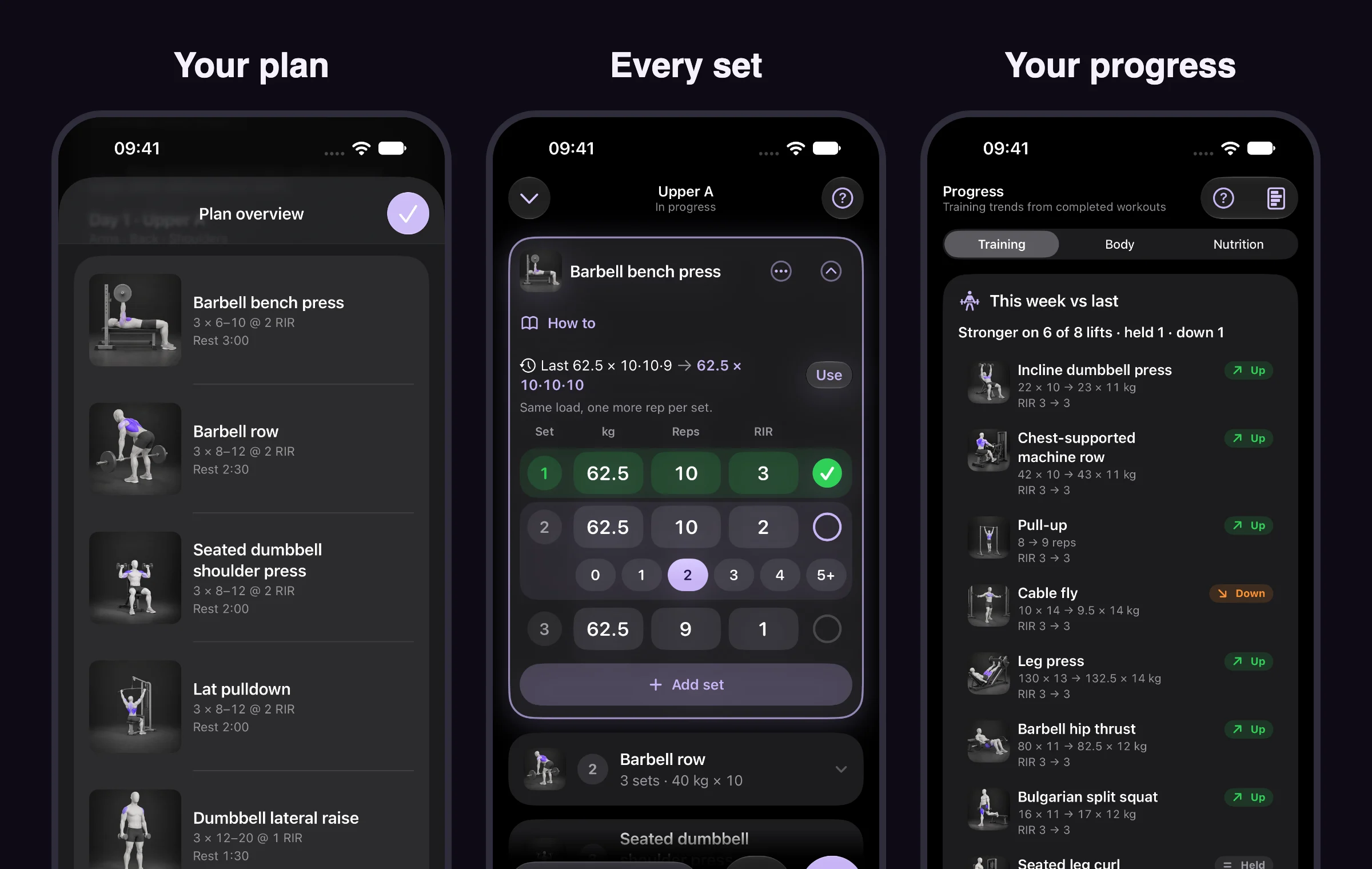
Example screens from FitArchive with sample data.
FitArchive includes an Upper/Lower 4 day template with A and B days and more sets per exercise than this program. You can lower it to 1 or 2 sets per exercise, or build your own plan with one Upper and one Lower. An anterior/posterior split works the same way if you would rather divide the body front and back. Plan days follow in order rather than by weekday: after you finish a workout, the next one in the plan is suggested, so a missed day does not break the rotation. Each set records weight, reps and RIR, and the Progress screen shows estimated one-rep max per exercise, weekly hard sets by muscle and training days per muscle. Try it with sample data in the demo.