The short version: after a working set, ask how many more repetitions you could have completed at the same load with the same acceptable technique. Record that estimate—your reps in reserve, or RIR—beside the load and reps you actually performed. When you return to the exercise, compare all three numbers rather than judging progress from weight alone.
What RIR means in a log
If you finish 10 repetitions and believe you could have done two more clean repetitions before you had to stop, write 10 reps @ 2 RIR. At 0 RIR, you do not think another repetition would meet the same technique standard. RIR is an estimate of proximity to your limit, not a sensor measurement or a guarantee of what would have happened on the next rep. NASM’s coaching explanation uses the same “clean reps left” definition.
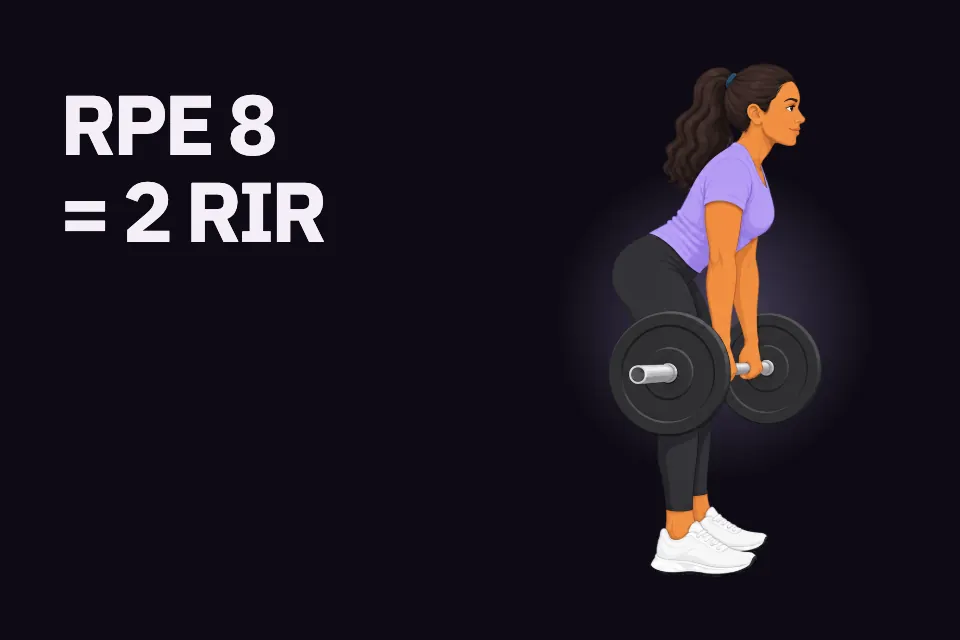
You may also see lifting RPE described as roughly 10 − RIR near the hard end of its scale: 2 RIR is approximately RPE 8. That is a translation of two subjective rating systems, not a calculation of strength or calories. If your program already uses one scale consistently, keep using it rather than converting every entry.
If your older entries use RPE, our RPE vs RIR comparison explains when that shorthand is useful and when the scales should stay separate.
The four-step logging loop
- Finish the set at your chosen technique standard. A rep you could only complete by changing the range of motion or losing control is not automatically “in reserve.” Stop if a movement becomes unsafe or painful; an RIR target does not overrule technique.
- Estimate immediately. Ask, “At this load, how many more reps like those could I have completed?” Record the answer while the set is fresh.
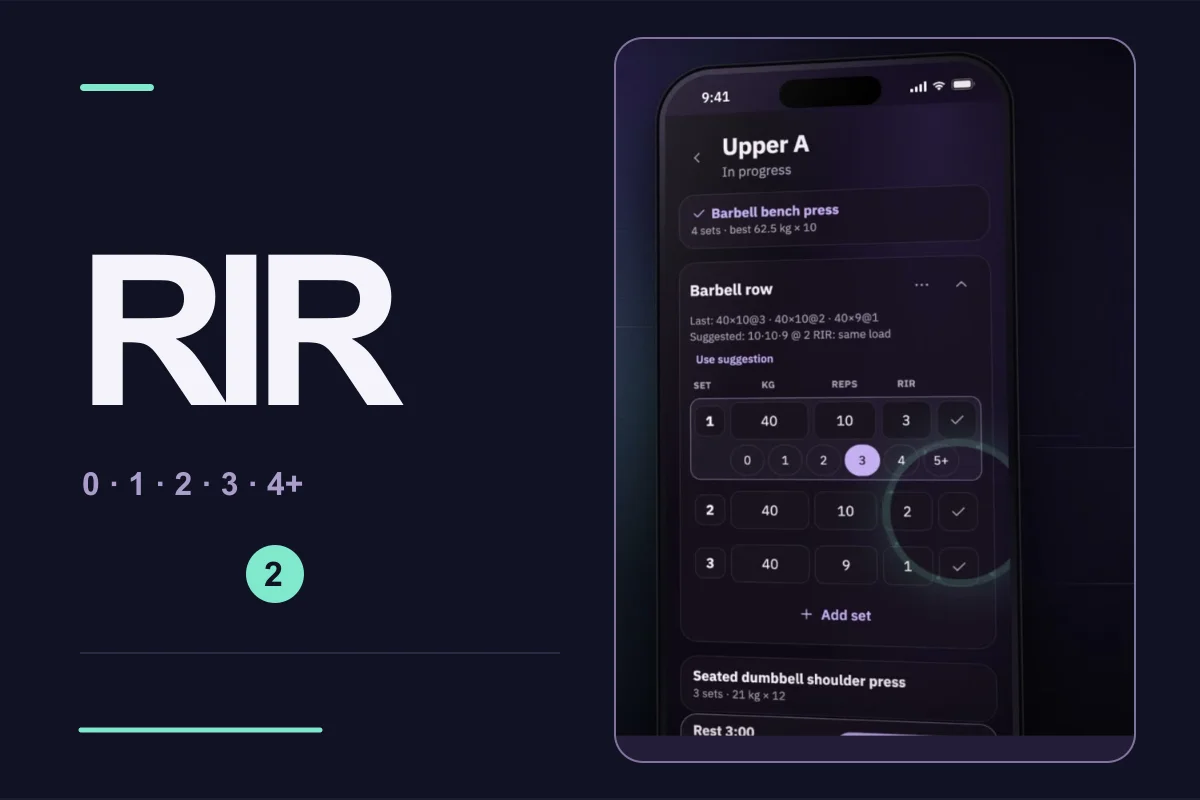
0,1,2,3, and4+are useful working labels; do not force false precision when you are far from your limit. - Write the actual set, not the plan. Keep exercise, load and unit, completed reps, and estimated RIR on the same row. Add a brief note if rest, range of motion, equipment, or technique changed. A planned “8 reps @ 2 RIR” is different from actually performing “8 reps @ 4 RIR.”
- Compare similar sets later. Look at the same exercise and setup, preferably the same set position and a comparable rest interval. One session can be noisy. Use several entries to decide whether to hold load, add a rep, or reconsider a target.
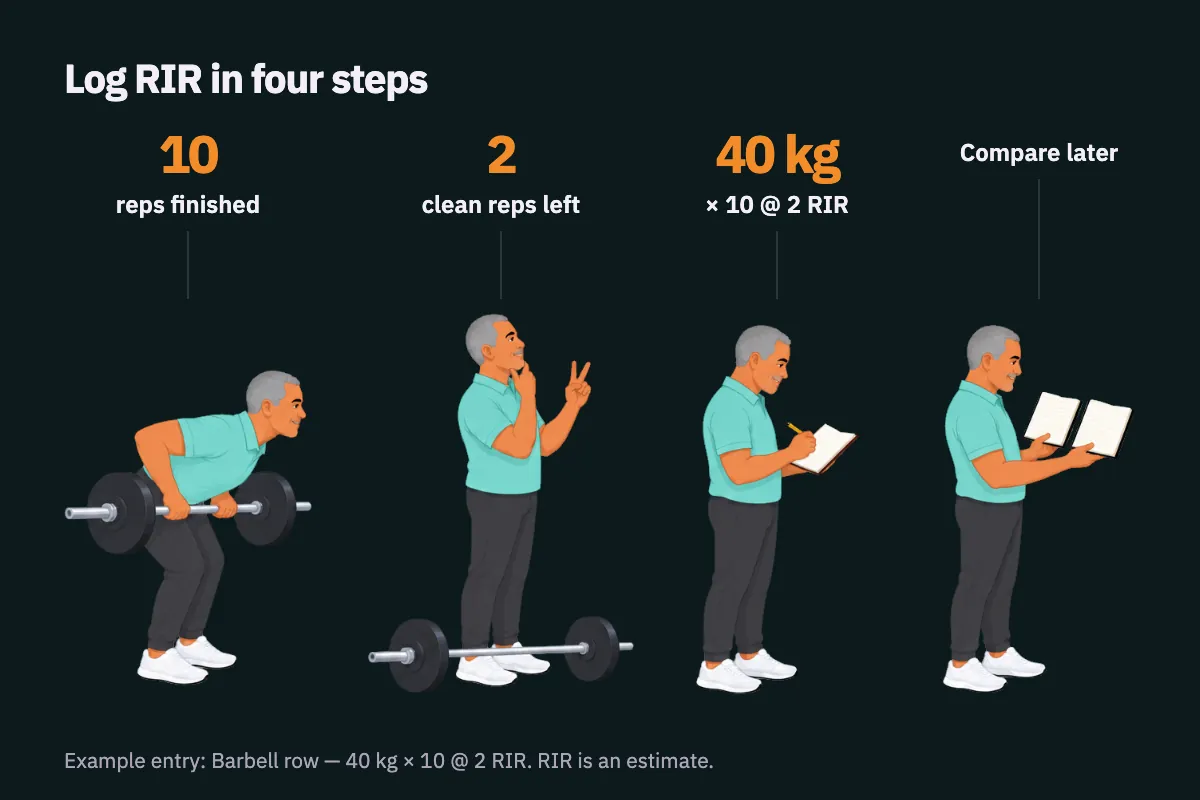
The estimate belongs to the set you just finished.
You can log this in a notebook as Barbell row — 40 kg × 10 @ 2 RIR. The FitArchive workout log has fields for weight, reps, and RIR per set; its sample-data demo lets you see the layout before recording your own training.
A worked example: the same reps can mean different effort
The rows below are illustrative, not real user data or a recommended loading plan. Assume the same barbell row technique, comparable rest, and the first working set each time.
| Session | Load | Completed reps | Estimated RIR | What the record supports |
|---|---|---|---|---|
| A | 40 kg | 10 | 3 | Baseline entry. |
| B | 40 kg | 10 | 1 | The same output felt closer to the limit. This alone does not explain why. |
| C | 40 kg | 11 | 2 | One more clean rep at the same load and a similar reported effort to A is a useful sign of improved performance on this exercise. |
Comparing A with B by load and reps alone would hide the effort difference. Comparing A with C gives more useful context, but even that is not proof of muscle gain. RIR is self-reported; sleep, rest time, technique, and ordinary day-to-day variation can change a session. Review a pattern, not a single number.
How accurate does your RIR need to be?
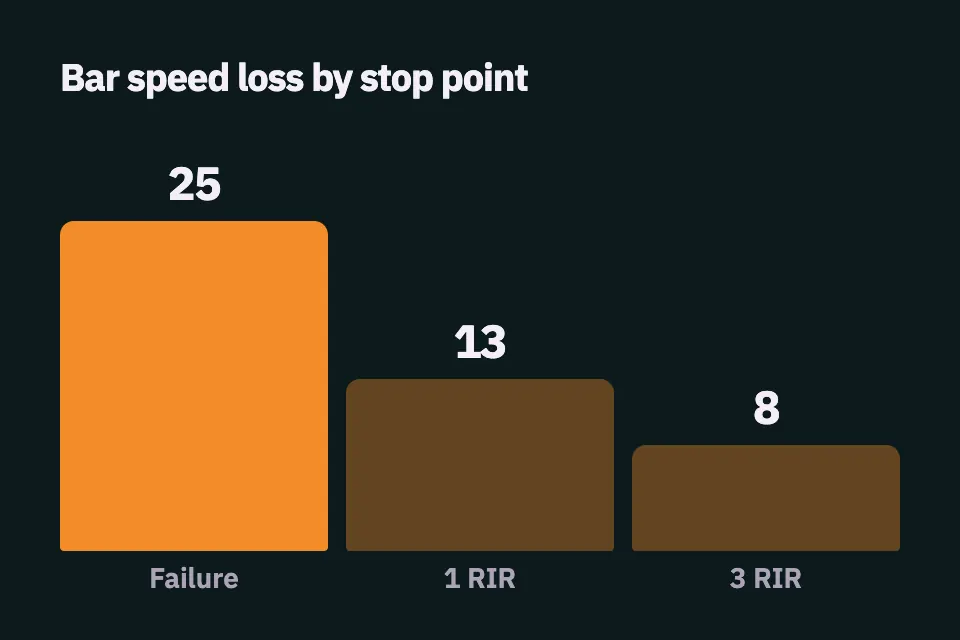
It does not need to be perfect to make a log useful, but it should be interpreted as an estimate. In a study where participants rated repetitions left and then continued to failure, error was smaller close to failure than when many reps remained; accuracy also differed between chest press and leg press. That result comes from those exercises and the study setup, not every lift or every person. Read the study abstract.
The practical response is modest: use the same definition of a clean rep, record soon after the set, and mark a value as uncertain if you are guessing. You do not need to take every set to failure to “calibrate” a log. A systematic review and meta-analysis found no clear hypertrophy advantage for momentary muscular failure over non-failure training in the studies it compared. It also does not establish one ideal RIR number for everyone.
How to use the record next time
Before repeating an exercise, scan the last few comparable entries:
- More reps at similar load and reported RIR? You may have room to progress, while checking that technique stayed consistent.
- Same output at a much lower reported RIR? Hold off on calling it progress. Check rest, setup, fatigue, and recent sessions before changing the plan.
- RIR estimate feels vague? Keep the entry as an honest approximation. A rough
3–4or4+is better than a confident-looking number you cannot justify. - Pain or technique changes? Stop using that set as a clean comparison. RIR is not a reason to push through symptoms.
The useful habit is small: load × reps @ RIR, recorded for each working set you want to compare. It turns “I did 10 again” into a more informative question: “Were those 10 reps performed under similar conditions, and how many clean reps did I think were left?” If you want the previous set beside the current one, open your FitArchive log or explore the demo.
For the next decision after recording, compare several sessions for progressive overload. If your question is whether every set must reach 0 RIR, read the evidence on training to failure.