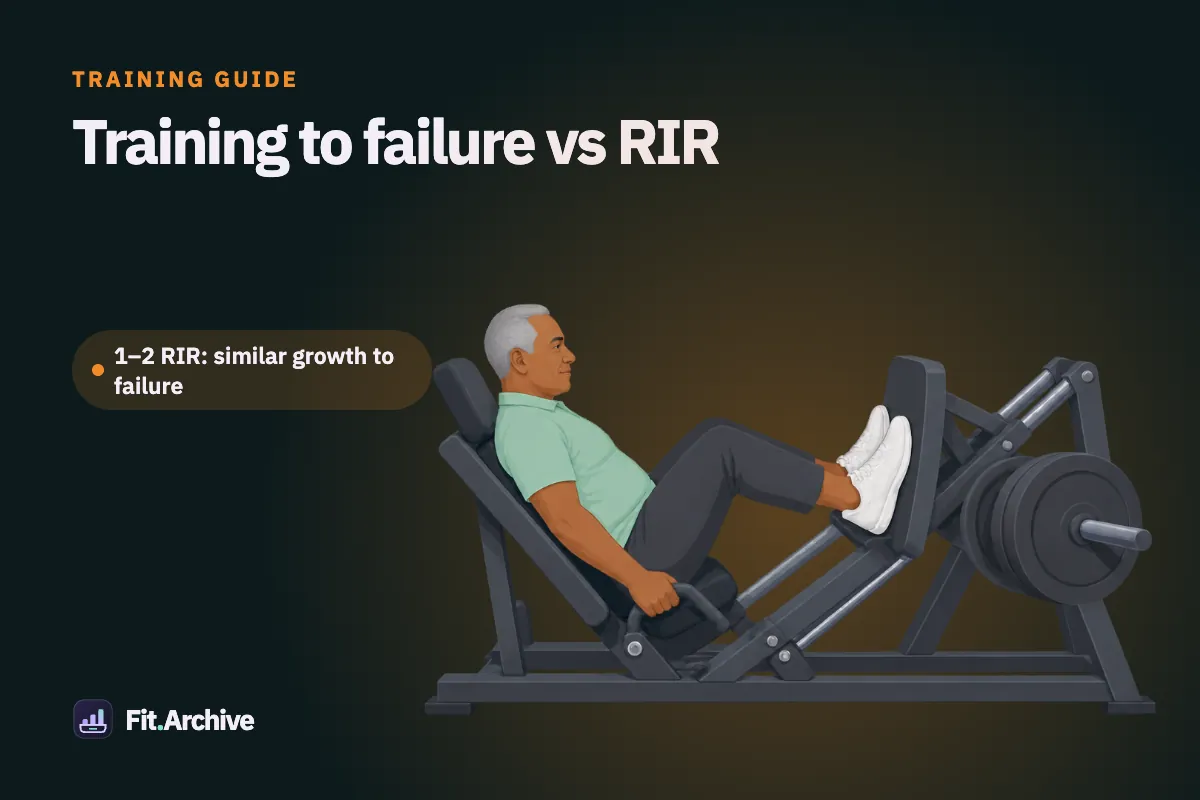
You do not need to take every set to failure to build muscle or strength. Current evidence suggests that sets stopped close to failure, such as one or two good reps short, can produce muscle growth similar to sets taken all the way, with less fatigue. Sets stopped far from failure may give up some growth, so “not to failure” should still mean hard work.
What does “training to failure” mean?
Advice about failure often disagrees because people mean different things by the word:
- Momentary muscular failure: you try another rep and cannot complete it.
- Technical failure: the next rep would break the technique standard you set, for example losing depth, control or a pause.
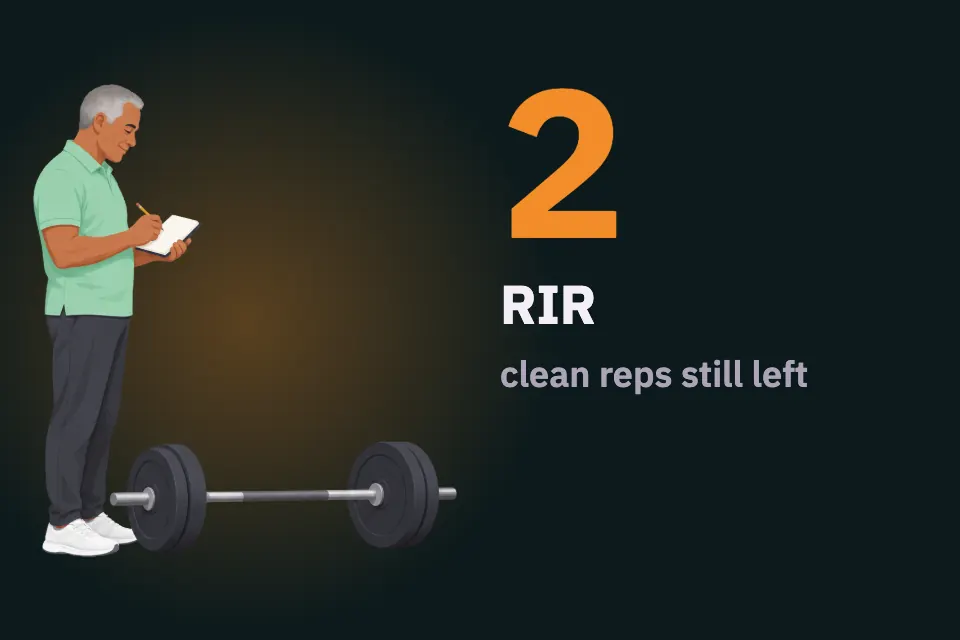
- Reps in reserve (RIR): your estimate of how many more good reps you could have done. 0 RIR is failure under your standard; 2 RIR means you stopped about two reps short.
Technical and momentary failure are not always the same event. If the next squat rep would need a much shorter range of motion, you can stop and honestly log 0 clean reps in reserve without having reached momentary failure. Write your standard in a note when it changes. Our RPE vs RIR guide explains how this number relates to RPE.
Is training to failure necessary for muscle growth?
Not according to the systematic reviews so far, though how close you get still seems to matter.
- A systematic review and meta-analysis by Refalo et al. (2023) found no clear hypertrophy advantage for momentary muscular failure over non-failure training. Across all definitions of failure there was only a trivial advantage, and the authors noted that studies defined failure inconsistently.
- A meta-analysis by Grgic et al. (2022) found no significant overall difference for hypertrophy or strength and concluded that failure “does not seem to be required”. In its subgroup of resistance-trained participants, failure showed a small advantage for hypertrophy, so the question is not fully closed for experienced lifters.
- A series of meta-regressions by Robinson et al. (2024) estimated RIR across studies and found muscle growth tended to increase as sets ended closer to failure, while strength gains were similar across a wide range of RIR. The authors call the analysis exploratory and say the exact relationship remains unclear.
- In an eight-week trial by Refalo et al. (2024), trained lifters did leg press and leg extension to failure with one leg and at about 1–2 RIR with the other. Quadriceps growth was similar, while the failure condition caused consistently more acute fatigue.
- The 2026 ACSM position stand, an overview of 137 systematic reviews, found that training to momentary muscle fatigue did not consistently change training outcomes.
None of these sources gives an exact best RIR for every person, lift or set.
Is training to failure better for strength?
The evidence suggests not. Robinson et al. found strength gains were similar across a wide range of RIR, and Grgic et al. found no significant overall difference. In Grgic et al.’s studies that did not equate total training volume, non-failure training actually came out ahead for strength. For strength work, practice with heavy, good-quality reps seems to matter more than reaching failure.
Does training to failure cause more fatigue?
Yes, and that is the main practical cost. In a bench press study by Refalo et al. (2023), lifting velocity four minutes after six sets dropped by about 25% when sets went to failure, versus about 13% at 1 RIR and 8% at 3 RIR. Some differences remained at 24 hours and had disappeared by 48 hours. Perceived discomfort and soreness also rose as sets got closer to failure. An earlier study by Morán-Navarro et al. (2017) found that failure sets slowed neuromuscular recovery for up to 24–48 hours compared with the same volume done short of failure.
Fatigue also depends on the exercise and load. A 2026 study by Cowley et al. found back squats caused more fatigue than prone rows, and moderate loads (65% of 1RM) more than heavy ones (85%), across the proximities to failure tested.
Worked example: failure on every set vs stopping at 2 RIR
These numbers are an invented example to show how fatigue can carry between sets. They are not study data or a recommendation.
| Set | Every set to failure | Every set at about 2 RIR |
|---|---|---|
| 1 | 60 kg × 12 @ 0 RIR | 60 kg × 10 @ 2 RIR |
| 2 | 60 kg × 9 @ 0 RIR | 60 kg × 10 @ 2 RIR |
| 3 | 60 kg × 7 @ 0 RIR | 60 kg × 9 @ 1–2 RIR |
| Total reps | 28 | 29 |
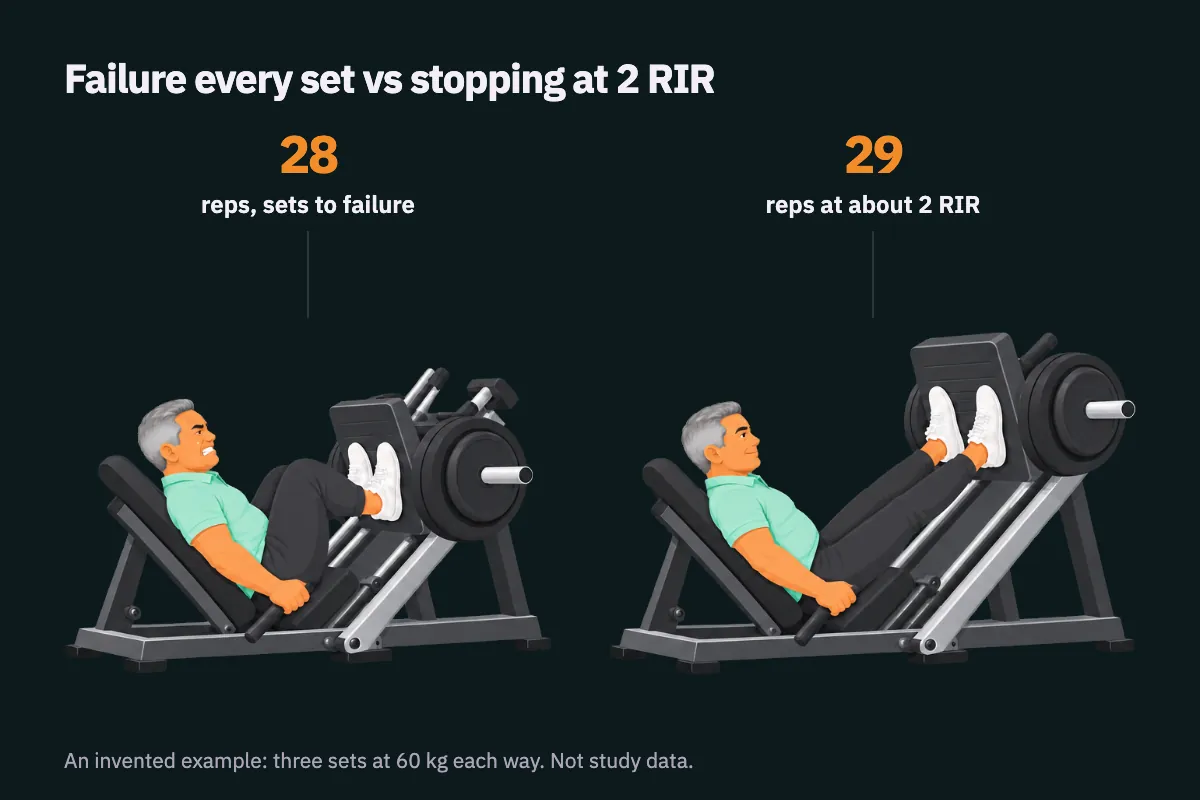
Failure sets lose reps fast, so total reps end up similar.
In this example, the failure sets lose reps quickly, so total reps end up similar. Refalo et al. (2024) reported a comparable pattern: high repetition loss with failure meant 1–2 RIR training accumulated similar volume over eight weeks. When you compare weeks, look at weekly sets per muscle and reps as well as effort.
How many reps in reserve should you leave?
No study gives a single answer, but a reasonable reading of the evidence is:
- For muscle growth, finish most working sets close to failure. In the Refalo et al. (2024) trial, sets at about 1–2 RIR produced growth similar to failure. Sets that routinely end with many reps left are probably too easy.
- For strength, you can stop further from failure on heavy sets without losing much, based on Robinson et al. and Grgic et al.
- Choose by exercise. Failure on a heavy barbell squat or bench press without safety arms or a spotter carries more risk, and Cowley et al. found squats more fatiguing than rows. Machine and isolation exercises are a safer place to take a set to failure, if you want to.
- Use failure occasionally, not constantly. A research note by Willardson (2007) suggested advanced lifters might use failure periodically, but warned against doing it repeatedly over long periods.
Common mistakes
- Relabelling a set to match the plan. If the plan said 2 RIR and you hit 0, log 0. An honest log is how you spot that the load is too heavy.
- Comparing studies or advice without checking the failure definition. “To failure” may mean momentary failure, technical failure or something else entirely.
- Assuming you are at 2 RIR when you are at 5. Estimates tend to be less accurate further from failure, so check your guesses on a safe exercise now and then.
- Pushing through pain. RIR describes fatigue, not injury. Stop the set if something hurts and seek appropriate professional advice for persistent symptoms.
- Judging progress by the session after a hard one. Failure work can leave you weaker for a day or two, so one flat workout is not a plateau. Audit your log first, and if fatigue keeps building, a planned deload week may be the better fix.
Logging your actual stopping point
These are illustrative entries, not a training recommendation:
| Planned set | Actual set | Useful note |
|---|---|---|
| 10 reps @ 2 RIR | 10 reps @ about 2 RIR | Technique stayed consistent. |
| 10 reps @ 2 RIR | 10 reps @ 0 clean RIR | It was harder than planned; do not relabel it as 2 RIR. |
| 10 reps @ 2 RIR | Stopped at 7 because of pain | Do not use RIR to justify continuing; seek appropriate professional advice for persistent symptoms. |
Our RIR logging guide explains how to make the estimate. FitArchive records the RIR you actually report for each set, not just what the plan intended.