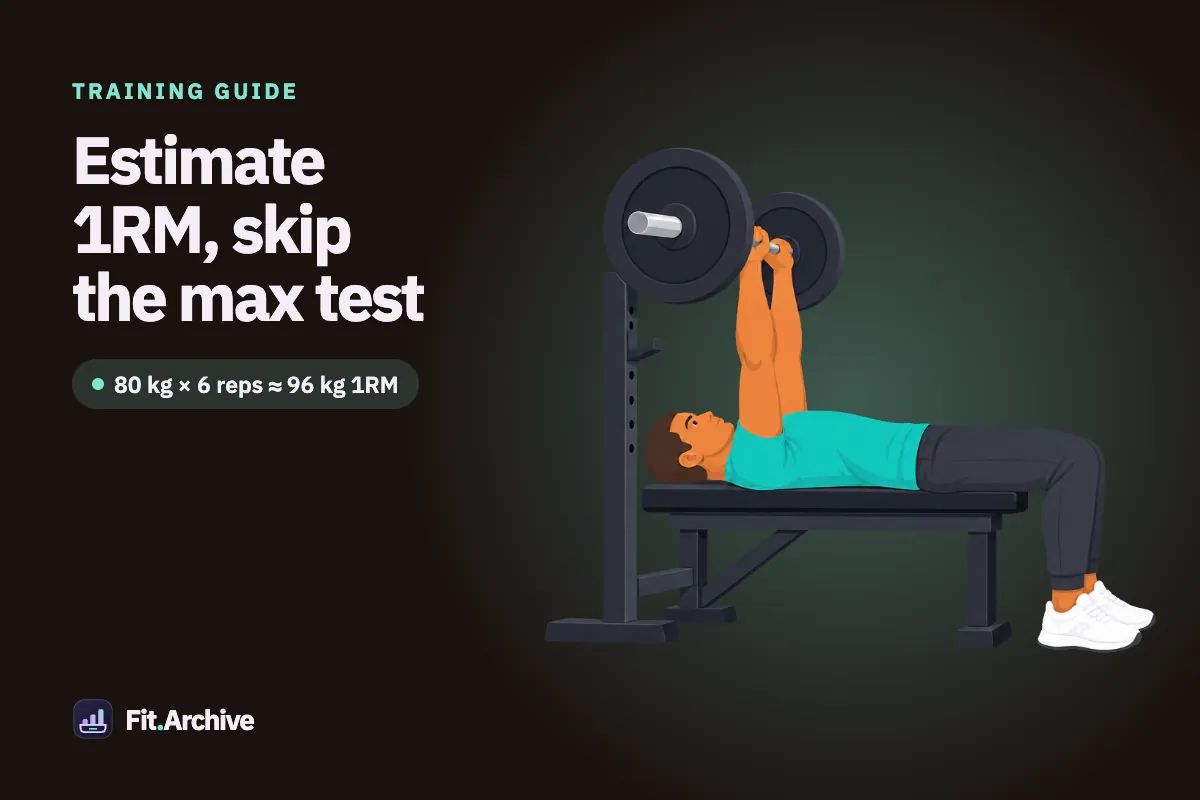
Your one-rep max (1RM) is the most weight you can lift for one full repetition with good form. You do not have to test it: you can estimate it from a set of about 10 reps or fewer. The Epley formula is 1RM = weight × (1 + reps / 30) and the Brzycki formula is 1RM = weight × 36 / (37 − reps). For 80 kg × 6 reps, they estimate 96 kg and about 93 kg. Both are estimates, and they get less reliable as reps climb.
This guide explains what 1RM means, works through both formulas, gives a percentage chart for 1 to 12 reps, and shows how to use reps in reserve and estimated 1RM to track progress without max testing.
What does 1RM mean?
1RM is specific to one exercise, done one way. Your squat 1RM depends on depth, bar position and equipment, and it changes with sleep, fatigue and practice. A 1RM from a smith machine or a leg press does not transfer to a free-weight squat.
Lifters and programs use it as a reference point. Loads are often written as a percentage of 1RM, such as 3 sets at 80%. The 2026 ACSM position stand, an overview of 137 systematic reviews, found voluntary strength was enhanced by lifting heavier loads (80% of 1RM or more), so knowing roughly where 80% sits is useful even if you never test a max.
One rep max formulas: Epley and Brzycki
Both formulas take the weight (w) and the number of reps (r) you completed in a set taken to, or very near, failure:
- Epley: 1RM = w × (1 + r / 30)
- Brzycki: 1RM = w × 36 / (37 − r)
They are named after the strength coaches who published them. A few properties worth knowing:
- They agree at 10 reps. Both say 10 reps is 75% of 1RM, so they give the same estimate there.
- Below 10 reps, Epley gives the higher estimate; above 10 reps, Brzycki does, and the gap widens quickly.
- At 1 rep, Epley returns 103% of the weight lifted, a quirk of the formula. Brzycki returns the weight itself. Many calculators simply show the lifted weight for a single.
Other published equations exist and give different numbers again. Studies comparing several equations, such as a study of 103 young women tested before and after 12 weeks of training, found the equations were more accurate when the set had fewer than 10 reps.
Worked example: 80 kg for 6 reps
- Epley: 80 × (1 + 6 / 30) = 80 × 1.2 = 96.0 kg
- Brzycki: 80 × 36 / (37 − 6) = 80 × 36 / 31 = 92.9 kg
The two estimates differ by about 3 kg. Here is how the gap changes for the same 80 kg at other rep counts (example calculations):
| Set | Epley estimate | Brzycki estimate |
|---|---|---|
| 80 kg × 3 | 88.0 kg | 84.7 kg |
| 80 kg × 6 | 96.0 kg | 92.9 kg |
| 80 kg × 10 | 106.7 kg | 106.7 kg |
| 80 kg × 15 | 120.0 kg | 130.9 kg |
At 15 reps the formulas disagree by almost 11 kg. Neither is “right”; the point is that high-rep sets carry more uncertainty. Choose one formula and keep it.
1RM percentage chart (1 to 12 reps)
These percentages come from the formulas themselves: Epley % = 1 / (1 + reps / 30) and Brzycki % = (37 − reps) / 36. They are estimates of an average, not your personal numbers.
| Reps to failure | Epley (% of 1RM) | Brzycki (% of 1RM) |
|---|---|---|
| 1 | 96.8% | 100% |
| 2 | 93.8% | 97.2% |
| 3 | 90.9% | 94.4% |
| 4 | 88.2% | 91.7% |
| 5 | 85.7% | 88.9% |
| 6 | 83.3% | 86.1% |
| 7 | 81.1% | 83.3% |
| 8 | 78.9% | 80.6% |
| 9 | 76.9% | 77.8% |
| 10 | 75.0% | 75.0% |
| 11 | 73.2% | 72.2% |
| 12 | 71.4% | 69.4% |
To read it: by these formulas, 80% of 1RM is roughly what you could lift for 7 to 8 reps to failure. If your estimated 1RM is 100 kg, the percentages are the loads in kilograms.
Real people vary around these lines:
- A 2024 meta-regression of 952 reps-to-failure tests from 269 studies (7,289 people) found more reps in the leg press than the bench press at the same percentage, so it built separate tables for those two lifts. Sex, age and training status had little influence.
- In a study of trained and untrained men, more reps were done in the back squat than in the bench press or arm curl at 60% of 1RM.
- In a small study of leg press, endurance runners did far more reps than weightlifters at 70% of 1RM (about 40 vs 18), but not significantly more at 90%.
So one chart cannot be exact for every exercise or every lifter.
Why are 1RM estimates worse at high reps?
As sets get longer, the number of reps depends more on muscular endurance, breathing, pacing and tolerance for discomfort, which vary between people and exercises. In a study of 70 adults who tested 1, 5, 10 and 20 rep maxes on the bench press and leg press, load fell non-linearly as reps rose, the 5-rep max predicted 1RM best, and the authors advised using no more than 10 reps in linear equations. That matches the women’s study above. For estimating 1RM, sets of roughly 3 to 10 hard reps are the most useful.
Using reps in reserve to estimate 1RM
Most sets do not go to failure. If you log reps in reserve (RIR), you can add the reps you had left to the reps you did, and apply the formula to that total. This is the method FitArchive uses:
Estimated 1RM = kg × (1 + (reps + RIR) / 30), calculated only when reps + RIR is 15 or less.
Example: 80 kg × 6 at 2 RIR means about 8 reps were possible. 80 × (1 + 8 / 30) = 101.3 kg. Using plain Epley on the 6 reps would give 96 kg and underestimate a set you stopped short on purpose.
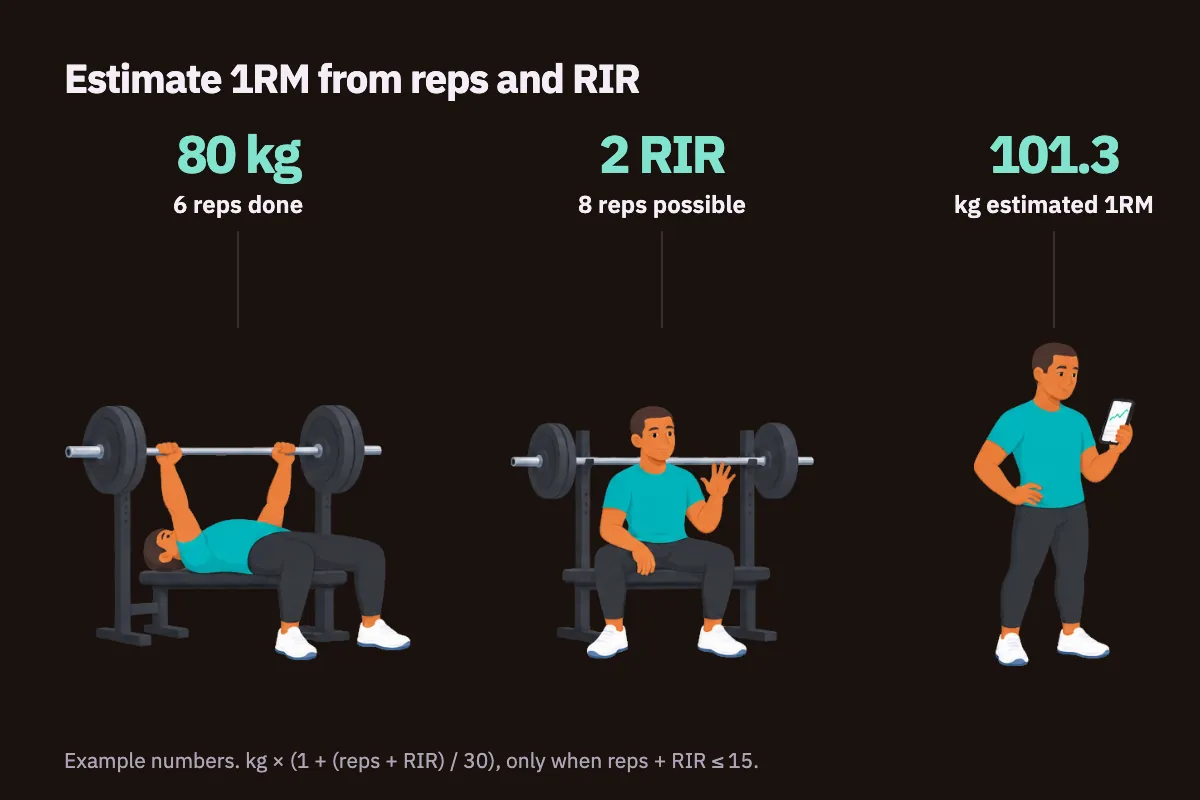
Adding RIR to the reps done gives a fairer estimate than plain Epley.
RIR is itself an estimate. A 2022 meta-analysis found lifters underpredicted their reps left by about one rep on average (so RIR-based estimates may run a little low), with predictions more accurate closer to failure and in sets of 12 or fewer reps. With Epley, each rep of error moves the estimate by the weight divided by 30, so about 2.7 kg at 80 kg. If you are unsure whether RIR or RPE suits you, see RPE vs RIR.
1RM calculator for bench press and squat
The same formulas are used for every lift, but the studies above show lower-body exercises such as the squat and leg press usually allow more reps at the same percentage than the bench press. A long squat or leg press set may therefore overestimate your 1RM more than a bench set of the same length would. Basing squat estimates on lower-rep sets, about 3 to 8 reps, is a reasonable precaution.
Two example calculations with the RIR method:
- Bench press 60 kg × 8 at 1 RIR: 9 possible reps, so 60 × (1 + 9 / 30) = 78.0 kg.
- Squat 100 kg × 5 at 2 RIR: 7 possible reps, so 100 × (1 + 7 / 30) = 123.3 kg.
Should you test your true 1RM?
A max test can make sense if you compete in powerlifting, follow a program written in percentages and want an accurate starting point, or have a sport that tests it. It is less useful, and riskier, if you are still learning the lift, are in pain, train alone without safety bars or a spotter, or are already fatigued.
If you do test:
- Warm up gradually with fewer reps as the weight rises.
- Use safety pins, a rack or a spotter, and know how to bail.
- Stop when technique breaks down; a rep with a different movement is not a 1RM.
- Do not test often. Each attempt is fatiguing and leaves no margin for error.
This is general information, not medical advice. If a lift causes pain, stop and get qualified advice.
Track estimated 1RM instead of testing
For most lifters, an estimated 1RM from normal training is enough to see progress. To keep it meaningful:
- Compare the same exercise, done the same way.
- Use similar rep ranges over time; an estimate from 3 reps and one from 12 reps are not equally reliable.
- Keep one formula.
- Look at the trend across several sessions, not one day.
If the trend flattens for weeks, the plateau audit and the progressive overload guide show what to check. Your weekly sets also matter; the training split guide covers how to fit them into your week.
Common mistakes
- Using sets of 15 or more reps. The estimate becomes guesswork.
- Switching formulas. Epley and Brzycki can differ by several kilograms from the same set.
- Comparing across exercises. A leg press estimate says nothing about your squat.
- Loading the estimate as if it were a tested max. It is an approximation of an average.
- Counting sets with plenty left in the tank without RIR. Plain formulas assume failure, so they underestimate.
Estimated 1RM in FitArchive
FitArchive shows an estimated 1RM per exercise on the Progress screen. It applies Epley to the reps that were possible, kg × (1 + (reps + RIR) / 30), and gives no estimate when reps + RIR is above 15. Log each set’s weight, reps and RIR and the trend builds as you train. You can see it with sample data in the demo.