Push/pull/legs (PPL) and the Arnold split are both six-day splits that train each muscle twice a week. PPL groups muscles by movement: chest, shoulders and triceps on push day, back and biceps on pull day, then legs. The Arnold split pairs chest with back, shoulders with arms, then legs. When weekly sets per muscle are similar, research suggests the arrangement matters far less than the total work and your recovery, so choose the one whose sessions you can do well for months. A 3-day PPL is a different program: each muscle gets direct work only once a week.
Both splits are popular on social media, often with strong claims that one is “superior”. This guide compares them on frequency, session length, weekly sets per muscle and recovery, with labelled example programs. For the bigger picture, including full body and upper/lower, see push/pull/legs vs upper/lower vs full body.
What is a push pull legs split?
PPL sorts exercises by movement pattern:
- Push: pressing movements and the muscles they use: chest, shoulders (mainly front and side delts) and triceps.
- Pull: rows, pulldowns and curls: lats, upper back, rear delts and biceps.
- Legs: squats, hinges, leg curls and calf raises: quads, hamstrings, glutes and calves.
Run twice through in six days (PPL 6 days a week), each muscle gets direct work twice. Run once in three days (PPL 3 day), each muscle gets direct work once a week, which makes it closer to a bro split in frequency; our bro split vs PPL guide covers that trade-off.
What is the Arnold split?
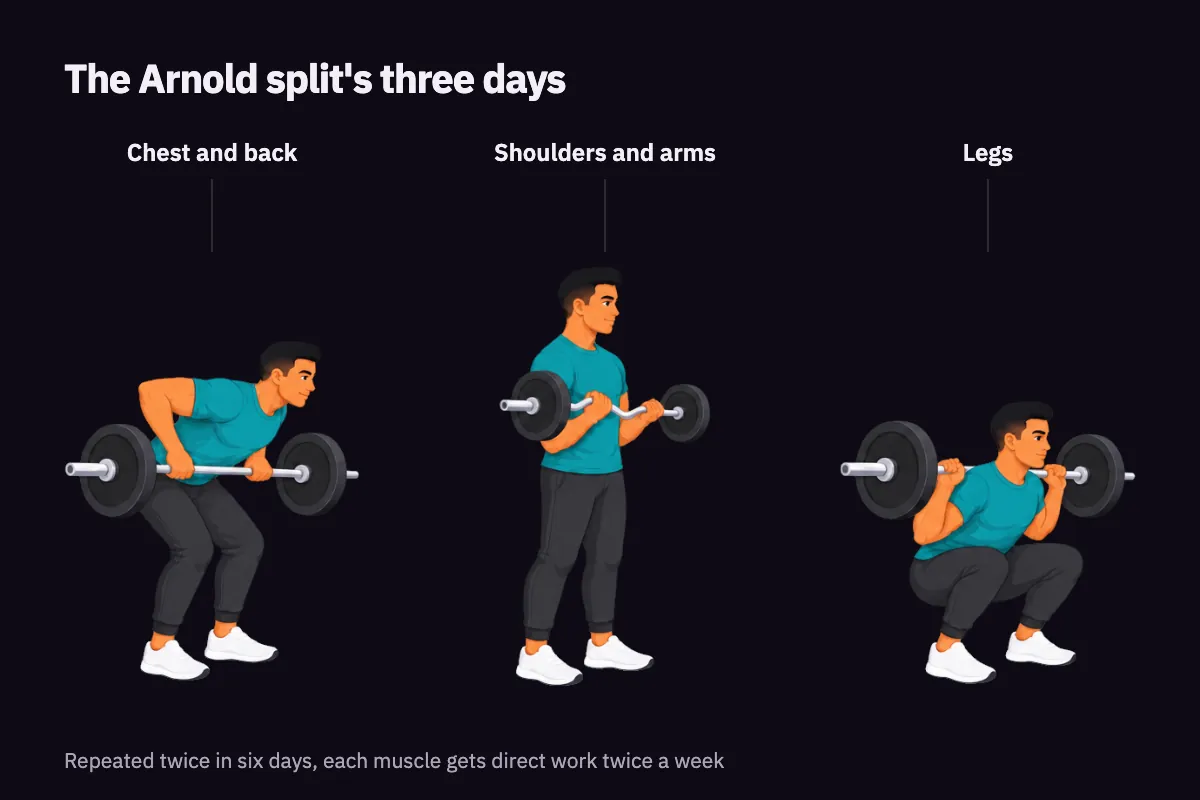
The Arnold split is named after Arnold Schwarzenegger, whose bodybuilding-era routines paired opposing muscle groups. The common modern version:
- Chest and back: pressing and pulling in the same session, often alternated or supersetted.
- Shoulders and arms: overhead presses, raises, curls and triceps work.
- Legs.
Repeated twice in six days, each muscle gets direct work twice a week, just like PPL. Versions online vary a lot, and some carry very high volume; the example below uses normal set counts.
PPL vs Arnold split: an example week
| Day | PPL (6 days) | Arnold split (6 days) |
|---|---|---|
| Mon | Push A | Chest and back A |
| Tue | Pull A | Shoulders and arms A |
| Wed | Legs A | Legs A |
| Thu | Push B | Chest and back B |
| Fri | Pull B | Shoulders and arms B |
| Sat | Legs B | Legs B |
| Sun | Rest | Rest |
Same six-day rhythm as PPL; only the muscle pairings change.
The structure is the same; what changes is which muscles share a day, and so which muscles work two days in a row.
Frequency, session length and recovery compared
| PPL (6 days) | Arnold split (6 days) | PPL (3 days) | |
|---|---|---|---|
| Direct work per muscle per week | 2 | 2 | 1 |
| Muscles trained as main target per session | 3 small to medium groups | 2 large groups, or 3 small ones | Same as PPL 6 |
| Where helper muscles overlap | Push then pull: triceps and front delts rest on pull day | Chest and back day uses front delts, triceps and biceps; next day trains them directly | Same as PPL 6 |
| Session feel | Even, moderate sessions | Chest and back days are demanding; shoulders and arms days use smaller muscles and lighter loads | Longer sessions needed to reach the same weekly sets |
| Time saver | Supersets possible, less natural | Chest and back pair well as supersets | Supersets help fit the extra sets |
That overlap row is the main practical difference. On an Arnold split, your triceps, front delts and biceps work as helpers on chest and back day and then become the main target the next day. Some lifters like the extra arm work; others find their shoulder and arm day suffers. PPL spaces those helpers more evenly.
Session length mostly depends on how many sets you do, not the split’s name. A 2025 meta-analysis of 19 studies found supersets, pairing two exercises with little rest, kept total reps and load similar while shortening sessions, with similar long-term strength and growth. Pairing a press with a row on Arnold chest and back days is a natural fit. Our workout length guide covers the time side in more detail.
Weekly sets per muscle: example weeks compared
The PPL column is FitArchive’s Push/Pull/Legs 6 days template. The Arnold column is an example program written for this article (shown further down) with a similar total. Sets are counted with FitArchive’s rule: warm-ups excluded, 1 set for the main muscle, 0.5 for helper muscles. These are example totals, not targets.
| Muscle | PPL template (6 days) | Arnold example (6 days) | PPL run once (3 days, A days only) |
|---|---|---|---|
| Chest | 12 | 15 | 5 |
| Lats | 14.5 | 14.5 | 8 |
| Upper back | 16 | 13.5 | 8 |
| Side delts | 9 | 9 | 4.5 |
| Rear delts | 11 | 8.5 | 5.5 |
| Biceps | 18 | 17 | 9 |
| Triceps | 17 | 17.5 | 9 |
| Quads | 13 | 11 | 5 |
| Hamstrings | 10.5 | 10.5 | 6 |
| Calves | 8 | 8 | 4 |
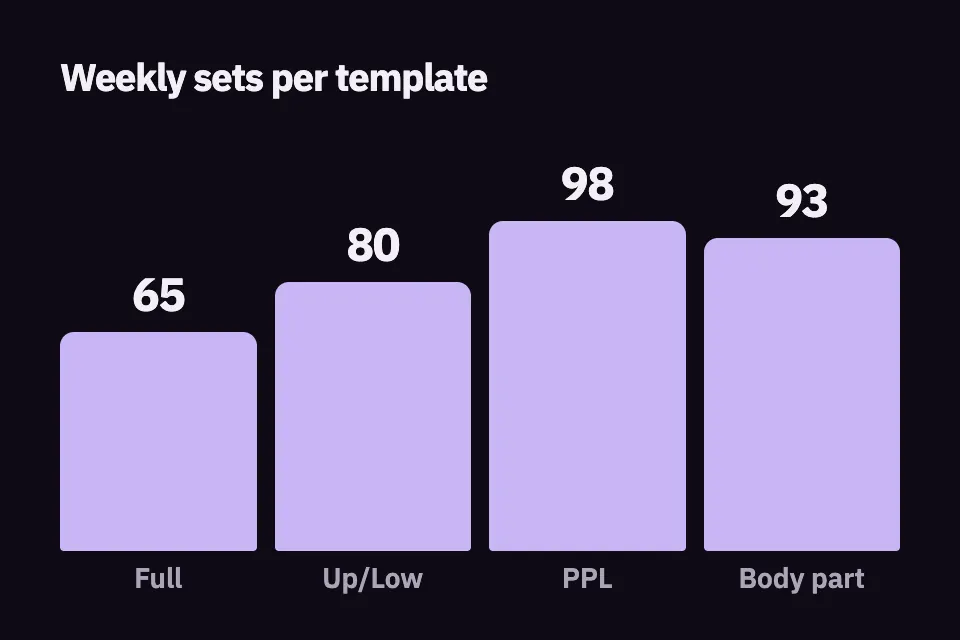
| Total working sets per week | 98 | 96 | 47 |
Two lessons. First, two well-built six-day programs land close together; the split name does not decide the numbers, your exercise choices do. Second, running the same sessions only once a week halves every total. A PPL 3 day plan needs roughly twice the sets per session to match, which means long sessions.
Does the arrangement matter? What research says
No study has compared PPL with the Arnold split directly, so the evidence is indirect:
- A 2019 meta-analysis of 25 studies found no significant difference in muscle growth between training frequencies when weekly volume was equated.
- A 2024 meta-analysis of 14 studies found split and full-body routines produced similar strength and growth with volume equated.
- A 2019 trial in 27 trained men found 3 and 6 sessions a week gave similar strength and muscle thickness over 6 weeks when weekly volume was the same.
- A 2026 meta-regression of 67 studies found growth rose with weekly sets, with diminishing returns, while frequency had little identifiable effect on growth once volume was counted. Strength did increase with frequency.
Together these point one way: weekly hard sets, effort and consistency matter more than how muscles are grouped. The studies are mostly short and in young men, so small differences between real-world programs cannot be ruled out. The frequency guide has more on how often to train each muscle.
Who each split suits
- PPL 6 days: people who can train six days most weeks, like even sessions and want shoulder and arm helpers spread out.
- Arnold split: people who enjoy chest and back together, like supersets, and want a dedicated arm and shoulder day twice a week.
- PPL 3 days: people with only three days who still like the PPL layout, accepting once-a-week frequency or longer sessions. A full-body routine or upper/lower usually fits fewer days better.
Six training days leave one rest day. If sleep, work or another sport already takes a lot out of you, a split with more rest days may be the better choice.
Example programs
FitArchive Push/Pull/Legs 6 days template. The full exercise list is in the split comparison guide, so here is the outline. Push days open with barbell bench press (A) or overhead press (B), pull days with pull-ups (A) or lat pulldowns (B), and leg days with back squats (A) or hack squats (B). Each session has 15 to 18 working sets, compound lifts at about 2 reps in reserve (RIR) and isolation exercises at about 1 RIR.
Example Arnold split (not a FitArchive template; sets x reps, compounds at about 2 RIR, isolation at about 1 RIR):
| Day | Exercises |
|---|---|
| Chest and back A | Barbell bench press 3 x 6-10, pull-up 3 x 6-10, incline dumbbell press 3 x 8-12, barbell row 3 x 8-12, cable fly 2 x 12-15, lat pulldown 2 x 8-12 |
| Shoulders and arms A | Overhead press 3 x 6-10, dumbbell lateral raise 3 x 12-20, reverse pec deck 2 x 12-20, EZ-bar curl 3 x 8-12, EZ-bar skull crusher 3 x 8-12, hammer curl 2 x 10-15, triceps pushdown 2 x 10-15 |
| Legs A | Back squat 3 x 6-10, Romanian deadlift 3 x 8-12, leg press 2 x 10-15, lying leg curl 3 x 10-15, standing calf raise 4 x 10-15 |
| Chest and back B | Incline barbell bench press 3 x 8-12, chest-supported row 3 x 8-12, machine chest press 2 x 8-12, seated cable row 3 x 8-12, chest dip 2 x 8-12, straight-arm pulldown 2 x 12-15 |
| Shoulders and arms B | Seated dumbbell shoulder press 3 x 8-12, cable lateral raise 3 x 12-20, face pull 2 x 12-20, incline dumbbell curl 3 x 10-15, overhead cable triceps extension 3 x 10-15, cable curl 2 x 10-15 |
| Legs B | Hack squat 3 x 8-12, hip thrust 3 x 8-12, leg extension 3 x 10-15, seated leg curl 3 x 10-15, seated calf raise 4 x 12-20 |
On chest and back days you can pair the press and the row as a superset to save time. Progress each exercise within its rep range with double progression: add reps first, then weight.
Common mistakes
- Picking a six-day plan for a four-day life. Missed days on either split leave muscles with one session that week.
- Running PPL 3 days with six-day session sizes. You end up at about half the weekly sets you think you are doing.
- Ignoring helper overlap on an Arnold split. If your pressing on shoulder day keeps dropping, the chest day before may be the reason.
- Copying high-volume routines wholesale. Classic bodybuilding programs vary widely and were not designed around your recovery.
- Switching splits to fix a plateau. Check sleep, effort and food first with a plateau audit.
Running PPL or an Arnold split in FitArchive
FitArchive includes the Push/Pull/Legs 6 days template above. There is no Arnold split template, but you can build your own plan with the example exercises or edit the PPL one. Log each set’s weight, reps and RIR; the Progress screen shows weekly hard sets by muscle (1 for the primary muscle, 0.5 for secondary, working sets at 0 to 4 RIR) and training days per muscle per week, so you can see what your split really delivers. Try it with sample data in the demo.