FBEOD means full body every other day: you train your whole body, rest one day, and repeat. Sessions fall on Monday, Wednesday, Friday and Sunday one week and Tuesday, Thursday and Saturday the next, which averages 3.5 sessions a week, usually alternating two workouts called A and B. Because each muscle comes back so often, each exercise gets just 1 hard set, 2 at most. Studies comparing full-body and split routines find similar gains when weekly volume is matched, so FBEOD is a scheduling choice. It suits people who like a steady one-on, one-off rhythm and do not need training tied to the same weekdays.
FBEOD gets recommended a lot in online lifting communities as the simple answer to “which split should I run”. This guide explains how the rotation works, how it differs from a fixed 3-day full-body plan, explains why more frequency means fewer sets per session, gives an example A/B program, and checks what the research actually supports.
What is FBEOD?
FBEOD is short for “full body every other day”. The rules fit in four lines:
- Every session trains the whole body: presses, rows and pulldowns, a squat or leg press, a hip hinge, plus shoulders, arms, calves and abs.
- Each exercise gets 1 hard working set, 2 at most.
- There is always exactly one rest day between sessions.
- You alternate two workouts (A, B, A, B), or sometimes three.
Because a week has seven days, the training days move. Here is an example two-week calendar that starts on a Monday:
| Week | Mon | Tue | Wed | Thu | Fri | Sat | Sun |
|---|---|---|---|---|---|---|---|
| 1 | A | Rest | B | Rest | A | Rest | B |
| 2 | Rest | A | Rest | B | Rest | A | Rest |
Week 3 starts with B on Monday, and the pattern carries on. That is 7 sessions every 14 days, or 3.5 a week, and each muscle is trained directly about 3.5 times a week.
FBEOD vs a 3-day full body routine
| FBEOD | Fixed 3-day full body (example Mon, Wed, Fri) | |
|---|---|---|
| Sessions per two weeks | 7 | 6 |
| Average sessions per week | 3.5 | 3 |
| Rest between sessions | Always 1 day | 1 day, then 2 days over the weekend |
| Training weekdays | Shift every week | Fixed |
| Weekends | One weekend day each week has a session | Usually free |
The difference is smaller than it looks: one extra session every two weeks, about 17% more. With the same workouts, that also means about 17% more weekly sets. If someone gets better results on FBEOD than on a 3-day plan, that extra volume is the likely reason, not the rhythm itself. In exchange, you give up fixed training days.
Train more often, do less each session
The more often you train a muscle, the fewer sets each session should give it. Ten sets for a muscle is a big block in one weekly workout, but spread over 3.5 sessions it is about 3 sets each time. Copying the 3 to 4 sets per exercise from a body-part split into FBEOD turns every workout into a 40-set marathon, and the same muscles are back again two days later.
So the rule for this program is simple:
- 1 hard set per exercise. Use 2 sets only for a priority muscle or your main lift.
- Make that set count. After warm-ups, stop about 1 to 2 reps short of failure on heavy compound lifts and 0 to 1 short on machines and isolation exercises.
- Add variety with exercises, not sets. A second angle for the chest teaches more than a third set of the same press.
This is a practical way to program high frequency, not a proven optimum. The studies further down compare weekly volume and frequency; none of them tested this exact 1-set structure.
Why many lifters like training this often
There is no strong evidence that training a muscle 3 to 3.5 times a week beats twice a week when weekly sets are equal. The case for FBEOD is practical, and some of it is still a reasonable guess:
- A missed session costs little. Miss one workout and each muscle has still been trained 2 to 2.5 times that week.
- More first sets. Your first set for a muscle in a session is the one you do freshest. At 3.5 sessions a week, each muscle gets 3 to 4 first sets a week instead of 1 or 2. Growth has diminishing returns as sets pile up, which is why a fresh set may be worth more than an eighth set in a row. That is a logical argument, not a tested result.
- Less fatigue from each session. Spreading the work means no single muscle takes a long beating, so sets can stay hard from the first exercise to the last.
- 3 to 4 rest days every week. At 3.5 sessions a week, you also get 3.5 rest days, and never two training days in a row.
- Muscle protein synthesis, maybe. In the small study covered below, it rose after a hard workout and was near baseline by about 36 hours. Training every other day could keep it raised on more days, but nobody has shown this produces more growth over time.
Some posts online say 1 set done 3 times a week is far better than 3 sets done once. The research does not go that far: trials at equal weekly volume usually find similar gains, as shown below.
Cover every movement
A simple way to build a full-body session is to list the movements each muscle performs, then pick one exercise for each.
| Area | Movement | Example exercises |
|---|---|---|
| Chest | Horizontal adduction | Pec deck or chest press |
| Chest | Shoulder flexion | Incline fly or press |
| Back | Shoulder adduction | Lat pulldown or pull-up |
| Back | Shoulder extension | Close-grip row or close-grip pulldown |
| Back | Scapular retraction | Upper back row |
| Arms | Elbow flexion | Preacher or machine curl |
| Arms | Elbow extension | Triceps extension, overhead extension |
| Shoulders | Shoulder flexion | Shoulder press |
| Shoulders | Shoulder abduction | Lateral raise |
| Legs | Plantar flexion | Calf raise or calf press |
| Legs | Knee extension | Leg extension |
| Legs | Knee flexion | Seated leg curl |
| Legs | Hip adduction | Adductor machine |
| Legs | Squat pattern | Squat or leg press |
| Legs | Hip hinge | Romanian or stiff-leg deadlift |
| Legs | Hip extension | Hip thrust |
One set of each, with both triceps exercises, is 17 sets. You can repeat that one workout every session, which makes progress on each exercise easiest to see. Or split the list across workouts A and B, as in the example below, for shorter sessions and more variety. Each exercise then comes back less often, so progress on any one exercise is slower to show.
Example FBEOD program (A/B)
This is an example program, not a prescription. Workout A leans toward chest and back, workout B toward legs. Each exercise has a rep range for double progression and a target RIR (reps in reserve: the reps you could still have done). Use a machine or free-weight version, whichever you can load safely close to failure.
Workout A: chest and back focus
| Exercise | Sets × reps | Target RIR |
|---|---|---|
| Chest press | 1 × 8-12 | 1 |
| Upper back row (elbows wide) | 1 × 8-12 | 1 |
| Incline press or fly | 1 × 8-12 | 1 |
| Lat pulldown | 1 × 8-12 | 1 |
| Lat row (elbows close) | 1 × 8-12 | 1 |
| Reverse pec deck | 1 × 12-15 | 1 |
| Shoulder press | 1 × 8-12 | 1 |
| Leg extension | 1 × 10-15 | 1 |
| Romanian deadlift | 1 × 8-12 | 2 |
| Biceps curl | 1 × 10-15 | 1 |
| Triceps extension | 1 × 10-15 | 1 |
| Calf raise | 1 × 10-15 | 1 |
| Abs (cable or machine crunch) | 1 × 10-15 | 1 |
Workout B: leg focus
| Exercise | Sets × reps | Target RIR |
|---|---|---|
| Squat or leg press | 2 × 6-10 | 2 |
| Leg curl | 2 × 10-15 | 1 |
| Leg extension | 1 × 10-15 | 1 |
| Adductor machine | 1 × 10-15 | 1 |
| Hip thrust | 1 × 8-12 | 1 |
| Chest press | 1 × 8-12 | 1 |
| Upper back row (elbows wide) | 1 × 8-12 | 1 |
| Lat pulldown | 1 × 8-12 | 1 |
| Lateral raise | 1 × 12-20 | 1 |
| Biceps curl | 1 × 10-15 | 1 |
| Triceps extension | 1 × 10-15 | 1 |
| Calf raise | 1 × 10-15 | 1 |
| Abs (cable or machine crunch) | 1 × 10-15 | 1 |
That is 13 working sets in A and 15 in B. Warm up before the first press, row and squat, then rest as long as you need to make the next set hard. Expect a session of roughly 35 to 45 minutes.
How the direct sets add up (example totals, counting exercises where the muscle is the main target). At 3.5 sessions a week you do 1.75 A and B pairs a week:
| Muscle | Sets per A + B pair | Average per week |
|---|---|---|
| Chest | 3 | About 5 |
| Back (rows and pulldowns) | 5 | About 9 |
| Quads | 4 | 7 |
| Hamstrings | 3 | About 5 |
| Shoulders (press and lateral raise) | 2 | 3.5 |
| Rear delts | 1 | About 2 |
| Biceps and triceps | 2 each | 3.5 each, plus pulling and pressing |
| Calves and abs | 2 each | 3.5 each |
| Glutes and adductors | 1 each | About 2 each, plus squats and hinges |
Several muscles sit under the 10 weekly direct sets many guides use as a target, and that is the tradeoff for short, hard sessions. If a muscle is a priority or stops progressing, give one of its exercises a second set first. If it needs more after that, add a different exercise rather than a third set.
Full body vs split: what the research says
- A 2024 meta-analysis by Ramos-Campo and colleagues pooled 14 studies with 392 participants. With volume equated, split and full-body routines produced similar gains in bench press strength, lower-body strength and muscle size. The authors concluded that people can choose by preference.
- In a 2015 trial in 20 well-trained men, a total-body routine three times a week (one exercise per muscle per session) produced a larger increase in forearm flexor muscle thickness than a split that trained each muscle once a week. Strength gains did not differ. PubMed lists no retraction for this paper.
- In a 2021 trial in 21 trained men over 10 weeks, each routine won on one measure: total body on a fast isokinetic bench press test, the split on thigh muscle thickness. The other measures were similar.
- A 2019 trial in 27 trained men found that training 3 or 6 times a week at equal weekly volume gave similar strength and muscle gains over 6 weeks.
No routine wins consistently. These studies were small, short (6 to 10 weeks) and mostly in young men, and none tested FBEOD’s rotating calendar itself. The broader frequency evidence is covered in how often to train each muscle.
Is one rest day enough to recover?
Often yes at moderate volume, though nobody can promise it for you. In a small 1995 study, muscle protein synthesis after a hard arm workout was more than double at 24 hours and nearly back to baseline by about 36 hours. That is one short-term measure in six young men, so it does not prove 48 hours is the right gap, but it is not at odds with training every other day.
FBEOD helps recovery in one practical way: each session gives a muscle only a few hard sets (1 or 2 for the chest in the example), rather than 10 or more in one go. Keep the heavy compound lifts at about 1 to 3 RIR instead of grinding them to failure every session, and watch for your main lifts slipping across several sessions rather than one. Soreness alone is a poor guide; the muscle soreness guide explains why.
Is training full body every day a good idea?
It can work, but it is not better. In the trial above, 6 sessions a week matched 3 at the same weekly volume. Training full body daily means either very short sessions or a large jump in weekly volume with no rest days. For most people, every other day gives the same frequency benefits with more room to recover. The rest days guide covers daily training in more depth.
Pros and cons of FBEOD
Pros
- You practise the main lifts about 3.5 times a week, which suits strength goals.
- A missed session costs little: everything gets trained again within two days.
- The one-on, one-off rhythm is easy to remember and always leaves a rest day.
- Each session is varied, with only a few sets per muscle.
Cons
- Training days move every week, and one weekend day each week has a session.
- Every session includes legs, which some people find draining.
- Each session has 13 to 15 exercises, which is awkward in a crowded gym.
- It is harder to fit around a sport or class on fixed weekdays.
FBEOD vs upper/lower: who it suits
FBEOD suits people with flexible or shifting schedules, such as shift workers and students, beginners who benefit from practising lifts often, and anyone who prefers a rest day after every session. An upper/lower split suits people who want fixed weekdays, four sessions a week, and fewer exercises in each session. Both train each muscle at least twice a week. An anterior/posterior split is the 4-day alternative that divides the body front and back. The split comparison covers full body, upper/lower and push/pull/legs side by side.
How to log an every-other-day rotation
The key is to track your program by sequence, not by weekday. “Monday is A” stops working after one week. What matters is which workout comes next and how this A compares with your last A.
- Compare A with A and B with B. Your chest press numbers from workout A are the ones to beat next time you do A. With one set per exercise, there is only one number to beat.
- Write a note when the rhythm breaks. If you train two days in a row or take two rest days, a short note explains a good or bad session later.
- Record RIR for each working set. It shows whether a weight that felt fine at 2 RIR is getting closer to failure across sessions.
Common mistakes
- Going to failure on squats and deadlifts every session. With only a day between sessions, keep a few reps in reserve on the heaviest lifts.
- Adding sessions without checking volume. Moving a 3-day plan to FBEOD adds about 17% more weekly sets. Usually that is fine; check your weekly sets per muscle anyway.
- Forcing fixed weekdays. Doing A every Monday breaks the every-other-day spacing and creates back-to-back days.
- Comparing different workouts. Workout B’s numbers say nothing about workout A’s progress.
- Copying 3 to 4 sets per exercise from a split. At this frequency that adds up fast. Start at 1 set per exercise and add a second only where you need it.
- Treating 1 set as a warm-up. A low-volume session only works if the set is hard. Log the RIR and check that you are really close to failure.
- Stacking exercises until sessions run long. If a session drags past what you can keep up, cut an exercise rather than rushing rests.
Running FBEOD in FitArchive
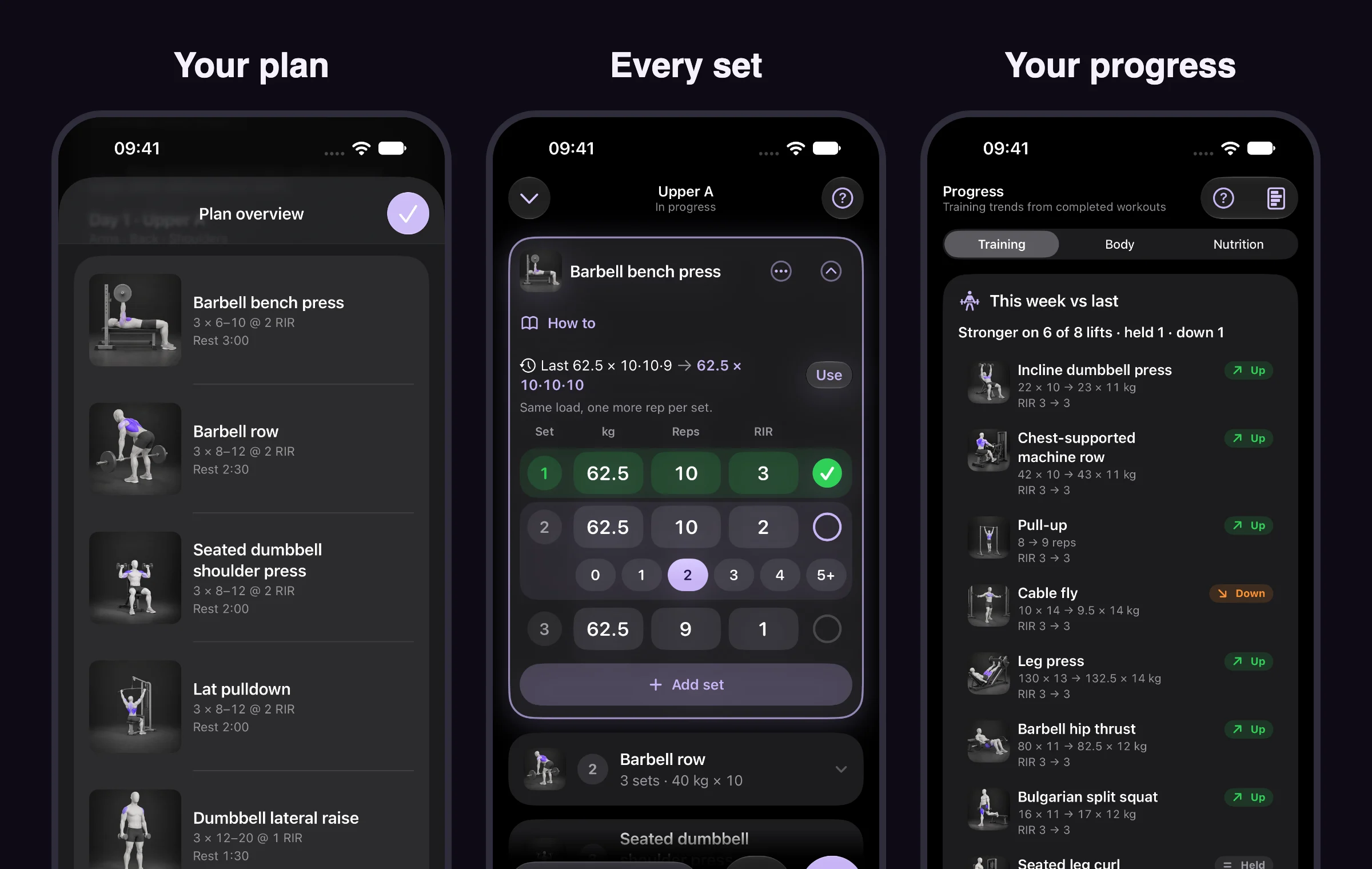
Example screens from FitArchive with sample data.
FitArchive does not tie plan days to weekdays. When you finish a workout from a plan, the next workout moves to the day after the one you just finished and wraps back to the start, so an every-other-day rotation continues from wherever you left off, even after a missed day. The built-in Full body 3 day template has three workouts (A, B and C) with more sets per exercise than this program, so lower it to 1 or 2 sets per exercise to run it every other day, or build your own A/B plan like the example above. Each set records weight, reps and RIR, and the Progress screen shows weekly hard sets and training days per muscle. Try it with sample data in the demo.