An anterior/posterior split divides your training by the front and back of your body: anterior days train the chest, front and side delts, triceps, quads and abs, and posterior days train the back, biceps, hamstrings, glutes and calves. A common week is anterior, posterior, rest, anterior, posterior, rest, rest, so each muscle is trained twice. Because it is high frequency, each exercise needs only 1 or 2 hard sets. It is a scheduling choice rather than a proven upgrade: no study has tested this split against others directly, and similar weekly volume in other splits gives similar results.
This guide explains what goes on each day, gives an example program with set counts per muscle, and compares it with upper/lower so you can decide if it suits you.
What is an anterior/posterior split?
The split sorts muscles by which side of the body they sit on:
- Anterior (front) days: chest, front and side delts, triceps, quads, adductors and abs.
- Posterior (back) days: lats, upper back, rear delts, biceps, hamstrings, glutes and calves.
Unlike upper/lower, each day has both upper-body and lower-body work. That keeps legs in every session, and it gives you a mix of pressing and quad work one day, pulling and hinging the next.
Weekly layouts
These are example layouts. Any arrangement works if the same day does not repeat without a rest or the opposite day in between.
| Layout | Mon | Tue | Wed | Thu | Fri | Sat | Sun |
|---|---|---|---|---|---|---|---|
| 4 days, classic | Anterior | Posterior | Rest | Anterior | Posterior | Rest | Rest |
| 4 days, spread out | Anterior | Rest | Posterior | Rest | Anterior | Posterior | Rest |
| 5-day rotation, week 1 | Anterior | Posterior | Anterior | Rest | Posterior | Anterior | Rest |
| 5-day rotation, week 2 | Posterior | Anterior | Posterior | Rest | Anterior | Posterior | Rest |
The classic layout keeps the weekend free. The 5-day rotation trains each muscle about 2.5 times a week, which is 25% more sessions and sets, so check how you recover before adopting it.
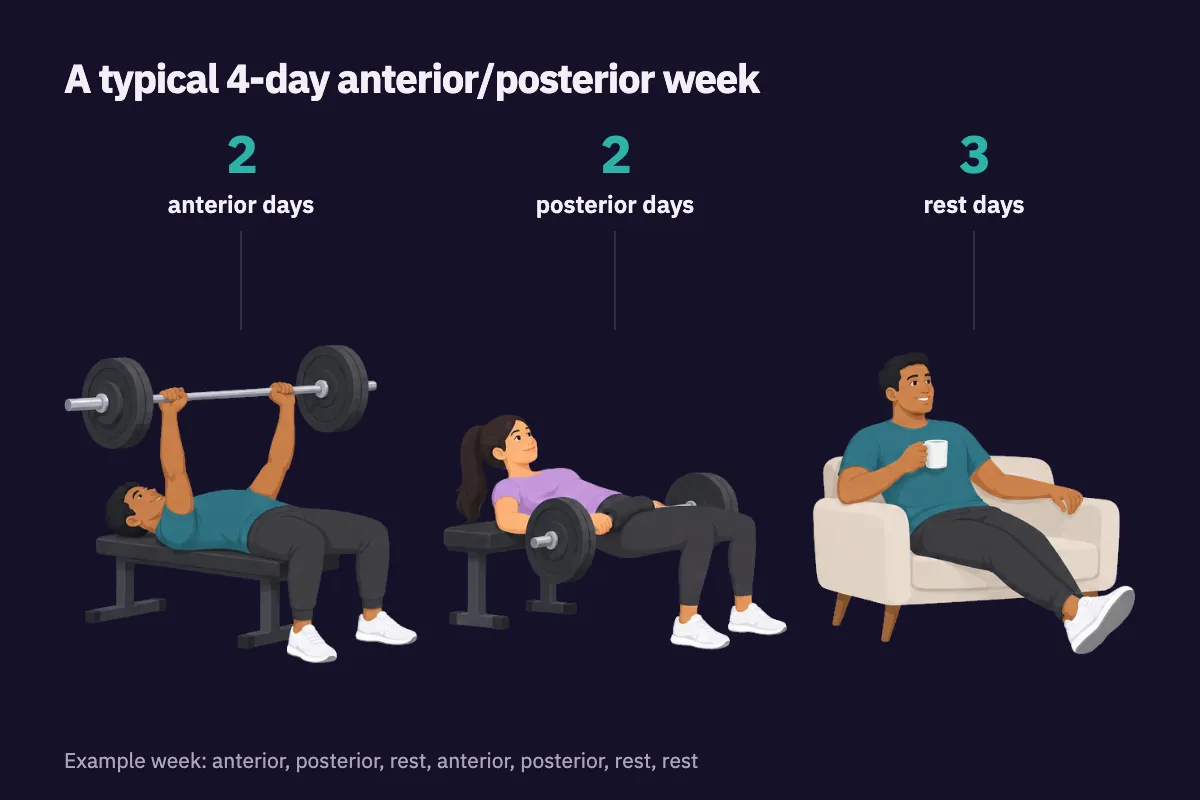
Four sessions train each muscle twice and leave three days to recover.
Why 1 or 2 sets per exercise?
The more often you train a muscle, the fewer sets each session should give it. At twice a week, you can reach a useful weekly total with 1 or 2 hard sets per exercise, and add variety with exercises rather than sets. Stop about 1 to 2 reps short of failure on heavy compound lifts and 0 to 1 short on machines and isolation exercises.
This is a practical way to keep sessions short, not a proven optimum. The research compares weekly volume and frequency, not this exact set structure.
Example anterior/posterior program
This is an example program, not a prescription. Numbers in brackets are target RIR (reps in reserve: the reps you could still have done). Use a machine or free-weight version, whichever you can load safely close to failure.
Anterior day
| Exercise | Sets × reps | Target RIR |
|---|---|---|
| Pec deck fly | 2 × 10-15 | 1 |
| Incline chest press | 2 × 8-12 | 1 |
| Lateral raise | 2 × 12-20 | 1 |
| Shoulder press | 1 × 8-12 | 1 |
| Triceps extension | 2 × 10-15 | 1 |
| Dips or close-grip press | 1 × 8-12 | 1 |
| Leg extension | 2 × 10-15 | 1 |
| Squat or leg press | 1 × 6-10 | 2 |
| Adductor machine | 1 × 10-15 | 1 |
| Machine crunch | 2 × 10-15 | 1 |
Posterior day
| Exercise | Sets × reps | Target RIR |
|---|---|---|
| Upper back row (elbows wide) | 2 × 8-12 | 1 |
| Lat pulldown | 2 × 8-12 | 1 |
| Lat row (elbows close) | 1 × 8-12 | 1 |
| Biceps curl | 2 × 10-15 | 1 |
| Leg curl | 2 × 10-15 | 1 |
| Romanian deadlift or back extension | 1 × 8-12 | 2 |
| Hip thrust or abductor machine | 1 × 8-12 | 1 |
| Calf press | 2 × 10-15 | 1 |
That is 16 working sets on anterior days and 13 on posterior days, or 58 a week. Warm up before the first press, row and squat, then rest as long as you need to make the next set hard. Expect about 40 minutes a session.
Direct sets per muscle if every set is completed at the planned effort (example totals, counting exercises where the muscle is the main target):
| Muscle | Weekly sets | Muscle | Weekly sets |
|---|---|---|---|
| Chest | 8 | Back (rows and pulldowns) | 10 |
| Shoulders (press and raises) | 6 | Biceps | 4 |
| Triceps | 6 | Hamstrings | 6 |
| Quads | 6 | Glutes | 2, plus hinges and squats |
| Adductors | 2 | Calves | 4 |
| Abs | 4 | Rear delts | Worked by rows |
If a muscle is a priority or stops progressing, give one of its 1-set exercises a second set first, then add a different exercise. The weekly sets guide explains the counting rule.
What the research says
No trial that we know of has tested an anterior/posterior split directly, so treat claims that it is superior with caution. What the evidence does support:
- A 2019 meta-analysis of 25 studies found no significant difference between higher and lower frequencies when weekly volume was equal.
- A 2024 meta-analysis of 14 studies found similar strength and muscle gains from split and full-body routines with volume equated, and concluded that people can choose by preference.
- The 2026 meta-regression of 67 studies found frequency added little to growth once volume was counted, while strength did rise with frequency.
So the split matters less than hard sets, progress over time and a schedule you can keep. These studies were mostly short and in young men. The training frequency guide covers the wider evidence.
Anterior/posterior vs upper/lower
| Anterior/posterior | Upper/lower | |
|---|---|---|
| Sessions per week | 4 | 4 |
| Times each muscle is trained | 2 | 2 |
| Legs | Some every session | Only on lower days |
| Upper-body pressing | Anterior days | Upper days |
| Upper-body pulling | Posterior days | Upper days |
| Session feel | Mixed upper and lower | One half of the body |
Both are fine. Anterior/posterior can suit you if upper days feel too long, because pressing and pulling are on different days. Upper/lower can suit you if you want legs on separate days, for example around a sport. If your schedule moves from week to week, FBEOD is another option.
Who is it for?
- Lifters who train 4 days a week and want each muscle hit twice in shorter sessions.
- People with machine access, since many of the exercises are easiest to take close to failure on a machine.
- Beginners, with care. Start with 1 set per exercise and spend time learning the squat, press, row and hinge.
How to log it
Compare each day with the same day last time. With one version of each day, every exercise comes back twice a week, so you get two chances to beat your numbers. If you want variety, you can use two versions of each day, but then each exercise comes back only once a week and progress on any one exercise is harder to see.
Use double progression: stay at one weight until you reach the top of the rep range on all sets at the target RIR, then add the smallest weight step. Recording RIR for each set shows whether the reps came at the planned effort.
Common mistakes
- Keeping 3 to 4 sets per exercise. At this frequency, sessions get long and later sets get weak. Start with 1 or 2.
- Treating 1 set as a warm-up. A low-volume session only works if the set is hard.
- Changing exercises every week. Keep the main lifts for a full block so you can see progress.
- Heavy lower-back work two days in a row. Squats on an anterior day followed by heavy Romanian deadlifts the next day can add up. Keep one of them lighter, or use a back extension.
- Skipping legs because they come last. Move them earlier if they keep getting cut.
Running an anterior/posterior split in FitArchive
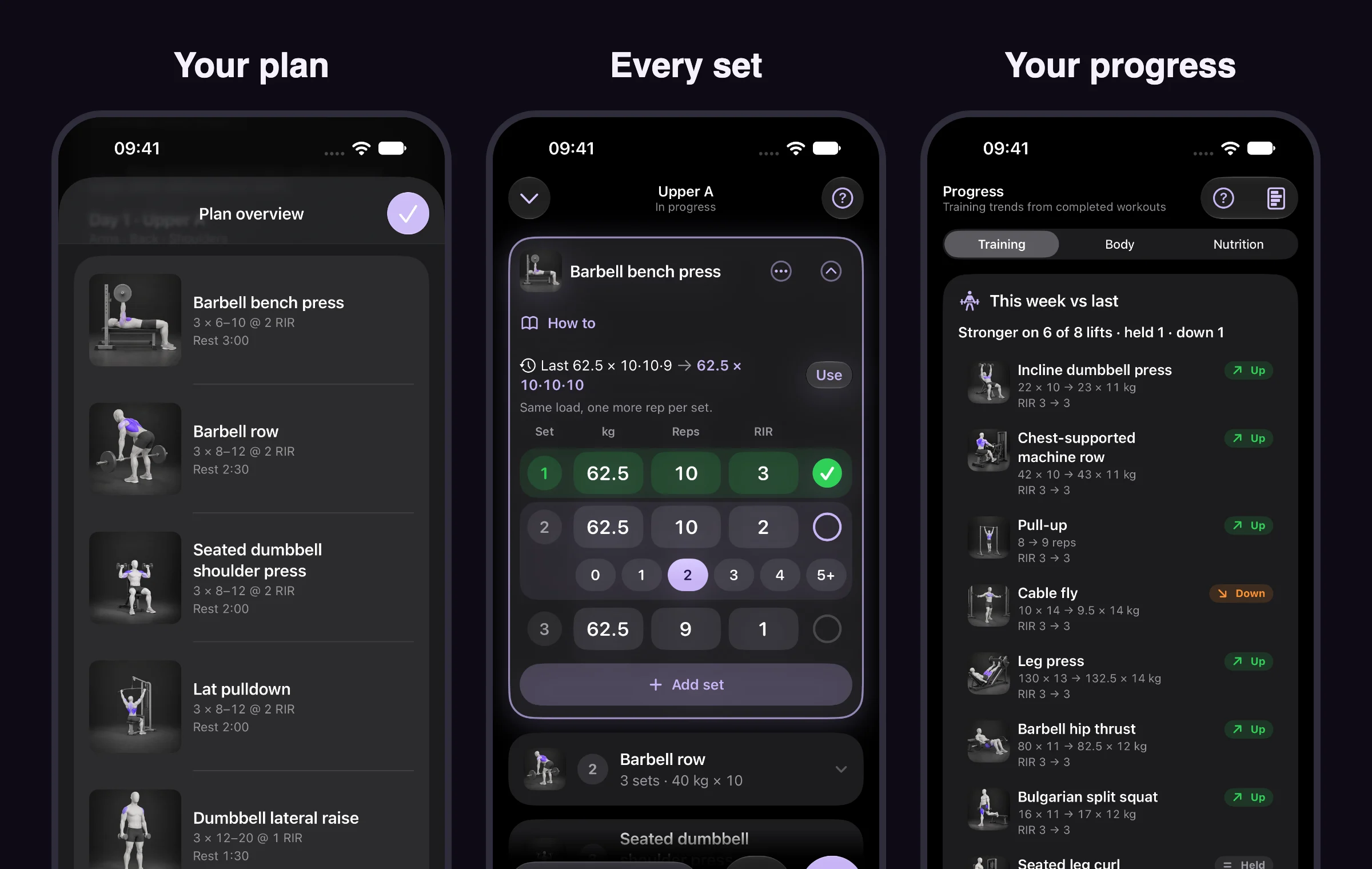
Example screens from FitArchive with sample data.
FitArchive does not tie plan days to weekdays. You can build a plan with an Anterior day and a Posterior day and repeat them, and after you finish a workout the next one in the plan is suggested, so a missed day does not break the rotation. Each set records weight, reps and RIR, and the Progress screen shows estimated one-rep max per exercise, weekly hard sets by muscle and training days per muscle. Try it with sample data in the demo.