A strength plateau is a lift that stays flat across several comparable sessions, not one disappointing day. Before changing your program, check your log: were exercise, setup, rest and effort actually similar? If the stall is real, look at recovery and training first, then change one variable at a time and judge it over a few sessions.
Is it a real plateau or just a bad day?
Single sessions are noisy. Sleep, stress, food, gym crowding and even which machine was free can move a set by a rep or two. A useful working definition for your own log:
- Same exercise and variation, same setup and roughly the same range of motion.
- Same set position, such as the first working set, rather than whichever set happened to be best.
- Similar rest and effort, so you are not comparing a rushed set with a fresh one.
- Several exposures, not just the latest one. Many lifters look at the last three or four sessions of a lift before calling it stuck; that is a rule of thumb, not a research threshold.
If those conditions do not match, you have a comparison problem, not necessarily a plateau.
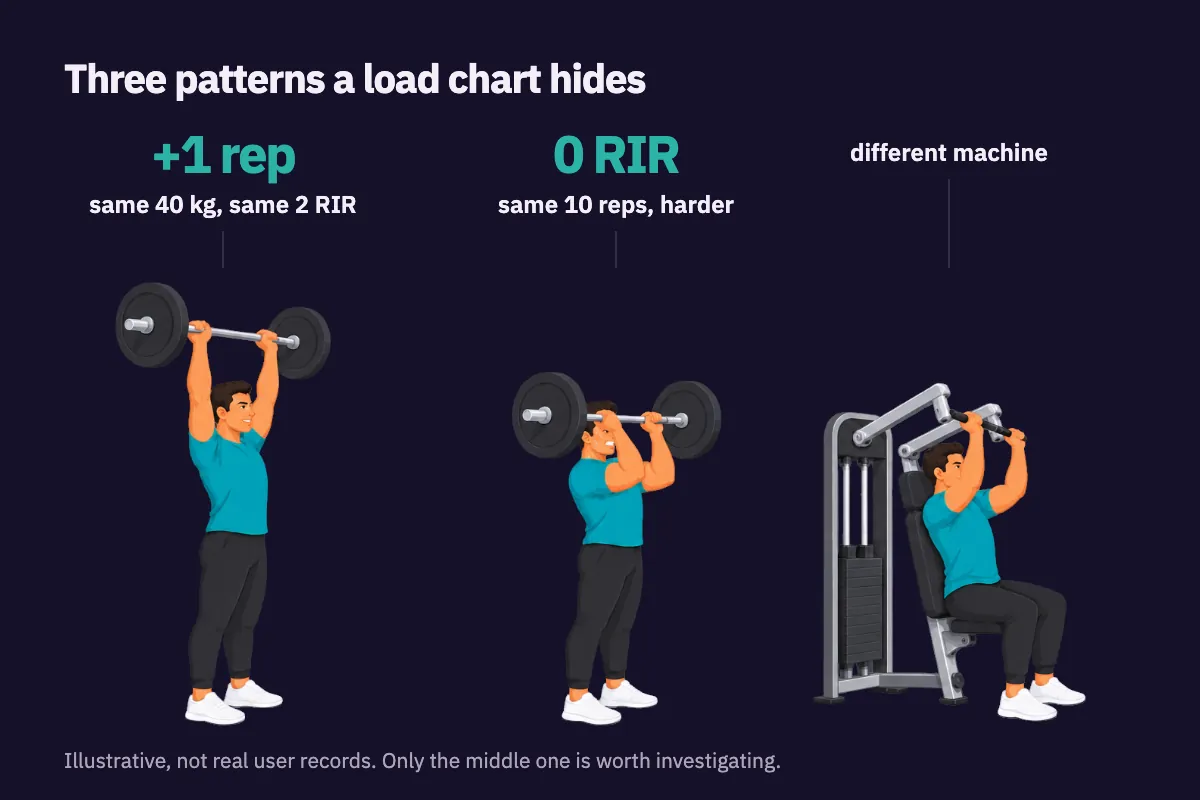
Three patterns that look similar on a weight chart
A chart that only shows load can hide real progress or real fatigue. These are illustrative, not real user records:
| Pattern across sessions | What a load-only chart hides | First question |
|---|---|---|
| 40 kg × 10 @ 2 RIR, then 40 kg × 11 @ 2 RIR | Load is flat, but one more rep was completed. | Is technique still comparable? |
| 40 kg × 10 @ 2 RIR, then 40 kg × 10 @ 0 RIR | Output is flat and effort rose. | Were rest, setup, and recent workload similar? |
| 40 kg × 10 @ 2 RIR on machine A, then 40 kg × 10 @ 2 RIR on machine B | Numbers match but equipment changed. | Are these actually the same exercise for comparison? |
Fix the comparison before calling a lift stuck.
The first row is not a plateau at all: reps went up at the same effort, which is progress under double progression. The second row is the one worth investigating. The third needs a new reference point before any judgment.
Keep in mind that RIR is an estimate. A 2022 meta-analysis found lifters tended to misjudge reps left before failure by about one rep on average, with considerable variation between studies, and predictions were more accurate closer to failure and with heavier loads. Treat a one-point RIR change as a hint, not proof.
What causes a strength plateau?
Your log cannot diagnose the cause, but it can narrow the list. Common contributors include:
Comparison drift. Changes in grip, depth, tempo, bench height, machine or load unit can make numbers look flat or worse. Fix the comparison first.
Rest between sets. Shorter breaks tend to reduce the reps you complete on later sets. A 2018 systematic review suggested trained lifters may need more than 2 minutes between sets to maximize strength gains. See rest between sets for how to log it.
Accumulated fatigue. If the same reps keep taking more effort, recent workload may be outpacing recovery. Check your weekly working sets and how often you train close to failure; the failure vs RIR guide covers that trade-off.
Sleep. A systematic review on inadequate sleep found that several consecutive nights of restricted sleep could reduce force output in multi-joint lifts, though not single-joint ones, while total sleep deprivation had little effect on strength in the studies reviewed. Study quality was rated moderate to weak, so treat this as a possibility worth logging, not a certainty.
Eating in a deficit. A 2022 meta-analysis found that an energy deficit impaired lean-mass gains from resistance training, while strength gains were comparable to those without a deficit. So a deficit does not automatically explain a strength stall, but it may matter more for muscle gain. The food and workout logging guide explains how to read both without overreacting to a single day.
The training itself. The 2026 ACSM position stand, an overview of 137 systematic reviews, found that strength gains were enhanced by heavier loads (at least 80% of one-rep max), a full range of motion, 2–3 sets, placing the lift early in the session, and at least two sessions a week. If your stalled lift is always done last, with light loads, once a week, those are reasonable things to review. The same stand found many other variables did not consistently change outcomes, so there is rarely one secret fix.
How to break a strength plateau: a decision order
- Repair the comparison. Standardize exercise variation, technique, load unit, and roughly similar rest before concluding output is flat.
- Read effort and weekly work. If the same reps now require more effort, review recent sessions, sleep notes and weekly sets before adding more work.
- Choose one modest experiment. Depending on your existing plan, you might hold the load while working for a clean extra rep, lengthen rest on the stalled lift, move it earlier in the session, add a second weekly exposure, or take a planned lighter week. Record which variable changed and why.
- Reassess after comparable sessions. Do not declare the experiment a success or failure from a single set. Give it the same number of comparable sessions you used to spot the stall.
Should you deload to break a plateau?
Sometimes. A deload is a planned period of lighter training. An international Delphi consensus of coaches defined it as “a period of reduced training stress designed to mitigate physiological and psychological fatigue, promote recovery, and enhance preparedness for subsequent training.” In a 2024 survey of strength and physique athletes, respondents reported deloading roughly every 5–6 weeks for about a week, and often when performance stalled. These sources describe expert opinion and common practice; controlled evidence on deloading is still limited.
If your log shows rising effort at flat output, a lighter week is a reasonable experiment. Record it clearly so the following sessions are not misread; the deload logging guide shows one way.
How long should you wait before changing your program?
There is no research-backed number. What matters is that you give a change enough comparable sessions to show a pattern. If a lift has been flat across several exposures, the comparison is clean, and recovery looks reasonable, a targeted change to that lift is sensible. Overhauling the whole program after one flat week mostly destroys the reference points you need to judge anything.
Common mistakes
- Changing several things at once. New exercises, new rep ranges and a new split in the same week leave you unable to tell what worked.
- Judging from the best or worst set. Pick a consistent reference set and stick with it.
- Reading a deload or short-rest session as regression. Context belongs in the log next to the numbers.
- Testing a max too often. Occasional max attempts are hard to compare from session to session; repeatable submaximal sets with RIR usually give a clearer trend.
- Treating pain as a plateau. If pain, joint symptoms, or other concerning signs are involved, stop the painful movement and get appropriate professional advice instead of troubleshooting it as a training problem.
Auditing a plateau in FitArchive
If you need a consistent format, start with the workout log template and the progressive overload guide. In FitArchive, the workout screen lists the sets you logged last time for each exercise (load, reps and RIR) while you log today’s, so a flat trend is visible in the moment and you can note rest, setup or sleep in the workout notes.