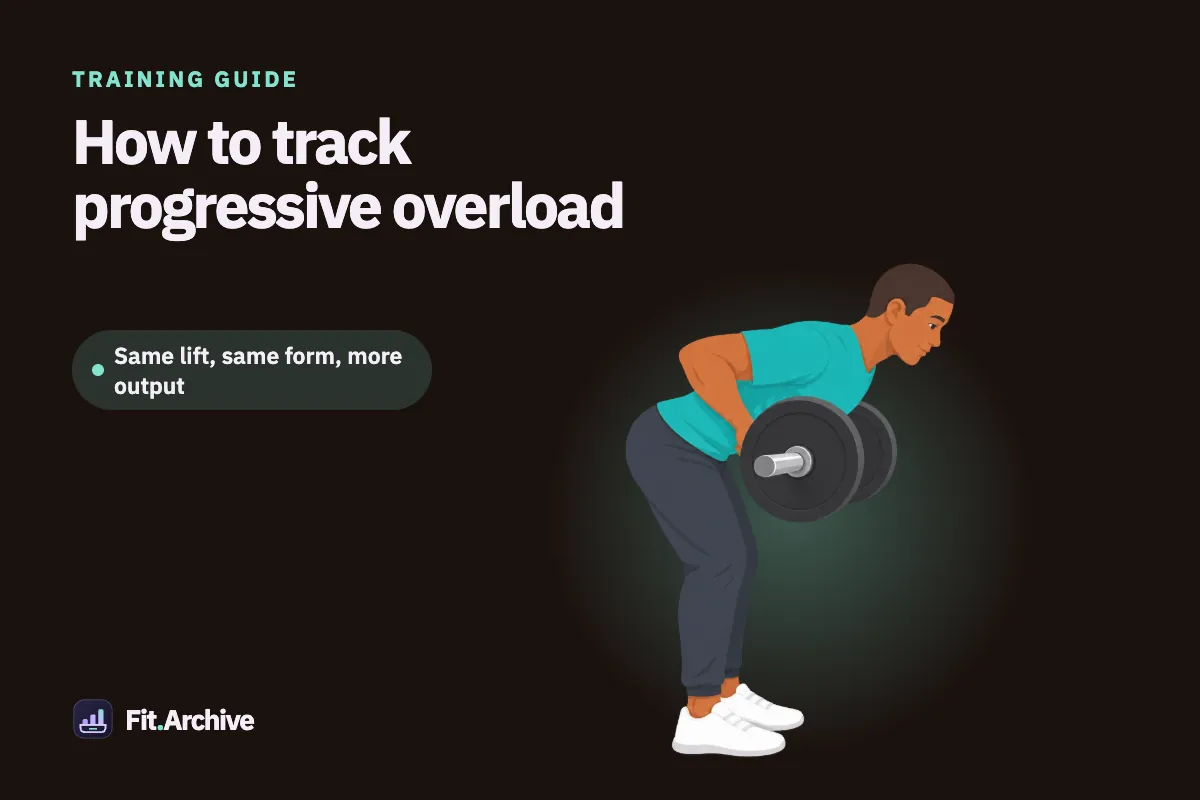
Track progressive overload by comparing like-for-like sets over several weeks, not by insisting the weight rises every workout. For one repeatable reference set, log the exercise variation, load, reps, and an effort estimate such as RIR. More clean reps at a similar load and effort, or more load for similar reps and effort, suggests better performance on that lift; one good entry does not prove muscle growth.
Progressive overload means gradually increasing the demand you place on your muscles so they keep having a reason to adapt. The 2026 ACSM resistance-training position stand concludes that healthy adults should perform progressive resistance training, but it does not prescribe one weekly load increase for everyone. Your log is a decision aid, not an automatic escalation schedule.
What does progressive overload look like in a log?
In a workout log, progressive overload usually shows up as one of these changes while everything else stays reasonably similar:
- More reps at the same load: 40 kg × 10 becomes 40 kg × 11.
- More load for the same reps: 40 kg × 10 becomes 42.5 kg × 10.
- More weekly sets for a muscle. The ACSM overview found muscle growth was enhanced by higher volumes (about 10 or more sets per week). Before adding sets, count your weekly sets per muscle so you know your starting point.
- The same work at an easier effort or with better execution: 40 kg × 10 at 3 reps in reserve instead of 1, or with a fuller, more controlled range of motion.
Weight is only one lever. If you log all of them, you can see progress that the plates alone would hide.
Can you progressively overload without adding weight?
The evidence suggests yes, adding reps is a reasonable way to progress. In an 8-week trial with trained lifters, Plotkin and colleagues compared one group that added load while keeping reps fixed with another that added reps while keeping load fixed. Both groups improved, the differences in muscle thickness and strength between them were small, and the authors described both approaches as viable. It was one study of lower-body exercises over 8 weeks, so treat it as support for rep progression rather than proof that the two are identical in every situation.
Load still matters for some goals. A meta-analysis of low- vs high-load training found similar hypertrophy across a range of loads when sets were taken to failure, but greater one-rep-max strength gains with heavier loads. If your goal is a heavier max, the log should eventually show heavier sets, not only longer ones.
What should you record for each set?
A comparison is only fair when two entries describe the same task. For each working set, keep these together:
| Field | Why it matters |
|---|---|
| Exercise variation and equipment | A machine row and a cable row are not the same test. |
| Load | The obvious number, but it means little on its own. |
| Reps | Always read together with load. |
| Effort (RIR or RPE) | Separates “more reps” from “more reps because I went closer to failure”. |
| Set position | A first working set and a tired fourth set are not comparable. |
| Short note | Rest, range of motion, pain, or anything unusual. |
If you have not picked an effort scale, compare RPE vs RIR, then learn how to record RIR after each set. Treat RIR as an estimate: a review of prediction accuracy found lifters are imperfect at predicting how many reps they have left, with predictions improving closer to failure and with heavier loads. Rest also changes how many reps you can complete, so it is worth recording rest between sets when it varies a lot. For a ready-made layout, use the strength workout log template.
A worked comparison across four sessions
Suppose these are invented examples of the first working set of the same row variation, with similar range of motion and rest. They illustrate how to read entries, not a recommended load or rate of progress:
| Session | Recorded set | What it suggests |
|---|---|---|
| A | 40 kg × 10 @ 2 RIR | A baseline. |
| B | 40 kg × 11 @ 2 RIR | One more rep at similar reported effort: a useful performance signal. |
| C | 42.5 kg × 9 @ 1 RIR | Heavier, but fewer reps and a harder effort. Not a clear improvement over B. |
| D | 42.5 kg × 10 @ 2 RIR | Heavier load for A’s reps at A’s effort: clearer evidence of progress. |
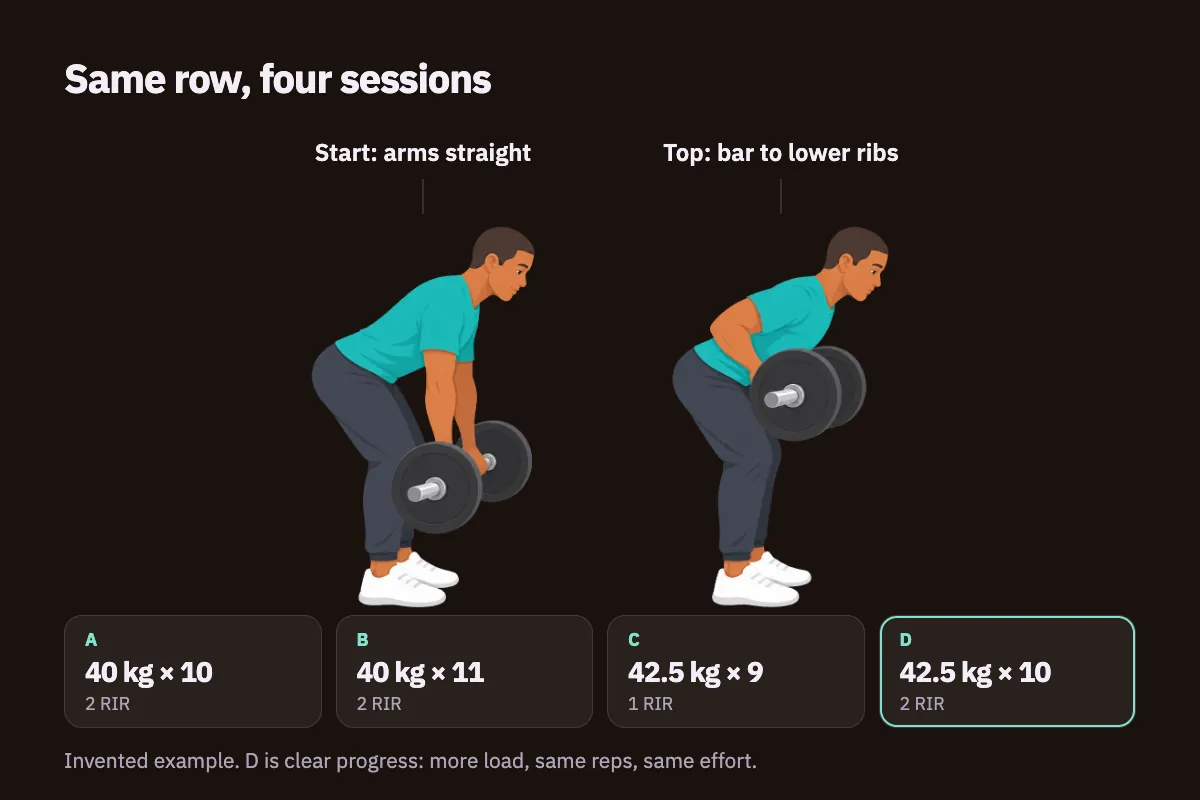
Keep the movement the same, then compare load, reps and effort.
The wrong reading is “C used the most weight, so C was best.” The useful question is “What changed while the other conditions stayed reasonably similar?” Session C may still be a normal step after a load increase; it just does not prove much yet. Session D is easier to interpret because only one thing, the load, moved. If C had followed shorter rest or a different machine, the note field is where that context belongs.
How often should you increase the weight?
There is no single schedule that suits every lifter and exercise. The 2009 ACSM progression position stand suggested increasing load by 2–10% once you can perform the current workload for one to two reps beyond your target, and stressed that recommendations depend on your goals, capacity, and training status.
A practical way to apply that is to let the log, not the calendar, decide:
- Set a condition before the session, such as “all sets reach the top of my rep range at about 2 RIR.” Double progression is a simple version of this rule.
- Increase by the smallest practical step. The arithmetic matters: 2.5 kg is 2.5% of a 100 kg squat but 25% of a 10 kg lateral raise. When the smallest jump is large relative to the load, add reps for longer before adding weight.
- Expect reps to drop after a load increase, then rebuild them at the new weight.
What to review over several weeks
- Choose one repeatable reference set. The first working set of an exercise is often easier to compare than a mix of warm-ups and later fatigued sets.
- Read load and reps together. A rep added at the same load counts even if the plates did not change. A new load with a very different rep count needs context.
- Read effort and technique. If the same output now needs a much lower RIR or a shorter range of motion, the log does not yet support a confident progress claim.
- Look for a pattern. Several comparable entries are more useful than one unusually good or poor day. Record sleep or rest changes only when they help explain a comparison; a diary so detailed that you stop logging helps no one.
If several comparable sessions stay flat, audit the log for a strength plateau before rewriting the program.
Common mistakes when tracking progressive overload
- Calling every heavier set progress. A heavier load with fewer reps and a harder effort, like session C, is not automatically better.
- Comparing different tasks. A different machine, grip, tempo, or set position changes the test. Compare like with like or note the change.
- Letting range of motion shrink. The ACSM overview found strength was enhanced by training through a complete range of motion. Extra reps that come from shorter reps are not the same progress.
- Reading one session as a trend. Sleep, food, stress, and rest all move single-day numbers. Look for repeated patterns.
- Treating a planned lighter week as regression. Lower numbers during a deload are expected; log the deload week clearly so you do not compare it with normal sessions.
- Pushing through pain to keep the numbers rising. Progress in the log is never a reason to train through pain. Stop the exercise if it hurts, and seek advice from a qualified professional if pain persists.
Tracking it in FitArchive
You can see previous sets beside the current ones in the FitArchive workout log, with load, reps, and effort on the same line, or open its sample-data demo to see the format before logging your own sessions.