A PPLUL split is a 5-day program: push, pull, legs, then upper, lower. Push trains chest, shoulders and triceps; pull trains back, rear delts and biceps; legs and lower train the legs; upper trains everything above the waist. Most muscles are trained twice a week in five sessions instead of the six a push/pull/legs split needs. The upper body gets three sessions and the legs two, so it leans toward the upper body. No study has tested PPLUL itself, and research on equal weekly volume suggests the order and layout matter much less than the total sets you do and whether you keep progressing.
This guide covers weekly layouts, a full 5-day program with sets, reps and RIR, the weekly sets per muscle, PPLUL vs ULPPL, vs 6-day PPL and vs upper/lower, and who it suits.
The PPLUL weekly layout
| Layout | Mon | Tue | Wed | Thu | Fri | Sat | Sun |
|---|---|---|---|---|---|---|---|
| PPLUL, rest midweek | Push | Pull | Legs | Rest | Upper | Lower | Rest |
| PPLUL, weekends off | Push | Pull | Legs | Upper | Lower | Rest | Rest |
| ULPPL | Upper | Lower | Rest | Push | Pull | Legs | Rest |
The midweek rest day is the most common choice: it separates legs from lower and gives your joints a break after three days in a row. Weekends-off works too, but then legs (Wednesday) and lower (Friday) are only one day apart. Keep leg sets 1 to 2 reps short of failure in that case; a 2017 study found sets taken to failure slowed recovery for 24 to 48 hours. More on rest days in how many rest days you need.
PPLUL vs ULPPL: does the order matter?
Not much. No study has compared them. Both are the same five sessions in a different order. What changes is which days sit next to each other:
- PPLUL puts push, pull and legs together, then upper and lower after a rest day.
- ULPPL starts the week with upper and lower, which some people like because the heavier compound work comes when they are freshest.
Pick the order that fits your schedule. If one muscle group always feels tired on a given day, try the other order.
Example PPLUL program
This is FitArchive’s Upper/Lower + Push/Pull/Legs · 5 days template. It is listed in ULPPL order; to run it as PPLUL, start on the Push day. Numbers in brackets are target RIR (reps in reserve).
Push
| Exercise | Sets × reps | RIR |
|---|---|---|
| Incline dumbbell press | 3 × 8-12 | 2 |
| Machine chest press | 2 × 8-12 | 2 |
| Cable fly | 2 × 10-12 | 1 |
| Cable lateral raise | 4 × 10-12 | 1 |
| Overhead cable triceps extension | 3 × 10-12 | 1 |
Pull
| Exercise | Sets × reps | RIR |
|---|---|---|
| Pull-up | 3 × 6-10 | 2 |
| Chest-supported row | 3 × 8-12 | 2 |
| Reverse pec deck | 3 × 10-12 | 1 |
| Incline dumbbell curl | 3 × 10-12 | 1 |
| Hammer curl | 2 × 10-12 | 1 |
Legs
| Exercise | Sets × reps | RIR |
|---|---|---|
| Hack squat | 3 × 8-12 | 2 |
| Hip thrust | 3 × 8-12 | 2 |
| Seated leg curl | 3 × 10-12 | 1 |
| Leg extension | 2 × 10-12 | 1 |
| Seated calf raise | 4 × 10-12 | 1 |
Upper
| Exercise | Sets × reps | RIR |
|---|---|---|
| Barbell bench press | 3 × 6-10 | 2 |
| Barbell row | 3 × 8-12 | 2 |
| Lat pulldown | 3 × 8-12 | 2 |
| Seated dumbbell shoulder press | 2 × 8-12 | 2 |
| Dumbbell lateral raise | 3 × 10-12 | 1 |
| Face pull | 2 × 10-12 | 1 |
| EZ-bar curl | 2 × 10-12 | 1 |
| Triceps pushdown | 2 × 10-12 | 1 |
Lower
| Exercise | Sets × reps | RIR |
|---|---|---|
| Back squat | 3 × 6-10 | 2 |
| Romanian deadlift | 3 × 8-12 | 2 |
| Leg extension | 2 × 10-12 | 1 |
| Lying leg curl | 2 × 10-12 | 1 |
| Standing calf raise | 4 × 10-12 | 1 |
| Cable crunch | 3 × 10-12 | 1 |
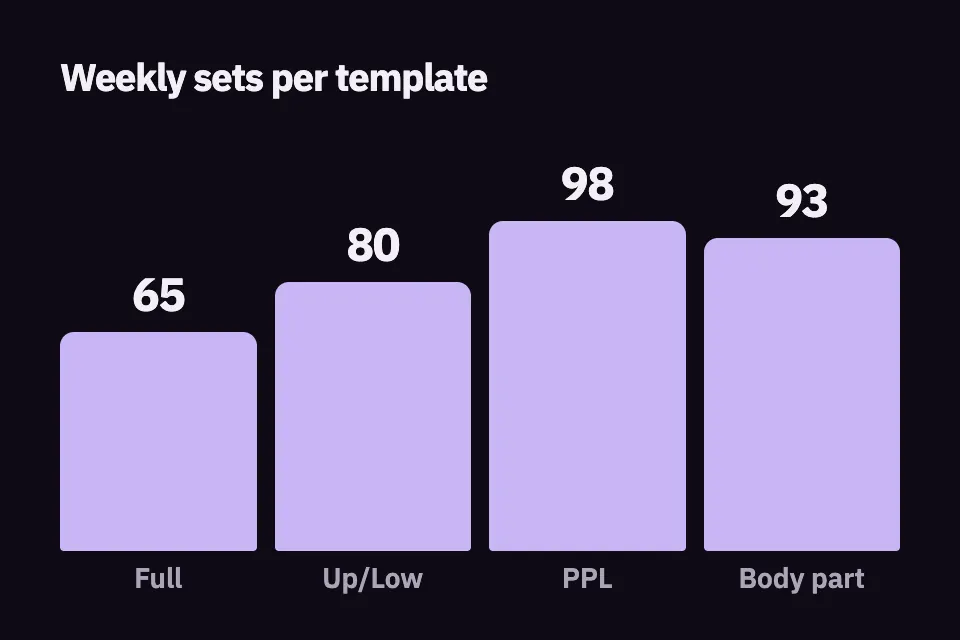
That is 80 working sets a week: 14 to 15 on the push, pull and legs days, 20 on upper and 17 on lower. The push, pull and legs days use mostly machines and dumbbells in the 8 to 12 range; the upper and lower days start with heavier barbell lifts. Expect 50 to 80 minutes a session, depending on rest.
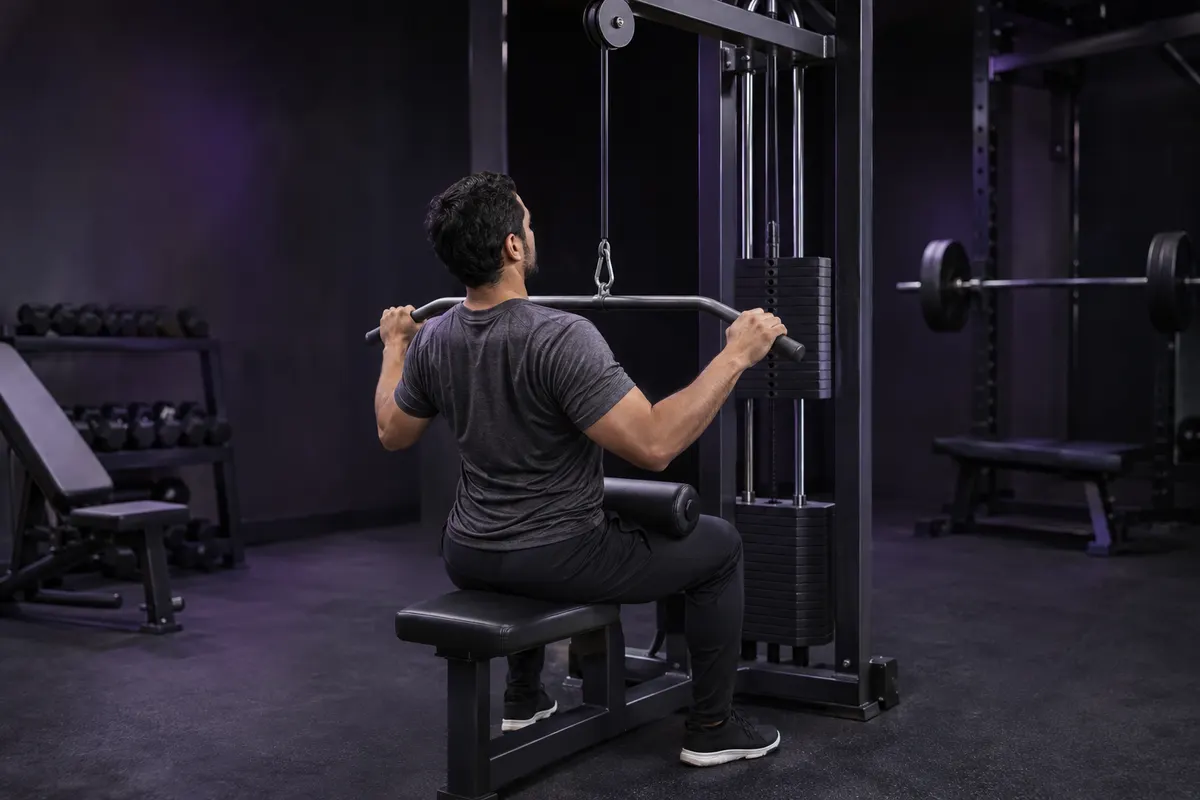
Back gets two sessions a week: pull day and upper day.
Weekly sets per muscle
Direct sets count exercises where the muscle is the main target. The second column adds half credit for indirect work, the counting method a 2026 meta-regression of 67 studies found fit the data best.
| Muscle | Direct sets | With half credit |
|---|---|---|
| Chest | 10 | 10 |
| Lats | 9 | 10.5 |
| Upper back | 6 | 11.5 |
| Side delts | 7 | 8 |
| Rear delts | 5 | 8 |
| Front delts | 2 | 6 |
| Biceps | 7 | 13 |
| Triceps | 5 | 10 |
| Quads | 10 | 10 |
| Hamstrings | 8 | 9.5 |
| Glutes | 9 | 10.5 |
| Calves | 8 | 8 |
| Abs | 3 | 3 |
This version keeps the legs close to the upper body in sets, even though legs get only two days. Most muscles land around 8 to 12 sets a week, a reasonable middle range. A 2017 meta-analysis found each extra weekly set added a little more growth on average, so add sets to a lagging muscle before adding a sixth day. The weekly sets guide explains how to count.
What the research says
No study has tested a PPLUL split by name. The relevant evidence:
- Twice a week is a practical minimum. A 2016 meta-analysis found training each muscle twice a week grew more muscle than once a week, largely because it makes enough weekly sets easier to fit. PPLUL does that.
- Beyond twice a week, total volume matters more than the layout. A 2019 meta-analysis of 25 studies found no significant difference between frequencies when weekly volume was equal. A 2024 meta-analysis found split and full-body routines gave similar results with volume matched.
- A sixth day is not needed. In a 2019 study of trained men, training 3 or 6 times a week with the same total volume gave similar strength and muscle gains.
- You do not need to fail every set. A 2023 meta-analysis found only a trivial growth advantage for going to failure. Stopping 1 or 2 reps short is fine, especially on back-to-back days.
So PPLUL is a convenient way to fit twice-weekly training into five days, not a superior split. These studies were mostly short and in young adults. See how often to train each muscle.
PPLUL vs other splits
| PPLUL | 6-day PPL | Upper/lower | PHUL | |
|---|---|---|---|---|
| Days per week | 5 | 6 | 4 | 4 |
| Times each muscle is trained | 2 | 2 | 2 | 2 |
| Upper sessions | 3 | 4 | 2 | 2 |
| Leg sessions | 2 | 2 | 2 | 2 |
| Session length | Medium | Shorter | Longer | Longer |
- PPLUL vs 6-day PPL (PPLPPL): PPL spreads the same work over six shorter sessions. If you can only train five days, PPLUL gives the same twice-a-week frequency. Our PPL vs Arnold split compares 6-day options.
- PPLUL vs upper/lower (ULUL): upper/lower fits the same frequency into four longer days. If four days suit you better, see the 4-day upper/lower split.
- PPLUL vs PHUL: PHUL is an upper/lower plan with two heavy days and two lighter ones. See PHUL vs PPL.
For the bigger picture, read PPL vs upper/lower vs full body. For another 5-day option with heavy power days, see the PHAT workout.
Is PPLUL good for beginners?
It can work, but it is not the best start. Beginners progress fast with fewer, simpler sessions and practise the main lifts more often on a 3-day full-body plan such as FBEOD. PPLUL suits lifters with six months or more of steady training who can commit to five days a week.
Common mistakes
- Doing the same exercises on push day and upper day. Use different variations so each session adds something, and so progress is easy to compare.
- Letting legs slip. Legs get only two sessions; do not skip them when the week gets busy.
- Training to failure on three days in a row. Push, pull and legs are back to back; keep most sets 1 to 2 reps short.
- Copying 4 sets per exercise from a 3-day plan. At this frequency, 2 to 3 sets per exercise is enough.
How to log and progress it
Compare each session with the same session the week before: push with push, upper with upper. A lift that appears on two days, such as a lateral raise, is easier to track if you use a slightly different variation or rep range each day. Use double progression: add reps up to the top of the range at the target RIR, then add the smallest weight step.
Run a PPLUL split in FitArchive
FitArchive includes the Upper/Lower + Push/Pull/Legs · 5 days template shown above. Pick it, start on the Push day to run it as PPLUL, and swap any exercise for one your gym has. Each set records weight, reps and RIR, FitArchive suggests when to add weight or reps, and the Progress screen shows your estimated one-rep max for every lift and weekly hard sets for every muscle, so you can check whether the legs keep up. You can pin sessions to weekdays, and if you miss a day, the next workout in the rotation is still suggested.
Get FitArchive free on iPhone or Android. Logging and your full history are free, with no ads.