Training each muscle about twice a week is a sensible default. When weekly sets are equal, studies find that training a muscle once, twice, or three or more times a week builds similar muscle, so frequency matters much less for size than how many hard sets you do. Frequency earns its place in two ways: it lets you spread a larger weekly volume into sessions you can do well, and it gives you more practice at the lifts you want to get stronger at.
On social media you will hear both “hit every muscle every 48 hours” and “one brutal session per muscle a week is all you need”. This guide tests both claims against the meta-analyses, explains how frequency and volume interact, and shows how to pick a frequency that fits your week.
What is training frequency?
Training frequency means two different things, and mixing them up causes most of the confusion:
- Session frequency: how many days a week you lift. Someone on a 4-day upper/lower split has a session frequency of 4.
- Muscle frequency: how many of those sessions train a given muscle directly. On that same upper/lower split, the chest is trained twice a week.
When people ask how many times a week they should train each muscle group, they mean muscle frequency, and that is also what most studies change. A session counts for a muscle when it gives that muscle direct hard sets. A bench press day counts for the chest; the triceps work during the bench press is indirect. The weekly sets guide explains how to count both.
Training frequency for muscle growth: what the studies show
| Study | What it covered | Main finding |
|---|---|---|
| Schoenfeld, Ogborn and Krieger 2016, meta-analysis | 10 studies, 1 to 3 sessions per muscle per week, volume equated | Twice a week gave a larger growth effect than once (effect size 0.49 vs 0.30). Whether 3 beats 2 was left open |
| Schoenfeld, Grgic and Krieger 2019, meta-analysis | 25 studies | No significant difference between higher and lower frequencies when volume was equated, including in trained people and with direct muscle measures. Without equal volume, higher frequency had a modest edge |
| Saric et al. 2019, trial | 27 trained men, 6 weeks, equal weekly volume | Training 3 or 6 times a week gave similar strength and muscle thickness gains |
| Pelland et al. 2026, meta-regression | 67 studies, 2,058 people | Once volume was accounted for, the effect of frequency on growth was compatible with a negligible effect |
The 2016 paper is where the popular “twice a week beats once” rule comes from. The 2019 update, with more than twice as many studies, found the advantage largely disappears when total weekly sets are matched, and its authors concluded that people can choose a frequency by preference for a given volume. The 2026 meta-regression, which counted direct and indirect sets separately, pointed the same way.
The honest summary for muscle growth: frequency is a weak lever on its own. The weekly number of hard sets is the stronger one.
Training frequency for strength
Strength behaves a little differently, because a heavy squat or bench press is partly a skill you get better at by practising it.
- A 2018 meta-analysis by Grgic and colleagues of 22 studies found strength gains rose with frequency (effect sizes 0.74, 0.82, 0.93 and 1.08 for 1, 2, 3 and 4 or more sessions a week). In volume-equated studies the effect was not significant, so the authors read it mainly as a volume effect. Most participants were untrained.
- A 2018 meta-analysis by Ralston and colleagues of 12 studies found no significant effect of frequency on strength when volume was equated, with a possible advantage for higher frequency in upper-body lifts.
- The 2026 meta-regression found that strength gains did increase with frequency, with diminishing returns, even after accounting for volume.
- The 2026 ACSM position stand, an overview of 137 systematic reviews, lists 2 or more sessions a week among the factors that enhanced strength.
The practical reading: if you want a bigger squat or bench press, practising it at least twice a week is a reasonable choice. The studies disagree on how much frequency adds beyond volume, but none suggest it hurts at sensible volumes.
Training frequency vs volume: which matters more?
Volume, by a clear margin, at least for muscle size. Frequency is mostly the container you pour your weekly volume into. Here is the same example weekly chest volume arranged three ways:
| Layout (example) | Sessions with chest | Hard chest sets per session | Weekly chest sets |
|---|---|---|---|
| Body-part split | 1 | 12 | 12 |
| Upper/lower | 2 | 6 | 12 |
| Full body | 3 | 4 | 12 |
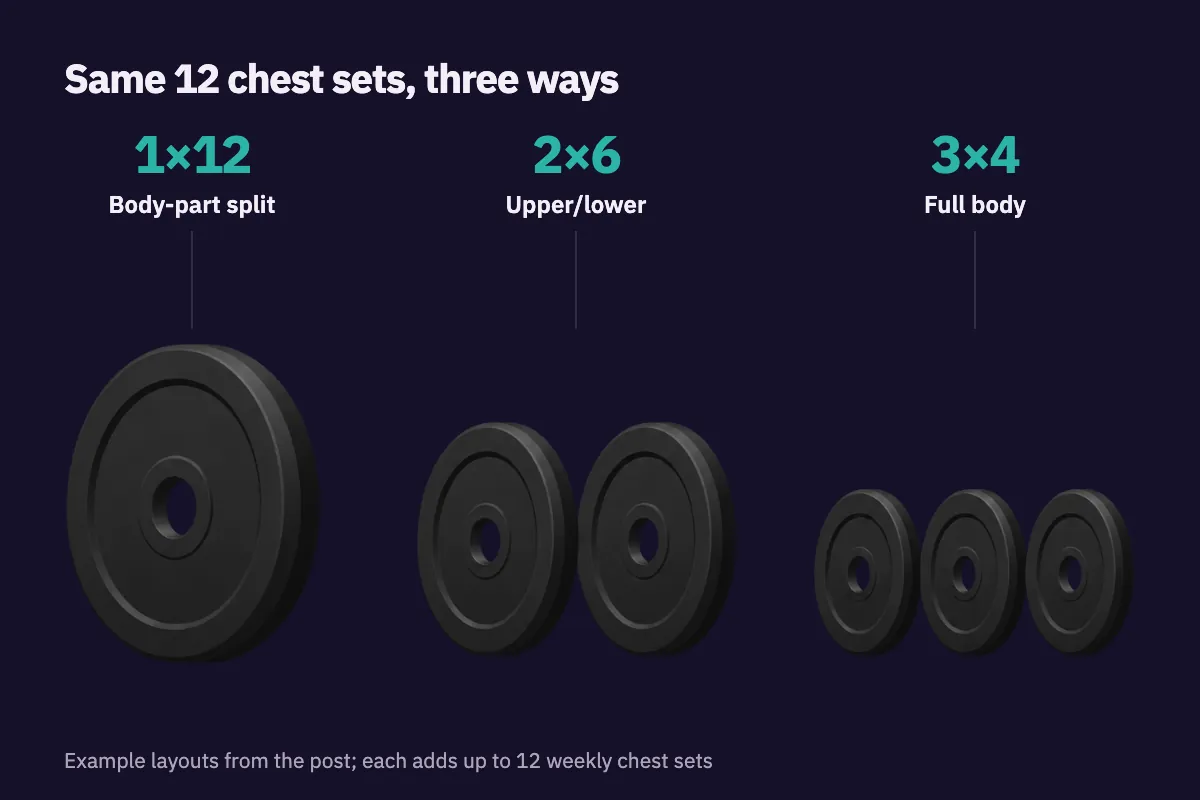
Frequency is the container; the weekly number of hard sets matters more.
The research above suggests these three would build broadly similar muscle if every set was equally productive. In practice they are not always equal. By the tenth or twelfth set for one muscle in a single session, fatigue often means fewer reps per set and lower quality work. That is the main practical case for spreading volume: six good sets twice a week are easier to do well than twelve in a row. The junk volume guide covers how growth scales with sets and where the returns flatten.
The reverse is also true. If adding sessions simply adds sets, your gains may improve, but the cause is the extra volume, not the frequency.
How many times a week should you train each muscle group?
Decide your weekly sets first, then choose a frequency that delivers them. These are practical rules of thumb, not research thresholds:
- Pick a weekly number of hard sets per muscle you can recover from. The ACSM overview links 10 or more sets a week with more growth, and many people start around there.
- Split it so no session has too many sets for one muscle. If your last sets for a muscle drop off sharply in reps, move some of them to another day.
- Fit the days you can actually train. Three days suits full body, four suits upper/lower, and five or six suits push/pull/legs run twice. The split comparison has example weeks for each.
- For strength goals, practise your main lifts at least twice a week.
- Keep the frequency once you choose it. Changing it every few weeks makes your log hard to compare.
How often each split trains a muscle (examples):
| Split | Days a week | Times each muscle is trained directly |
|---|---|---|
| Full body, fixed 3 days | 3 | 3 |
| Full body every other day (FBEOD) | About 3.5 | About 3.5 |
| Upper/lower, 4 days | 4 | 2 |
| Push/pull/legs run twice | 6 | 2 |
| Push/pull/legs run once | 3 | 1 |
| Body-part (“bro”) split | 5 | About 1 |
Popular frequency claims, tested
“Muscle protein synthesis only lasts 48 hours, so train every muscle every 48 hours.” The data behind this are small. In a 1995 study of six young men, muscle protein synthesis in the trained arm was more than double at 24 hours and nearly back to baseline by about 36 hours. That is a short-term measurement after one arm workout, not a growth outcome. The volume-equated trials above, which measured growth over weeks, do not show higher frequency winning at equal volume.
“Once a week is enough if you really destroy the muscle.” Training a muscle once a week does build muscle. Still, the 2016 analysis found twice a week did better than once in volume-equated comparisons, and very long single sessions make it hard to keep quality high. Once a week is workable, not superior.
“Train everything every day for maximum growth.” The Saric trial found 6 sessions a week no better than 3 at the same volume over 6 weeks. Daily training can work, but it is a scheduling choice, not a shortcut. The rest days guide looks at that question in detail.
How strong is the evidence?
Moderate for the main point and thin on the details. Most frequency studies lasted 6 to 12 weeks, many participants were young and untrained, and 79% of participants in the 2026 meta-regression were male. Long-term comparisons in experienced lifters, women and older adults are limited. Grgic’s analysis found a frequency effect on strength in women and young adults but not in men or older adults, from small subgroups. Treat twice a week as a well-supported default rather than a rule.
Common mistakes
- Raising frequency without checking volume. Going from 3 to 6 days can quietly double your sets. Decide the weekly sets first.
- Counting indirect work as a training day. Pressing adds some triceps work, but it is not the same as a direct triceps exercise.
- Cramming a whole week into one session. If reps fall off sharply after several sets, split the work across two days.
- Forgetting missed sessions. When each muscle is trained once a week, skipping one session costs that muscle a full week.
- Judging a frequency change after two weeks. Compare several weeks of data; the progressive overload guide shows what to compare.
Tracking frequency in FitArchive
FitArchive logs each set’s weight, reps and RIR. Its Progress screen shows weekly hard sets by muscle (1 set for the primary muscle, 0.5 for secondary muscles, counting working sets at 0 to 4 RIR) and training days per muscle per week, so you can see the frequency and volume your plan actually delivers. It includes Full body 3 day, Upper/Lower 4 day, Push/Pull/Legs 6 day and Body-part split 5 day templates that you can edit or replace with your own. Try it with sample data in the demo.