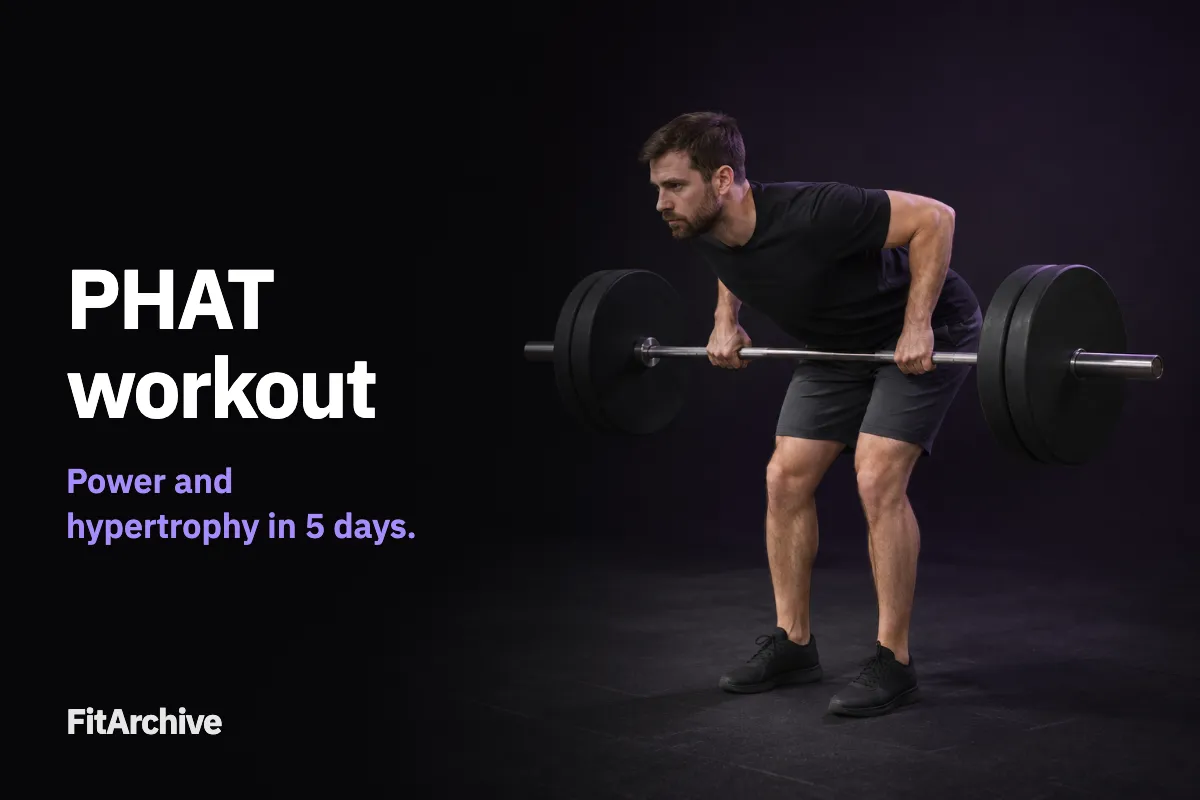
PHAT (Power Hypertrophy Adaptive Training) is a 5-day training split. You do two heavy power days early in the week, an upper and a lower, with sets of 3 to 5 reps on the main lifts, then three hypertrophy days: back and shoulders, legs, and chest and arms, mostly with 8 to 20 reps. Each muscle is trained twice a week, once heavy and once with more volume. It is built for intermediate and advanced lifters who want both strength and size. No study has tested PHAT itself, but research supports its main idea: heavy sets build strength best, and muscle grows across a wide range of reps.
This guide covers the original weekly layout, what speed sets are and how heavy they should be, a trimmed version that fits in less time, PHAT vs PHUL, and how to log and progress it.
The PHAT weekly layout
| Day | Session | Focus |
|---|---|---|
| 1 | Upper body power | Heavy rows, presses and pull-ups, 3-5 reps on the main lifts |
| 2 | Lower body power | Heavy squats and hinges, 3-5 reps on the main lifts |
| 3 | Rest | |
| 4 | Back and shoulders hypertrophy | Speed rows, then 8-20 reps |
| 5 | Lower body hypertrophy | Speed squats, then 8-20 reps |
| 6 | Chest and arms hypertrophy | Speed presses, then 8-20 reps |
| 7 | Rest |
On power days, the first exercise of each type is heavy (3 to 5 reps), with assistance work at 6 to 10 reps. Rest as long as you need on the heavy sets, often 3 to 5 minutes. On hypertrophy days, each session starts with speed sets of one main lift, then moves to higher-rep work with 1 to 2 minutes of rest. As published, the hypertrophy days carry more volume than the power days.
What are speed sets?
Speed sets open each hypertrophy day: 6 sets of 3 reps at about 65 to 70% of the weight you used for 3 to 5 reps on your power day, lifted as fast as you can with good form, with about 90 seconds of rest. If you rowed 100 kg for your power-day sets, speed rows use 65 to 70 kg. They are not heavy triples. If the bar slows down, the weight is too heavy.
Be clear about what they do. Fast lifts with moderate loads are a good way to train power: the 2026 ACSM position stand lists 30 to 70% of a one-rep max with fast lifting as what improves power. There is no good evidence that speed sets build extra muscle. If your goal is size and time is short, they are the first thing to drop.
Example PHAT program
This is FitArchive’s PHAT · 5 days template, a trimmed version of the original. It keeps the two power days and three hypertrophy days but uses fewer exercises, skips the speed sets and comes to 82 sets a week instead of well over 100. Numbers in brackets are target RIR.
Day 1: Upper power
| Exercise | Sets × reps | RIR |
|---|---|---|
| Barbell bench press | 3 × 3-5 | 2 |
| Barbell row | 3 × 3-5 | 2 |
| Overhead press | 3 × 5-8 | 2 |
| Pull-up | 2 × 5-8 | 2 |
| EZ-bar curl | 2 × 6-10 | 1 |
| Skull crusher | 2 × 6-10 | 1 |
Day 2: Lower power
| Exercise | Sets × reps | RIR |
|---|---|---|
| Back squat | 3 × 3-5 | 2 |
| Romanian deadlift | 3 × 5-8 | 2 |
| Leg press | 2 × 8-12 | 2 |
| Standing calf raise | 4 × 6-10 | 1 |
Day 4: Back and shoulders
| Exercise | Sets × reps | RIR |
|---|---|---|
| Barbell row | 3 × 6-10 | 2 |
| Lat pulldown | 3 × 8-12 | 2 |
| Seated cable row | 3 × 12 | 1 |
| Seated dumbbell shoulder press | 3 × 8-12 | 2 |
| Dumbbell lateral raise | 4 × 12 | 1 |
| Reverse pec deck | 3 × 12 | 1 |
Day 5: Lower hypertrophy
| Exercise | Sets × reps | RIR |
|---|---|---|
| Hack squat | 3 × 8-12 | 2 |
| Leg extension | 3 × 10-12 | 1 |
| Seated leg curl | 3 × 10-12 | 1 |
| Hip thrust | 3 × 8-12 | 2 |
| Seated calf raise | 4 × 12 | 1 |
Day 6: Chest and arms
| Exercise | Sets × reps | RIR |
|---|---|---|
| Incline dumbbell press | 4 × 8-12 | 2 |
| Cable fly | 3 × 12 | 1 |
| Cable lateral raise | 3 × 12 | 1 |
| Face pull | 2 × 12 | 1 |
| Incline dumbbell curl | 3 × 10-12 | 1 |
| Overhead cable triceps extension | 3 × 10-12 | 1 |
| Cable curl | 2 × 12 | 1 |
Differences from the original program: no speed sets; a barbell bench press instead of a dumbbell press on the power day; a Romanian deadlift instead of a stiff-legged deadlift; fewer exercises per day; no direct ab work. If you want speed sets, add them at the start of days 4, 5 and 6 using the 6 × 3 rule above. That adds 18 easy sets a week; remove one accessory set from each of those days to keep sessions manageable.
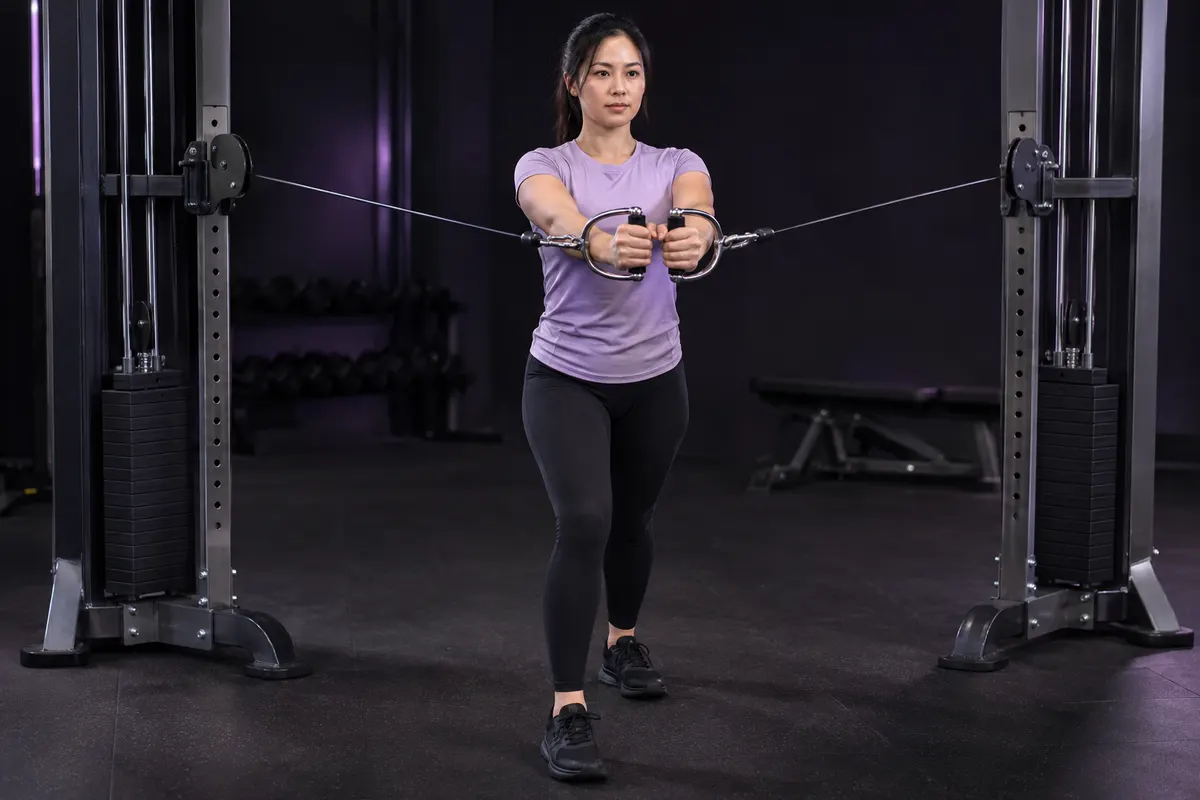
Hypertrophy days use lighter loads, more sets and shorter rests than power days.
Weekly sets per muscle in this version
| Muscle | Direct sets | Muscle | Direct sets |
|---|---|---|---|
| Chest | 10 | Biceps | 7, plus rows |
| Lats | 14 | Triceps | 5, plus presses |
| Upper back | 9 | Quads | 11 |
| Side delts | 7 | Hamstrings | 6 |
| Rear delts | 5 | Glutes | 9 |
| Front delts | 6 | Calves | 8 |
Rows and pulldowns give the biceps a lot of indirect work, and presses do the same for the triceps. Hamstrings are the lowest; add a set of leg curls on the lower power day if they are a priority. See how to count weekly sets.
PHAT as a 4-day program
Many people search for a 4-day PHAT. The common way is to merge the two upper hypertrophy days (back and shoulders, chest and arms) into one upper hypertrophy day, keeping only the most important exercise for each muscle. That gives upper power, lower power, rest, upper hypertrophy, lower hypertrophy. At that point it is very close to PHUL.
PHAT vs PHUL
| PHAT | PHUL | |
|---|---|---|
| Days per week | 5 | 4 |
| Power days | Upper and lower | Upper and lower |
| Hypertrophy days | Back and shoulders, legs, chest and arms | Upper and lower |
| Speed sets | Yes, in the original | No |
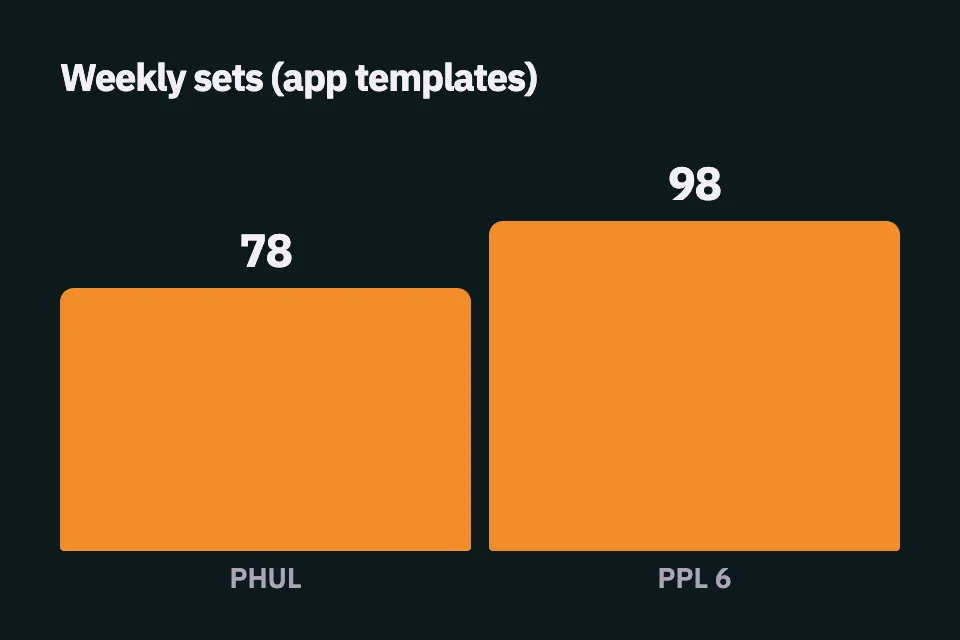
| Weekly volume | Higher | Lower |
| Sessions | Five, often 75 to 90 minutes | Four, often 60 to 75 minutes |
Both train each muscle twice a week, once heavy and once lighter. PHAT spreads the upper hypertrophy work across two days, so each muscle gets more sets. PHUL fits into four days. If you are unsure, start with PHUL; FitArchive includes both templates. For a 5-day option without dedicated power days, see the PPLUL split. Our PHUL vs PPL comparison explains PHUL in more detail.
What the research says
No study has tested PHAT by name. What the evidence says about its parts:
- Heavy sets build strength best; muscle grows across rep ranges. A 2017 meta-analysis of 21 studies found greater one-rep max gains with heavier loads but similar muscle growth with heavy and light loads taken to failure. A 2021 network meta-analysis found the same. See how many reps to build muscle.
- Mixing heavy and lighter days may help strength in trained lifters, not size. A 2022 meta-analysis found varying the load within the week (undulating periodization) gave somewhat larger strength gains than a linear plan, especially in trained people, but no difference in muscle growth.
- More volume helps, with diminishing returns. A 2026 meta-regression of 67 studies found size and strength rose with weekly sets, but each extra set added less. More is not always better.
- Failure slows recovery. A 2017 study found sets to failure slowed recovery for 24 to 48 hours, which matters because PHAT’s two power days are back to back. Stay 1 to 2 reps short of failure on the heavy lifts.
- Longer rest helps heavy work. In a 2016 study of trained men, 3-minute rests led to more strength and thigh growth than 1-minute rests. Do not rush power days. See rest between sets.
So PHAT is a sensible way to combine strength and size work, not a uniquely effective one.
Is PHAT good for beginners?
No. Five sessions with heavy triples and high volume are a lot to recover from, and beginners progress fast on far less. A 3-day full-body plan or upper/lower is a better start. PHAT fits lifters with at least a year or two of steady training who can give it five days.
How to progress and deload
- Power days: when every set reaches the top of that exercise’s rep range at the target RIR (5 reps on the main 3-5 rep lifts, 8 on the 5-8 rep lifts), add the smallest weight step.
- Hypertrophy days: use double progression: add reps up to the top of the range, then add weight.
- Speed sets: keep them at 65 to 70% of your current power-day weight. When your power-day weight rises, they rise too. The one-rep max chart helps you work out percentages.
- Rotate the main power exercise every few weeks if progress stalls, for example a barbell row to a chest-supported row.
- Deload when performance drops for more than a week or so, or plan one every 6 to 12 weeks. See how to log a deload week.
Run PHAT in FitArchive
FitArchive includes the PHAT · 5 days template shown above, along with PHUL · 4 days if you want the shorter option. Pick it, swap exercises to match your gym, and start logging. Each set records weight, reps and RIR, so heavy days and speed sets are easy to tell apart, and the rest timer helps you keep power-day rests long. FitArchive suggests when to add weight or reps, and the Progress screen shows estimated one-rep max for every lift and weekly hard sets for every muscle. You can pin sessions to weekdays, and after each workout the next one in the rotation is suggested.
Get FitArchive free on iPhone or Android. Logging and your full history are free, with no ads.