Working out every day can be fine, as long as you are not training the same muscles hard on consecutive days. After a hard session, a muscle typically needs about 24 to 72 hours before it performs at its best again: closer to a day after moderate sets that stop short of failure, and two to three days or more after many sets taken to failure. Most lifters do well with one to three full rest days a week, but no study sets an exact number. The best guide is your performance trend at the same load and effort, not soreness alone.
Two claims compete online. One says muscles only grow on rest days, so never train two days in a row. The other says rest days are for people who are not serious. This article looks at what recovery means for a muscle, what studies on training frequency found, and how to read your log to decide whether you need more rest.
If you are looking for rest between sets rather than between workouts, see rest between sets.
What happens to a muscle between workouts?
A hard session leaves a muscle temporarily weaker and starts a repair and building process that runs for a day or more.
- Muscle building rises and then falls. In a small 1995 study of 6 young men who did 12 heavy sets of curl-type exercises for one arm, muscle protein building was more than double at 24 hours and had nearly returned to baseline by about 36 hours. That is one small study on one muscle, but it shows the building response is not a week-long window.
- Performance takes longer after sets to failure. In a 2017 study, 10 trained men did bench press and squat sessions using their 10-rep-max load in three ways: 3 sets of 5, 6 sets of 5, or 3 sets of 10 to failure. Measured over 72 hours, bar speed and jump height recovered significantly faster after the two non-failure sessions. Going to failure in every set slowed recovery by up to 24 to 48 hours, even compared with the same total reps spread over 6 sets.
So “recovered” is not one moment. Fatigue fades, repair continues, and how long it takes depends on how many hard sets you did, how close to failure they were, whether the exercise was new to you, and how well you slept and ate.
How many rest days between workouts for the same muscle?
This table is a rough guide based on the studies above and common practice, not a rule. Individual recovery varies:
| Session for that muscle | Typical time before training it hard again |
|---|---|
| A few sets, stopped 2 to 3 reps short of failure | About 24 to 48 hours |
| Moderate to high volume, most sets 1 to 2 reps short of failure | About 48 hours |
| Many sets to failure, a new exercise, or a lot of lowering under load | About 48 to 72 hours or more |
A 2016 meta-analysis found that training a muscle at least twice a week produced more growth than once a week, which fits a rhythm of two or three days between sessions for the same muscle. Our article on how often to train each muscle covers frequency in more depth.
Is it OK to work out every day?
It depends on what “every day” means.
Training daily with a split. If Monday is legs, Tuesday upper body and so on, each muscle still gets days off. This is how a 6-day push/pull/legs program works: each muscle is trained about twice a week, with rest in between.
Training the same muscles every day. This has been tested, but with total weekly volume held equal:
- In a 2019 trial, 27 trained men did the same weekly sets either over 3 sessions or spread across 6. After 6 weeks, strength and muscle thickness gains were similar.
- In a 2018 trial, 28 trained men followed 3 or 6 weekly sessions with volume and intensity equated. Strength and fat-free mass increased similarly.
- A 2019 meta-analysis of 25 studies found no significant difference in muscle growth between frequencies when weekly volume was equated. A 2026 meta-regression found frequency had little effect on growth once volume was accounted for, while strength gains did rise with frequency.
Note what these studies did: they spread a normal week’s sets across more days, so each session was shorter. They did not test doing a full, hard session for the same muscle every day, and they lasted only 6 weeks in young trained men. Training the same muscle to failure daily runs into the recovery times above, and the 2017 recovery study suggests you would start many sessions not fully recovered.
How many rest days a week do you need?
There is no evidence-based number of rest days that suits everyone. The 2026 ACSM position stand, an overview of 137 systematic reviews, found strength improved with 2 or more sessions a week and muscle growth with 10 or more sets per muscle a week. Many schedules meet that. FitArchive’s built-in plan templates show the range:
| Template | Training days | Full rest days | How often each muscle is trained |
|---|---|---|---|
| Full body | 3 | 4 | About 3 times a week |
| Upper/Lower | 4 | 3 | About twice a week |
| Body-part split | 5 | 2 | Mostly once a week |
| Push/Pull/Legs | 6 | 1 | About twice a week |
Choose the schedule you can repeat for months. For a fuller comparison of these splits, see push pull legs vs upper lower vs full body.
Signs you need more rest
Soreness alone is a poor guide. You can be sore and still perform well, and you can be under-recovered with no soreness at all. Our muscle soreness guide covers that in detail. More useful signs:
- Performance drops at the same load and effort. For example, the reps you can do with the same weight at the same reps in reserve fall across two or three comparable sessions.
- Usual weights feel much heavier. Your RIR estimates drift: a weight that used to leave 2 reps in reserve now leaves 0.
- Joint or tendon aches build up from week to week.
- Sleep, mood or motivation slide along with performance.
One bad session is noise. A trend across several sessions is a signal. Before blaming training, check other explanations: shorter sleep, an energy deficit, illness, stress, or a change in exercise or rest times. Sharp or worsening pain is a reason to stop that exercise and get qualified advice.
Overtraining or just under-recovered?
“Overtraining” is used loosely in the gym. The 2013 joint consensus statement from the European College of Sport Science and the American College of Sports Medicine separates three stages:
- Functional overreaching: a short-term performance dip from hard training that leads to improvement after recovery. Often planned.
- Non-functional overreaching: a longer performance drop that takes weeks to recover from, without a later benefit.
- Overtraining syndrome: prolonged maladaptation with performance decline lasting much longer, often with mood disturbances. It is diagnosed by excluding other causes such as illness, low energy intake or iron deficiency, and no single test or marker confirms it.
Most recreational lifters who feel flat for a week are under-recovered, not overtrained. A lighter week, more sleep and enough food usually fix it. If performance and well-being stay down for weeks despite rest, see a doctor to rule out other causes. A planned deload week is one way to build lighter periods in before problems appear.
What to do on rest days
- Move lightly. Walking, easy cycling or swimming keep you active without adding much fatigue. A 2018 meta-analysis of 99 studies found active recovery reduced muscle soreness somewhat, with massage the most effective method for soreness and perceived fatigue. These are short-term comfort measures, not proof of extra muscle growth.
- Sleep. Our article on sleep and muscle growth covers the evidence.
- Eat normally. Rest days are not the day to under-eat protein.
- Do mobility or technique work with light loads if you enjoy it.
How your log shows recovery: an example
These are invented log entries, not suggested loads. They show one lifter who added an extra hard upper-body day:
| Session | Bench press | Effort | Days since last chest session | Note |
|---|---|---|---|---|
| Mon | 60 kg × 8, × 8, × 7 | 2 RIR | 3 | Normal |
| Tue | 60 kg × 6, × 6, × 5 | 2 RIR | 1 | Extra session, sets to failure on Mon |
| Thu | 60 kg × 8, × 8, × 8 | 2 RIR | 2 | Back to normal |
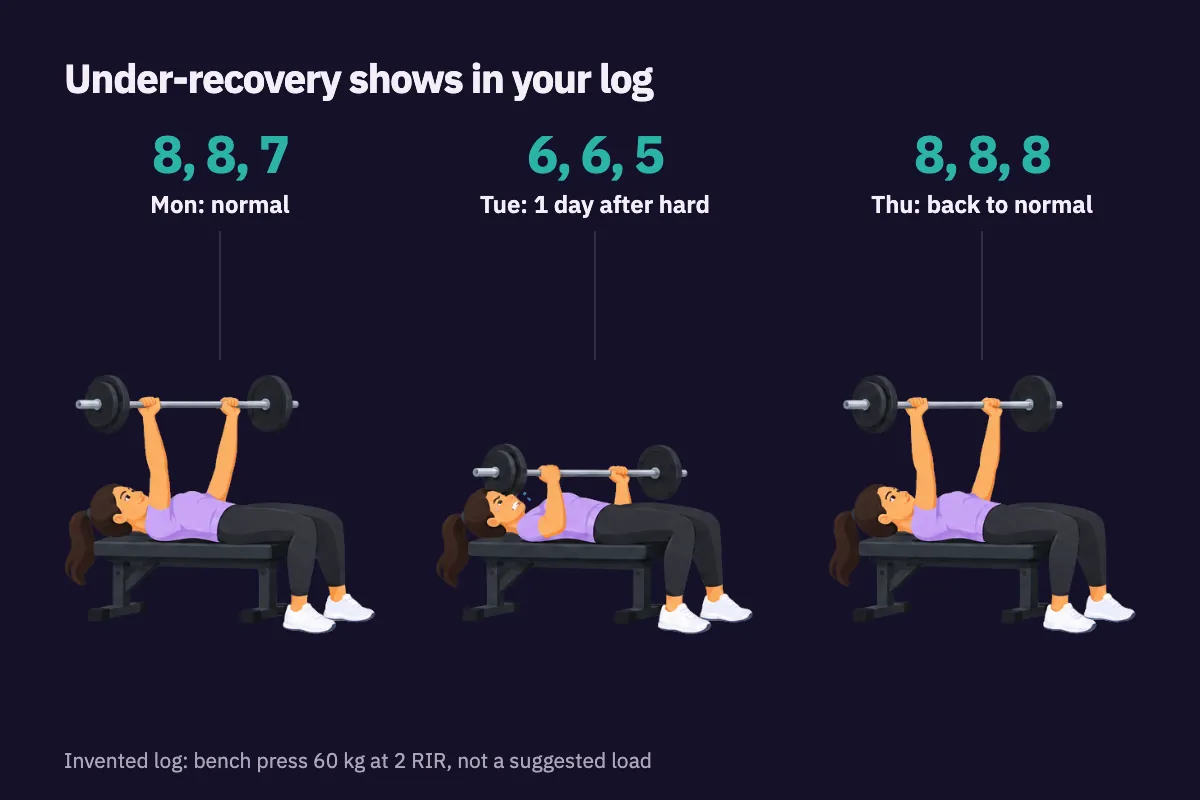
Same load and effort, fewer reps the day after a hard session.
Same load, same effort, fewer reps the day after a hard session: that is under-recovery showing up in numbers. Two days later, reps return. If this pattern repeats, more space between sessions for that muscle, or fewer sets to failure, is a reasonable change to try.
Common mistakes
- Using soreness as the only signal for whether to train.
- Forgetting overlap between days. Deadlifts on leg day also work the back, and presses on push day also work the triceps.
- Adding training days without removing anything, so weekly volume and fatigue both climb.
- Taking every rest day as a sign of weakness. Rest is where the work pays off.
- Changing several things at once after a bad week, so you cannot tell which change helped.
Tracking rest and recovery in FitArchive
FitArchive is a free, private training log that works in your browser and offline; your data stays on your device unless you sign in to sync. It records the weight, reps and RIR of every set, so you can compare sessions at the same load and effort. The Progress screen counts weekly hard sets by muscle and training days per muscle per week, which shows how often each muscle actually got worked and how much rest it had. Use the workout notes for sleep, illness or an extra session. Try it with sample data in the demo.