PHUL vs PPL comes down to days and rep ranges. PHUL (Power Hypertrophy Upper Lower) is a 4-day split: an upper and a lower day with heavy, low-rep lifts, then an upper and a lower day with moderate reps. PPL (push, pull, legs) usually runs 6 days and mostly uses moderate reps. Both train each muscle twice a week, and research suggests weekly hard sets, not the split’s name, drive most muscle growth. Choose PHUL if you have 4 days and want heavy strength work built in; choose PPL if you can train 6 days and prefer shorter, more even sessions.
People searching “PHUL vs PPL” usually want one answer: which one should I run? This guide compares them on days, rep ranges, weekly sets per muscle and session length, shows an example PHUL week, and summarises what the evidence can and cannot say.
What is PHUL?
PHUL stands for Power Hypertrophy Upper Lower. It is an upper/lower split with a twist: the first two sessions of the week are “power” days built around heavy compound lifts for low reps (about 3 to 8 on the main lifts), and the last two are “hypertrophy” days with more exercises in the 8 to 15 rep range.
| Day | PHUL |
|---|---|
| Mon | Upper power |
| Tue | Lower power |
| Wed | Rest |
| Thu | Upper hypertrophy |
| Fri | Lower hypertrophy |
| Sat | Rest |
| Sun | Rest |
Each muscle gets two sessions a week, one heavy and one lighter. The PHAT workout extends this power-and-hypertrophy structure to five sessions. That mix is the main reason people choose it: it borrows from strength training and bodybuilding at the same time.
What is PPL?
PPL groups muscles by movement: push (chest, shoulders, triceps), pull (back, biceps, rear delts) and legs. Run twice through, it takes six days and trains each muscle twice a week. Run once, it takes three days and trains each muscle once. Most PPL programs use moderate reps (about 6 to 15) on every day rather than separate heavy days. Our PPL vs Arnold split guide covers PPL’s layout in more detail.
PHUL vs PPL compared
| PHUL (4 days) | PPL (6 days) | PPL (3 days) | |
|---|---|---|---|
| Training days per week | 4 | 6 | 3 |
| Sessions per muscle per week | 2 | 2 | 1 |
| Rep ranges | Heavy (3–8) main lifts on power days, 8–15 on hypertrophy days | Mostly 6–15 | Mostly 6–15 |
| Session length | Longer: more muscles per session | Shorter: fewer muscles per session | Long, to fit enough weekly sets |
| Rest days | 3 | 1 | 4 |
| Best for | Strength and size together, 4 days available | Size, 6 days available, even sessions | Busy weeks, accepting lower frequency |
Weekly sets per muscle: FitArchive’s templates compared
Both splits exist as templates in FitArchive’s plan library. These totals count working sets only (warm-ups excluded) and are example totals from the templates, not targets.
| PHUL · 4 days template | Push/Pull/Legs · 6 days template | |
|---|---|---|
| Sessions per week | 4 | 6 |
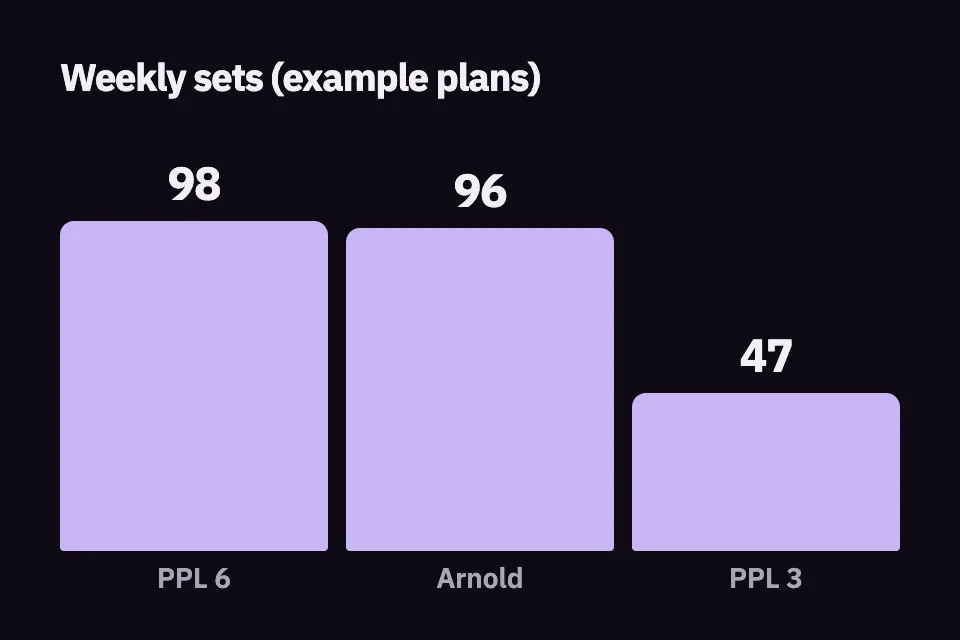
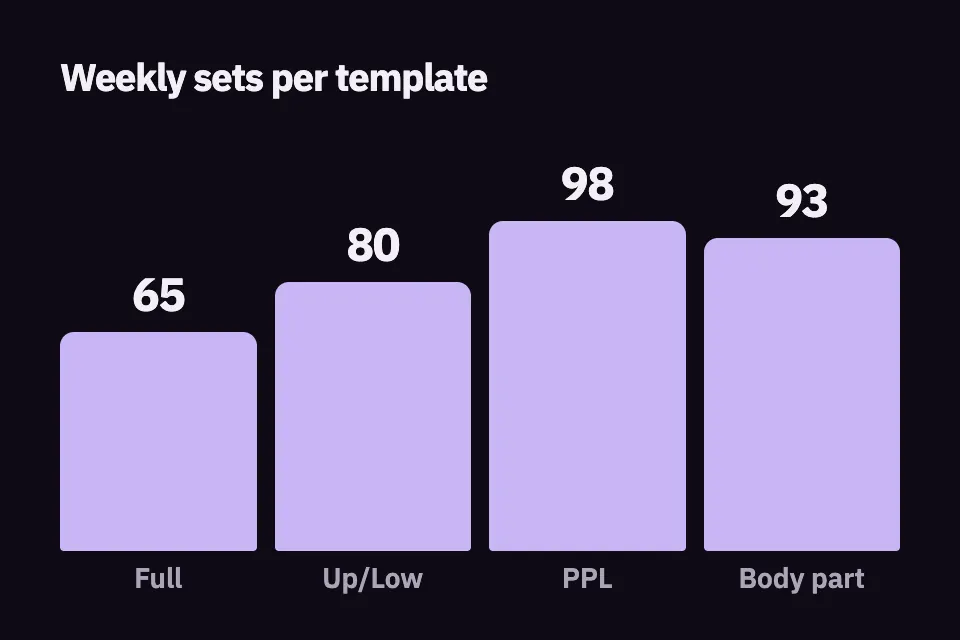
| Total working sets per week | 78 | 98 |
| Average working sets per session | about 20 | about 16 |
So the six-day plan does more total work, spread over more sessions with fewer sets each; PHUL fits a little less work into fewer, bigger sessions. Either can be adjusted: the names do not decide the numbers, your exercise and set choices do. See how to count weekly sets per muscle to check any plan.
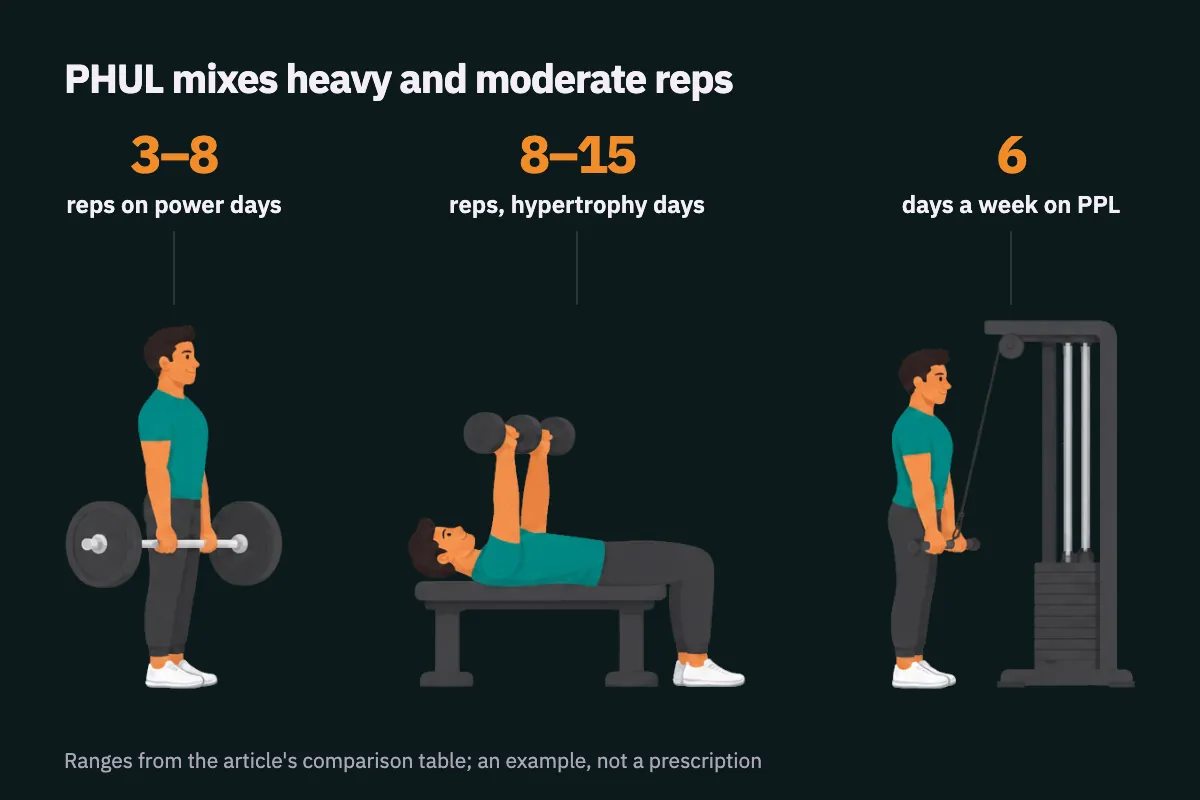
Heavy compound lifts anchor PHUL’s power days; PPL spreads moderate-rep work over six days.
Which builds more muscle? What research says
No study has compared PHUL and PPL directly, so the evidence is indirect:
- Weekly volume matters most. A 2026 meta-regression of 67 studies found muscle growth rose with weekly sets, with diminishing returns, while frequency had little identifiable effect once volume was counted.
- Frequency at equal volume makes little difference. A 2019 meta-analysis and a 2026 preprint meta-analysis of 16 volume-equated trials (low-certainty evidence) found no clear growth difference between 1, 2 or 3 sessions per muscle per week. Both splits (with six-day PPL) already train each muscle twice.
- Heavy and moderate loads build similar muscle; heavy loads build more max strength. A 2017 meta-analysis found similar growth across load ranges when sets were taken to failure, but larger 1RM gains with heavy loads. That is the real argument for PHUL’s power days: if you care about your squat, bench or deadlift max, PHUL practises heavy lifting twice a week.
Our research update for November 2026 covers the newest studies on volume, load and frequency.
Who should pick PHUL, and who PPL?
Pick PHUL if:
- You can reliably train 4 days a week, but not 6.
- You want to get stronger on the main barbell lifts while building muscle.
- You prefer longer sessions with more rest days in between.
Pick PPL (6 days) if:
- You can train 6 days most weeks and recover well (sleep, food, stress).
- You prefer shorter sessions focused on fewer muscles.
- Your goal is mainly muscle size and you do not need heavy singles or triples.
Neither? With 3 days, full body every other day or a plain upper/lower split usually gives more frequency than a once-through PPL.
Example PHUL week
This is FitArchive’s PHUL · 4 days template (sets × reps; most compounds at about 2 reps in reserve, isolation at about 1):
| Day | Exercises |
|---|---|
| Upper power | Barbell bench press 4 × 4–6, barbell row 4 × 5–8, overhead press 3 × 5–8, dumbbell lateral raise 4 × 10–12, EZ-bar curl 2 × 6–10, skull crusher 2 × 6–10 |
| Lower power | Back squat 4 × 4–6, deadlift 3 × 3–5, leg press 3 × 10–12, lying leg curl 3 × 6–10, standing calf raise 4 × 8–12 |
| Upper hypertrophy | Incline dumbbell press 3 × 8–12, cable fly 3 × 12, lat pulldown 4 × 8–12, seated cable row 3 × 10–12, cable lateral raise 3 × 12, reverse pec deck 3 × 12, incline dumbbell curl 2 × 10–12, triceps pushdown 2 × 10–12 |
| Lower hypertrophy | Hack squat 3 × 8–12, Romanian deadlift 3 × 8–12, leg extension 3 × 10–12, seated leg curl 3 × 10–12, seated calf raise 4 × 12, cable crunch 3 × 10–12 |
Short on time? Cut every exercise to 2 sets. Sessions get much shorter and each muscle still trains twice a week; weekly sets drop, so add a set back to any muscle that stops progressing. Use double progression on every exercise: add reps within the range, then add weight.
Common mistakes
- Treating power days as max-out days. Heavy sets should still leave a rep or two in reserve; grinding singles every week adds fatigue fast.
- Running six-day PPL on a four-day schedule. Missed sessions leave some muscles trained only once that week.
- Adding too much volume at once. A 2026 trial in 25 trained adults found a +120% jump in weekly leg sets grew no more quadriceps than +20% over 8 weeks.
- Judging a split after two weeks. Give any plan 8 to 12 weeks of consistent logging before deciding it does not work.
Running PHUL or PPL in FitArchive
FitArchive includes both the PHUL · 4 days and Push/Pull/Legs · 6 days templates in its plan library. Pick one, swap any exercise for your equipment, and log each set’s weight, reps and reps in reserve. The Progress screen shows weekly hard sets per muscle and how many days each muscle was trained, so you can see what your split actually delivers. Try it with sample data in the demo.