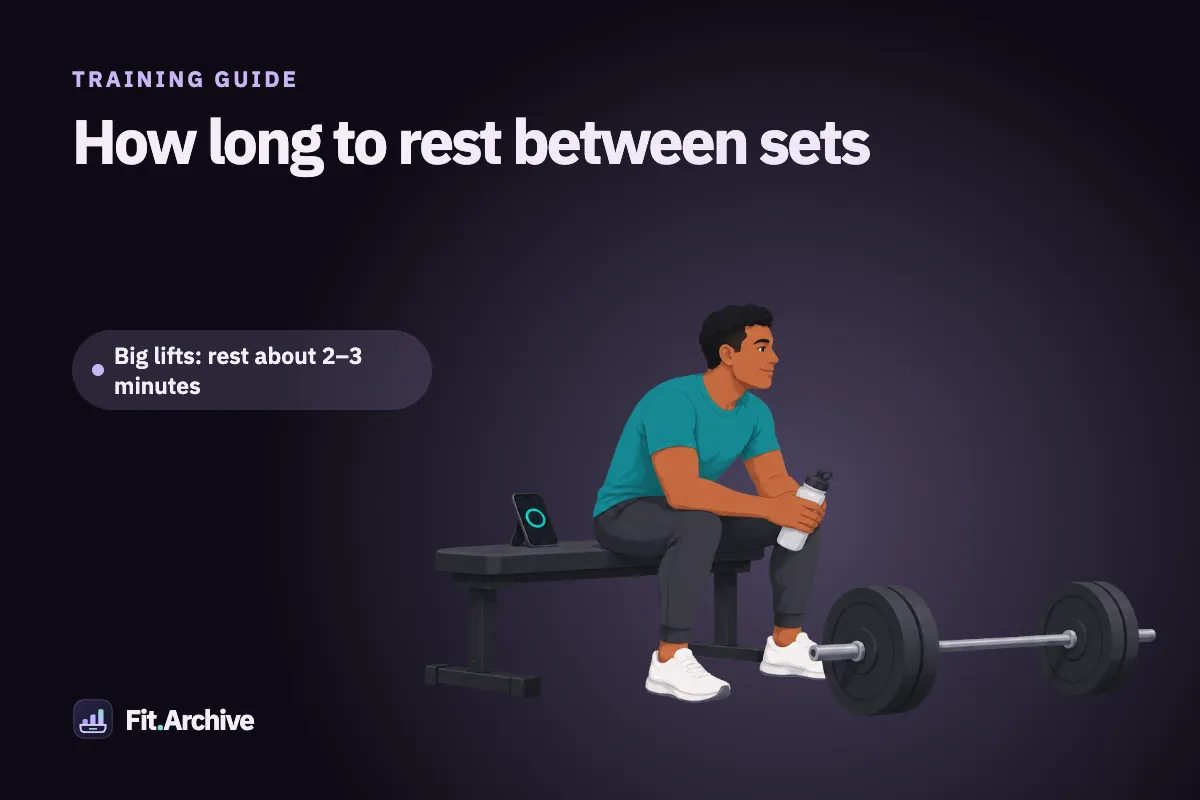
For most strength and muscle-building work, evidence suggests resting roughly 2–3 minutes between sets of heavy compound lifts and about 1–2 minutes for smaller exercises; very short breaks of a minute or less tend to cost reps. Whatever you choose, keep it roughly consistent and write it down, because a change in rest can change your reps without any change in strength.
How long should you rest between sets?
There is no single correct timer. Research and guidelines point to ranges that depend on the exercise and what you want from it. The table below summarizes the general direction of the evidence; it is a starting point, not a prescription.
| Goal or exercise type | Commonly suggested rest | Where the guidance comes from |
|---|---|---|
| Heavy strength work (roughly 1–6 reps) | About 3–5 minutes | ACSM 2009 position stand |
| Muscle growth, moderate reps (roughly 6–12) | About 1–2 minutes in the 2009 stand; later reviews suggest longer than 60–90 seconds may help | ACSM 2009, Singer et al., 2024 |
| Strength in experienced lifters | Longer than 2 minutes appears to help maximize gains | Grgic et al., 2018 |
| Strength in newer lifters | About 60–120 seconds appears sufficient | Grgic et al., 2018 |
| Local muscular endurance (light loads, 15+ reps) | Under about 90 seconds | ACSM 2009 |
A practical default many lifters use: around 2–3 minutes for squats, deadlifts, presses and rows, and around 1–2 minutes for curls, raises and other single-joint work. If you are still breathing hard or your next set would start with noticeably worse technique, that is a reasonable sign to wait a little longer.
What the research actually tested
The most cited head-to-head study is a randomized trial in 21 young resistance-trained men. Over 8 weeks, one group rested 1 minute between sets and the other 3 minutes, with everything else held the same (3 sets of 8–12 reps on 7 exercises, three times a week). The 3-minute group gained more 1RM strength on the squat and bench press and more thigh muscle thickness. It is one small study in one population, so it does not prove three minutes is ideal for everyone or every exercise.
Reviews give a broader picture:
- A 2018 systematic review of 23 studies on strength concluded that robust strength gains are possible even with short rest, but longer rest (over 2 minutes) seems to maximize strength gains in trained lifters, while 60–120 seconds appeared sufficient for untrained people.
- A 2017 review on muscle size found both short and long rest could support hypertrophy, with a possible advantage for longer rest in trained participants, and called for more research.
- A 2024 Bayesian meta-analysis of 9 studies suggested a small hypertrophy benefit from resting more than 60 seconds, likely because shorter rest reduces the work you can do, but found no appreciable extra benefit beyond about 90 seconds.
The common thread is mechanical rather than magical: short rest tends to reduce the reps and load you manage on later sets. That is exactly why rest belongs in your log.
Is one minute of rest between sets enough?
For isolation exercises, light accessories, or deliberately conditioning-style work, a minute can be fine. For heavy compound lifts, evidence suggests one minute often limits how much work you can do on the following sets, and the studies above lean toward longer breaks when strength or muscle gain is the priority. If you are short on time, supersets of non-competing exercises (for example, a press paired with a row) are one way to save time without cutting rest for each muscle as much.
Is resting longer than 3 minutes a waste of time?
Not necessarily. Heavy, low-rep sets of big lifts are often rested 3–5 minutes, and the ACSM 2009 stand lists that range for strength. For moderate-rep hypertrophy work, the 2024 meta-analysis did not find meaningful extra benefit beyond about 90 seconds, so very long breaks there mainly cost time. The 2026 ACSM position stand also found that relatively few prescription variables consistently changed outcomes, which supports choosing a sustainable range over chasing an exact number.
Why rest time belongs in your workout log
When you compare one session with another, you are assuming the conditions were similar. Rest is one of those conditions. These are illustrative entries, not real results, for the first working set of the same exercise:
| Day | Rest before set | Result | Cautious reading |
|---|---|---|---|
| A | About 3 minutes | 50 kg × 10 @ 2 RIR | Reference entry. |
| B | About 1 minute | 50 kg × 8 @ 1 RIR | Shorter rest may help explain fewer reps; this is not clear evidence of a strength loss. |
| C | About 3 minutes | 50 kg × 11 @ 2 RIR | More comparable with A than B is. |
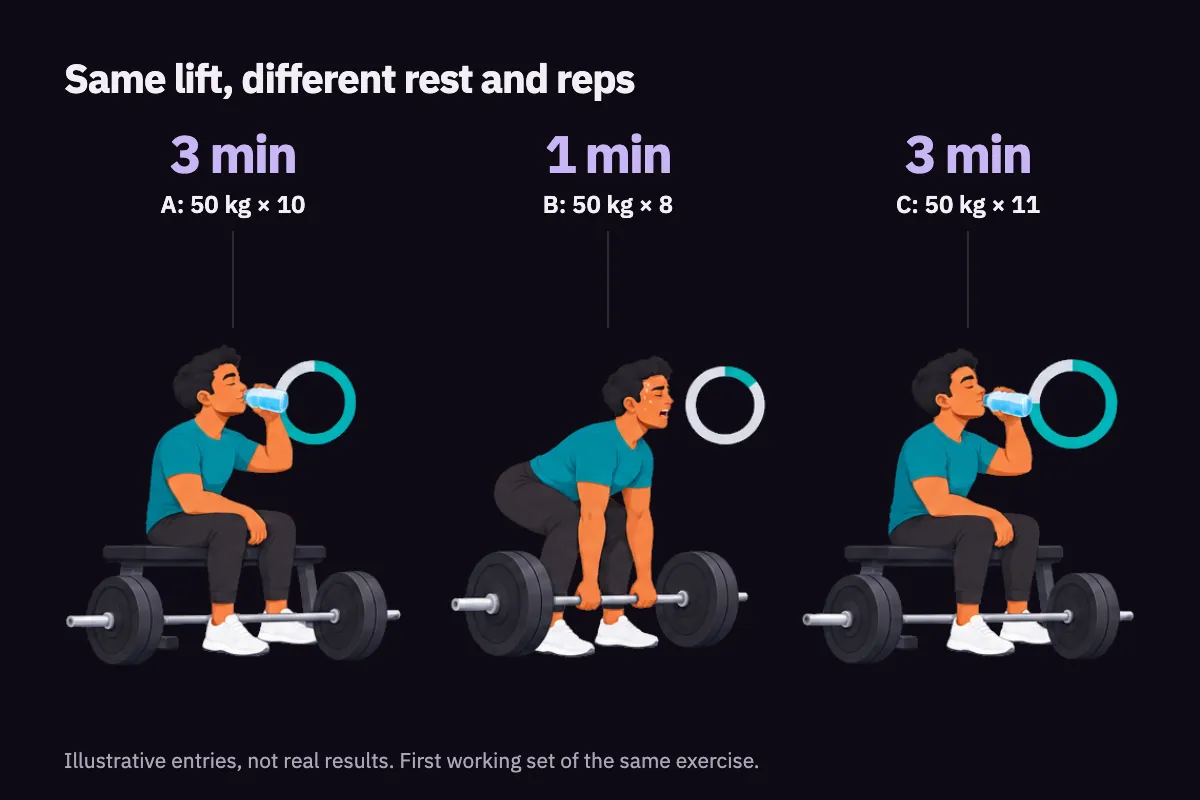
Compare Day C with Day A: the rest was similar.
Read on its own, Day B looks like a bad session or the start of a strength plateau. With rest noted, it is simply a different condition. Day C, with similar rest to Day A, is the fairer comparison and shows one more rep at the same effort.
RIR is an estimate, and a 2022 meta-analysis found lifters tend to misjudge reps to failure by about one rep on average, with wide variation. Rest context helps you avoid stacking another unknown on top of that. The RIR logging guide covers that effort field in more detail.
How to record rest without a stopwatch diary
You need a consistent convention, not second-by-second precision:
- Decide your normal range per exercise. For example, “about 3 minutes” for squats and “about 90 seconds” for curls. Write it once in your plan or workout log template.
- Note only the exceptions. Use short tags such as
~1 min,short,long, orinterruptedwhen a break was clearly different from normal. - Note related changes too. If a crowded gym changed your exercise order, machine, or pairing, write that down. These affect comparisons in the same way rest does.
- Compare like with like. When tracking progressive overload, compare sets done under similar rest. If you change your rest on purpose, treat the next session as a new reference point.
Common mistakes
- Treating one study’s number as a law. Three minutes outperformed one minute in one trial of trained men. That supports “not too short” for heavy work, not “exactly three minutes for everything.”
- Cutting rest to make a session feel harder. Shorter rest can raise how tired you feel while reducing the work you complete. If the purpose of the session is strength or muscle, that trade may work against you.
- Changing rest and load at the same time. If both change, you cannot tell which one moved your reps. Change one thing and note it, as in double progression.
- Ignoring rest when reading weekly totals. Sets done on very short rest may be lower quality. Keep that in mind when counting weekly sets.
- Pushing through warning signs. Needing longer rest is normal. Dizziness, chest pain, or unusual breathlessness are not; stop and seek medical advice.
Recording rest in FitArchive
In the FitArchive log, you can set a rest time for each exercise in your plan; after you complete a set, a countdown starts, and you can trim or extend it. The app does not store your actual break for each set, so when rest was clearly different from your normal (shorter, interrupted, a changed pairing), add a quick line to the workout notes before you judge the session against last time.