A deload week is a planned, temporary reduction in training stress, usually about a week of fewer sets, lighter loads, more reps in reserve, or some combination, so you can manage fatigue before the next block. If you take one, label it in your log and record exactly what you reduced. Without that label, a progress chart can make a deliberately easier week look like an unexplained drop in performance.
This guide covers what a deload is, how lifters typically do one, what the research says about losing progress, and how to log it so the weeks around it still compare cleanly.
What is a deload week?
An international Delphi consensus of strength and physique coaches proposed this definition: “Deloading is a period of reduced training stress designed to mitigate physiological and psychological fatigue, promote recovery, and enhance preparedness for subsequent training.” Note what that does and does not say. A deload is a planned lighter period, not necessarily a week off, and it is defined by its purpose rather than by one fixed recipe.
The word is used loosely. Some people mean a lighter week inside a training block; others use it for a taper before competition, a reduced week while travelling, or simply a week off. A survey of strength and conditioning coaches found varied practices across those situations, with volume reduced more often than load. It describes what coaches reported, not proof that one template is best. The 2026 ACSM evidence overview supports progressive resistance training but does not set a mandatory deload interval for healthy adults.
How often should you deload?
There is no evidence-based schedule that fits everyone. The best descriptive data come from a 2024 survey of 246 competitive strength and physique athletes: on average their deloads lasted about 6 days (6.4 ± 1.7) and came roughly every 5 to 6 weeks (5.6 ± 2.3). Most planned them in advance, sometimes combined with an as-needed approach, and many also deloaded when performance stalled or soreness and joint aches built up.
Those are averages from experienced competitors describing their own habits, not a prescription. The spread is wide, and a recreational lifter on a moderate program may need deloads less often or not at all. If you follow a coach or a written program, use its schedule. If you have a rehabilitation plan, follow that instead of any generic rule.
How to deload: what to reduce
The same athlete survey found that during a deload most people:
- reduced volume, by doing fewer sets per week and fewer reps per set;
- reduced load, lifting less weight;
- reduced effort, finishing sets with more reps in reserve;
- kept the same training frequency and generally the same exercises.
Coaches in the coach survey most often reported cutting volume, and the most commonly reported cut was 0 to 25%. Those coaches mostly worked with athletes around competition and travel, so their numbers may not transfer to a gym program. None of these figures is a proven optimum. In practice, pick one or two variables to reduce, decide the amount before the week starts, and write it down. If you track RIR, a deload is a good time to keep recording it: the point is that sets end farther from your limit than usual.
Do you lose gains during a deload?
The direct research is still small:
- In a 2024 randomized trial, 39 trained young adults followed a 9-week program; one group stopped training entirely for one week at the midpoint. Gains in lower-body muscle size, power and local endurance were similar between groups, but the group that trained continuously gained more lower-body strength.
- In a 2026 within-subject study of 19 untrained young men, one limb trained continuously for 8 weeks while the other had reduced-volume, reduced-frequency weeks at weeks 4 and 8. Muscle thickness and 10-rep-max gains were similar between conditions.
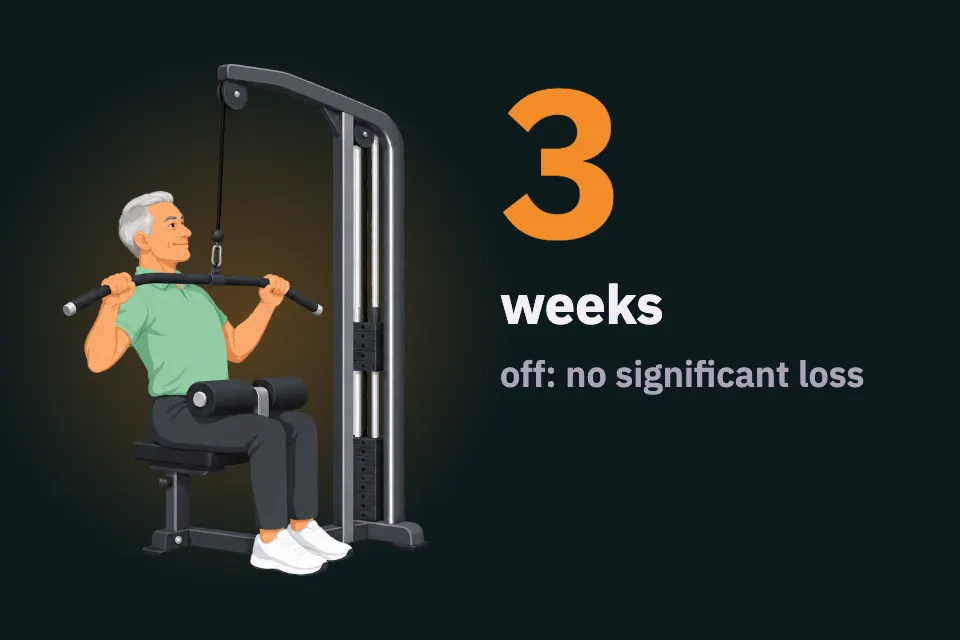
Taken together, these suggest a short deload is unlikely to undo muscle growth over a few months, and there is no strong evidence that it boosts growth either. The first study’s “deload” was a full week off, which is not how most lifters deload, and both studies were short. Treat the evidence as limited.
Signs you might need a deload
The athlete survey and the coach consensus both describe deloads being used when fatigue builds: performance stalls across several sessions, soreness or joint aches persist, or motivation drops. These are judgement calls, not diagnostic tests. One bad workout is not a sign; a pattern across comparable sessions might be. Before deciding, check your log for other explanations such as shorter rest, poor sleep, an exercise change or a calorie deficit. The plateau audit guide walks through that check.
Pain is different. Sharp, worsening or persistent pain is a reason to stop the exercise and get qualified advice, not something a deload is designed to fix. This article is not medical guidance.
How to log a deload week: one example
These are invented log entries, not suggested loads:
| Week | Row exercise | Working sets | Effort note | How to tag it |
|---|---|---|---|---|
| 1 | 40 kg × 10 | 3 | Around 2 RIR | Regular week |
| 2 | 35 kg × 8 | 2 | Around 4 to 5 RIR | Planned deload: load and sets reduced |
| 3 | 40 kg × 10 | 3 | Around 2 RIR | Return to regular comparison |
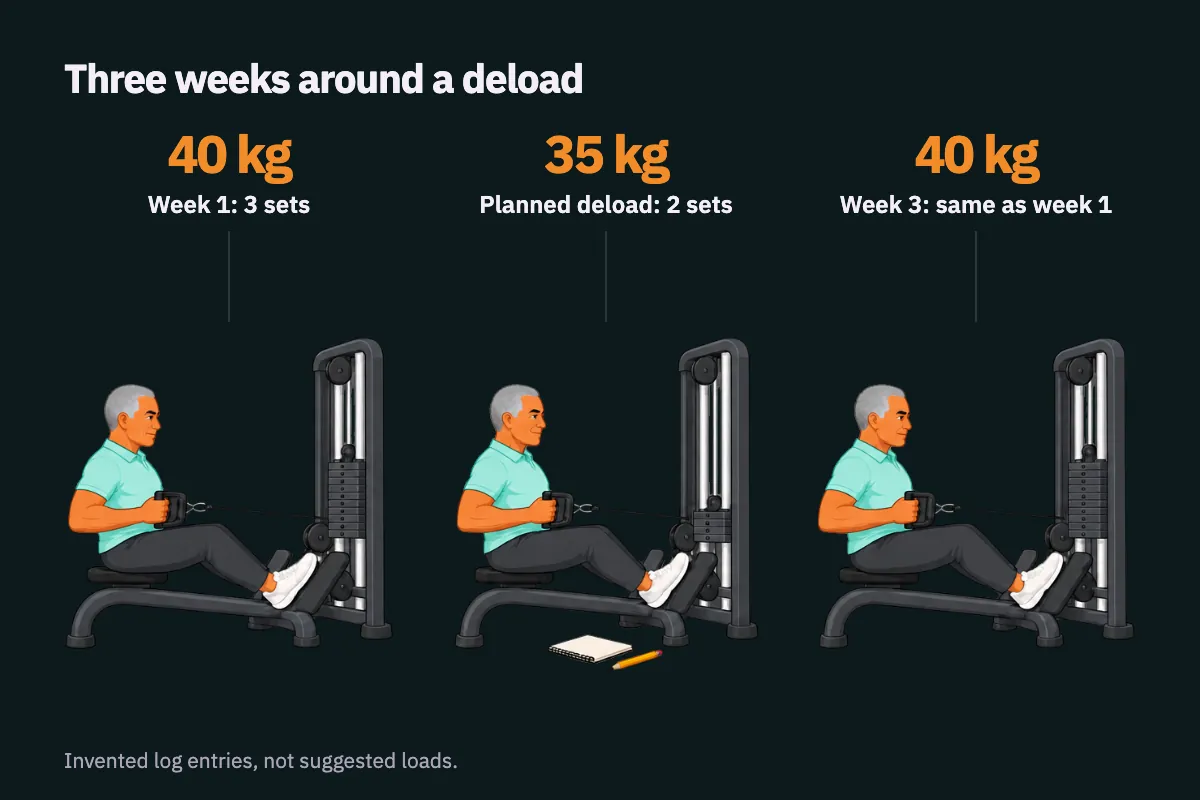
Keep the lighter week in the log, and compare week 3 with week 1.
Week 2’s smaller numbers were chosen in advance. Do not compare its top set with week 1 as though both tested the same target. Keep the actual sets in the record anyway; deleting them hides what happened and makes your weekly volume look like you skipped a week. Compare week 3 with week 1, while noting any changes in technique, rest or exercise variation.
What to write:
- A session note before you start, such as
planned deload: 2 rather than 3 working sets; row 35 kg instead of 40 kg. - The reason. Planned block end, travel, illness, or fatigue all lead to different conclusions later.
- Actual sets, reps, load and effort, even though the plan was easier.
- The return week. Mark the first regular week after, so you know where comparisons restart.
If you count weekly sets per muscle, the deload week will show a lower total. That is expected; keep counting it with the same rule rather than leaving the week out.
Common mistakes when logging a deload
- Not labelling it. Months later you will not remember why a week dipped.
- Deleting or skipping the lighter sessions. The log should show what you did, not what an ideal program would have shown.
- Judging progress from the deload week. Planned lower numbers are not a plateau or a loss of strength.
- Judging the deload from one session. Feeling great on the first workout back does not prove the deload worked, and feeling flat does not prove it failed. Look at several comparable sessions.
- Changing everything at once. If you also switch exercises after the deload, record it; otherwise the next comparison mixes two changes.
After the deload, the progressive overload guide explains how to restart comparisons against your last regular week.
Logging a deload in FitArchive
FitArchive has a notes field for each workout and records RIR per set, so you can tag the week (for example, “planned deload”) and still keep the real sets rather than replacing them with targets. You can try the layout in the demo.