To gain weight you have to eat more energy than you use, consistently, for weeks and months. To make a good share of that weight muscle, pair the extra food with resistance training that gets harder over time and enough protein. Research on lifters suggests a modest surplus and slow gain; gaining faster mainly adds more fat. For most people who call themselves hardgainers, the real obstacle is eating enough day after day, not a body that cannot gain.
“Hardgainer” is a popular label on social media, usually sold with a fast metabolism story and a tub of mass gainer. This guide covers what makes gaining hard, what studies found about how fast to gain, and how to eat more with Vietnamese food. It applies to men and women alike.
Why is it so hard for some people to gain weight?
People who stay thin without trying often share a few habits rather than a special metabolism:
- Small appetite and early fullness. Big meals are uncomfortable.
- Irregular meals. Skipping breakfast on busy days removes a whole meal several times a week.
- Lots of daily movement. A job on your feet, walking, sport and fidgeting all use energy.
- Overestimating intake. One large dinner is easy to remember; the light days are easy to forget.
Daily movement can matter more than people expect. In a 1999 overfeeding study, 16 non-obese adults ate 1,000 kcal a day above their needs for 8 weeks. The amount of fat they stored differed about tenfold between people, and changes in everyday movement outside exercise explained much of that difference. It was one small study, so treat it as a reason why some people gain slowly, not as a diagnosis.
If you are losing weight without trying, or have always been underweight despite eating a lot, see a doctor before starting a weight-gain plan. Thyroid problems, digestive conditions and other illnesses can cause it, and they need diagnosis rather than more food.
Can skinny people build muscle?
Yes. People new to lifting usually respond well, whatever their starting size, given enough training, energy and protein. A meta-analysis by Schoenfeld and colleagues found that more weekly sets per muscle went with more growth, with a trend favouring 10 or more sets a week over fewer than 5. For protein, a meta-analysis of 49 trials found that gains in lean mass stopped improving at around 1.6 g per kg of body weight per day.
How quickly you see it varies a lot between people. Our guide on how long it takes to build muscle covers realistic rates for beginners and the limits of those numbers.
How big a surplus, and how fast should you gain? What studies found
These are research findings, not personal targets. Nobody can give you an accurate calorie number from an article; a registered dietitian or doctor can help set one for your situation.
- A review for natural bodybuilders. An off-season nutrition review by Iraki and colleagues suggested a surplus of about 10 to 20% above maintenance, with weight gain of about 0.25 to 0.5% of body weight a week for novice and intermediate lifters, and more conservative gains for advanced lifters. This is a narrative review written for physique athletes, not a trial.
- A trial of small and large surpluses. In an 8-week study by Helms and colleagues, trained lifters ate at maintenance, 5% above or 15% above. Faster weight gain mainly predicted more skinfold thickness, a sign of fat, rather than more squat strength or muscle thickness. The large-surplus group did gain more bench press strength, and the biceps may have benefited slightly. Only 17 people finished, so the authors call the result limited.
Neither source studied very thin beginners. Beginners may build muscle faster, so a slightly faster gain could still be mostly lean tissue for them, but that has not been tested well.
To make the percentages concrete, here is the arithmetic only: for someone weighing 55 kg, 0.25 to 0.5% a week is about 0.14 to 0.28 kg a week, or roughly 0.6 to 1.2 kg a month. That is small enough that daily scale noise from water, salt and food in the gut can hide it for a week or two.
How to eat more when you’re never hungry
Aim for a small, steady increase you can keep up, not one heroic day:
- Add a meal or snack rather than making every meal huge. A mid-morning or late-afternoon snack is easier than doubling dinner.
- Eat at regular times, especially on busy days. Many thin people lose most calories to skipped meals.
- Drink some of your calories. In a small crossover study, people did not eat less food to make up for calories from a drink, but they did when the same calories came as a solid snack. That is a problem for weight control and a help for gaining.
- Choose energy-dense additions: nuts, peanut butter, milk, eggs, a little extra oil in cooking.
- Order the larger size of meals you already like.
- Keep protein at each meal so the extra food supports training.
Easy additions from Vietnamese food
These are FitArchive catalogue and recipe estimates for the stated weights, rounded. Brands and restaurant portions differ, especially in the amount of rice, meat, oil and sugar.
| Addition (weight) | kcal | Protein | Carbs | Fat |
|---|---|---|---|---|
| Extra bowl of cooked white rice (150 g) | 195 | 4 g | 42 g | 0 g |
| Whole milk (244 g, one cup) | 149 | 8 g | 12 g | 8 g |
| Roasted peanuts (28 g, small handful) | 164 | 7 g | 6 g | 14 g |
| Peanut butter (32 g, 2 tablespoons) | 191 | 7 g | 7 g | 16 g |
| Banana (118 g, one medium) | 105 | 1 g | 27 g | 0 g |
| Two hard-boiled eggs (100 g) | 155 | 13 g | 1 g | 11 g |
| Bánh mì bread only (90 g, as in FitArchive’s bánh mì recipes) | 245 | 10 g | 47 g | 2 g |
| Sinh tố bơ (240 g: avocado, condensed milk, milk, sugar) | 356 | 8 g | 40 g | 21 g |
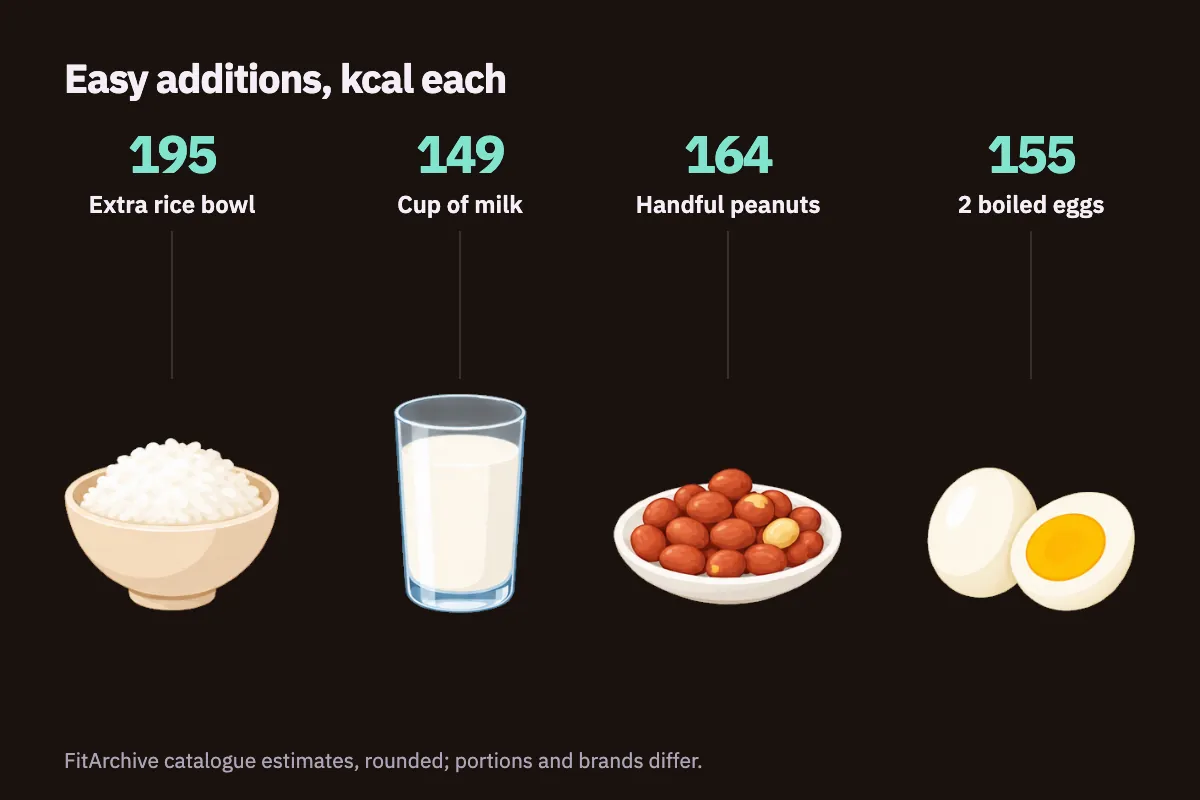
A snack between meals is easier than doubling dinner.
Upgrading a meal you already eat can add as much as a snack:
| Meal | Regular | Upgrade | Upgraded total |
|---|---|---|---|
| Cơm gà (518 g) | 655 kcal, 39 g protein | Large size (×1.3) | 852 kcal, 51 g protein |
| Cơm gà (518 g) | 655 kcal, 39 g protein | More rice (300 g instead of 200 g) | 785 kcal, 42 g protein |
| Phở bò (785 g) | 418 kcal, 38 g protein | More noodles (300 g instead of 200 g) | 526 kcal, 39 g protein |
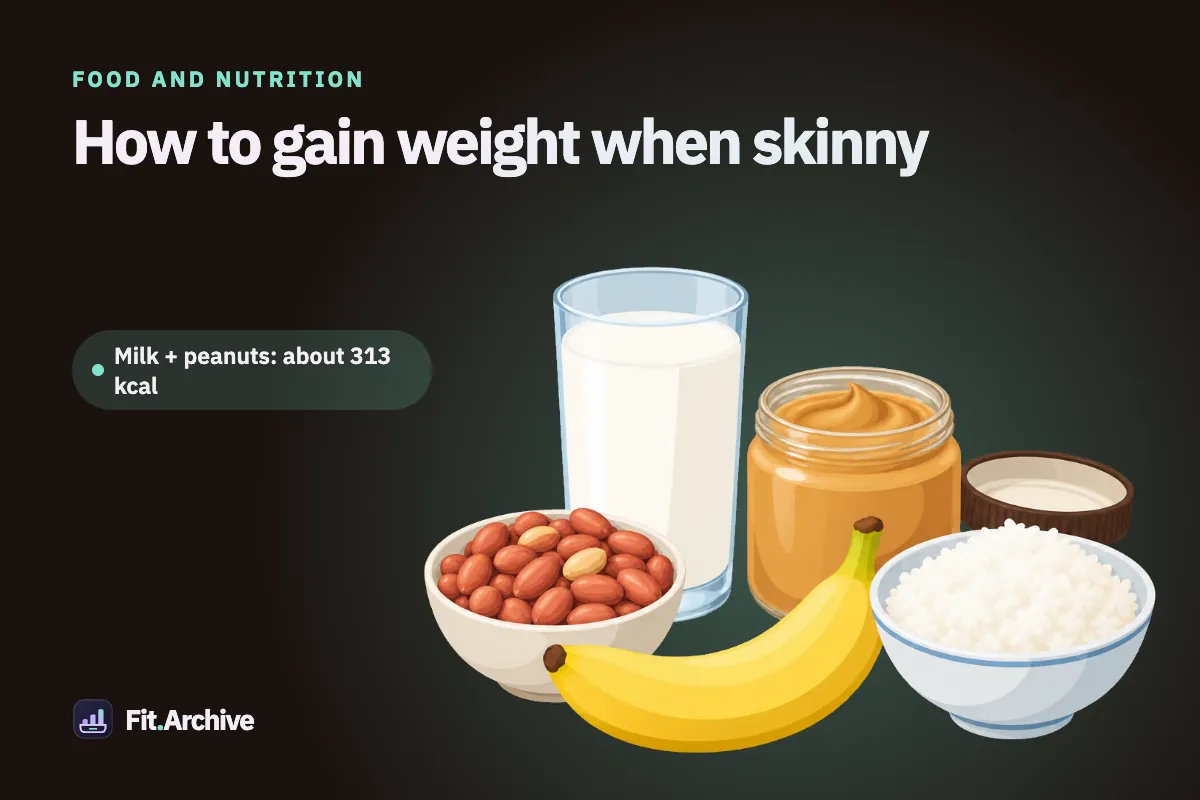
A glass of milk and a handful of peanuts between meals adds about 313 kcal in this catalogue without another full meal. For more dishes, see the Vietnamese food calorie table and our guide on what to eat to build muscle.
Mass gainer or whey: which should you take?
Neither is required. Both are convenient food in powder form.
- Whey protein is mostly protein. It helps if you struggle to reach your protein total, but adds relatively few calories.
- Mass gainers are mostly carbohydrate with some protein, and one serving can provide several hundred kcal. They help if eating more food is the bottleneck, but a homemade shake of milk, banana and peanut butter does the same job.
- Food first works fine. In the protein meta-analysis above, supplements added a modest amount of lean mass, and beyond about 1.6 g per kg a day of total protein, more did not help. Food that reaches the same total is a reasonable alternative.
If you buy a powder, read the label: serving size in grams, kcal and protein per serving, added sugar, and whether the product is third-party tested. Ask a doctor first if you have kidney disease, take regular medication, are pregnant or are under 18. Our protein per day guide covers amounts.
How should a skinny beginner train to gain weight?
Training tells your body to put the extra food into muscle. A simple plan is enough:
- Train each muscle about twice a week, with a full body plan on three days or an upper and lower split on four. Our guide to training splits for beginners compares the options.
- Use a wide rep range. Muscle grows across many rep ranges when sets end close to failure; see how many reps build muscle.
- Add reps, then weight. Progressive overload is the signal that your training is working.
An example session, not a prescription: back squat 3 × 6 to 10, bench press 3 × 6 to 10, barbell row 3 × 8 to 12, then lateral raise and curl 2 or 3 × 10 to 15, all stopping about 1 to 2 reps in reserve (RIR). FitArchive’s Full body 3 days template follows a similar pattern, with squat, bench press and row for 6 to 12 reps at about 2 RIR on its first day.
How to track weight gain: weekly averages and strength
Daily weight bounces around. Weigh yourself under the same conditions, such as each morning after the toilet, and compare weekly averages. These are invented example numbers:
| Week | Average weight | Squat top set | Read it as |
|---|---|---|---|
| 1 | 55.0 kg | 50 kg × 8 | Starting point |
| 2 | 55.1 kg | 50 kg × 10 | Strength up, weight flat |
| 3 | 55.4 kg | 52.5 kg × 8 | Both moving slowly |
| 4 | 55.6 kg | 52.5 kg × 10 | On track for a slow gain |
If the weekly average has not moved after two or three weeks, you are probably eating less than you think. If it climbs much faster than the research ranges above while strength is flat, the extra is likely mostly fat and water. Our guide to body recomposition, bulking and cutting explains how to read weight and strength together.
Who should see a doctor first?
Talk to a doctor before trying to gain weight if you:
- are losing weight without trying, or cannot gain despite eating much more;
- have a history of an eating disorder, or feel anxious or out of control around food or body size;
- have diabetes, a thyroid, digestive, kidney or heart condition, or take regular medication;
- are under 18, since growth and nutrition needs differ, or are pregnant.
This article is general information, not medical or nutrition advice.
Common mistakes when trying to gain weight
- Eating a lot on gym days only. Weight follows the weekly total, not a few big days.
- Judging from the scale every morning. Use weekly averages over several weeks.
- Dirty bulking. Very large surpluses mainly added fat in the trial above.
- Training without progression. Extra food without harder training mostly adds fat.
- Comparing yourself with people online. Age, sex and training history all change how fast anyone gains.
Tracking weight gain in FitArchive
FitArchive is a free, private training and food log that works in your browser and offline. You can log Vietnamese dishes with a large size or more rice or noodles, add your own foods, and see daily calories and protein. Record one body weight reading a day to see a smoothed weight trend and change per week, and log each set’s weight, reps and RIR so the Progress screen shows estimated 1RM per exercise. Try it with sample data in the demo.