A break of one to three weeks costs very little. In studies, strength is usually maintained for up to about four weeks without training, and in a controlled trial a three-week break did not reduce muscle size or strength in a measurable way. Losses become clear over longer layoffs of several weeks to months, with muscle size falling faster than strength. When you start again, previously trained muscle tends to come back faster than it took to build the first time, although the human evidence for a true cellular “muscle memory” is still mixed.
Two opposite claims circulate on social media. One says you start losing gains after a week off, so you should never miss a session. The other says muscle memory means you never really lose anything. This article checks both against the research, says how strong that research is, and shows how to return after a break without misreading your log.
How long does it take to lose muscle?
The most cited summaries are two reviews by Mujika and Padilla. They split detraining into short-term breaks of under four weeks and long-term breaks of more than four weeks. For muscle, their 2001 review concluded:
- Strength performance is generally maintained for up to about four weeks of inactivity. Exceptions include eccentric strength and sport-specific power in highly trained athletes, and strength that was gained only recently.
- Muscle fibre size declines faster than strength, especially in strength and sprint athletes. The short-term review notes that fibre size gains can begin to reverse within the first four weeks, while strength losses stay limited.
- Force production declines slowly and often stays above untrained levels for a long time.
A 2013 meta-analysis by Bosquet and colleagues pooled 103 studies on stopping resistance training. Every measure of muscular performance declined after training stopped, and the loss grew with the length of the break. Losses were larger in people over 65 and, for maximal force and power, in previously inactive people compared with recreational athletes.
Here is a simplified summary of these findings. It describes typical results in studies, not a prediction for anyone:
| Length of break | What studies usually show |
|---|---|
| Up to 1 week | No meaningful loss of muscle or strength |
| 2 to 3 weeks | Strength largely maintained; fibre size may start to shrink, but the trials below found no measurable loss of whole-muscle size |
| 4 to 8 weeks | Muscle size measurably lower in some studies; strength falls more slowly |
| Several months | Recently gained muscle size can return to baseline, while part of the strength gain often remains |
Is a week off bad for gains?
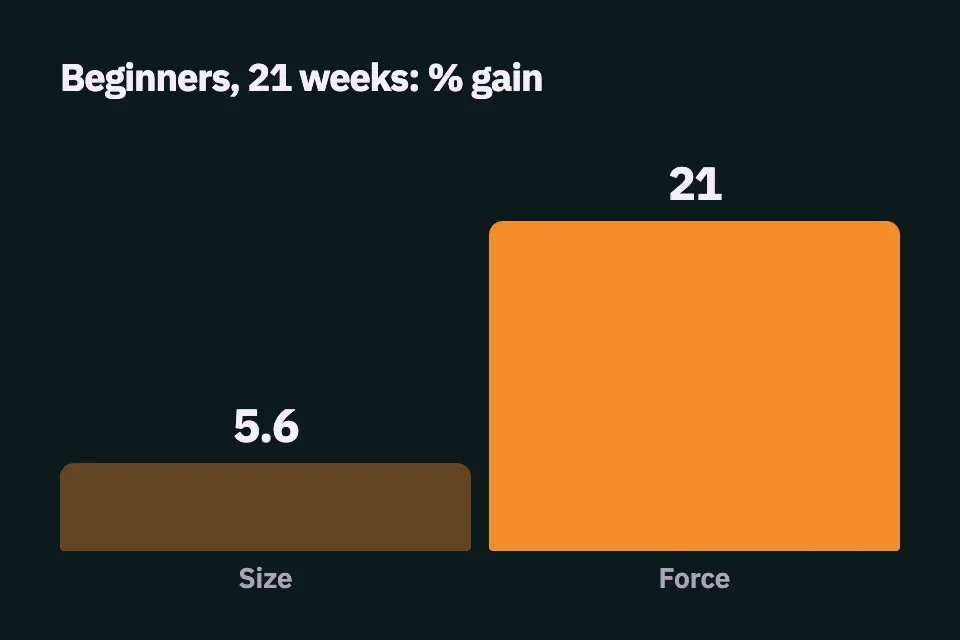
The most direct evidence comes from two Japanese trials of bench press training in previously untrained young men.
- In a 15-week study of 15 men, one group trained continuously and the other trained for 6 weeks, stopped for 3 weeks, then resumed. The 3-week break caused no significant decrease in chest or triceps size (measured by MRI) or in 1RM, and both groups finished with similar gains.
- In a 24-week follow-up of 14 men, one group trained continuously and the other repeated cycles of 6 weeks of training and 3 weeks off. The interrupted group trained for 18 of the 24 weeks, yet overall gains in muscle size and strength were similar. Gains during their second retraining cycle were larger than in the continuous group over the same period.
These are small studies with one exercise in beginners, so they do not prove that breaks are free for everyone. They do make it very unlikely that a week or two away from the gym, for a holiday, an exam period or a minor illness, will undo months of work. If you train hard all year, a short planned break may even be similar in effect to a deload week.
Why strength lasts longer than size
A large part of strength is skill: your nervous system learning to recruit and coordinate muscles for a specific lift. That learning fades slowly.
- In a study of 19 men and women who trained one leg for 10 weeks and then stopped for 20 weeks, muscle thickness and fibre size returned to baseline, but strength stayed well above where it started.
- In six women who had trained their legs for 20 weeks and then stopped for 30 to 32 weeks, maximal strength decreased but not back to pre-training levels, and fibre size changed relatively little.
So the first thing you notice after a break is often not weakness. It is that the last reps feel harder and your work capacity is lower, while your one-rep strength is close to where you left it.
What is muscle memory?
“Muscle memory” in the gym usually means that regaining lost muscle is faster than building it the first time. Researchers have proposed a few mechanisms:
- Motor learning. You already know the movements, so technique and coordination return almost immediately.
- Myonuclei. Muscle fibres gain extra nuclei as they grow. A 2016 review by Gundersen describes animal studies in which these extra nuclei were kept even after the fibres shrank, and the fibres regrew faster when loaded again. The review notes it is not yet known whether this lasting memory exists in humans.
- Epigenetic memory. Training changes chemical tags on DNA that affect how genes are switched on. Some of these changes may persist after training stops.
Is muscle memory real in humans?
The human evidence is promising but small and mixed:
- In a 2018 study by Seaborne and colleagues, 8 previously untrained men trained their legs for 7 weeks, stopped for 7 weeks, then trained for another 7 weeks (7 completed all phases). Leg lean mass rose by 6.5%, fell by 4.6% during the break, then reached 12.4% above baseline after retraining. The gain during retraining was larger than during the first block, and some DNA methylation changes from the first block were still present during the break.
- In the 2019 study by Psilander and colleagues mentioned above, the previously trained leg did not respond better than the untrained leg during 5 weeks of retraining. The authors point out that the first training block never increased myonuclear number, so their study could not properly test the myonuclei theory.
- A 2020 review by Snijders and colleagues concluded that muscle memory based on myonuclei is mostly supported by rodent data and remains largely unresolved in humans.
The honest summary: people clearly regain strength quickly after a break, and several small studies suggest muscle size returns faster too. Whether a specific cellular memory explains it in humans is not settled.
How fast do you get muscle back after a break?
No study gives a reliable number for an individual. What the trials show:
- In the 24-week Ogasawara study, the group that took 3-week breaks gained as much or more during each retraining block as the continuous group did over the same weeks.
- In the Staron study, 6 weeks of retraining after more than 7 months off produced clear increases in fast-twitch fibre size.
- In the Seaborne study, 7 weeks of retraining more than recovered the lean mass lost during 7 weeks off.
For a short break, expect your working weights to feel normal again within a few sessions. For a break of several months, plan on a few weeks to get back to your old numbers, and longer if you were ill or injured.
How to keep muscle when you cannot train normally
You do not need full training to keep what you have. In a 2011 randomized trial, 70 adults trained 3 days a week for 16 weeks, then spent 32 weeks either detraining or on a maintenance program at one third or one ninth of the original weekly dose. Both maintenance doses preserved muscle size in the younger adults (20 to 35 years), but not in the older group (60 to 75). Strength was largely retained even in the detraining group, with only a slight drop at the end.
Mujika and Padilla’s long-term review reached a similar conclusion for athletes: keep the intensity, reduce frequency only moderately, and cut volume much more if you need to. In practice, one or two short sessions a week with a few hard sets on your main lifts goes a long way during a busy month.
If you are recovering from illness, surgery or injury, follow your clinician’s advice on when and how to return. This article is general information.
How to return after a break: an example
These are invented log entries for one lifter, not suggested loads. The estimated 1RM uses kg × (1 + (reps + RIR) / 30):
| Week | Bench press | Effort | Estimated 1RM | Note |
|---|---|---|---|---|
| Before break | 80 kg × 8 | 2 RIR | 107 kg | Regular week |
| Return week 1 | 70 kg × 8 | 4 RIR | 98 kg | Back after 3 weeks off, fewer sets |
| Return week 2 | 75 kg × 8 | 3 RIR | 103 kg | Sets back to normal |
| Return week 3 | 80 kg × 8 | 2 RIR | 107 kg | Same as before the break |
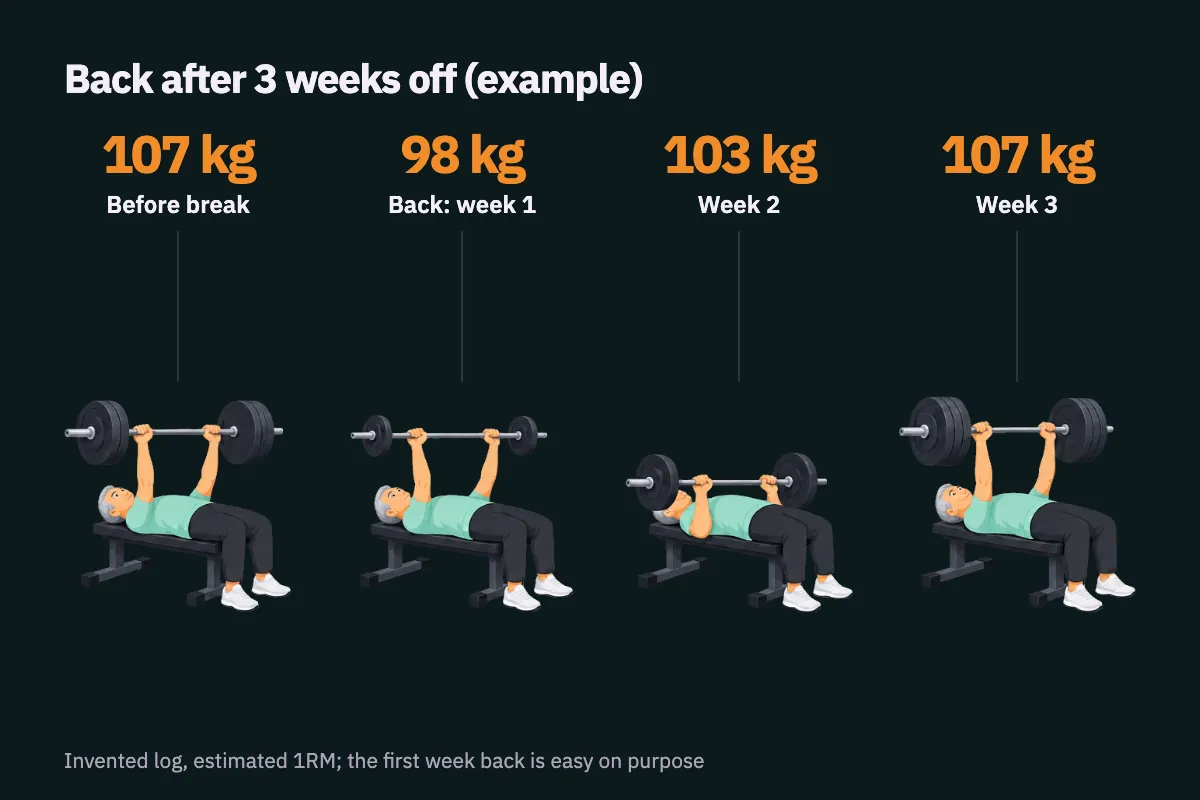
Compare week 3 with the week before the break, not the easy first week.
The first week back is deliberately easy, so its estimate is lower by design. The useful comparison is week 3 against the week before the break. Write the reason for the gap in your workout notes, so a chart months later does not show a mystery dip. If you use RIR, keep recording it on the way back; your sense of effort may be off for the first session or two.
Common mistakes after time off
- Testing your max in the first session. Strength may be close, but tolerance for volume is lower and soreness is likely after a long break.
- Deleting or hiding the gap. Logged breaks explain the chart. Missing weeks do not.
- Panicking after a week off. Short breaks cost very little.
- Assuming muscle memory makes a long layoff free. Size does fall over months, more so in older adults.
- Judging the return from one workout. Compare several sessions against the weeks before the break, as described in the progressive overload guide.
For a realistic picture of how long the first build takes, see how long it takes to build muscle.
Logging breaks and comebacks in FitArchive
FitArchive is a free, private training log that works in your browser and offline, with data kept on your device unless you sign in to sync. It records the weight, reps and RIR of each set, has a notes field for every workout where you can write “back after 3 weeks off”, and its Progress screen shows an estimated 1RM per exercise so you can see when you are back to your old numbers. If your older history lives in Strong or Hevy, you can import it so the comparison reaches back before the break. Try it with sample data in the demo.