DOMS (delayed onset muscle soreness) is the tender, stiff feeling that starts several hours after unfamiliar or hard exercise, usually peaks one to three days later and then fades. It is common, especially after a new exercise or a lot of lowering (eccentric) work, but it is not a reliable sign that a workout built muscle. You can usually train while mildly sore: work other muscles, or train the sore ones lighter after a good warm-up. Severe pain, marked swelling, or dark, cola-coloured urine after an extreme session are reasons to get medical care.
“No soreness, no growth” is a popular line in gyms and on social media. This guide tests it against the research, explains how long DOMS lasts and what helps, and shows how to log soreness so a sore day is not mistaken for a plateau. It is general information, not medical advice.
What does DOMS mean?
DOMS stands for delayed onset muscle soreness. A review of DOMS research describes it as most common at the start of a season, after a break, or when people first try a new activity, and notes that eccentric actions (the lowering part of a lift) cause it more than other muscle actions. The exact mechanism is still debated. The review lists six proposed theories, from lactic acid to muscle damage, connective tissue damage and inflammation, and concludes that a combination of two or more probably explains the soreness.
How long does DOMS last?
| Time after the workout | What typically happens |
|---|---|
| First few hours | Usually little or no soreness |
| About 6 to 8 hours | Soreness starts to become noticeable |
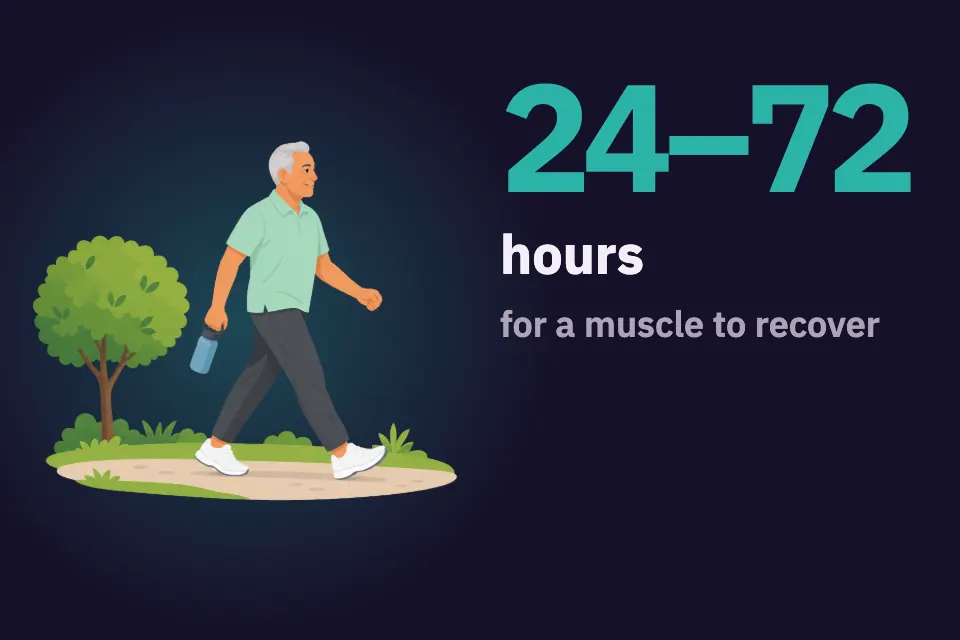
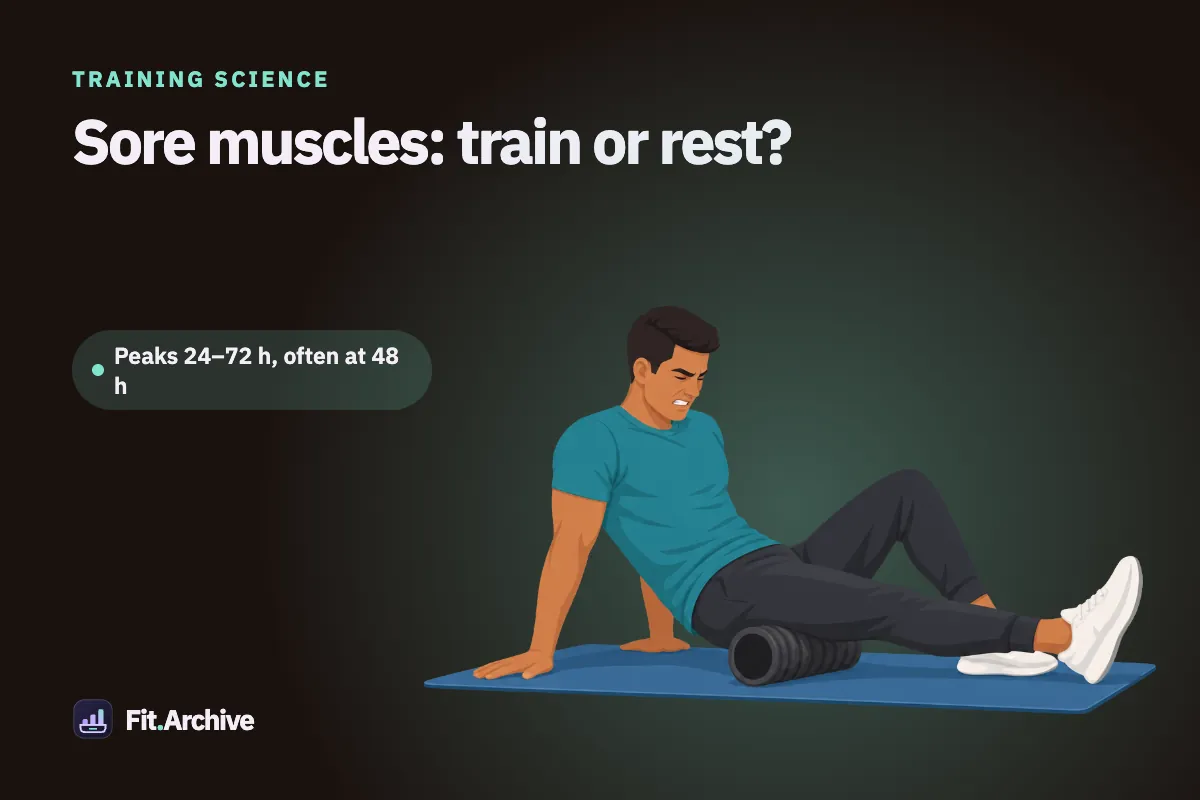
| 24 to 72 hours | Soreness peaks, often around 48 hours |
| After the peak | It fades over the following days |
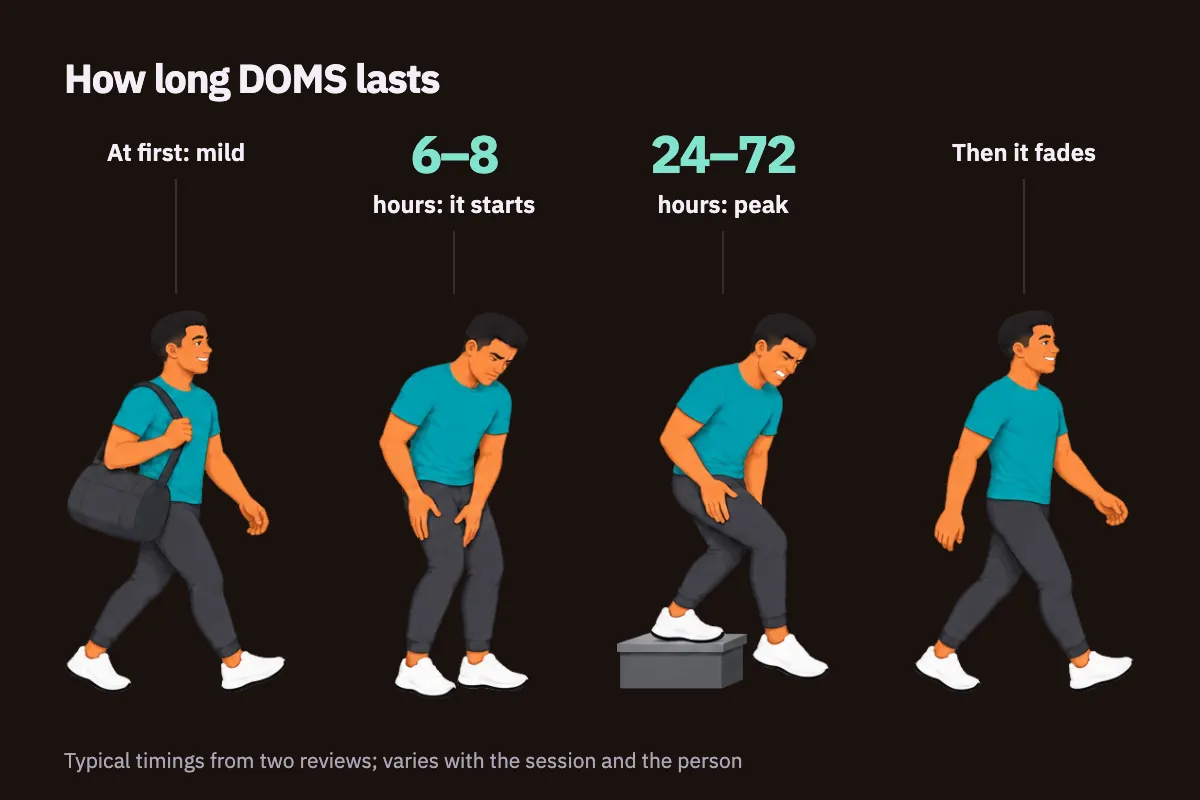
Soreness usually peaks around 48 hours, then fades; it does not measure growth.
These timings come from two reviews: Schoenfeld and Contreras put onset at about 6 to 8 hours and the peak at about 48 hours, and a 2018 DOMS review places peak soreness at 48 to 72 hours. Both stress that the time course varies a lot with how hard and unfamiliar the session was, training status and genetics. After a very damaging session, Schoenfeld and Contreras note that full recovery of strength can take weeks.
DOMS also affects performance while it lasts. The DOMS review notes it can reduce range of motion and peak force and change how muscles are recruited, which is why a sore session often feels weaker.
Is muscle soreness a sign of growth?
Not a reliable one. Schoenfeld and Contreras reviewed the question in 2013 and gave several reasons:
- Soreness tracks muscle damage poorly. Ratings of soreness correlate weakly with the timing and size of damage markers such as strength loss, swelling and creatine kinase in the blood.
- Soreness can appear without inflammation, and long endurance events such as marathons cause plenty of soreness without much muscle growth.
- People and muscles differ. Some experienced lifters rarely get sore yet have large muscles, and some muscles almost never get sore.
- Soreness drops as you adapt, while muscle can keep growing.
A 2016 study by Damas and colleagues adds direct data. Ten young men starting a 10-week program had muscle biopsies at weeks 1, 3 and 10. Muscle damage was highest after the first sessions, and so was muscle protein synthesis, but neither was related to the muscle growth they eventually made. By weeks 3 and 10, damage had dropped, and protein synthesis then was strongly related to growth. The authors concluded that growth came mainly after damage had faded. It is a small study with ten people, but it fits the idea that early soreness reflects repair, not growth.
So soreness tells you the session was unfamiliar or hard on that muscle. Whether you are building muscle shows up over weeks in your reps, loads and weekly hard sets.
Should you work out while sore?
Usually yes, with adjustments. The DOMS review suggests reducing intensity and duration for one to two days after a very sore-making session, or training less affected body parts. It also notes that exercise is the most effective way to ease the pain of DOMS, though the relief is temporary. Schoenfeld and Contreras add that training during early recovery does not seem to worsen the damage, but very heavy soreness can still get in the way of good training.
A practical approach:
- Mild soreness: warm up well and train as planned. The soreness often eases once you get moving.
- Moderate soreness: train other muscles, or keep the sore muscle’s work lighter, with more reps in reserve and fewer sets.
- Severe soreness that limits normal movement: give that muscle another day or two before loading it hard.
Most splits already handle this. In an upper/lower or push/pull/legs split, the sorest muscles from one day usually get time off the next.
What helps DOMS and what doesn’t
The largest comparison is a 2018 meta-analysis of 99 studies on recovery techniques:
| Method | Effect on soreness in the meta-analysis |
|---|---|
| Massage | Largest reduction of the methods studied |
| Active recovery (light movement) | Reduced soreness |
| Compression garments | Reduced soreness |
| Water immersion or contrast baths | Small reduction |
| Cryotherapy | Reduced soreness |
| Stretching | No meaningful effect |
| Electrical muscle stimulation | No significant effect |
A Cochrane review of 12 stretching studies agrees: stretching before or after exercise changed soreness by about one point or less on a 100-point scale a day later, which is not clinically important.
Two caveats. Many studies were small, and the meta-analysis authors note publication bias may have inflated effects. And feeling less sore is not the same as building more muscle; these methods are about comfort and readiness. Pain-relief medicines are a separate question for a pharmacist or doctor.
Why a new exercise makes you so sore: the repeated bout effect
The first time you do an exercise, especially one with heavy lowering or a deep stretch, you tend to get much sorer than the second time. This is the repeated bout effect. A review by McHugh describes how a single session of eccentric exercise protects the muscle against damage from later sessions, likely through a mix of nervous system, mechanical and cellular adaptations, though no single explanation is settled. Schoenfeld and Contreras note that even lighter sessions give some protection.
In practice:
- Introduce new exercises with fewer sets for the first one or two sessions; the DOMS review suggests bringing in new or eccentric-heavy work gradually over one to two weeks.
- Expect extra soreness after a change of program, a return from a break, or exercises that load the muscle at long lengths, such as lengthened partials.
- Do not chase that first-week soreness. It fades as you adapt, which is normal and not a sign the program stopped working.
When it is not DOMS: red flags
Ordinary DOMS is a dull, diffuse ache in the muscles you trained that peaks within a few days and then improves. Get medical advice if instead you notice:
- Dark, red or cola-coloured urine, or passing much less urine, together with severe muscle pain or weakness after an extreme session. MedlinePlus lists these as symptoms of rhabdomyolysis, a breakdown of muscle tissue that can damage the kidneys and needs prompt treatment.
- Severe pain or marked swelling, especially if it keeps getting worse instead of better.
- A sudden sharp pain during a set, a pop, bruising or a joint that hurts. That sounds more like an injury than DOMS.
Exertional rhabdomyolysis is uncommon but real: a 2023 systematic review of 772 cases found most followed running, with weightlifting the next most common activity, and recommends checking people who have soreness, cramps or dark urine after heavy endurance events.
How to log soreness so it doesn’t fool you
A sore, weaker session can look like a plateau in your log. A short note fixes that. Here is an invented example, not a recommendation:
| Day | Session | Note |
|---|---|---|
| Monday | Legs: new Bulgarian split squats, 3 sets | New exercise |
| Wednesday | Upper body | Quads sore 6/10, glutes 4/10 |
| Friday | Legs: squat 2 reps down at the same RIR | Quads still sore 3/10, expected after Monday |
With that note, Friday’s lower squat number reads as soreness from a new exercise, not lost strength. Compare the next normal session with the last one before the change. The plateau guide walks through other causes to check when numbers stall.
Common mistakes
- Treating soreness as the goal. A session can be productive with little soreness.
- Thinking no soreness means no progress. Look at reps and loads over weeks instead.
- Skipping a whole week for mild soreness. Light movement often helps; train other muscles.
- Adding many new exercises at once. The soreness can disrupt the next week; phase them in.
- Reading a sore session as a plateau. Add a note and judge the trend, not one day.
- Ignoring red flags. Dark urine with severe pain needs medical care, not a rest day.
Logging soreness in FitArchive
FitArchive is a free, private training log that works in your browser. Each workout has a notes field, so you can record which muscles are sore and how much, and every set keeps its weight, reps and RIR. The Progress screen shows estimated 1RM per exercise, weekly hard sets per muscle and training days per muscle, so a sore session sits in context rather than looking like a drop. You can try it with the demo and its sample data.