“Junk volume” has no agreed scientific definition. On average, research shows that adding hard sets keeps adding a little more muscle, with diminishing returns: the first few sets per muscle each week do the most, and each extra set adds less. One hard set per exercise can work, especially for beginners and busy people, but several sets tend to build more muscle. In practice, your fatigue, time and recovery set the ceiling, not a universal number.
The debate is loud on social media right now. One camp says anything after a single all-out set is wasted; the other stacks 25 sets per muscle per week. This guide names what each side means, checks it against the studies, and shows how to find a workable number from your own training log.
What does “junk volume” mean?
People use the phrase for at least five different things, and most arguments happen because they mean different ones:
- Sets too easy to count. Sets that end far from failure, such as 10 easy reps with 8 more in the tank. This is the most defensible meaning: a 2024 series of meta-regressions found muscle growth tended to increase as sets ended closer to failure.
- Sets beyond the flat part of the curve. Extra sets that add almost nothing because you already did enough that week.
- Sets you cannot recover from. Volume that makes your next sessions worse, so performance drifts down over weeks.
- Sets limited by something other than the target muscle. A fourth set of rows where your grip or lower back gives out before your upper back is challenged.
- Anything after the first all-out set. The strict high-intensity training view: if the first set was truly maximal, a second one cannot add anything.
Meanings 1 to 4 can be real, and your log can show them. Meaning 5 is a claim, and it is the one the research tests most directly.
Is junk volume a myth?
Partly. The claim that a second or third hard set is useless does not hold up on average. But the idea that every extra set is equally valuable is not true either.
The studies most often quoted for a hard “upper threshold”, two high-volume trials in trained women and trained men published in 2019 and 2020, were later retracted, so they are not used here. Without them, the remaining evidence points to a curve that keeps rising but flattens, rather than a cliff where more sets start causing less growth. Very high volumes have been studied far less, so nobody can say exactly where the flat part begins for you.
One set to failure vs several sets: what the studies show
| Study | Who and how long | What was compared | Main finding |
|---|---|---|---|
| Krieger 2010, meta-analysis | 8 studies, trained and untrained | 1 vs 2 to 3 vs 4 to 6 sets per exercise | Multiple sets gave about 40% larger effect sizes for muscle growth than 1 set |
| Schoenfeld, Ogborn and Krieger 2017, meta-analysis | 15 studies | Weekly sets per muscle | Each extra weekly set linked to about 0.37% more growth; 10 or more sets trended highest |
| Schoenfeld et al. 2019, trial | 34 trained men, 8 weeks | 1, 3 or 5 sets per exercise, 3 sessions a week | Strength gains similar; muscle size favoured the higher volumes at 3 of 4 sites |
| Androulakis-Korakakis et al. 2020, review | 6 studies, trained men | Lowest effective dose for 1RM | A single set near failure, 1 to 3 times a week, raised squat and bench 1RM, though less than more volume |
| Baz-Valle et al. 2022, review | 7 trials, trained young men | Under 12, 12 to 20, over 20 weekly sets | No clear difference between 12 to 20 and over 20 for quads and biceps; triceps favoured over 20 |
| Pelland et al. 2026, meta-regression | 67 studies, 2,058 people | Weekly sets as a continuous dose | Size and strength rise with volume, with diminishing returns; strength flattens sooner |
Reading the table as a whole:
- One hard set is not nothing. It reliably builds strength and some muscle, which makes it a sensible floor when time is short.
- More sets usually add more muscle, and the effect is clearer for size than for strength.
- Most participants were young, many were untrained, and most studies lasted 6 to 12 weeks. Long-term data in experienced lifters are limited.
What about the “to failure” part? A 2023 meta-analysis found no clear growth advantage for momentary failure over stopping short, while the 2024 meta-regressions mentioned above suggest growth suffers when sets end far from failure. So “one hard set” and “one set to failure” are close cousins: a set at about 1 to 3 reps in reserve is hard work too. Our failure vs RIR guide covers that evidence in detail.
Diminishing returns, explained with an example
These numbers are invented to show the shape of the curve. They are not study data and not a prediction for anyone.
| Weekly hard sets for one muscle | Example gain (relative units) | Extra gain per added set | Time cost at about 3 min per set |
|---|---|---|---|
| 3 | 45 | first sets | 9 min |
| 6 | 65 | about 6.7 | 18 min |
| 10 | 80 | about 3.8 | 30 min |
| 15 | 91 | about 2.2 | 45 min |
| 20 | 97 | about 1.2 | 60 min |
| 25 | 100 | about 0.6 | 75 min |
The total keeps rising, so the extra sets are not “junk” in the strict sense. But going from 20 to 25 sets buys a fraction of what going from 3 to 6 did, while costing more time and more fatigue. Whether the last step is worth it depends on your goal, your schedule and whether your other sessions suffer. That is the practical ceiling the research cannot set for you.
High-intensity training vs higher-volume training
Single-set training has a long history. High-intensity training (HIT) grew out of the Nautilus machine era of the 1970s, and Heavy Duty, the version made famous by bodybuilder Mike Mentzer, has had a revival on YouTube and TikTok. The core ideas are one or two all-out work sets per exercise, often pushed past failure with forced reps or negatives, and long rest between workouts.
| HIT / Heavy Duty style | Higher-volume style | |
|---|---|---|
| Work sets per exercise | 1, sometimes 2 | 2 to 5 |
| Effort | To failure and often beyond | Mostly 0 to 3 reps in reserve |
| Weekly hard sets per muscle | Often under 5 | Often 10 to 20 or more |
| Session length | Short | Longer |
| What the evidence suggests | Builds strength and some muscle; usually less growth than more sets | More growth on average, with diminishing returns |
| Main cost | Very high effort per set, more acute fatigue, less practice | Time, joint load and accumulated fatigue |
| Who it may suit | Beginners, very busy people, people who prefer short sessions | People chasing maximum size who can recover from it |
Neither style is a scam. The evidence simply does not support the strongest version of the HIT claim, that a second hard set is wasted.
How many sets per exercise should you do?
For most people, 2 to 4 hard sets per exercise is a practical middle, with weekly totals per muscle built from two or three exercises across the week. Our weekly sets guide explains how to count those totals and what ranges are commonly quoted, so it is not repeated here. If you are a beginner or short on time, one or two hard sets per exercise is a perfectly good start. Your split also changes the arithmetic; see push/pull/legs vs upper/lower vs full body.
How to find your own sweet spot using your log
Treat volume like an experiment you run on yourself, with your log as the record:
- Know your current weekly hard sets per muscle. Count them the same way every week.
- Track one performance marker per muscle. For example, reps at a fixed load on your main press, or an estimated 1RM. Log RIR so you know the sets were comparable.
- Change one thing at a time. Add one or two sets per muscle per week and hold that for three or four weeks.
- Watch recovery. Note soreness that lasts into the next session for that muscle, poor sleep, or joints that ache.
- Decide from the trend. If performance keeps rising and recovery is fine, the new volume is working. If performance stalls or falls while soreness builds, step back to the last level that worked.
An example log for chest, invented for illustration:
| Block (4 weeks) | Weekly hard chest sets | Bench reps at 60 kg, last week | Recovery note | Decision |
|---|---|---|---|---|
| A | 8 | 8 | Fine | Add sets |
| B | 11 | 10 | Fine | Add sets |
| C | 14 | 10 | Chest still sore at next session | Return to about 11 |
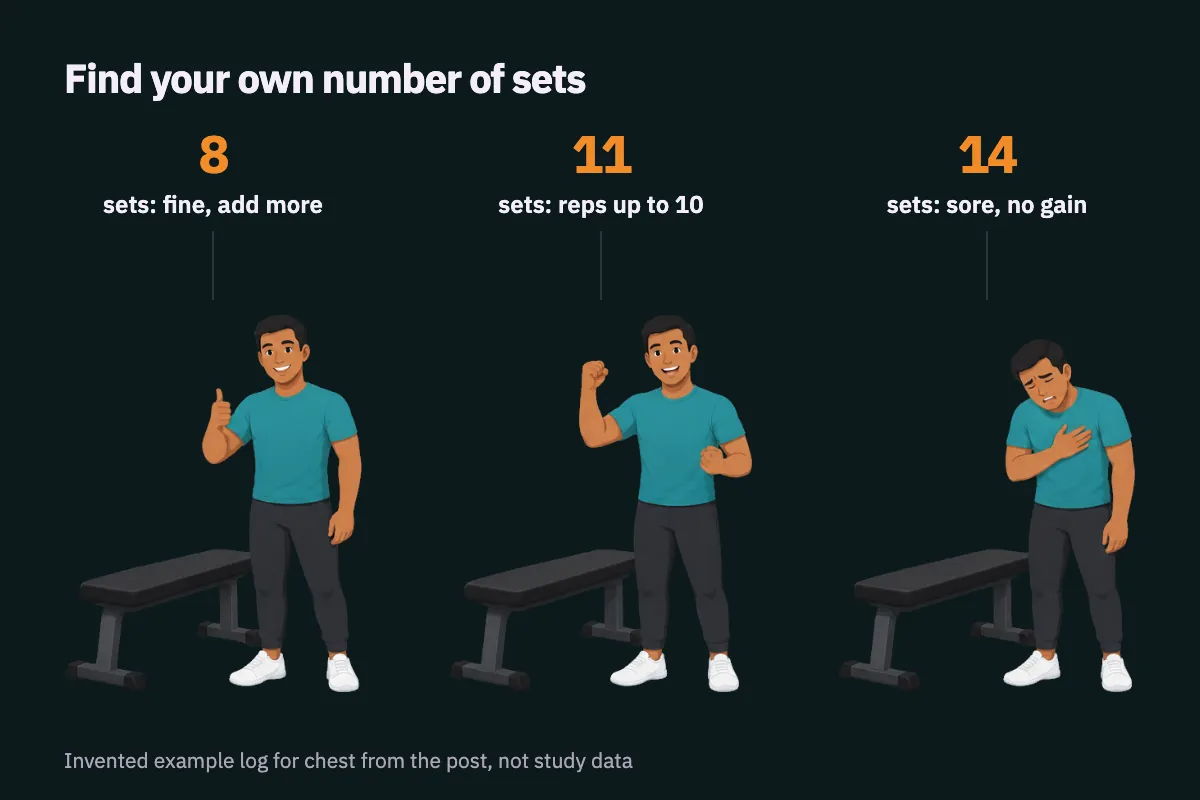
Add sets in small steps and keep the level where performance still rises.
In this example, block C cost more without showing more. That does not prove 14 sets is “junk” forever; sleep, diet or a busy month could explain it. But it is real information about that lifter in that period, which is more useful than any internet rule. If the trend is flat for several weeks, a broader plateau audit checks other causes before you add or cut more.
Common mistakes
- Counting easy sets as volume. Ten sets at 6 or more reps in reserve may be the real junk volume.
- Jumping straight to very high volume. Big jumps make it impossible to tell what helped and what hurt.
- Judging from one session. One great or terrible workout says little. Compare several weeks.
- Taking every set past failure on high volume. Forced reps and negatives on 20 sets a week stack up a lot of fatigue.
- Ignoring time. A plan you cannot keep doing beats a perfect plan you abandon.
- Training through pain. Pain is a reason to stop the exercise and get qualified advice, not a volume question.
Tracking volume in FitArchive
FitArchive is a free training log that works in your browser. You log each set’s weight, reps and RIR and mark warm-ups. The Progress screen shows weekly hard sets by muscle, counting working sets logged at 0 to 4 RIR, with 1 set for the primary muscle and 0.5 for secondary muscles, next to an estimated 1RM per exercise and training days per muscle per week. That puts volume, performance and frequency side by side. You can look around with sample data in the demo.