A bro split trains one muscle group per session, usually chest, back, legs, shoulders and arms on five separate days, so each muscle gets direct work about once a week. It is not “bad”: when weekly sets are matched, studies find similar muscle and strength gains from split and full-body routines. But training a muscle twice a week makes enough sets easier to fit and may give a small edge, which is why push/pull/legs (PPL) is often the better default. If you enjoy a bro split and hit enough hard sets per muscle, it can work.
On social media the bro split gets called either outdated or the “real bodybuilder” way to train. This guide tests both claims against the research, compares it with PPL using real numbers, and shows how to make a body-part split work better. For a broad overview of all the common splits, see push/pull/legs vs upper/lower vs full body.
What is a bro split?
A bro split is a body-part split: each session focuses on one or two muscle groups with several exercises and many sets, then that muscle rests until the same day next week. A typical week:
| Day | Session |
|---|---|
| Mon | Chest |
| Tue | Back |
| Wed | Legs |
| Thu | Shoulders |
| Fri | Arms |
| Sat, Sun | Rest |
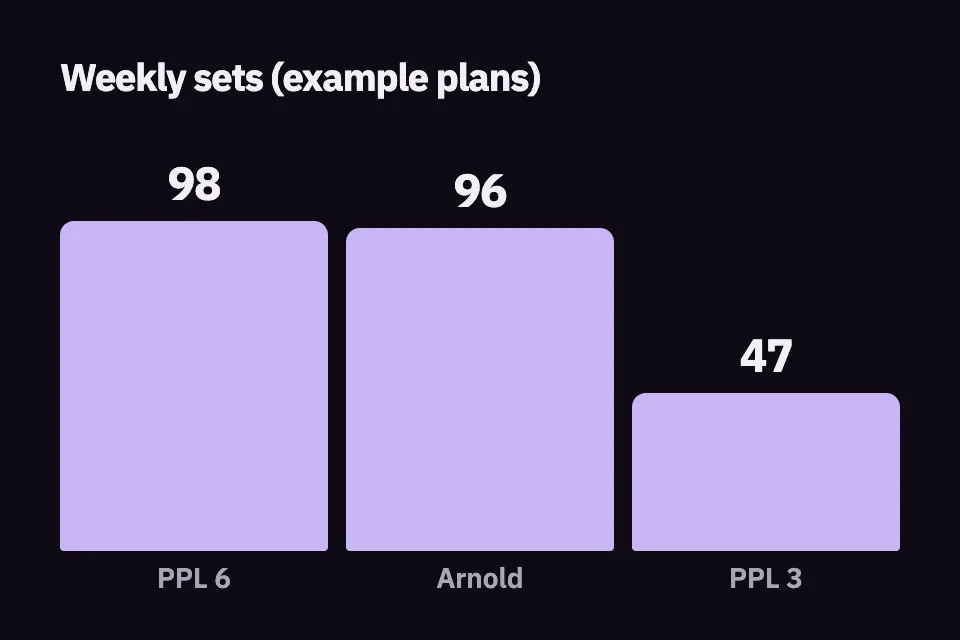
The name is gym slang, not a scientific term. The layout grew out of bodybuilding culture, where routines were organised around body parts. Ironically, one of the best-known old-school bodybuilding routines, the Arnold split, trained each muscle twice a week. And in a 2022 survey of 235 competitive male bodybuilders, 85.5% used split routines, but more than half trained major muscle groups twice a week, and off-season sessions most often covered 2 to 3 muscle groups. So even among bodybuilders, one muscle once a week is not what most reported. Keep in mind that 53.6% of respondents who did not compete in natural federations reported using performance-enhancing drugs, so their routines may not transfer to everyone.
Is a bro split bad? What the research shows
The popular claim is that once a week is “not enough frequency”. Here is what the studies say:
- A 2016 meta-analysis of 10 studies found that, with volume equated, training a muscle twice a week produced more growth than once a week (effect sizes about 0.49 vs 0.30).
- The 2019 update with 25 studies found no significant difference between frequencies when weekly volume was equated, including in trained people. Where volume was not equated, higher frequency had a modest edge.
- A 2024 meta-analysis of 14 studies (392 participants) found split and full-body routines gave similar strength and muscle growth when volume was equated, and concluded people can choose by preference.
- A 2026 meta-regression of 67 studies found muscle growth tracked weekly sets, while frequency had little identifiable effect on growth once volume was counted. Strength gains, however, did rise with frequency.
Trials that tested a once-a-week body-part split directly, all in trained young men over about 8 weeks:
| Study | People | Comparison | Result |
|---|---|---|---|
| Schoenfeld 2015 | 20 trained men | Split, each muscle 1x/week, vs total body 3x/week | Strength similar; total body grew the elbow flexors more |
| Gomes 2019 | 23 men, about 7 years’ training | Split 1x/week vs total body 5x/week, same weekly sets | Strength and lean mass similar |
| Brigatto 2019 | 20 trained men | 16 sets once a week vs 8 sets twice a week | No significant differences; effect sizes slightly favoured twice |
| Zaroni 2019 | 18 trained men | Split 1x/week vs total body 5x/week | Strength similar; total body grew elbow flexors and outer quad more |
The honest reading: a bro split builds muscle and strength. Some trials show a small advantage for spreading the same work over more days, others show none. The studies are small, short and almost all in young men, so nobody can promise you a difference in either direction. The bigger lever is the number of hard sets each muscle gets per week; the frequency guide goes deeper on how often to hit each muscle.
Bro split vs PPL: the numbers
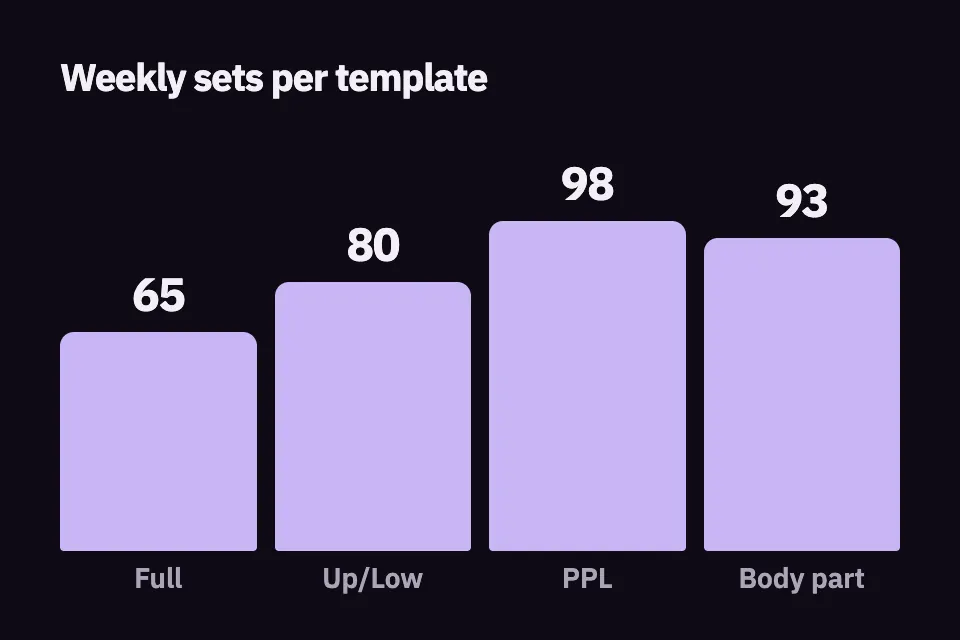
The table compares FitArchive’s Body-part split 5 days template with its Push/Pull/Legs 6 days template. Weekly sets are counted with the app’s rule: warm-ups excluded, 1 set for the main muscle, 0.5 for helper muscles. These are example programs, not targets.
| Body-part split (5 days) | Push/pull/legs (6 days) | |
|---|---|---|
| Direct work per muscle | About once a week | Twice a week |
| Working sets per session | 15 to 23 | 15 to 18 |
| Total working sets per week | 93 | 98 |
| Chest, sets per week | 16.5 (15 in one session) | 12 (6 per push day) |
| Quads, sets per week | 10 | 13 |
| Hamstrings, sets per week | 6 | 10.5 |
| Lats, sets per week | 14 | 14.5 |
| Side delts, sets per week | 10 | 9 |
| Cost of a missed session | High: that muscle can wait two weeks | Moderate: the next round is a few days away |
Two things stand out. First, the totals are close; the difference is how the work is spread. Second, the bro split gives chest 15 sets in a single session, while hamstrings get only 6 for the week. Long single-muscle sessions are where quality tends to slip: the last few sets are done tired, often with less weight or sloppier reps. If you train a bro split, check whether those late sets still count as hard, productive work.
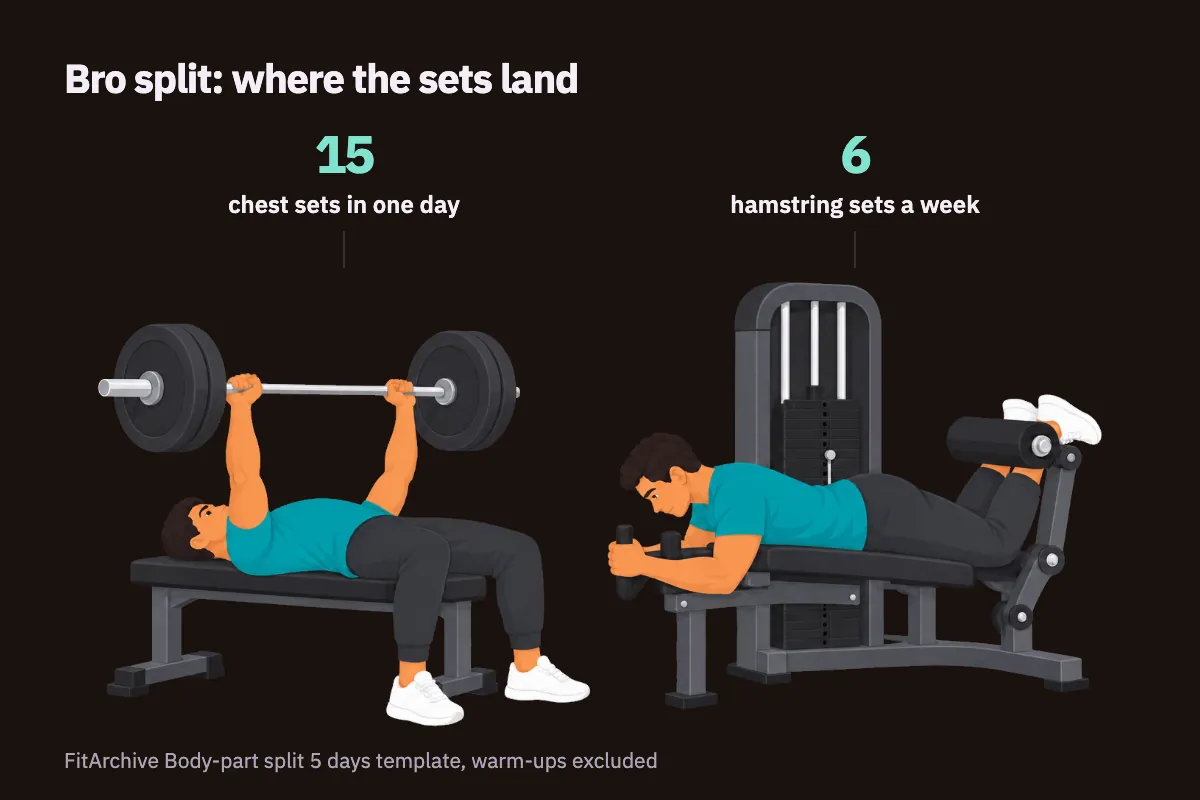
Totals are close to PPL; the spread is what differs.
When a bro split is fine
A body-part split is a reasonable choice when:
- Your weekly sets are enough. The 2026 ACSM position stand links more growth with 10 or more sets per muscle per week. A bro split can reach that for most muscles.
- You like it and will keep doing it. Adherence beats a theoretically better plan you skip. The 2019 and 2024 meta-analyses both say preference is a valid way to choose.
- You are an experienced lifter who enjoys long sessions per muscle. Some people simply train better focusing on one area.
- Your schedule is a stable five days. The split depends on every day happening.
It fits less well if you are a beginner still learning the main lifts (you get only one practice session per lift per week), if strength in specific lifts is your main goal (strength rose with frequency in the 2026 meta-regression), or if you often miss days.
How to make a bro split better
Start from what you have, then fix the weak spots rather than rebuilding everything. FitArchive’s Body-part split 5 days template runs Chest, Back, Legs, Shoulders, Arms, with compound lifts at about 2 reps in reserve (RIR) and isolation exercises at about 1. Its arms day also holds calf raises and cable crunches. Here are example tweaks to it:
| Change | Why | Weekly effect (example) |
|---|---|---|
| Add seated leg curl 3 x 10 to 15 at 1 RIR on Back day | Hamstrings get only 6 sets a week | Hamstrings 6 to 9 sets, over 2 days |
| Move cable lateral raise 3 x 12 to 20 at 1 RIR from Shoulders day to Chest day | Lateral raises are short and light, so they fit easily on a second day | Side delts stay at 10 sets, now over 2 days |
| If the last exercises of a long session feel weak, move 2 or 3 of those sets to another day | Keeps late sets productive | Same weekly sets, better quality |
| Order the week so arms day does not follow a heavy pressing or pulling day | Triceps and biceps work as helpers on those days | Fresher arms |
A further step, if you have the days, is moving towards a twice-a-week structure: a PPL or Arnold split or an upper/lower split. That is an option, not a requirement.
Whatever you change, keep effort honest. Sets that end with many reps left in the tank inflate the count without doing much; log RIR so you can see it.
Common bro split mistakes
- Skipping or shortening legs day. One leg session a week leaves no backup if you miss it.
- Counting pump sets as hard sets. Endless light sets at the end of a session add fatigue more than growth.
- Too many exercises for one muscle. Five chest exercises at 4 sets each is 20 sets in one session; the volume guide explains diminishing returns.
- Ignoring overlap. Chest and shoulder days also hit triceps; back day hits biceps. Count helper sets at half value so you know the real totals.
- Judging the split from one month. Compare several weeks of logs before deciding it does not work.
Using a body-part split in FitArchive
FitArchive includes a Body-part split 5 days template and a Push/Pull/Legs 6 days template, and you can edit either or build your own. You log each set’s weight, reps and RIR. The Progress screen shows weekly hard sets by muscle (1 for the primary muscle, 0.5 for secondary, working sets at 0 to 4 RIR) and training days per muscle per week, so you can check whether your bro split gives each muscle enough work. Try it with sample data in the demo.