There is no ideal workout length in the research. How long a session takes is mostly arithmetic: working sets × (time per set + rest), plus warm-ups and moving between exercises. With 15 to 20 working sets and normal rest, that usually comes to about 50 to 80 minutes; a beginner doing 9 to 12 working sets can finish in 30 to 45. If you need shorter sessions, use supersets or fewer exercises before cutting rest so far that your sets suffer. The popular rule that cortisol “eats your muscle” after 45 minutes is not supported by evidence.
Is there an ideal workout length?
No study has found a best session duration for strength or muscle. What drives results is what happens inside the sessions across a week. The 2026 ACSM position stand, which pooled 137 systematic reviews, found that few prescription details changed outcomes consistently; muscle growth was enhanced by higher volumes (10 or more sets per muscle per week), and strength by heavier loads and at least two sessions a week. A review on time-efficient training concluded that weekly volume matters more than how often you train, and suggested a minimum of about 4 weekly sets per muscle group as a starting point for people short on time.
So the better question is: how many hard sets do you need this week, and how do you fit them into the time you have?
How to estimate how long your workout will take
Use this formula:
Session time ≈ working sets × (time per set + rest) + warm-ups + changeovers
A set of 6 to 12 reps usually takes well under a minute. The formula slightly overestimates, because you do not rest after the last set of an exercise, but changeovers usually eat that back.
Quick example (example numbers only): 16 working sets, about 40 seconds per set and 2 minutes 30 seconds of rest. That is 16 × (40 s + 150 s) = 3,040 seconds, about 51 minutes. Add 8 minutes of warm-up sets and the session takes about 59 minutes.
Exercise-by-exercise example (example numbers only), counting one minute per set to include setting up, unracking and re-racking:
| Exercise | Working sets | Rest | Time per set + rest | Subtotal |
|---|---|---|---|---|
| Back squat | 3 | 3 min | 4 min | 12 min |
| Bench press | 3 | 3 min | 4 min | 12 min |
| Barbell row | 3 | 2 min | 3 min | 9 min |
| Romanian deadlift | 3 | 2 min | 3 min | 9 min |
| Lateral raise | 3 | 1 min | 2 min | 6 min |
| Cable curl | 3 | 1 min | 2 min | 6 min |
| Total | 18 | 54 min |
Add warm-up sets for the squat and bench press (about 8 minutes) and roughly a minute to move between each of the six exercises, and the session lands at about 68 minutes.
The same arithmetic applies to any plan. FitArchive’s Full body 3 days template, day A, lists 20 working sets across six exercises, with rest from 90 seconds for isolation work up to 3 minutes for squats and bench presses. At one minute per set, that is about 65 minutes of sets and rest before warm-ups.
How long should a workout be to build muscle?
Long enough to complete the hard sets your plan calls for, with enough rest to do them well. Muscle growth tracks weekly hard sets, with diminishing returns as they rise (see junk volume and one set to failure). The same weekly sets can be spread over more, shorter sessions or fewer, longer ones; how often to train each muscle covers that trade-off, and push/pull/legs vs upper/lower vs full body shows how splits change the weekly layout.
Rest is the biggest lever on session length, and it is not free to cut. In a trial in 21 trained men, resting 3 minutes instead of 1 between sets led to more strength and more thigh muscle growth over 8 weeks. A 2024 meta-analysis found a small growth benefit for resting longer than 60 seconds, with no appreciable extra benefit beyond about 90 seconds. Our rest between sets guide covers this in detail.
How long should a workout be for a beginner?
Shorter is fine, and often easier to keep up. Example beginner session, not a prescription:
| Exercise | Sets × reps | Target RIR |
|---|---|---|
| Leg press | 3 × 10 to 15 | 2 to 3 |
| Machine chest press | 3 × 8 to 12 | 2 to 3 |
| Lat pulldown | 3 × 8 to 12 | 2 to 3 |
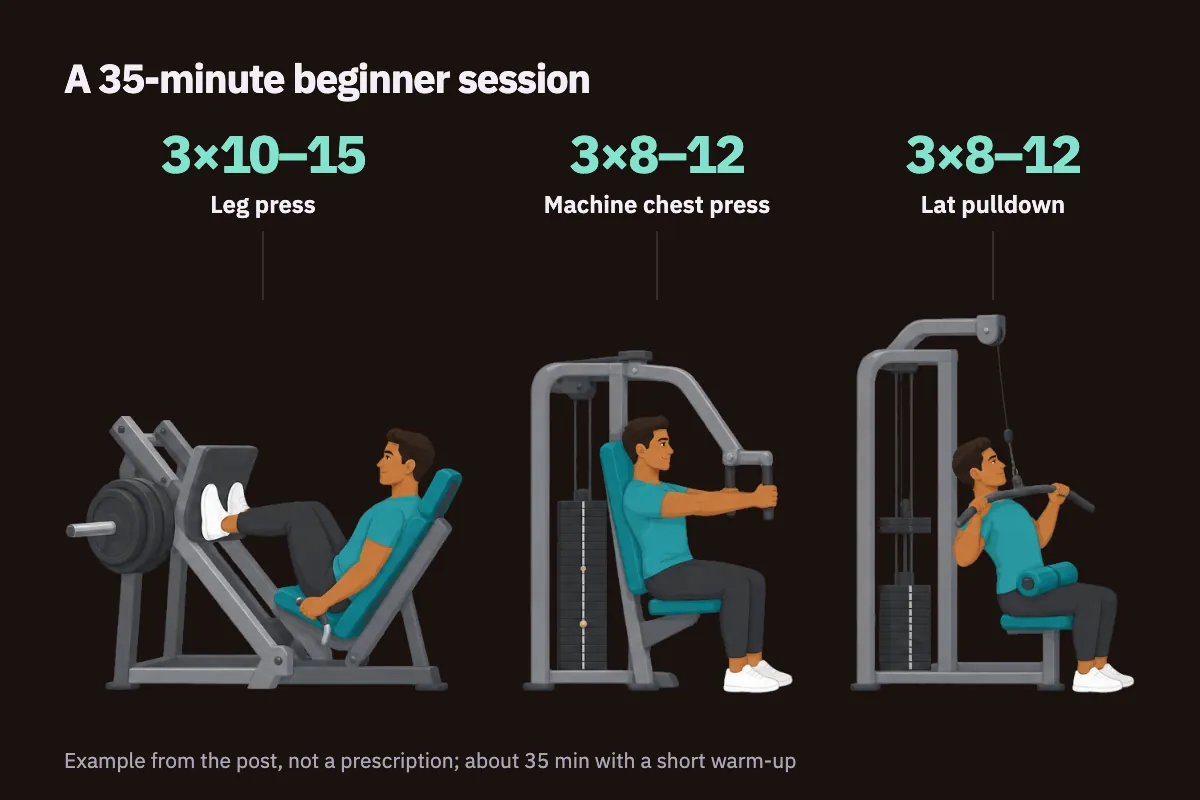
Three machines, three sets each: about 35 minutes including a short warm-up.
That covers the minimum the time-efficiency review recommends: one leg pressing movement, one upper-body push and one upper-body pull. Nine working sets at one minute per set plus 2 minutes of rest is 27 minutes; with a short warm-up it takes about 35 minutes. Two or three sessions like this a week is a reasonable start, and you can add a set or an exercise as the routine settles.
Is a one-hour workout enough?
For most people, yes. An hour fits 15 or so working sets with sensible rest and warm-ups, which is plenty for one session of a typical program. If you regularly need much longer than 90 minutes to finish, it is usually a sign of long chats, phone breaks or a plan with more sets than you need in one day, not proof you are training “hard enough”.
The 45-minute cortisol myth
A popular claim on social media says to stop after 45 or 60 minutes because testosterone falls and cortisol rises, so longer workouts turn “catabolic” and eat muscle. The idea assumes that short-term hormone changes during a session decide how much muscle you build. Studies that tested that assumption directly do not support it:
- In 56 young men training for 12 weeks, the post-exercise rises in growth hormone, free testosterone and IGF-1 did not correlate with gains in lean mass or strength. The cortisol response showed a weak positive correlation with lean mass and muscle fibre growth, the opposite of the myth.
- In 49 resistance-trained men over 12 weeks, no acute post-exercise rise in any supposedly anabolic hormone correlated with changes in strength or muscle size.
Correlations in two cohorts are not the final word, and neither study tested session length itself. But they remove the mechanism the 45-minute rule relies on. There are real reasons to keep sessions moderate: quality drops when you are tired late in a session, and a plan that fits your week is easier to stick with. Hormones are not one of them.
How to shorten a workout without losing much
Starting from the 54-minute example above (sets and rest only):
| Change | Working sets | Sets and rest time |
|---|---|---|
| As written | 18 | 54 min |
| Bench press and row as a superset (1.5 min between exercises); lateral raise and curl back to back, then 1 min rest | 18 | 45 min |
| Also cut Romanian deadlifts from 3 sets to 2 | 17 | 42 min |
| Also drop curls (rows and pulldowns on another day still train biceps) | 14 | 39 min |
In the superset version, each muscle actually rests longer between its own sets (4 minutes for chest and back) while the session gets shorter. That matches a 2025 meta-analysis of 19 studies: compared with traditional sets, supersets kept training volume similar, shortened sessions, and produced similar long-term gains in strength and muscle size, although they felt harder and raised short-term fatigue. Pairing opposing muscles (push and pull) kept reps up best; pairing two exercises for the same muscle reduced the load lifted.
Other options:
- Drop sets and rest-pause. The time-efficiency review found these roughly halve training time while keeping volume, though they may suit muscle growth better than strength. See drop sets, myo-reps and rest-pause.
- Fewer, bigger exercises. Compound lifts train several muscles per set; see compound vs isolation exercises.
- Leaner warm-ups. Keep the exercise-specific warm-up sets and trim the rest; see warm-up sets before lifting.
Log your session length consistently
If you compare sessions, record duration the same way every time, for example from your first warm-up set to your last working set. Then add a short note when a session was unusual: a crowded gym, an interruption, a new superset pairing, or a time cap. A rushed 35-minute session and a normal 65-minute one are not a fair comparison of strength, because rest was different. Without the note, the rushed day can look like a plateau.
Common mistakes
- Cutting rest on heavy compounds to save time. It can cost reps. Use supersets or fewer exercises first.
- Judging a workout by its length. A long session full of easy sets is not better than a short one with enough hard sets.
- Adding exercises until the session fills an hour. Add sets where your weekly counts show a gap, not because there is time left.
- Comparing sessions done under different time pressure. Note the conditions before reading your numbers.
- Planning sessions you cannot repeat. A 40-minute plan you keep beats a 90-minute plan you skip.
Planning session length in FitArchive
FitArchive is a free training log that works in your browser, even offline. The plan templates (Full body 3 days, Upper/Lower 4 days, Push/Pull/Legs 6 days and Body-part split 5 days) can be edited, so you can drop an exercise or a set to fit the time you have. Each workout has a notes field for a time cap or interruption, warm-up sets are marked separately, and the Progress screen shows weekly hard sets by muscle, so you can check that a shorter plan still covers each muscle. Try it with sample data in the demo.