Three recent muscle growth studies all point the same way. In trained lifters, a sudden +120% jump in weekly sets produced no more quad growth over 8 weeks than a +20% increase. In beginners, light and heavy loads taken to failure built similar muscle and strength in 6 weeks. And a new meta-analysis of 16 trials found that splitting the same weekly sets into 1, 2 or 3 sessions made no clear difference to growth. The practical message: count your weekly hard sets, add them gradually, take them close to failure, and arrange them in whatever schedule you can keep.
This is FitArchive’s monthly research update. For each paper we say what was tested, what it found, how much weight to give it, and what, if anything, to change in your training. We read the abstracts and the publisher pages; where a detail was not reported there, we say so rather than guess.
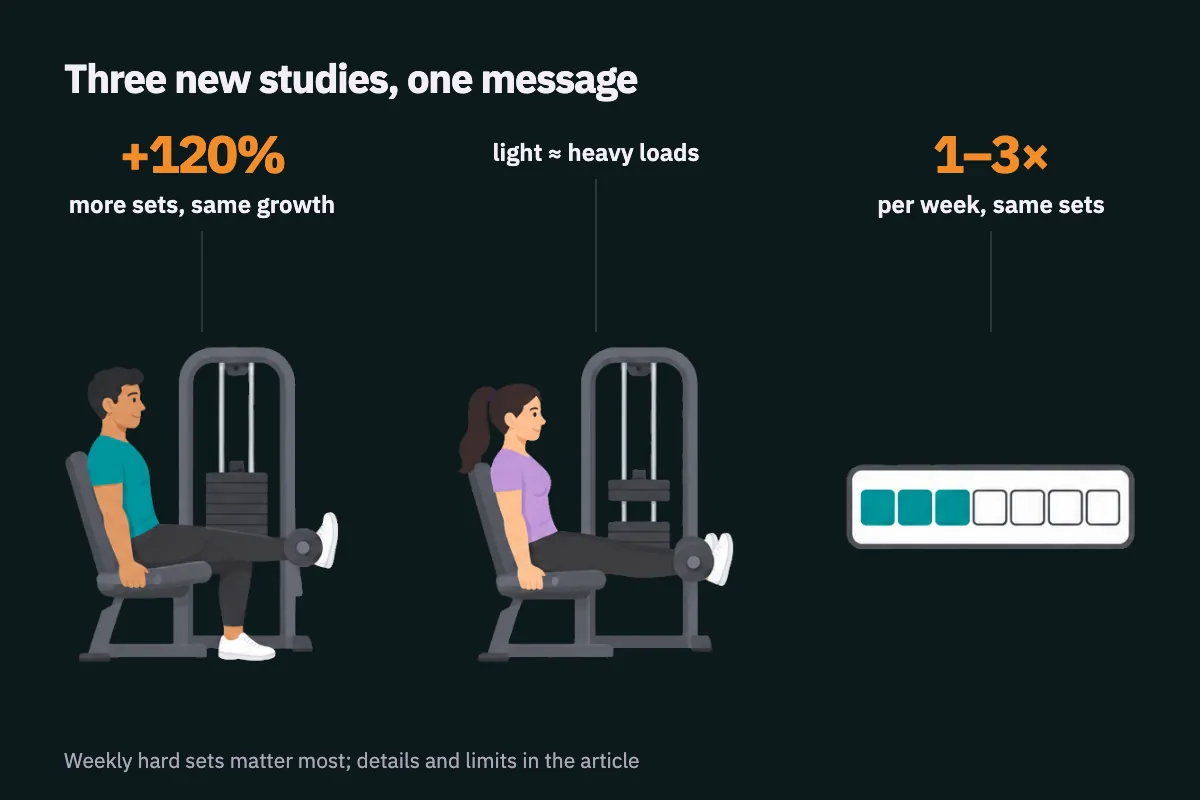
Three studies: more sets, lighter loads and spreading sets across the week.
Study 1: a huge volume jump did not beat a small one
The paper. Camargo and colleagues, Journal of Applied Physiology, published online on 16 July 2026 in the August issue. Randomised, single-blind, within-subject trial.
What they did. 25 resistance-trained men and women aged 18 to 35 trained both legs twice a week for 8 weeks. Each person’s legs were assigned at random: one leg did 120% more weekly sets than that person’s usual training, the other leg 20% more. Because both conditions ran in the same body, diet, sleep and genetics were the same for both. The researchers measured the cross-sectional area of the vastus lateralis (the outer quad) with ultrasound, and took muscle biopsies to look at fibre size, satellite cells and growth and breakdown signalling.
What they found.
- Both legs grew over the 8 weeks, with no difference between the +120% and +20% legs.
- Fibre size, satellite cells and myonuclei did not change significantly in either leg.
- Most growth and breakdown signalling markers were similar too.
How much weight to give it: moderate. A within-subject design is a strong way to compare two doses, and the participants were already trained, which is the group most people ask about. But it was 8 weeks, one muscle, 25 people, and both legs trained twice a week, so it cannot tell us what happens over a year or with a different set-up.
What it means. The paper’s own conclusion cuts both ways: the big jump did not hurt growth, but it did not add any either. Earlier evidence still says more weekly sets tend to give more growth with diminishing returns; a 2026 meta-regression of 67 studies found exactly that curve. Put together, doubling your sets overnight looks like a lot of extra time and fatigue for no extra muscle over two months. If you want more volume, add one or two sets per muscle per week and check that your performance holds before adding more. Our guide on how many sets per muscle per week shows how to count them.
Study 2: light weights to failure matched heavy weights in beginners
The paper. Kayhan and colleagues, BMC Sports Science, Medicine and Rehabilitation, published on 5 November 2026 as an accepted manuscript. Randomised trial.
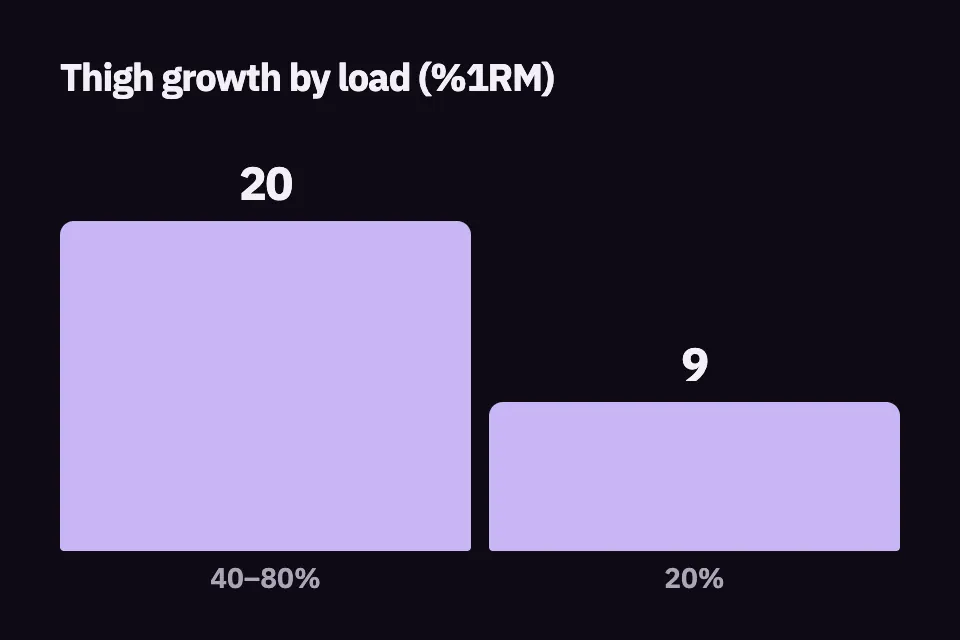
What they did. 22 healthy untrained men (average age 21) were split into a low-load group and a high-load group of 11 each. Both did supervised knee extensions taken to volitional failure, three times a week for 6 weeks. The team measured muscle thickness and cross-sectional area of two quad muscles (rectus femoris and vastus intermedius) by ultrasound, and estimated one-rep max (1RM). The abstract does not give the exact loads used for each group.
What they found.
| Result after 6 weeks | Low load | High load |
|---|---|---|
| Estimated 1RM | +35.9 kg | +32.5 kg |
| Rectus femoris thickness | +0.46 cm | +0.34 cm |
| Rectus femoris cross-sectional area | +2.07 cm² | +2.36 cm² |
| Total volume load (reps × load) | 58,119 kg | 45,598 kg |
There were no differences between groups for muscle size or strength. The light group lifted more total volume load to get there, because light sets to failure take many more reps.
How much weight to give it: low on its own, but it fits a large body of evidence. It is small, short, one exercise, untrained men only, and the trial was registered after it was run. The authors themselves put the similar results down to the fast early-phase gains of untrained people, which can hide differences. What makes it worth reporting is that it matches a 2017 meta-analysis that found similar growth with light and heavy loads, while heavier loads improved 1RM strength more.
What it means. For muscle size, load is flexible as long as the set ends close to failure. Light, high-rep sets are a real option for home training, sore joints or isolation exercises. If an exercise hurts, or pain persists, get it checked rather than training through it. If maximum strength is your goal, keep some heavy work in your week. The rep ranges guide covers where light sets stop being useful.
Study 3: 1, 2 or 3 sessions a week, same weekly sets
The paper. Boutagy and McKean, medRxiv, version 3 posted on 20 October 2026. Systematic review and meta-analysis. A preprint: it has not been peer reviewed yet.
What they did. They pooled every trial they could find (to October 2026) that lasted at least 6 weeks, measured muscle size and kept weekly volume the same while changing how many sessions per week each muscle was trained, from 1 to 3.
What they found.
- 16 trials with 380 participants.
- The effect of training more often was trivial and not significant: g = −0.06 (95% CI −0.24 to 0.13), with no detectable difference between studies (I² = 0%).
- One versus three sessions showed a small, non-significant difference in favour of three (g = −0.23, 95% CI −0.57 to 0.10).
- The authors rated certainty as low to very low, and note that most trials measured muscle thickness, which does not track whole-muscle growth well.
The same authors also posted a re-analysis of a 35-trial dose-response dataset (926 participants, mostly men; also a preprint, not peer reviewed). It found weekly volume predicted growth, while dividing that volume into more sessions had no detectable effect.
How much weight to give it: low to moderate, with a preprint caveat. It agrees with the 2019 frequency meta-analysis and the 2026 meta-regression above. It cannot rule out a small benefit from spreading volume, especially going from one session to three.
What it means. Choose your weekly schedule for the reasons that actually differ: how long each session is, how fresh you feel for your last sets, and how many days you can train. Training each muscle about twice a week remains a sensible default because it keeps sessions shorter for the same weekly sets, not because twice a week grows more muscle by itself. See how often to train each muscle and the PHUL vs PPL comparison for two ways to lay out the week.
What we would change in a training week
| If you currently… | Based on these papers, consider… |
|---|---|
| Plan to double your sets to break a plateau | Adding 1–2 sets per muscle per week, then checking reps and load hold |
| Avoid light weights because “they don’t build muscle” | Using light sets close to failure where heavy loads are awkward or painful |
| Worry that your split is “wrong” | Keeping the split you can follow; compare weekly sets per muscle instead |
| Train each muscle once a week in very long sessions | Splitting the same sets over two days to keep later sets higher quality |
None of these papers says that more training is useless or that effort does not matter. The common thread is that weekly hard sets close to failure are the lever, and the other variables are mostly about fitting those sets into your life.
How we judge new muscle growth research
- Design first: randomised trials and meta-analyses over single observations; within-subject designs get credit for removing between-person differences.
- Who was studied: results in untrained young men do not automatically transfer to trained lifters, women or older adults.
- What was measured: ultrasound at one site is a reasonable but partial view of whole-muscle growth.
- Peer review status: preprints are labelled as such.
- Fit with the existing evidence: one study rarely overturns many; we say whether a paper confirms, refines or challenges the current picture.
This article summarises research for general education. It is not medical advice or a personal training prescription.
Track your weekly sets in FitArchive
FitArchive logs every set’s weight, reps and reps in reserve (RIR). Its Progress screen shows weekly hard sets per muscle and how many days each muscle was trained, which are exactly the two numbers these studies talk about. You can check whether a volume increase actually happened, and whether your performance kept up, before deciding to add more. Try it with sample data in the demo.