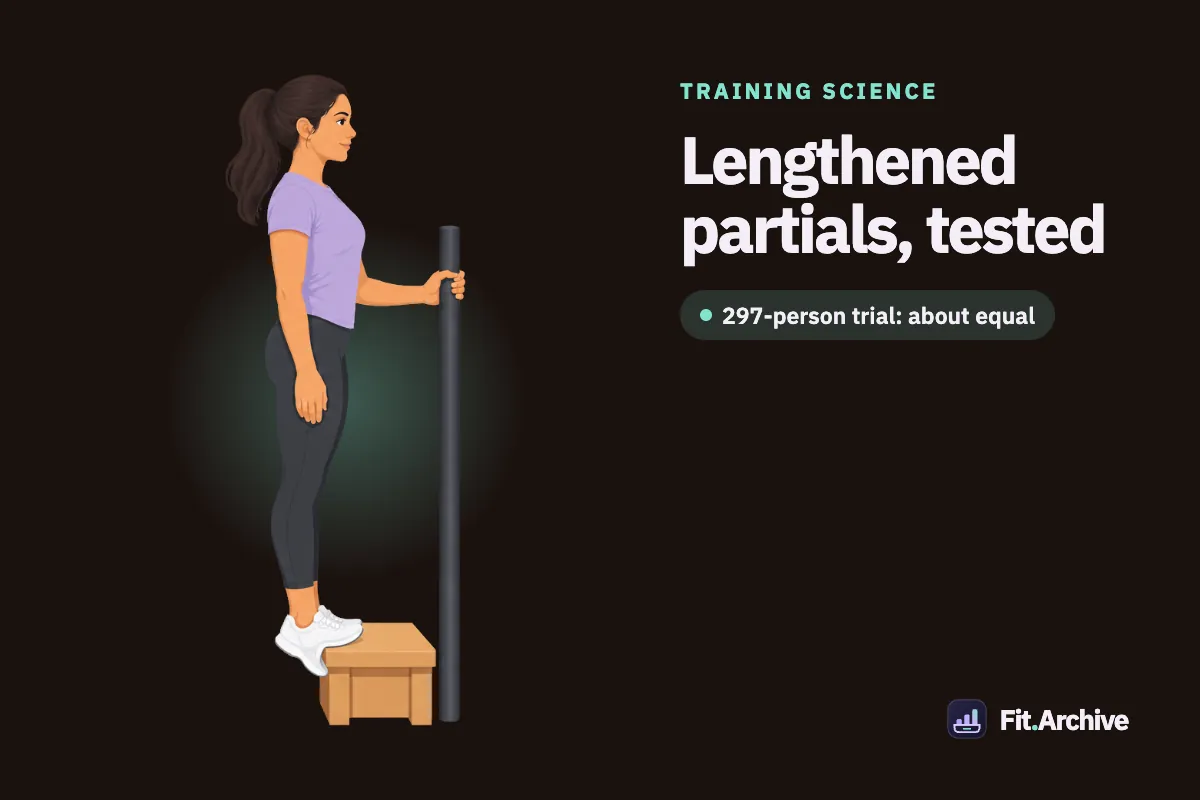
Lengthened partials are reps done only in the stretched part of an exercise, such as the bottom half of a leg extension or the heel-down half of a calf raise. Several small studies found they built as much muscle as full range of motion (ROM), and a few found more, but the largest and most recent trials found the two roughly equal. Full ROM remains a sound default. Lengthened partials are a reasonable option for extra reps after full-ROM failure, or on exercises where the stretched position is easy to load. What the research does not support is the popular social media claim that partials in the stretch are always better than full reps.
This guide explains what “lengthened” means, what the studies actually compared, how strong the evidence is, and how to log partial reps so your progress comparisons stay honest.
What are lengthened partials?
A muscle is lengthened when the joint position stretches it and shortened when it is fully contracted. A full rep moves through both. A lengthened partial keeps only the stretched half; a shortened partial (the classic quarter squat or top-half leg press) keeps only the contracted half.
There are two ways to train a muscle at long lengths:
- Lengthened partials: the same exercise, cut to the stretched part of the range.
- Exercise selection: choosing a variation that puts the muscle in a longer position, such as a seated leg curl (hip bent, so the hamstrings are stretched) instead of a lying one.
These examples show where the long and short ends sit on common exercises:
| Exercise (example) | Main muscle | Lengthened position | Shortened position |
|---|---|---|---|
| Leg extension | Quadriceps | Knee bent, start of the rep | Knee straight, top |
| Lat pulldown | Lats | Arms overhead, bar at the top | Bar at the chest |
| Calf raise | Calves | Heel dropped below the step | Up on the toes |
| Seated leg curl | Hamstrings | Knee straight | Knee fully bent |
| Overhead triceps extension | Triceps (long head) | Elbows bent behind the head | Arms straight |
| Dumbbell curl | Biceps | Elbow straight | Elbow fully bent |
What do studies show for lengthened partials vs full ROM?
Here are the main training studies, including the two “exercise selection” studies that are often cited in the same discussion:
| Study | People | Comparison | Result |
|---|---|---|---|
| Pedrosa et al. 2022 | 45 untrained women | Leg extension: initial (knee bent) half vs final half vs full ROM vs alternating | Initial-half partials gave greater relative quadriceps growth at several thigh sites; final-half partials were no better than no training at some sites |
| Kassiano et al. 2023 | 42 young women, 8 weeks | Calf raise: initial (stretched) vs final vs full ROM | Medial calf grew about 15% with stretched partials vs about 7% full and 3% final |
| Maeo et al. 2021 | 20 adults, 12 weeks, one leg each | Seated vs lying (prone) leg curl | Whole hamstrings grew about 14% seated vs 9% lying |
| Maeo et al. 2023 | 21 adults, 12 weeks, one arm each | Overhead vs arms-down cable triceps extension | Whole triceps grew about 20% overhead vs 14% arms-down, despite lighter loads |
| Wolf et al. 2025 | 30 trained adults, 8 weeks, one arm each | Upper-body lengthened partials vs full ROM | Similar arm muscle growth and lat pulldown 10-rep-max gains |
| Larsen et al. 2025 | 23 trained adults, 8 weeks, one leg each | Stretched calf partials vs full ROM followed by extra partials | Small, uncertain edge for stretched partials; both worked |
| Gschneidner et al. 2025 | 297 adults at 15 sites, 12 weeks | Lengthened partials vs full ROM on machines | Arm and thigh muscle changes practically equivalent |
| Plotkin et al. 2026 | 16 trained men, 8 weeks, one leg each | Leg press, leg extension and leg curl: lengthened partials vs full ROM | No clear difference in thigh muscle growth |
A pattern stands out. The studies showing an advantage for long-length training were mostly early and small, and several were done in untrained people. The newer trials in trained lifters, and the one large multi-site trial, found lengthened partials and full ROM roughly equal. In the studies that also tested partials at the short end, shortened partials did worst.
The reviews say much the same:
- A 2021 meta-analysis by Pallarés et al. of 16 studies found full ROM better than partial ROM for strength and lower-body muscle growth. It compared full against partial ROM in general and searched studies up to March 2021, before most lengthened-partial trials were published.
- A 2023 meta-analysis by Wolf et al. (International Journal of Strength and Conditioning, not indexed in PubMed) found a trivial overall edge for full ROM. A subgroup hinted at a growth benefit for partials at long lengths, but the uncertainty range crossed zero.
- A 2023 systematic review by Kassiano et al. of 11 studies concluded that training at longer lengths, through full ROM or stretched partials, tended to grow some muscles more than partials at the short end.
- A 2025 meta-analysis by Varovic et al. of 12 studies found trivial differences in regional growth between longer and shorter average muscle lengths. The authors noted the length differences between conditions were fairly small.
- The 2026 ACSM position stand, an overview of 137 systematic reviews, found strength was enhanced by training through a complete range of motion.
Is stretch-mediated hypertrophy real?
“Stretch-mediated hypertrophy” is the idea that loading a muscle in its stretched position is a strong growth signal on its own. On social media it is often turned into a rule: partials in the stretch beat full reps.
The human evidence supports a smaller claim. Training that loads the stretched position, through exercise choice or full ROM, seems to grow some muscles at least as well as training at short lengths, and in a few studies better. But full ROM already includes the stretch, and recent trials comparing lengthened partials with full reps found no meaningful difference. A 2026 systematic review by Wolf et al. of 8 studies (120 people) found long-length training may increase muscle size and fascicle length more, but called the evidence mixed and the measurement methods questionable.
How strong is the evidence overall? Most trials lasted 8 to 12 weeks, many used untrained people, several trained one limb against the other, and the effects, where they appeared, were modest. That is enough to justify trying it, not enough to call it necessary.
How to use lengthened partials
1. Choose exercises that load the stretch. This has the clearest support. Seated leg curls over lying ones and overhead triceps extensions over pushdowns are the best-studied swaps. For calves, let the heel drop fully and control the bottom.
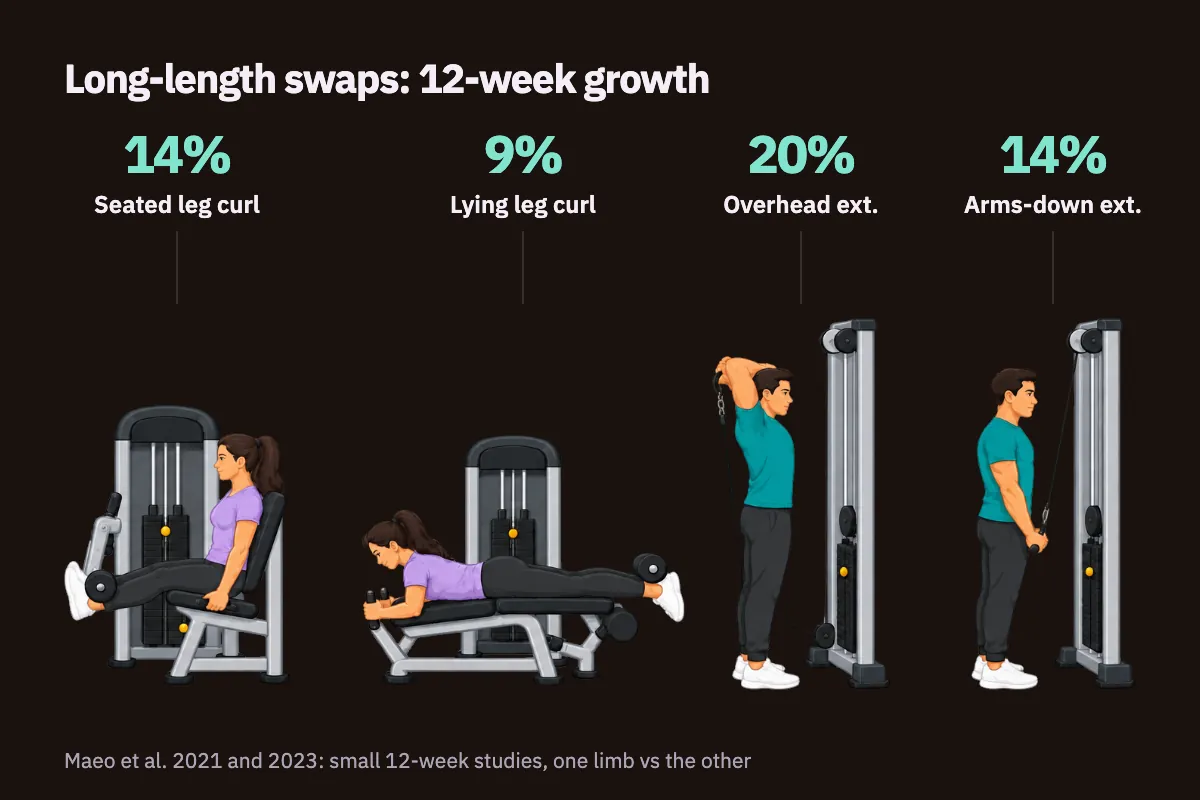
Choosing exercises that stretch the muscle has the clearest support.
2. Keep full ROM as the base. Do your normal full-range sets, and if you want, add lengthened partials at the end of a set once you can no longer complete a full rep. For example, 10 full reps on the leg extension, then 3 to 5 reps through the bottom half only. In the Larsen et al. study, both stretched partials and full ROM followed by extra partials grew the calves.
3. Or use whole sets of lengthened partials where full ROM is awkward. Some machines and cable setups make the top of the rep easy and the bottom hard; partials in the bottom half can work there. Mark the range (a pin setting, a pad position, a cue such as “to mid-shin”) so every session uses the same distance.
4. Keep the sets hard. Partials do not change the basic rule that working sets should end close to failure. Our guide to training to failure vs RIR covers how close.
5. Train the full lift for strength. Strength is partly specific to the range you train. Pedrosa et al. found partial groups gained most strength in the range they trained, and the ACSM review links full ROM to greater strength. If you want a stronger full squat, squat through the full range.
How to log partial reps so progress comparisons stay fair
Partial reps are easy to log in a way that makes progress look better or worse than it is. A few rules keep comparisons fair:
- Do not add partials to the full rep count. Log the full reps as the set, and write the partials in the workout notes.
- Record RIR for the full reps. If you added partials after full-rep failure, the full-rep part ended at 0 RIR.
- Keep the same ROM when you compare. A set of 12 bottom-half reps is not comparable with last month’s 10 full reps.
- Mark the switch. If you change from full reps to partials, note the date. That week becomes a new starting point, not a jump in strength.
Example log entries (invented numbers, not a recommendation):
| Week | Leg extension sets | Workout note | Compare with |
|---|---|---|---|
| 1 | 50 kg × 10, 10, 9 at 1 RIR | Full ROM | Next full-ROM week |
| 2 | 50 kg × 10, 10, 10 at 0 RIR | Full ROM, then 4 lengthened partials after each set | Week 1 (full reps only) |
| 3 | 55 kg × 12, 11, 11 at 1 RIR | Bottom-half partials only, pin 3 | Later bottom-half weeks only |
Week 3 shows more weight and more reps, but the range changed, so it does not show progress over week 2. If you track estimated 1RM, partial reps logged as full reps will inflate it. The same goes for the rules in our progressive overload guide: compare like with like.
Common mistakes
- Ego partials at the short end. Heavy quarter squats and top-half leg presses feel strong, but shortened partials grew the least muscle in the studies above.
- Changing ROM between sessions. A rep record is meaningless if the reps got shorter. Pick a range and keep it.
- Counting partials as reps. It inflates volume, rep records and strength estimates.
- Replacing all full-range work. You may give up strength through the full range, which matters for most compound lifts.
- Bouncing out of the stretch. Control the bottom of the rep. Sharp or persistent pain is a reason to stop the exercise and get qualified advice; this article is general information, not medical guidance.
- Expecting a big difference. Even in the positive studies, the extra growth was modest and took weeks to measure.
Logging lengthened partials in FitArchive
FitArchive logs each set’s weight, reps and RIR, with notes for each workout, so you can keep full reps in the set and write the partials and the range you used in the note. Its estimated 1RM uses the reps you log plus RIR, which is another reason not to log partials as full reps. Weekly hard sets count working sets at 0 to 4 RIR per muscle, whether you use full or partial reps. You can try it with sample data in the demo. For choosing how many reps those sets should have, see how many reps to build muscle.