To build muscle, eat enough total food for your goal, get a solid serving of protein at each of your main meals, put most of your carbohydrate around training, and fill the rest of the plate with vegetables and fruit. No single food builds muscle on its own: the training does the building, and your whole diet across the week supplies the materials. Ordinary Vietnamese meals such as phở, cơm tấm, cá chiên with rice, or tofu in tomato sauce can cover all of it.
This guide sums up what research says about each part, then turns it into Vietnamese dishes with numbers from FitArchive’s recipe estimates and three example days. The examples show how meals add up; they are not targets. For personal calorie or protein targets, especially with a medical condition, during pregnancy or under 18, talk to a dietitian or doctor.
What should you eat to build muscle?
Four things carry most of the weight:
- Enough total energy. Muscle gain is harder when you are eating well below what you burn.
- Enough protein, spread over the day. Total daily protein matters most; splitting it across meals is a sensible way to reach it.
- Carbohydrate to fuel training. Mainly so you can train well, not because carbs build muscle directly.
- Plenty of vegetables and fruit. For health, fibre and fullness, which keep the rest of the plan sustainable.
None of these replaces a training program that gets harder over time. Food supports progress; it does not create it.
Do you need to eat more to build muscle?
Not necessarily a lot more, but a large shortfall works against you. A 2022 meta-analysis of resistance training studies found that people training in an energy deficit gained less lean mass than people who were not, although strength gains were similar. In their meta-regression, a deficit of roughly 500 kcal a day was enough to prevent lean mass gains on average.
The other direction has limits too: research on surplus size suggests that eating far more than you need mainly adds fat. The bulk, cut or recomp guide covers those studies, and the weight gain guide for skinny lifters covers what to do if you struggle to eat enough. Your own numbers depend on body size, activity and goal, which is why the example days below are labelled as examples.
What to eat to build muscle and lose fat?
The same foods, in smaller total amounts. When you eat less, protein matters more and the deficit size matters: the meta-analysis above suggests that very large deficits cost lean mass. The recomp guide explains why new lifters and people returning after a break are the most likely to gain muscle while losing fat. Day A below is a lighter, protein-dense example. The guide to keeping muscle while cutting goes further.
How much protein, and should you spread it out?
Protein supports muscle gain on top of training: a 2018 meta-analysis of 49 trials found that extra protein added modest gains in lean mass and strength, and the benefit levelled off at a moderate daily intake. The protein per day guide explains what that means in grams for your body weight, so this article does not repeat it.
On timing, the evidence points to the daily total first. A meta-analysis of protein timing found that total protein intake, not eating it right around the workout, best explained differences in muscle growth. The ISSN position stand on nutrient timing treats meeting the daily total, ideally with protein spread at roughly 3 hour intervals, as a primary area of emphasis. The ISSN protein position stand suggests about 20 to 40 g per serving. In Vietnamese food terms, a regular bowl of phở bò (38 g) or a plate of cơm tấm sườn (36 g) already lands in that range; a pack of xôi xéo (7 g) does not.
Do you need carbs to build muscle?
Carbohydrate fuels hard training, but the effect on a typical lifting session is smaller than often claimed. A 2022 systematic review of 49 studies found that more carbohydrate did not improve strength performance in most trials. Benefits showed up mainly when the comparison group trained fasted, or in sessions with more than about 10 sets per muscle group. The authors concluded that carbohydrate intake is unlikely to matter in a fed state for workouts up to about 10 sets per muscle group.
The ISSN nutrient timing position stand notes that carbohydrate taken during resistance exercise has been shown to keep blood sugar steadier and glycogen stores higher, and that high-volume training depletes glycogen the most. In practice: do not train hungry and run down, eat a normal meal with rice, noodles or bread a few hours before, or a banana if training comes soon after waking, and include carbohydrate in the meal after. The pre and post workout meals guide has examples.
Why vegetables and fruit still matter
The World Health Organization advises everyone over 10 years old to eat at least 400 g of fruit and vegetables a day. They will not add much protein, but they bring fibre and micronutrients, and they make a meal more filling for few calories. Vietnamese meals make this easy: rau muống, cải, canh and the herb plate that comes with noodle soups all count.
Muscle building foods: Vietnamese dishes by role
Values are FitArchive recipe or catalogue estimates, rounded to whole kcal and grams. Dishes are regular size. Real portions vary with the amount of meat, rice or noodles, cooking oil, fatty cuts and sauces, so treat these as estimates for the stated weights.
| Role | Food | Amount | Calories | Protein | Carbs |
|---|---|---|---|---|---|
| Protein dish | Cá chiên (fried fish) | 172 g | 302 kcal | 40 g | 0 g |
| Protein dish | Bò lúc lắc (shaking beef) | 330 g | 419 kcal | 43 g | 17 g |
| Protein dish | Gà luộc (boiled chicken) | 170 g | 321 kcal | 35 g | 3 g |
| Protein dish | Trứng hấp thịt (steamed egg with pork) | 195 g | 332 kcal | 29 g | 3 g |
| Protein dish | Tôm rim (caramelised shrimp) | 149 g | 249 kcal | 28 g | 11 g |
| Protein dish | Bò xào cải làn (beef with Chinese broccoli) | 221 g | 249 kcal | 25 g | 7 g |
| Protein dish | Canh chua tôm (sour shrimp soup) | 618 g | 326 kcal | 30 g | 39 g |
| Carb source | Cooked white rice, 1 bowl | 150 g | 195 kcal | 4 g | 42 g |
| Carb source | Rice noodles (phở, bún), cooked | 200 g | 216 kcal | 4 g | 48 g |
| Carb source | Boiled sweet potato, 1 medium | 151 g | 115 kcal | 2 g | 27 g |
| Carb source | Rolled oats, dry | 50 g | 190 kcal | 7 g | 34 g |
| Carb source | Banana, 1 medium | 118 g | 105 kcal | 1 g | 27 g |
| Quick snack | 2 hard-boiled eggs | 100 g | 155 kcal | 13 g | 1 g |
| Quick snack | Greek yogurt, nonfat | 170 g | 100 kcal | 17 g | 6 g |
| Quick snack | Unsweetened soy milk, 1 cup | 243 g | 80 kcal | 7 g | 4 g |
| Quick snack | Whole milk, 1 cup | 244 g | 149 kcal | 8 g | 12 g |
| Quick snack | Gỏi cuốn (fresh spring roll), 1 roll | 98 g | 147 kcal | 9 g | 21 g |
| Quick snack | Bánh bao (steamed bun) | 133 g | 444 kcal | 20 g | 54 g |
Full rice and noodle dishes combine roles: phở bò is 418 kcal and 38 g protein, cơm tấm sườn 626 kcal and 36 g. The Vietnamese food calories table lists all 263 dishes.
What does a day of eating to build muscle look like?
Three example days built from the dishes above and the FitArchive catalogue, each with training in the late afternoon. Totals are sums of the rounded rows. They are not targets or meal plans: the right total for you depends on your size, activity and goal.
Day A: a lighter, protein-dense day (cut-leaning example)
| Meal | Food | Calories | Protein | Carbs | Fat |
|---|---|---|---|---|---|
| Breakfast | Phở bò, regular | 418 kcal | 38 g | 57 g | 4 g |
| Lunch | Cơm tôm rim (shrimp with rice) | 482 kcal | 29 g | 66 g | 10 g |
| Before training | Greek yogurt, nonfat, 170 g | 100 kcal | 17 g | 6 g | 1 g |
| Before training | 1 orange, 131 g | 62 kcal | 1 g | 15 g | 0 g |
| Dinner | Cá chiên | 302 kcal | 40 g | 0 g | 16 g |
| Dinner | 1 bowl cooked rice, 150 g | 195 kcal | 4 g | 42 g | 0 g |
| Dinner | Rau muống xào tỏi (water spinach with garlic) | 139 kcal | 5 g | 10 g | 10 g |
| Total | 1,698 kcal | 134 g | 196 g | 41 g |
Day B: a middle day (maintenance-leaning example)
| Meal | Food | Calories | Protein | Carbs | Fat |
|---|---|---|---|---|---|
| Breakfast | Xôi gà (sticky rice with chicken) | 361 kcal | 21 g | 38 g | 13 g |
| Breakfast | Cà phê sữa đá | 97 kcal | 3 g | 16 g | 3 g |
| Lunch | Cơm tấm sườn | 626 kcal | 36 g | 70 g | 21 g |
| Before training | 1 banana, 118 g | 105 kcal | 1 g | 27 g | 0 g |
| Before training | Unsweetened soy milk, 243 g | 80 kcal | 7 g | 4 g | 4 g |
| Dinner | 1 bowl cooked rice, 150 g | 195 kcal | 4 g | 42 g | 0 g |
| Dinner | Đậu hũ sốt cà chua (tofu in tomato sauce) | 479 kcal | 29 g | 20 g | 36 g |
| Dinner | Canh cải thịt bằm (greens and minced pork soup) | 309 kcal | 25 g | 18 g | 15 g |
| Evening | Papaya, 145 g | 62 kcal | 1 g | 16 g | 0 g |
| Total | 2,314 kcal | 127 g | 251 g | 92 g |
Day C: a bigger day (bulk-leaning example)
| Meal | Food | Calories | Protein | Carbs | Fat |
|---|---|---|---|---|---|
| Breakfast | Bánh mì gà (chicken bánh mì) | 469 kcal | 29 g | 49 g | 17 g |
| Breakfast | Whole milk, 244 g | 149 kcal | 8 g | 12 g | 8 g |
| Lunch | Cơm bò lúc lắc (shaking beef rice) | 634 kcal | 43 g | 63 g | 22 g |
| Before training | Sinh tố chuối (banana smoothie) | 255 kcal | 6 g | 50 g | 5 g |
| Before training | 2 hard-boiled eggs | 155 kcal | 13 g | 1 g | 11 g |
| Dinner | Cơm gà xối mỡ (crispy chicken rice) | 692 kcal | 46 g | 71 g | 23 g |
| Dinner | Rau muống xào tỏi | 139 kcal | 5 g | 10 g | 10 g |
| Evening | Sữa chua (Vietnamese yogurt) | 109 kcal | 5 g | 13 g | 5 g |
| Evening | Roasted peanuts, 28 g | 164 kcal | 7 g | 6 g | 14 g |
| Total | 2,766 kcal | 162 g | 275 g | 115 g |
What changes between the days is mostly rice, drinks and snacks; every day keeps a protein dish at lunch and dinner. Every main meal in the examples has at least 24 g of protein, so none relies on dinner alone to catch up. Each day includes a vegetable dish and a fruit, but many people will need more vegetables than shown to reach WHO’s 400 g.
How to eat for muscle on a budget in Vietnam
You do not need imported products. Protein per 100 kcal, from the FitArchive catalogue, is a useful way to compare foods:
| Food | Protein per 100 kcal |
|---|---|
| Tilapia (cá rô phi), cooked | 20 g |
| Chicken breast (ức gà), cooked | 19 g |
| Firm tofu (đậu phụ) | 12 g |
| Egg (trứng gà) | 9 g |
| Mackerel (cá thu), cooked | 9 g |
| Unsweetened soy milk | 9 g |
| Whole milk (sữa tươi) | 5 g |
| Roasted peanuts | 4 g |
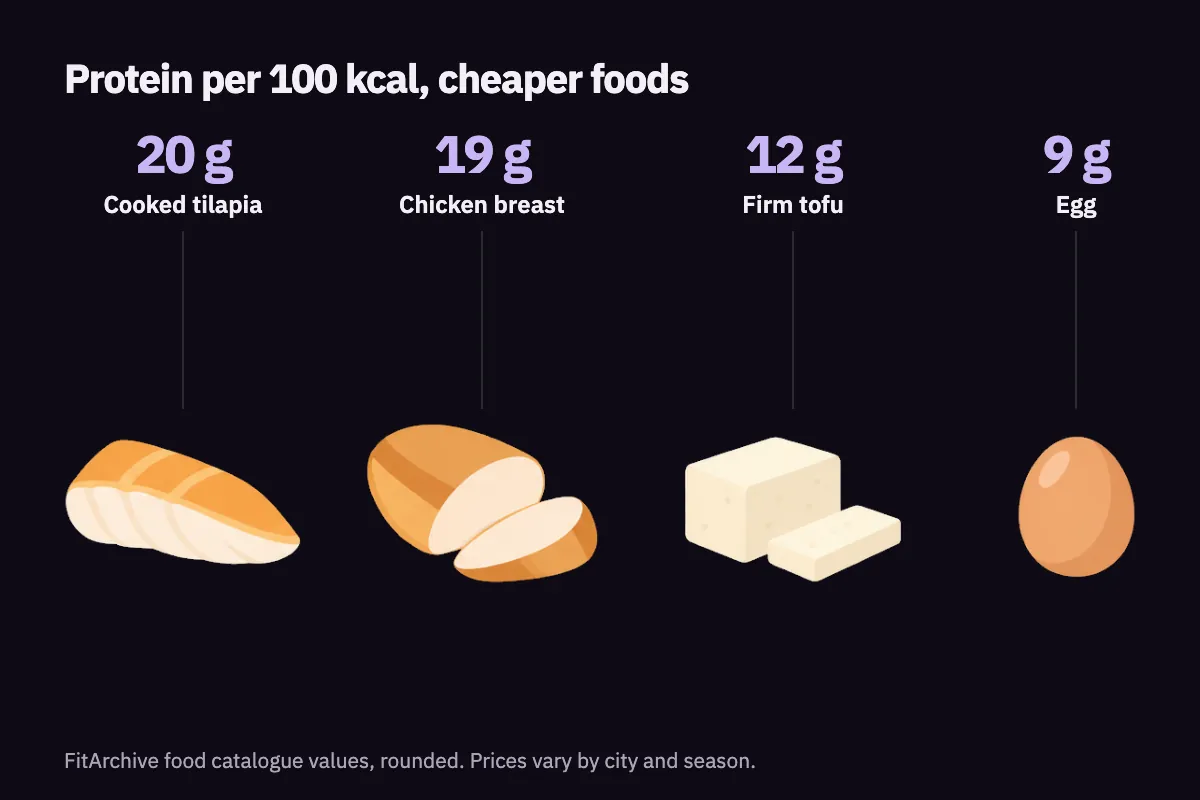
Fish, chicken, tofu and eggs give plenty of protein for their calories.
Eggs, tofu, market fish, chicken breast and milk are often among the cheaper protein sources at Vietnamese markets, though prices vary by city and season. Peanuts are energy-dense rather than protein-dense, which makes them more useful for a bulk than for a cut. Instant noodles sit at about 2 g per 100 kcal; the instant noodles guide shows how to fix that with eggs or tofu.
Do you need supplements to build muscle?
No. The ISSN protein position stand notes that active people can meet protein needs from whole foods, and none of the example days above uses a supplement. Whey or soy protein powder is simply a convenient way to add protein when meals fall short. Creatine is one of the best-studied supplements for strength training; the creatine guide covers what it does and its safety. If you have kidney disease, take regular medication, are pregnant or are under 18, ask a doctor before using supplements.
Common mistakes
- Looking for one magic food. Chicken breast and broccoli are fine, but so is phở bò or cá kho with rice. The week’s total matters.
- Light protein at breakfast and lunch, then catching up at night. A breakfast of xôi xéo (7 g) or plain bánh mì leaves a lot for dinner.
- Bulking on drinks and desserts. A regular trà sữa trân châu is 322 kcal and 1 g of protein in FitArchive’s estimate.
- Cutting very hard while trying to grow. Large deficits are linked to smaller lean mass gains.
- Skipping vegetables because they are low in protein. They do other jobs.
- Not counting oil and sauces. Frying oil, the oil in stir-fries such as rau muống xào, and sauces all add real calories.
This is general information, not personal nutrition or medical advice.
Tracking what you eat in FitArchive
FitArchive is a free, private food and training log that works in the browser. Its food log has about 263 Vietnamese dishes built from weighed parts, including every dish in this article, plus USDA foods and your own foods, and shows each day’s calories and protein. Your workouts go in the same log. Dishes such as cơm tấm can be logged small, regular or large, with less or more rice. Try it with sample data in the demo.