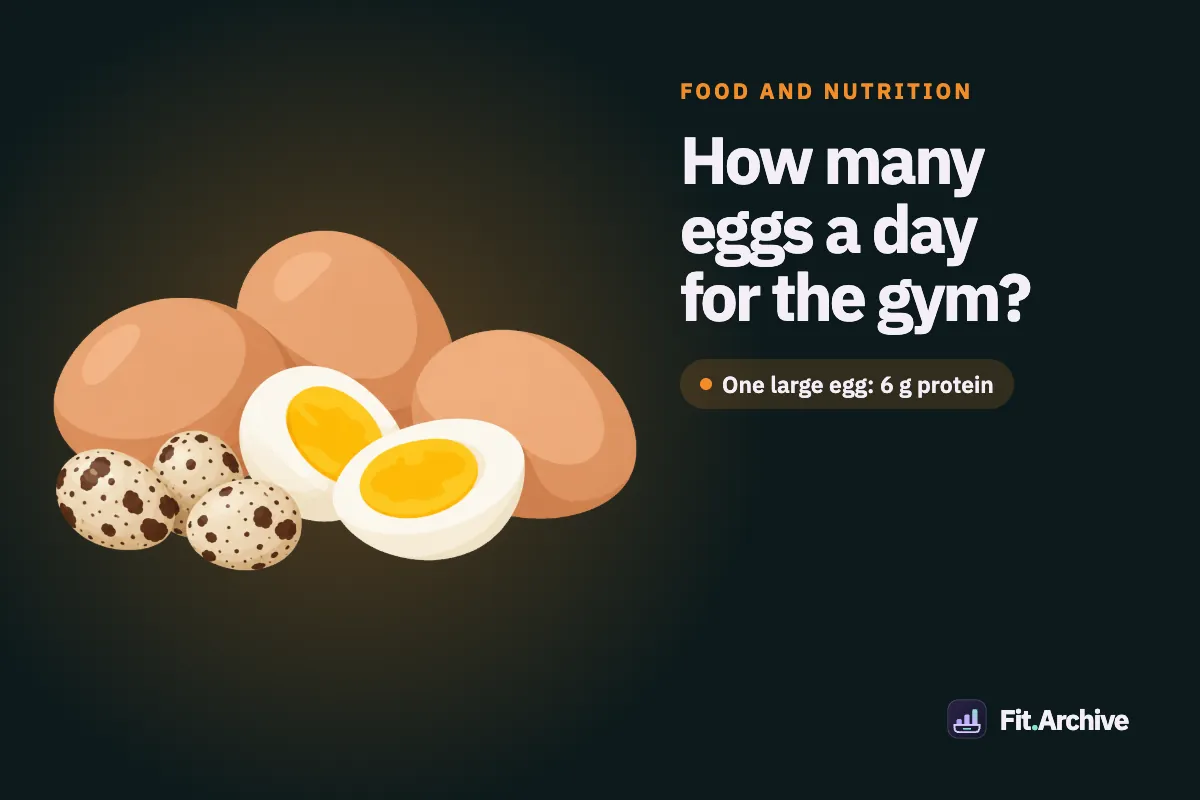
Eggs are a good, cheap source of high-quality protein for lifters, but there is no single right number of eggs a day. How many fit depends on how much protein the rest of your diet already gives you and on your health. In large studies of healthy adults, eating up to about one egg a day was not linked to a higher risk of heart disease; evidence for several eggs a day is thinner and mixed. One large chicken egg has about 6 g of protein and 72 kcal in FitArchive’s food catalogue, so eggs help with a day’s protein but rarely cover it alone.
Three claims about eggs keep coming back on social media: lifters should throw away the yolks and eat only whites, raw eggs build more muscle, and eggs clog your arteries. This guide checks each against the research and gives the numbers for chicken, duck and quail eggs. It is general information, not individual medical or nutrition advice.
How much protein is in an egg? Chicken, duck, quail and egg whites
These values come from FitArchive’s food catalogue (USDA data), for the serving sizes stated, rounded to whole kcal and grams.
| Egg (serving in catalogue) | Weight | Calories | Protein | Fat | Protein per 100 kcal |
|---|---|---|---|---|---|
| Chicken egg, large | 50 g | 72 kcal | 6 g | 5 g | 9 g |
| Chicken egg, medium | 44 g | 63 kcal | 6 g | 4 g | 9 g |
| Hard-boiled chicken egg, large | 50 g | 78 kcal | 6 g | 5 g | 8 g |
| Fried chicken egg, large | 46 g | 90 kcal | 6 g | 7 g | 7 g |
| Egg white, from a large egg | 33 g | 17 kcal | 4 g | 0 g | 21 g |
| Egg yolk, from a large egg | 17 g | 55 kcal | 3 g | 5 g | 5 g |
| Duck egg | 70 g | 130 kcal | 9 g | 10 g | 7 g |
| Quail egg | 9 g | 14 kcal | 1 g | 1 g | 8 g |
| 5 quail eggs | 45 g | 71 kcal | 6 g | 5 g | 8 g |
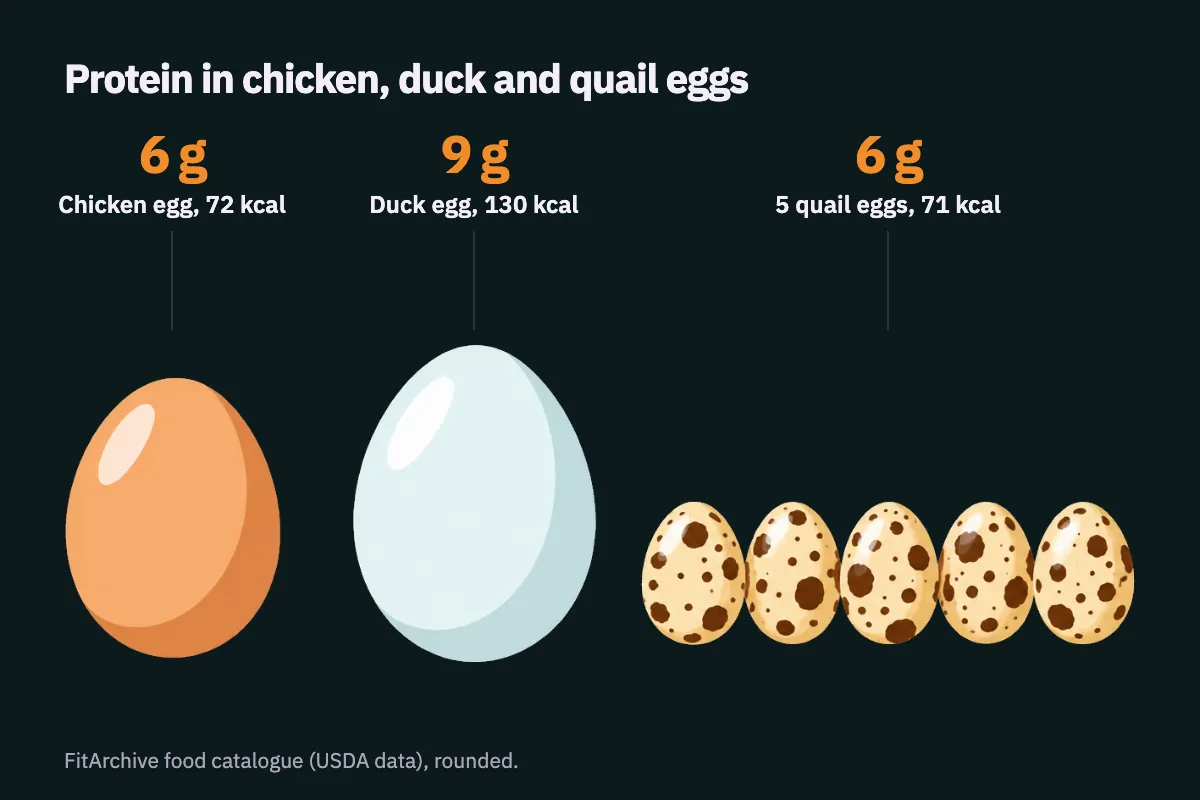
Five quail eggs are about one chicken egg; a duck egg is simply bigger.
A few things stand out:
- Almost half the protein is in the yolk. Of the 6.3 g in a large egg, about 3.6 g is in the white and 2.7 g in the yolk. Throwing the yolk away removes most of the fat, and a good part of the protein with it.
- Egg whites are the most protein per calorie, about 21 g per 100 kcal, because they have almost no fat.
- A duck egg is simply bigger. Per 100 g, duck and chicken eggs have nearly the same protein (12.8 g and 12.6 g) but duck eggs have more fat (13.8 g against 9.5 g). One duck egg gives about 9 g of protein for 130 kcal.
- Five quail eggs are about one chicken egg in calories and protein.
- Frying adds fat. The fried value includes cooking fat; a heavy pour of oil adds more. The small gap between the raw and hard-boiled values comes from separate USDA entries, not from boiling adding calories.
How many eggs to reach your protein for the day?
For people who lift to build muscle, a 2018 meta-analysis of 49 trials found that gains levelled off at about 1.6 g of protein per kg of body weight a day, with up to about 2.2 g/kg as a reasonable upper end. For a 70 kg person, 1.6 g/kg is about 112 g. The protein per day guide explains where those numbers come from.
As an example, using hard-boiled chicken eggs for a 70 kg lifter:
| Hard-boiled eggs | Calories | Protein | Share of 112 g |
|---|---|---|---|
| 1 egg | 78 kcal | 6 g | 6% |
| 2 eggs | 155 kcal | 13 g | 11% |
| 3 eggs | 233 kcal | 19 g | 17% |
| 4 eggs | 310 kcal | 25 g | 23% |
Getting the whole 112 g from eggs alone would take about 18 eggs, which nobody needs. Eggs work best as one protein source among several: two or three eggs with breakfast, plus meat, fish, tofu or milk in other meals. The International Society of Sports Nutrition position stand on nutrient timing suggests about 20 to 40 g of protein per meal, so three eggs get you close to the lower end of one meal. For meal ideas, see what to eat to build muscle.
Whole eggs vs egg whites: which is better for building muscle?
The popular advice is to eat whites and skip yolks to get “clean” protein. Three studies tested this directly:
| Study | Who and how long | Main finding |
|---|---|---|
| van Vliet et al. 2017 | 10 resistance-trained young men, one session each, crossover | After lifting, whole eggs (18 g protein, 17 g fat) raised muscle protein synthesis more than egg whites with the same 18 g protein |
| Bagheri et al. 2021 | 30 resistance-trained young men, 12 weeks, 3 sessions a week | 3 whole eggs or 6 egg whites after training: muscle size and lean mass rose in both groups with no significant difference between them (lean mass showed a non-significant trend towards whole eggs); the whole-egg group gained more on knee extension and handgrip strength |
| Bagheri et al. 2020 | Same trial, other measures | Similar body composition changes in both groups; the authors concluded whites and whole eggs can be used interchangeably when protein is matched |
How strong is this? The first study measured a short-term signal after one meal, not muscle growth. The training study is the more useful one, but it is a single small trial of young men from one research group, and its muscle size results showed no difference. The honest summary: whole eggs are at least as good as whites for building muscle, and may help a little more, but the evidence is limited.
In practice, choose by your calories. Whole eggs bring more energy and nutrients from the yolk, which can help if you are trying to eat more. Whites give more protein per calorie, which can help when food is tight during a cut; our guide to keeping muscle while cutting covers that. A mix such as two whole eggs and two whites is a common middle ground.
Is eating several eggs a day bad for your heart?
This is where the research is most mixed. Eggs contain dietary cholesterol, mainly in the yolk. The large studies:
| Study | Design | Main finding |
|---|---|---|
| Drouin-Chartier et al. 2020, BMJ | 3 US cohorts, 215,618 adults followed up to 32 years, plus a meta-analysis of 33 risk estimates (1.7 million people) | Up to one egg a day was not associated with cardiovascular disease overall; in Asian cohorts it was linked to slightly lower risk |
| Dehghan et al. 2020, PURE and two other cohorts | About 177,000 people in 50 countries, including about 31,500 with vascular disease | 7 or more eggs a week, compared with less than 1, was not associated with blood lipids, cardiovascular disease or death |
| Zhong et al. 2019, JAMA | 6 US cohorts, 29,615 adults, median 17.5 years | Each extra half egg a day was associated with slightly higher cardiovascular risk; the link disappeared after accounting for total dietary cholesterol |
| American Heart Association science advisory, 2020 | Review of human studies | Observational studies generally show no significant link with heart disease, but most intervention studies find that cholesterol intakes above current averages raise total or LDL cholesterol; advice should focus on healthy eating patterns |
All of the egg and heart disease studies above are observational. People reported their diets on questionnaires, and egg eaters differed in other ways; in the BMJ cohorts, people who ate more eggs also ate more red meat and had a higher body mass index. Most participants ate between one and five eggs a week, so there is little data on people eating three or more eggs every day, as some lifters do. And the BMJ cohorts excluded people with diabetes, heart disease or cancer at the start, so the reassuring results apply to healthy adults.
Who should ask a doctor before eating many eggs?
Talk to a doctor or dietitian about how many eggs suit you if you:
- have high LDL cholesterol, familial hypercholesterolaemia or are on cholesterol medication;
- have heart disease, or have had a heart attack or stroke;
- have diabetes;
- have kidney disease and have been told to watch protein;
- are pregnant, or are cooking for young children or older relatives (see food safety below);
- have an egg allergy.
Raw eggs, soft yolks and food safety
Drinking raw eggs is a popular old-school gym habit. It does not help. In a small study of five people using labelled egg protein, about 91% of cooked egg protein was digested and absorbed in the small intestine, against about 51% of raw egg protein. It was a tiny study, but no study shows raw eggs are better.
Raw and undercooked eggs also carry a risk of Salmonella. The US Food and Drug Administration advises:
- cook eggs until both the yolk and the white are firm, and cook egg dishes to 160°F (71°C);
- keep eggs refrigerated at 40°F (4°C) or below, and do not leave cooked eggs out for more than 2 hours;
- use pasteurised eggs for recipes that stay raw or undercooked.
The FDA lists children, older adults, pregnant women and people with weakened immune systems as being at greater risk of severe illness. Soft or runny yolks are a personal choice for healthy adults, but they are not the low-risk option.
Chicken eggs, duck eggs and trứng vịt lộn (balut)
Chicken or duck eggs both work for lifters; count them by the egg, since a duck egg is larger (9 g protein and 130 kcal against 6 g and 72 kcal). Choose by price, taste and how they fit your calories.
Trứng vịt lộn (balut, a fertilised duck egg with a developing embryo) is popular in Vietnam, and many lifters ask about it. It is not in the FitArchive catalogue, and regular duck egg values do not transfer to it, so we give no numbers here. If you eat it often, log it as your own food from a nutrition source you trust.
Common mistakes with eggs
- Throwing away every yolk to save protein. About 43% of an egg’s protein is in the yolk.
- Counting on eggs alone for protein. Four eggs are about 25 g, roughly a quarter of 112 g.
- Forgetting the oil. A fried egg or omelette carries the cooking fat; log the oil if you pour freely.
- Logging a duck egg as a chicken egg. That under-counts by about 58 kcal and 3 g protein per egg.
- Forgetting eggs inside dishes. Bánh mì trứng, cơm tấm sườn trứng and xôi mặn with quail eggs all contain egg; see the xôi calories guide and the bánh mì calories guide.
Logging eggs in FitArchive
FitArchive is a free, private food and training log that works in the browser. Its food catalogue includes chicken eggs (raw, hard-boiled, fried and scrambled), egg whites, egg yolks, duck eggs and quail eggs, alongside about 263 Vietnamese dishes, and you can add your own foods. The day’s calories and protein add up as you log, against nutrition targets you set yourself if you want them. The demo has sample data. If you also lift, see logging food and workouts together.