A good gym workout plan for beginners is three full-body sessions a week, on non-consecutive days, built mostly from machines and dumbbells. Start with 1 easy set per exercise, stopping each set with about 3 reps still in the tank, then do 2 sets per exercise from week 2 and progress by adding reps, then weight. Use 8 to 12 reps, and add weight only when you reach the top of the range with good form. That is enough to learn every movement safely and get stronger almost every week.
Below you get the full 4-week plan, the two workouts with demo clips, a first-day walkthrough and checklist, a simple way to pick your starting weights, reps in reserve explained in plain words, and the mistakes that make most beginners stall or quit.
Gym workout plan for beginners: the first 4 weeks
| Week 1 | Week 2 | Week 3 | Week 4 | |
|---|---|---|---|---|
| Goal | Learn the machines, find your weights | Second set on everything | Push a little harder | Beat your week 2 numbers |
| Sessions | 3 (A, B, A) | 3 (B, A, B) | 3 (A, B, A) | 3 (B, A, B) |
| Sets per exercise | 1 (2 on the first lift) | 2 | 2 | 2 |
| Reps | 10–12 | 8–12 | 8–12 | 8–12 |
| Effort | Stop with about 3 reps left | 2–3 reps left | 1–2 reps left | 1–2 reps left |
| Rest between sets | 90 s | 90–120 s | 2 min on the first two lifts | 2 min on the first two lifts |
| Session length | about 30–35 min | about 40 min | about 40–45 min | about 40–45 min |
Train on any three non-consecutive days, for example Monday, Wednesday and Friday. If you miss a day, do the next workout on your next gym day; don’t squeeze two into one.
How to start going to the gym: why this plan looks the way it does
Beginners need a plan that is easy to follow, safe to learn, and hard enough to make progress:
- Full body, 3 days a week. Each workout appears once or twice per week. Quads, hamstrings and back are trained on all three days; direct chest and shoulder pressing alternate, averaging 1.5 sessions each. A 2003 meta-analysis of 140 studies found untrained people gained the most strength training each muscle group 3 days a week at about 60% of their one-rep max. The 2026 ACSM position stand, which pooled 137 systematic reviews, found greater strength gains with at least 2 sessions a week.
- Machines first. A machine fixes the path of the weight, so you can focus on effort instead of balance. The same ACSM review found equipment type did not consistently change results. Our guide to free weights vs machines covers the trade-offs.
- 1 to 2 sets per exercise. Multiple sets build more muscle than one: a 2010 meta-analysis found about 40% larger effects. But when every muscle is trained up to three times a week, 1 to 2 sets per exercise is enough, keeps sessions short and soreness manageable. You progress by reps and load, not by piling on sets.
- Effort measured as reps left. Training to failure did not consistently improve results in the ACSM review, so every set stops with 1 to 3 reps left.
- 8 to 12 reps. A range that works for both muscle and strength at this stage, with moderate weights while joints and tendons adapt.
If you are unsure whether training is safe for you because of a heart condition, a recent injury, pregnancy or another health issue, ask your doctor before you start.
Workout A and Workout B
Each workout has five exercises: a squat-type leg exercise, a press, a pull, a hip hinge or hamstring exercise, and a core exercise.
| Workout A | Main muscles | Swap if busy |
|---|---|---|
| 1. Leg press | Quads, glutes | Goblet squat |
| 2. Machine chest press | Chest, front delts, triceps | Dumbbell bench press |
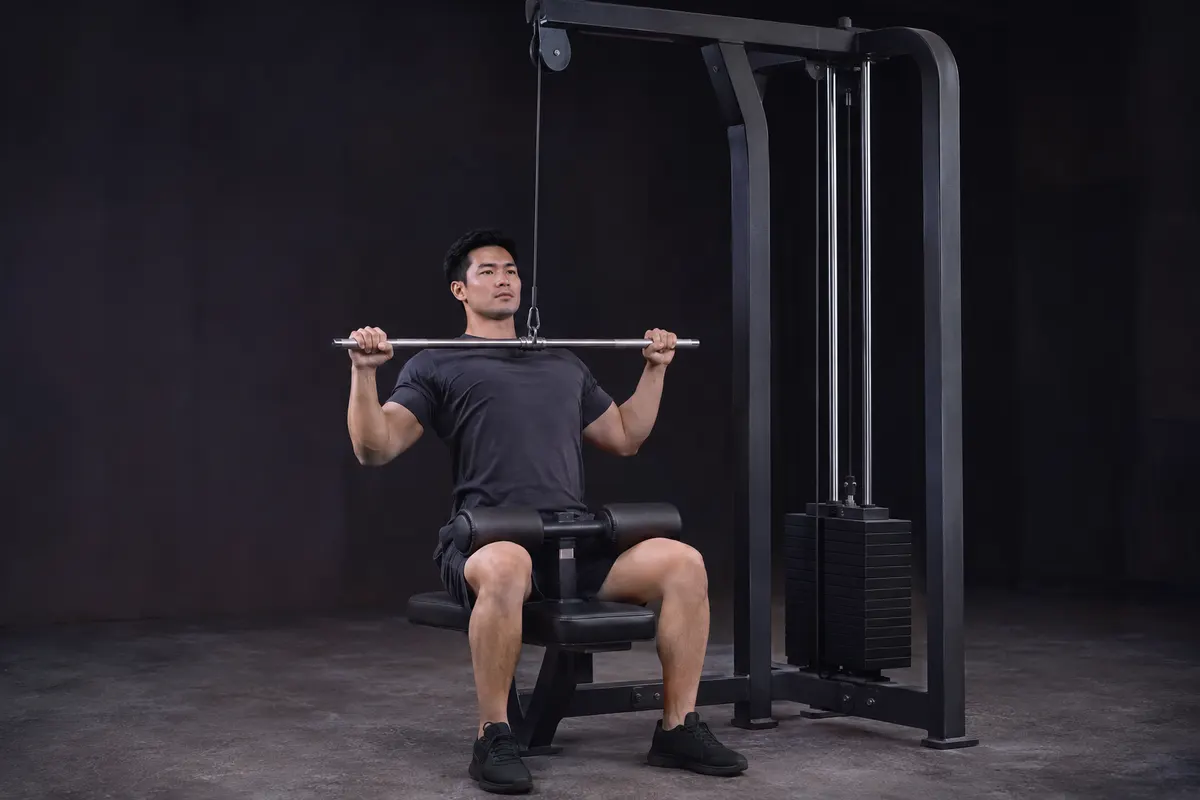
| 3. Lat pulldown | Lats, biceps | Machine lat pulldown |
| 4. Dumbbell Romanian deadlift | Hamstrings, glutes | Seated leg curl |
| 5. Dead bug | Abs | Plank, 20–40 s |
| Workout B | Main muscles | Swap if busy |
|---|---|---|
| 1. Goblet squat | Quads, glutes | Leg press |
| 2. Seated cable row | Upper back, lats | Chest-supported row machine |
| 3. Machine shoulder press | Front delts, triceps | Seated dumbbell shoulder press |
| 4. Seated leg curl | Hamstrings | Lying leg curl |
| 5. Plank | Abs, trunk | Dead bug |
Optional from week 3: 1 set of a curl and a triceps pushdown at the end of either workout, if you have time and energy.
The exercises, with setup cues
You only need a few cues per exercise. Read them once at home, then watch the clip again between sets.
The leg press as shown in FitArchive’s exercise library.
Leg press. Set the back pad so your knees can bend to about 90 degrees without your lower back lifting off the pad. Feet flat, about shoulder width, in the middle of the platform. Lower under control, push through the whole foot, and stop just short of locking your knees. Release the safety handles before your set and lock them again after.
The goblet squat as shown in FitArchive’s exercise library.
Goblet squat. Hold one dumbbell vertically against your chest. Feet a bit wider than hips, toes slightly out. Sit down between your heels with your chest up and heels flat, as deep as you can while keeping that position, then stand up. If your heels lift, put a small plate under them or squat a little less deep for now.
The machine chest press as shown in FitArchive’s exercise library.
Machine chest press. Adjust the seat so the handles line up with the middle of your chest. Shoulder blades back against the pad, feet flat. Press until your arms are almost straight, then let the handles come back slowly until you feel a stretch across the chest.
The lat pulldown as shown in FitArchive’s exercise library.
Lat pulldown. Set the thigh pad so your legs are locked in snugly. Grip the bar a little wider than your shoulders, lean back slightly, and pull the bar to your upper chest by driving your elbows down. Let it rise all the way until your arms are straight. No swinging.
The seated cable row as shown in FitArchive’s exercise library.
Seated cable row. Feet on the platform, knees slightly bent, back tall. Pull the handle to your lower ribs, squeeze your shoulder blades together, then let your arms reach forward fully. Your torso should stay almost still; if you rock back and forth, the weight is too heavy.
The dumbbell Romanian deadlift as shown in FitArchive’s exercise library.
Dumbbell Romanian deadlift. Stand with a dumbbell in each hand in front of your thighs, knees soft. Push your hips back and let the dumbbells slide down your legs with a flat back until you feel a strong stretch in your hamstrings, usually around mid-shin. Stand up by driving your hips forward. This is the exercise to take slowly: if your back rounds, stop higher.
The rest. On the machine shoulder press, set the seat so the handles start at about shoulder height and press without arching your lower back. On the seated leg curl, line your knee up with the machine’s pivot and lock the thigh pad down. For the dead bug, lie on your back, press your lower back into the floor, and slowly lower the opposite arm and leg. For the plank, keep a straight line from head to heels and stop the set when your hips sag.
Week by week: the full 4-week plan
Every session starts with 5 minutes of easy cardio, then 1 or 2 light warm-up sets of the first exercise (half your working weight for 8 reps, then about 75% for 4). Warm-up sets don’t count. Our warm-up sets guide explains why.
Week 1: learn and find your weights
| Day | Workout | Sets × reps | Effort | Rest |
|---|---|---|---|---|
| Mon | A | Leg press 2 × 10–12, all others 1 × 10–12 | About 3 reps left | 90 s |
| Wed | B | Goblet squat 2 × 10–12, all others 1 × 10–12 | About 3 reps left | 90 s |
| Fri | A | Same as Monday; adjust any weight that felt wrong | About 3 reps left | 90 s |
Core: 1 set of 8 slow reps per side (dead bug) or 20–30 seconds (plank). Write down every machine’s seat and pad setting the first time; you will reuse them.
Weeks 2 to 4: two sets, more reps, then more weight
| Week | Days | Sets × reps | Effort | Rest |
|---|---|---|---|---|
| 2 | B, A, B | 2 × 8–12 on every exercise | 2–3 reps left | 90–120 s |
| 3 | A, B, A | 2 × 8–12 on every exercise | 1–2 reps left | 2 min on lifts 1–2, 90 s on the rest |
| 4 | B, A, B | 2 × 8–12 on every exercise | 1–2 reps left | 2 min on lifts 1–2, 90 s on the rest |
Core in weeks 2 to 4: dead bug 2 × 8–12 per side, or plank 2 × 20–40 seconds; stop before your position deteriorates.
The set count stays at 2; what rises is effort, then reps, then weight. Keep the prescribed reps in reserve. If you want help estimating effort, ask a qualified trainer to observe a controlled set on a suitable machine; failure is not required.
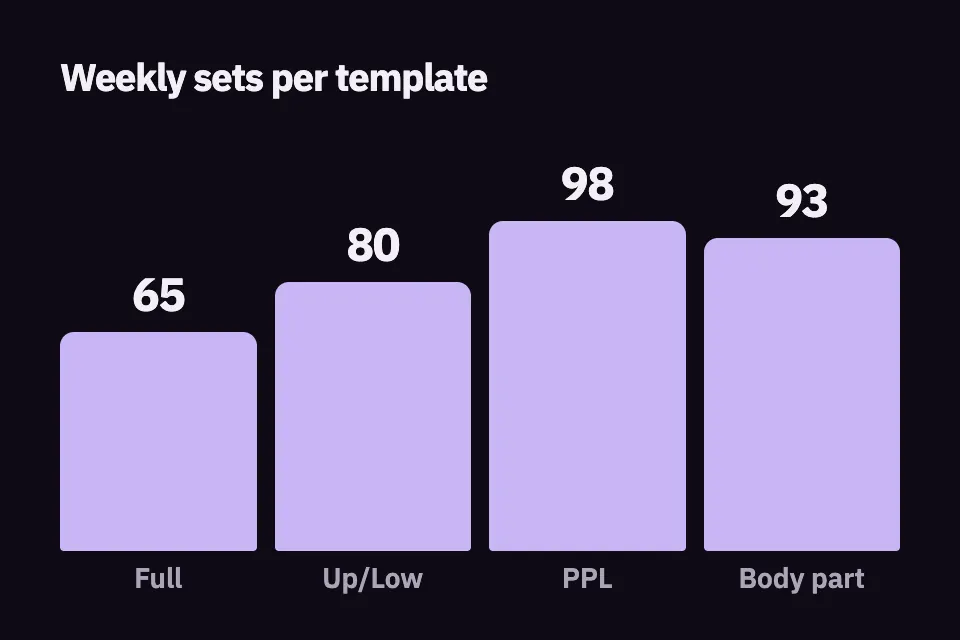
From week 2, a typical week gives your quads, back and hamstrings 6 direct hard sets each, and your chest 2 to 4 (shoulder pressing gets the other 2 to 4). That is deliberately below the 10 or more weekly sets per muscle that the ACSM review linked with more growth. A 2017 meta-analysis found more weekly sets brought more growth, but in your first month learning the movements and recovering between sessions matter more. Volume rises in month 2.
How to add weight: the progression rules
Use double progression: first add reps, then add weight. Our double progression guide goes deeper; for your first month, these rules are enough:
- Stay at a weight until you hit the top of the range. When you get 12 reps on every set at the target effort, increase the weight next session.
- Add the smallest step available. One pin hole on a weight stack, the next dumbbell pair up (usually 1 to 2.5 kg or 2.5 to 5 lb), or the smallest plates on the leg press.
- After a weight increase, expect fewer reps. Dropping from 12 to 9 is normal. Build back up to 12.
- If you fall below 8 reps, or form breaks down, go back to the previous weight and build reps again.
- If you reach failure when aiming for 2 RIR, reduce the load or stop roughly two reps earlier next time, then reassess.
Adding a rep or a small step of weight every week or two is common in the first months, largely because you are getting better at the movement itself.
Your first day at the gym, step by step
- Go at a quiet time if you can, such as late morning on a weekday. Ask the front desk when the gym is least busy.
- Take a lap. Find the changing room, water, cleaning spray, the machine area and the dumbbell rack.
- Ask for a tour of the machines you need. Ask staff to show you the seat adjustments on the leg press, chest press, pulldown and cable row.
- Warm up for 5 minutes on a bike, treadmill or cross-trainer.
- Do Workout A from week 1. Use very light weights for the first set. If you still have 6 or more reps left, go up and do one more set.
- Write everything down: exercise, seat setting, weight, reps and reps left.
- Leave after 30 to 40 minutes, feeling fresh. That makes the second visit much easier.
First-day checklist
- Comfortable clothes you can squat in, and flat, closed shoes
- Water bottle and a small towel
- Padlock, if your gym’s lockers need one
- This plan saved on your phone, or loaded in a workout app
- Something light to eat 1 to 3 hours before, if you are hungry
- A calendar slot for Workout B
How to choose your starting weights
Nobody knows their working weights on day one, so use your first set as a test. Pick a weight that looks easy, do 10 reps, then ask: how many more good reps could I have done?
| Reps you could still have done | What it means | Next set |
|---|---|---|
| 6 or more | Far too light | Go up two steps |
| 4–5 | A bit light | Go up one step |
| 2–3 | Right for weeks 1–2 | Keep it |
| 0–1, or your form broke | Too heavy for now | Go down one or two steps |
When in doubt, choose the lighter option. And log the machine you used: 30 kg on one brand’s chest press is not 30 kg on another.
Reps in reserve (RIR), explained simply
Reps in reserve is how many more good reps you could have done when you stopped the set. Stop at 10 reps when you could have done 13, and that set had 3 RIR. A set to complete failure has 0 RIR. In this plan you aim for 3 RIR in week 1, 2 to 3 in week 2, and 1 to 2 in weeks 3 and 4.
Expect to guess wrong at first. A 2022 meta-analysis of 12 studies found people underestimated how many reps they had left by about one rep on average, with predictions more accurate closer to failure and in later sets. A 2016 study that introduced the RIR-based effort scale found ratings tracked bar speed in both experienced and novice squatters. That is why this plan starts conservatively. To go deeper, read how to log RIR for every set.
Soreness: what’s normal in the first weeks
Expect some muscle soreness 1 to 3 days after your first sessions, especially in the legs. It usually fades within a few days and gets much milder after the first couple of weeks of regular training.
- Mild to moderate soreness: train as planned. A warm-up often makes it feel better.
- Soreness that limits normal movement or technique: rest the affected muscles or choose comfortable light activity; resume hard training when it improves.
- Sharp pain, joint pain, swelling or pain that gets worse during a set: stop that exercise and get it checked.
Soreness is not a sign of a good workout. More in our guide to muscle soreness (DOMS).
Eating basics for beginners
- Eat enough protein. A 2018 meta-analysis of 49 trials found intakes above about 1.6 g per kg of body weight per day gave no further increase in fat-free mass gains. For a 70 kg person, that is around 110 g a day, spread across meals. See how much protein per day to build muscle.
- Don’t start a hard diet at the same time. Large calorie cuts make your first month harder. If you want to lose fat, keep the cut moderate.
- Eat something 1 to 3 hours before training if you get light-headed on an empty stomach, and drink water during the session.
Gym tips for beginners: etiquette and habits
- Wipe down benches and pads and put weights back after you use them.
- Let others “work in” (take a set while you rest) when the gym is busy, and don’t sit on a machine scrolling your phone.
- Ask before taking equipment with a towel or water bottle on it.
- Ask for help. Staff are there to show you machines.
Common beginner mistakes
- Doing too much in week 1. Ten exercises and two hours on day one usually means a week of soreness and a skipped second visit.
- Going too heavy too soon. Full range of motion with control comes first.
- Training to failure on every set. It adds fatigue without a consistent benefit; leave 1 to 3 reps in reserve.
- Changing the plan constantly. You can’t add weight to an exercise you only did once. Stick with A and B for the full 4 weeks.
- Not writing anything down. Without a log, you will forget weights and settings.
- Judging results too early. Strength comes quickly; visible muscle takes months. See how long it takes to build muscle.
What to do after week 4
After four weeks, you know the main machines, your weights and how to judge effort. Month 2 has three good options:
- Keep this plan and add one exercise per workout, still at 2 sets each: a seated cable row on A and a machine chest press on B. Back then gets 8 to 10 weekly sets and chest 6, while quads and hamstrings stay at 6.
- Move to FitArchive’s Beginner machines · full body 3 days template. Its stored version uses 2 to 4 sets per exercise over three different machine days; reduce every exercise to 1 to 2 sets for a three-day full-body week. It is a different program, not this four-week progression.
- Switch to 4 days if your schedule allows. Our comparison of push pull legs vs upper lower vs full body explains which split fits which week.
Keep the same rules: 8 to 12 reps for most lifts, 1 to 2 reps in reserve, and add weight only at the top of the range.
Best workout app for beginners: what to look for
We make FitArchive, so weigh our view accordingly. A beginner needs a few simple things more than a long feature list: free logging without a routine cap, your last session shown beside each set, a ready beginner plan, a rest timer that starts by itself, a way to note effort such as RIR, and exercise demos for unfamiliar machines. Many popular gym logs cover most of these; check each one’s free limits on its own pricing page, since some features are paid.
Log your first 4 weeks in FitArchive
FitArchive lets you build Workout A and B yourself, with no cap on routines, or start from templates such as Beginner machines · full body 3 days and Gentle restart · 3 days (2 sets per exercise). Each set records weight, reps and reps in reserve beside what you did last session, and the rest timer starts on its own. The library has 444 exercises with short demo clips, and you can log sets from an Apple Watch. Logging, the free suggested next load and Watch logging are free with no ads and no account needed; Plus adds Smart load, which also accounts for exercise order. See how to log your first workout, or get the app for iPhone or Android.
FAQ
What should a beginner do on the first day at the gym?
Warm up for 5 minutes, then do one short full-body workout of about five machine and dumbbell exercises, 1 light set each, stopping with about 3 reps left. Ask staff to show you the machine settings, write down your weights, and leave after 30 to 40 minutes.
How many days a week should a beginner go to the gym?
Three non-consecutive days is a good start for most beginners. Two days still works if that is what you can keep up; the ACSM position stand found greater strength gains with at least 2 sessions a week. Consistency over months matters more than the exact number.
How long should a beginner workout be?
About 30 to 35 minutes in the first week and about 40 to 45 minutes from week 2. If you are short on time, keep the first three exercises and cut the rest for that day.
Should beginners use machines or free weights?
Both work. Machines are easier to learn and to load safely, which is why this plan starts with them, and the ACSM review found equipment type did not consistently change results. Add free-weight versions such as the dumbbell bench press once the machine versions feel routine.
Should beginners do cardio?
Yes, for health and fitness, but not necessarily in the same session. Five minutes of easy cardio works as a warm-up; longer walks, cycling or classes fit on the days between lifting sessions.
How many sets and reps should a beginner do?
In a three-day full-body plan, 1 to 2 sets of 8 to 12 reps per exercise: 1 set in week 1, then 2. Stop each set with 1 to 3 reps in reserve, and add weight when you reach 12 reps on every set.
Is it OK to go to the gym alone as a beginner?
Yes. Most people train alone. Go at a quiet time for your first few visits, follow a written plan so you always know what’s next, and ask staff to show you any machine you are unsure about.