A practical warm-up for lifting has two parts: a few minutes of light general activity, then a short ramp of specific warm-up sets of the exercise you are about to train, getting heavier while the reps drop. The heavier your working sets are for you, the more warm-up sets you need: often none or one for a light isolation exercise, and three to five before a heavy squat or deadlift. Warm-up sets should feel easy, and they do not count as working sets. The research supports warming up for strength and power, is mixed on how much it changes ordinary sets of 8 to 12, and is weaker than most people think on injury prevention.
The popular claims
Warm-ups attract hot takes. “Skip them, your first light working set is the warm-up.” “Never lift without a 20-minute warm-up and a full stretching routine.” “Warming up prevents injuries.” “Static stretching before lifting kills your strength.” Each has a grain of truth, and the evidence below shows how big that grain is.
General warm-up vs specific warm-up sets
- General warm-up: light whole-body activity such as 5 to 10 minutes on a bike, rower or brisk walk. Its main job is to raise body and muscle temperature.
- Specific warm-up: lighter sets of the exercise you are about to do, such as empty-bar squats and then a few heavier sets. It rehearses the movement, lets you check how the joints feel, and prepares you for the load.
Many lifters use both. When time is short, a review on time-efficient strength training advises keeping only the exercise-specific warm-up, and stretching only when flexibility is itself a goal.
What the research shows about warming up
| Study | Who or what | What was tested | Main finding |
|---|---|---|---|
| Fradkin et al. 2010, meta-analysis | 32 studies, many sports | Warm-up vs no warm-up (not stretching alone) | Performance improved in 79% of the outcomes measured; little evidence of harm |
| McCrary et al. 2015, systematic review | 31 randomized trials of upper-body warm-ups | Different warm-up types | Strong evidence that high-load dynamic warm-ups improve strength and power; short static stretching had no effect on power |
| Abad et al. 2011 | 13 trained people | Specific warm-up alone vs 20 minutes of cycling plus the same specific warm-up | Leg press 1RM was 8.4% higher with both |
| Ribeiro B et al. 2020 | 40 resistance-trained men | Three specific warm-ups before 3 × 6 at 80% of 1RM | A warm-up of only light sets (6 reps at 40% of the working load) was not enough; including heavier warm-up reps gave better bar speed and work |
| Ribeiro AS et al. 2014 | 15 men | No warm-up, specific, aerobic or combined, before 4 sets to failure at 80% of 1RM | Total reps on bench press, squat and curl did not differ between conditions |
| Wilson et al. 2025, meta-analysis | 33 studies | Raising muscle temperature | Warmer muscle improved fast, explosive force but not maximum force |
How to read this: warming up reliably helps fast and maximal efforts, and a specific warm-up should include at least one set reasonably close to the working weight, not just a few very light reps. For ordinary multi-set training at moderate loads, the effect on reps may be small. Most studies were short, acute tests in young adults, so they say nothing about long-term muscle growth.
Does warming up prevent injuries?
The honest answer is “possibly, but the evidence is thin”. A systematic review of randomized trials found only five good studies: three showed fewer injuries with a warm-up, two showed no difference, and the authors concluded the evidence was insufficient either way while leaning in favour of warming up. The upper-body review above found no trials on injury at all. For stretching specifically, a meta-analysis of injury-prevention programs found no protective effect.
So warm up because it helps your sets go well and lets you notice anything that feels wrong before the weight is heavy, not because it guarantees you will not get hurt. None of these trials studied lifting injuries in a typical gym.
Should you stretch before lifting?
Long static stretches right before heavy sets are the one habit worth trimming. A 2016 systematic review found static stretching reduced performance by about 3.7% on average when testing followed straight after. The loss was larger with 60 seconds or more per muscle (about 4.6%) than with shorter holds (about 1.1%), and when dynamic activity followed the stretching, no clear effect remained. Stretching did not clearly reduce injuries in that review either.
In practice: if you like stretching or need range of motion for a position, keep holds short and follow them with your warm-up sets. If you have no reason to stretch first, you can skip it.
How many warm-up sets before working sets?
There are no trials comparing three warm-up sets with five, so this is common coaching practice, not a tested rule:
| Working set | Example number of warm-up sets |
|---|---|
| Isolation exercise, or a muscle already warm from an earlier exercise | 0 to 1 |
| First compound of the day, moderate load (8 to 12 reps) | 1 to 2 |
| First compound of the day, heavy load (3 to 6 reps) | 3 to 4 |
| Very heavy singles or testing a 1RM | 4 to 6 |
The pattern: reps go down as the load goes up, every warm-up set stays far from failure, and the last one lands at roughly 80 to 90% of the working weight for one to three reps. Rest is short between the light sets and closer to normal before the first working set. The second exercise for the same muscles usually needs one warm-up set at most.
Example warm-up ramps for squats and deadlifts
Example numbers only. Squat with a working weight of 80 kg × 5:
| Set | Load | Reps | Note |
|---|---|---|---|
| Warm-up 1 | 20 kg (empty bar) | 10 | Groove the movement |
| Warm-up 2 | 40 kg | 5 | Easy |
| Warm-up 3 | 60 kg | 3 | Easy |
| Warm-up 4 | 70 kg | 1 | Should feel light and fast |
| Working sets | 80 kg | 5 | Logged as working sets |
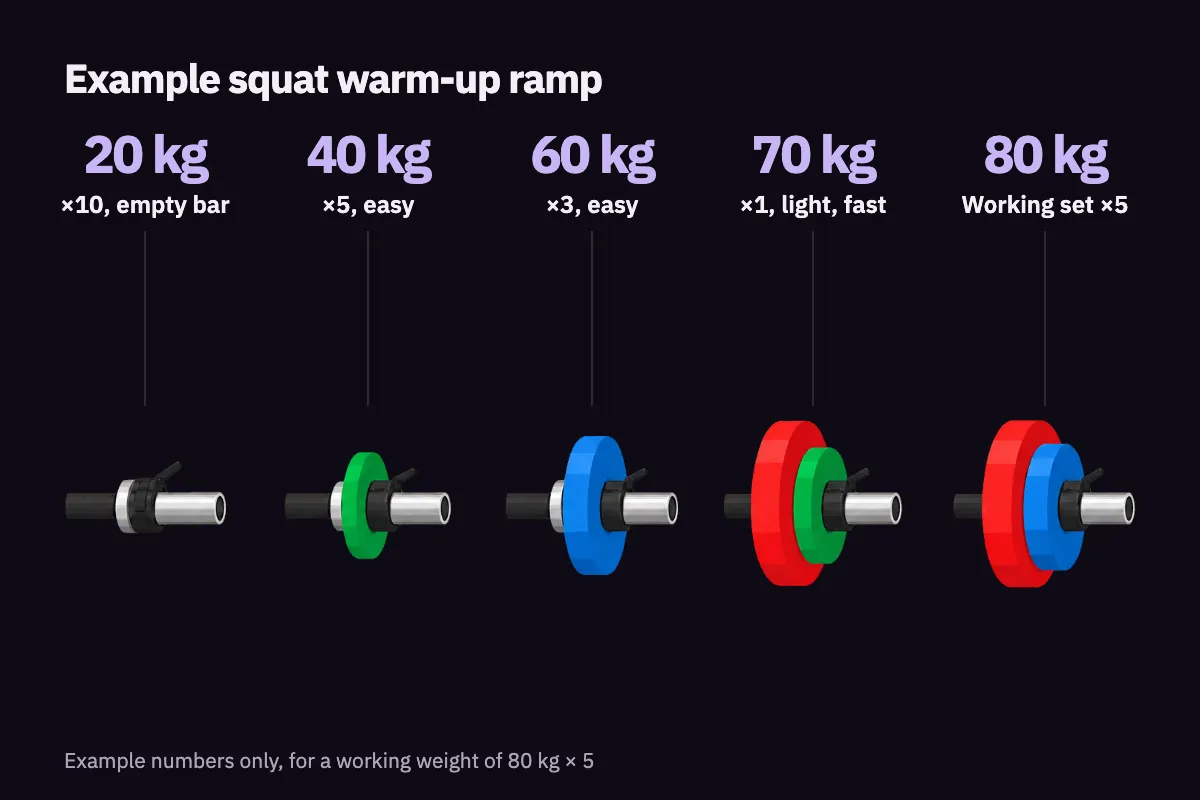
Load goes up, reps go down, and every warm-up set stays easy.
Deadlift with a working weight of 140 kg × 5: 60 kg × 5, then 90 kg × 3, then 115 kg × 2, then 130 kg × 1, then the working sets. For a bench press of 60 kg × 8, two warm-up sets such as 20 kg × 10 and 45 kg × 4 are often enough.
Warm-up sets add time, usually 5 to 15 minutes across a session. If time is your limit, how long a workout should be shows how to budget for them.
Do warm-up sets count as working sets?
No. Weekly volume in research and in most programs counts working sets: sets taken reasonably close to failure. A warm-up set with 10 or more reps left in the tank is not a hard set, and counting it inflates your weekly total. The weekly sets guide explains the counting rule.
Two edge cases:
- A “warm-up” that was actually hard. If your last warm-up ended at 2 RIR, it was a working set in disguise. Either log it as one or lighten your warm-ups.
- Feeder or ramping sets in a program. Some programs build up to a top set across several heavier sets. Count the ones that end within about 4 reps of failure, and log your RIR so it is clear which they were.
Mark warm-ups in your log rather than leaving them out. They show what you did, and they explain a long session. Keeping them separate also protects your estimated 1RM, which should come from working sets, not from an easy single.
Common mistakes
- Warm-ups that are too hard. Ten reps at 80% of your working weight is fatigue, not preparation. Keep reps low as the load rises.
- Only very light warm-ups before heavy sets. The 2020 trial found a few light reps alone were not enough. Get one set reasonably close to the working weight.
- Logging warm-ups as working sets. This inflates weekly volume and can skew progress charts.
- Long static stretches right before heavy lifting. Short holds followed by warm-up sets are fine; a minute or more per muscle may cost a little performance.
- Treating the warm-up as injury insurance. It may help, but the evidence is thin. Sharp or worsening pain is a reason to stop and get qualified advice.
- Changing your warm-up and judging the working sets. If you change your warm-up routine, note it, the same way you would note different rest between sets.
Logging warm-ups in FitArchive
In FitArchive you can mark any set as a warm-up. Warm-ups stay in the workout record but are left out of working sets, the weekly hard-set count by muscle and the estimated 1RM, so your progress numbers come from the sets that matter. If you import history from Strong or Hevy, warm-up flags carry over. The app is free and works in your browser; the demo has sample data to explore.