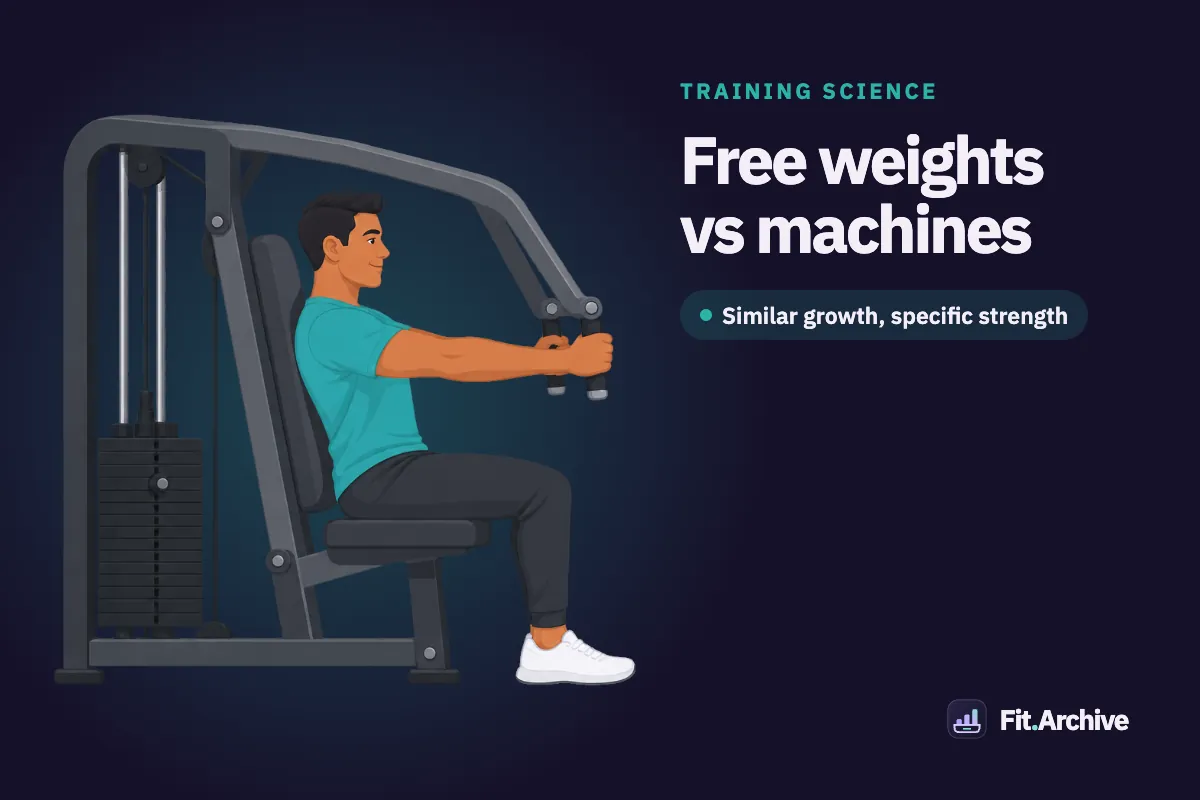
For building muscle, free weights and machines work about equally well: a 2023 meta-analysis and several trials found similar growth when the training was otherwise matched. Strength is more specific. People who train with free weights improve most on free-weight tests, and people who train on machines tend to improve most on machine tests. So the better choice depends on your goal, safety, what your gym has and what you will keep doing. Most lifters do well with a mix.
On social media you will hear both “machines are for beginners, real muscle comes from barbells” and “machines are better for hypertrophy because you don’t waste effort balancing”. This guide checks both claims against the studies, covers the Smith machine, and shows how to choose and log either.
What the research shows
| Study | Who and how long | Main finding |
|---|---|---|
| Haugen et al. 2023, meta-analysis | 13 studies, 1,016 adults (789 men, 219 women), at least 6 weeks | No difference in muscle growth (5 studies) or in strength when compared directly; strength gains favoured the training tool on its own test |
| Schwanbeck et al. 2020, randomised trial | 46 young adults (26 women), 8 weeks | Biceps and quad thickness grew similarly; machine bench press rose more in the machine group (13.9% vs 8.6%); free-weight bench, squat and Smith squat rose similarly in both (11 to 19%) |
| Hernández-Belmonte et al. 2023, randomised trial | 38 resistance-trained men, 8 weeks | Similar strength and quad growth; each group improved most on the tool it trained with; joint discomfort fell in both |
| ACSM position stand 2026, overview of 137 reviews | Healthy adults | Equipment type did not consistently change training outcomes |
How strong is this? The meta-analysis pooled 13 studies, but only 5 measured muscle size, and most trials ran 6 to 12 weeks. Participants were adults aged 18 to 60, mostly men. That is decent evidence of “no big difference” over a few months, not proof that the two are identical for every muscle and every person over years.
Free weights vs machines for hypertrophy
Muscle grows when it does enough hard sets through a good range of motion; the muscle does not know whether the load is a dumbbell or a weight stack. The studies above fit that: matched programs gave similar growth.
What about the claim that free weights build more muscle because they recruit stabilisers? In a 2009 study of 6 people, muscle activity averaged across leg and trunk muscles was 43% higher in a free-weight squat than a Smith machine squat at each lift’s 8-rep max. But muscle activity in one set is not the same as long-term growth, and the training studies that measured growth did not find a free-weight advantage. The opposite claim, that machines grow more muscle because they are stable, is not supported either.
Machines do have practical advantages for hypertrophy work: easy loading, small increments, the ability to push close to failure safely without a spotter, and options for muscles that are awkward to load with free weights. Free weights have their own: cheap, available almost anywhere, and adjustable to your body. Use whichever lets you train each muscle hard and consistently. Whether an exercise is compound or isolation usually matters more than the equipment.
Machines vs free weights for strength
Strength is specific to what you practise. In the Haugen meta-analysis, free-weight training beat machine training on free-weight tests, and machine training tended to beat free-weight training on machine tests; compared directly, overall strength gains were similar. Hernández-Belmonte found the same pattern: each group gained most on the tool it trained with.
Practical meaning:
- If you want a bigger barbell squat, bench or deadlift, for example for powerlifting, practise those lifts. Machines can add volume around them.
- If your goal is general strength, either works. Test progress on the tool you train with.
- Do not compare a machine number with a barbell number. A leg press “max” and a squat max are different skills.
Smith machine vs free weights
A Smith machine fixes the bar to a track, so you do not balance it side to side or front to back.
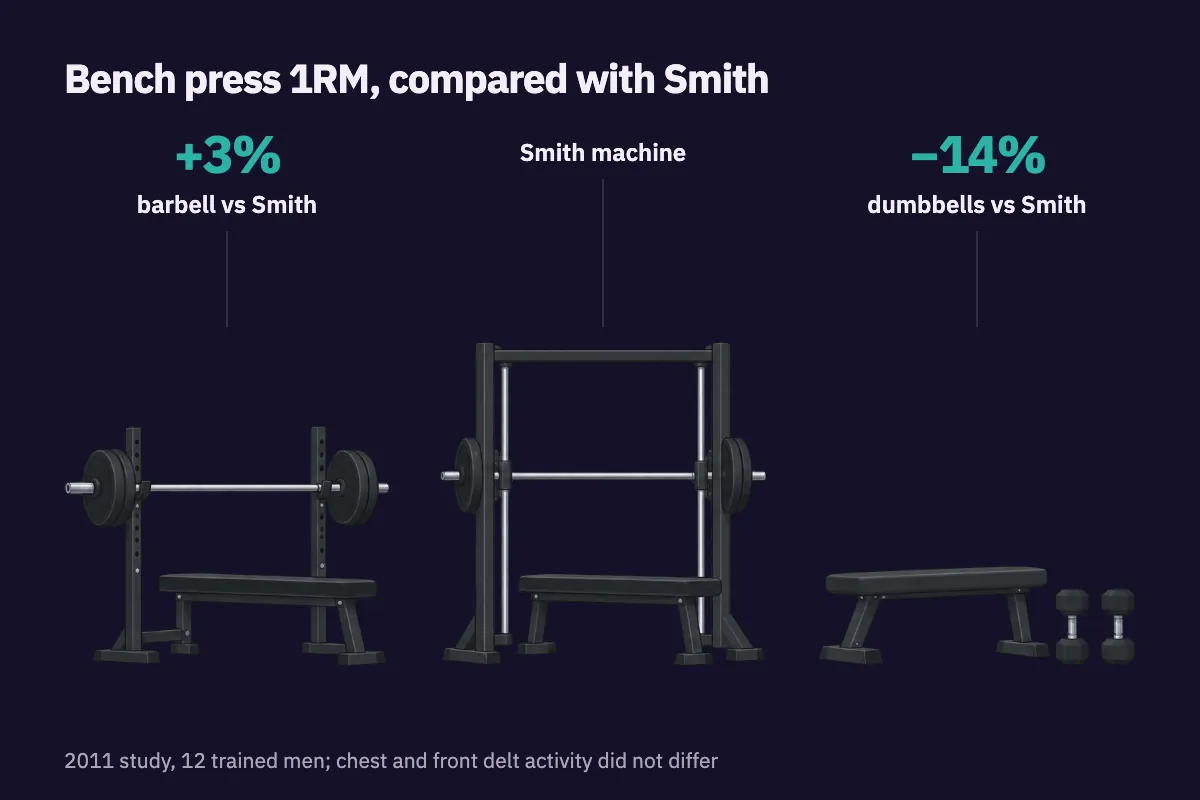
- Loads differ. In a 2011 study of 12 trained men, barbell bench press 1RM was about 3% higher than Smith machine 1RM, and dumbbell press 1RM was 14% lower than Smith and 17% lower than barbell. Chest and front delt activity did not differ between the three.
- Bench press training. In a 10-week trial in 36 trained men, the dumbbell and unstable-surface groups improved most on their own exercise, while the Smith machine group improved similarly across the chest-press tests, including the barbell bench.
- Squat training. In a trial in 59 men with 3 weeks of practice and then 7 weeks of training, Smith, free-weight and wobble-board squat groups gained similar muscle thickness. The Smith group improved more on the Smith squat than on the free-weight versions.
Log each tool as its own exercise; the numbers differ.
So a Smith machine can build muscle like a barbell, and its strength carries over reasonably, but your Smith and barbell numbers are not interchangeable. Log them as separate exercises.
Are machines safer than free weights?
Partly, and the data are limited. A study of US emergency department records from 1990 to 2007 estimated about 970,800 weight training injuries; 90.4% involved free weights, and the most common cause was a weight dropping on the person. Free-weight injuries more often involved fractures or dislocations. But the study had no data on how much each type of equipment was used, so it cannot tell you the injury rate per hour of training. Interestingly, people aged 55 and over had a larger share of injuries on machines than younger people.
Practical safety points either way: use safety pins or spotter arms for heavy barbell work, do not take free-weight sets to failure without a safe way to bail out, and set machines up to fit you. If you have an injury or a medical condition, ask a physiotherapist or doctor which options suit you. This is general information, not medical advice.
How to choose: goal, safety, access, preference
| Situation | Leaning | Reason |
|---|---|---|
| Powerlifting or a barbell strength target | Free weights for the main lifts, machines for extra volume | Strength is specific to the tool |
| Building muscle | Either, usually a mix | Growth is similar when sets and effort match |
| Training alone near failure | Machines, or free weights with safety pins | Safe to push hard without a spotter |
| Home gym or crowded gym | Whatever you can access reliably | Consistency matters more than the tool |
| Injury or medical condition | Ask a clinician first | Individual needs vary |
An example upper-body session mixing both (sets x reps, with a reps-in-reserve target):
| Exercise | Equipment | Sets x reps | Target RIR |
|---|---|---|---|
| Barbell bench press | Free weight | 3 x 6-10 | 2 |
| Chest-supported machine row | Machine | 3 x 8-12 | 2 |
| Machine chest press | Machine | 2 x 8-12 | 1 to 2 |
| Lat pulldown | Cable | 3 x 8-12 | 2 |
| Cable lateral raise | Cable | 3 x 12-20 | 1 |
| EZ-bar curl | Free weight | 2 x 10-15 | 1 |
FitArchive’s own templates already mix equipment: the Body-part split chest day, for example, has barbell bench press, incline dumbbell press, machine chest press, cable fly and chest dips.
Common mistakes
- Comparing numbers across tools. A Smith bench, barbell bench and machine press each need their own history.
- Switching gyms without noting it. Two “chest press” machines can feel very different; note the machine in your workout notes.
- Avoiding machines out of pride. They are valid tools for muscle and make close-to-failure sets easier to do safely.
- Avoiding free weights out of fear. Start light, learn the movement, and use safety equipment.
- Not tracking effort. Whatever the equipment, sets need to be hard; log RIR.
To see whether either choice is working, follow your progressive overload on each exercise and an estimated one-rep max per exercise.
Logging free weights and machines in FitArchive
FitArchive treats barbell, dumbbell, Smith machine and machine versions of a movement as separate exercises, so each keeps its own history and estimated 1RM. You log each set’s weight, reps and RIR, add notes per workout (useful for which machine or gym you used), and the Progress screen shows weekly hard sets by muscle whatever the equipment. The plan templates mix free weights, machines and cables, and you can edit them or build your own. Try it with sample data in the demo.