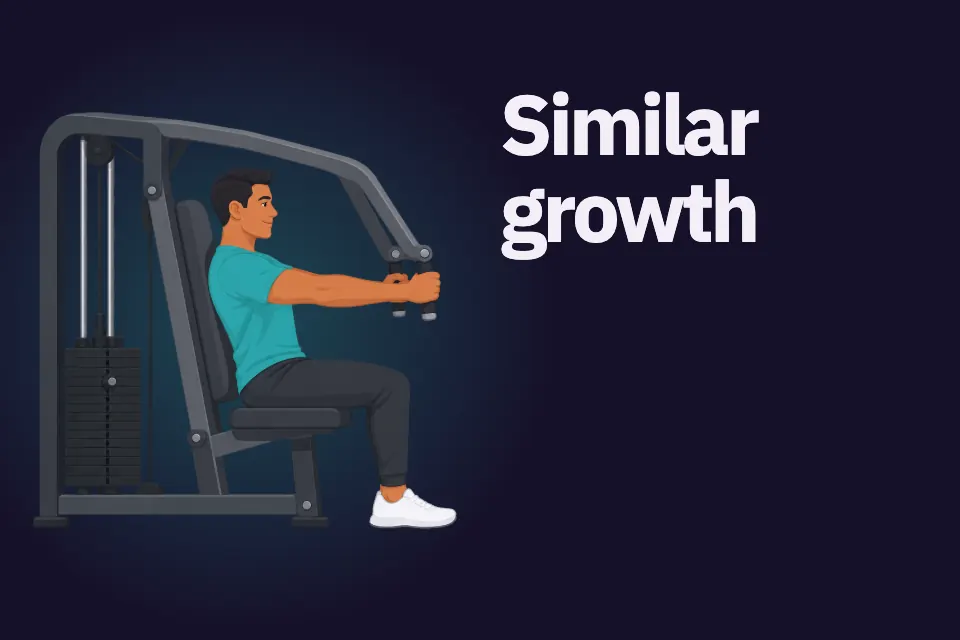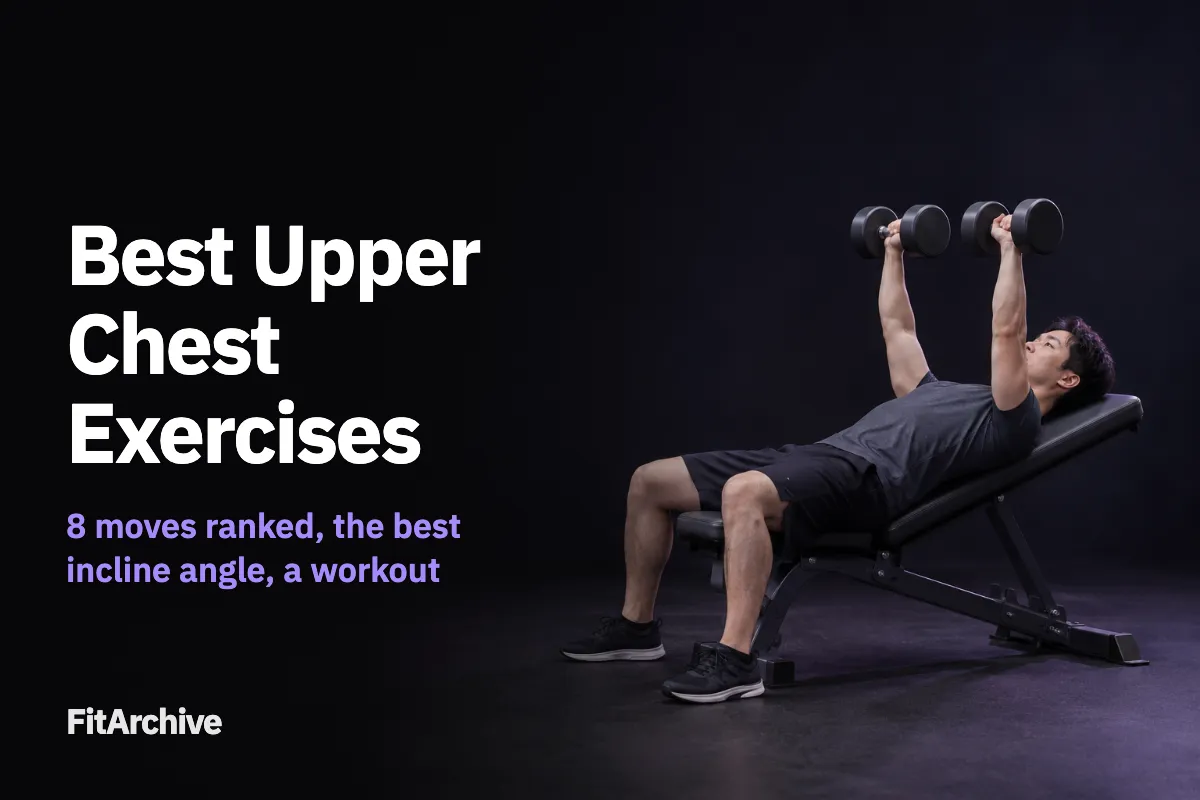
The best upper chest exercises are incline presses at about 30 degrees, led by the incline dumbbell press, followed by a low-to-high or incline cable fly. You can’t fully isolate the upper chest, but you can bias it: an 8-week trial found a 44-degree incline press grew the upper chest more than flat pressing, and EMG work makes about 30 degrees a practical starting angle, with steeper angles shifting more work to the front delts. Do roughly half of your weekly chest sets on an incline, within 10 to 20 total chest sets a week.
This guide covers how we ranked eight upper chest exercises, setup cues with demo clips, the best incline angle, incline dumbbell vs barbell press, the low-to-high cable fly, weekly sets, a sample upper chest workout and common mistakes.
The 8 best upper chest exercises at a glance
| Rank | Exercise | Tension in the stretch | Stability | Easy to progress | Evidence | Best for |
|---|---|---|---|---|---|---|
| 1 | Incline dumbbell press (30°) | High | Medium | Medium | EMG; growth trial used a Smith press | Most lifters’ main upper chest lift |
| 2 | Incline barbell bench press | Medium | Good | Very good | EMG; growth trial used a Smith press | Heavy, easy-to-track progress |
| 3 | Smith machine incline press | Medium | Very good | Very good | Incline growth trial (44°); EMG | Training close to failure safely |
| 4 | Incline machine press | Medium (machine-dependent) | Very good | Very good | Not tested directly | Beginners, high-effort sets |
| 5 | Incline cable fly | Very high | Good | Medium | Fly growth trial (flat) | Loading the stretch |
| 6 | Low-to-high cable fly | High | Good | Medium | Not tested directly | A second exercise, no bench needed |
| 7 | Incline dumbbell fly | High at the bottom | Medium | Low | Fly growth trial (flat) | Dumbbell-only gyms |
| 8 | Decline (feet-elevated) push-up | Medium | Good | Low to medium | Not tested directly | Home training |
“Tension in the stretch” means how much the exercise loads the chest with the arms wide and the pecs at their longest. “Incline growth trial” is the one study that measured upper chest growth after incline versus flat pressing; it used a Smith machine at 44 degrees.
How we ranked them
Five criteria, in this order of weight:
- Evidence. A training study that measured muscle size beats an EMG study, and EMG beats reasoning. For the upper chest, one growth trial and several EMG studies exist, so we use them all, labelled.
- Tension at long muscle lengths. Several studies found more growth when a muscle is loaded while stretched, such as overhead versus arms-down triceps work in a 12-week trial. A 297-person multi-site trial found partial reps in the stretch roughly equal to full reps, so this is a tiebreaker, not a rule (more in our guide to lengthened partials).
- Stability. Less balancing means more of each set goes to the chest.
- Ease of progression. Barbells and machines move in small, repeatable steps; dumbbells jump in bigger ones.
- Joint comfort. A press that hurts your shoulders ranks last for you, whatever its place here.
Can you really target the upper chest?
Partly. The chest muscle (pectoralis major) has a clavicular head, attached to the collarbone, and a larger sternocostal head below it. The two heads have different fibre directions, so the angle you press at changes how hard each works:
- A 2020 study of 30 trained adults recorded EMG during bench presses at 0, 15, 30, 45 and 60 degrees. Upper chest activity peaked at 30 degrees. Above 45 degrees, front delt activity rose and chest performance dropped.
- A 2022 study of 13 men found a 45-degree incline press activated the clavicular head more and caused a bigger short-term increase in its cross-sectional area (the post-workout “pump”), while the flat press did the same for the lower head.
- An 8-week trial in 47 untrained men is the closest thing to a growth answer. Groups trained once a week on a Smith machine with flat, incline (44 degrees) or both presses, with sets equalised. At the upper chest site (the second rib space), the incline group’s muscle thickness grew more than the flat group’s, by 0.62 cm, and more than the mixed group’s. At the other two sites there was no difference, and strength gains were similar in every group.
So incline pressing biases the upper chest. One Smith-machine trial in beginners is not the last word, but it agrees with the EMG data.
1. Incline dumbbell press
The incline dumbbell press as shown in FitArchive’s exercise library.
Dumbbells let the hands drop below the bench line and travel slightly inward at the top, so the chest gets a deeper stretch than with a bar. Each arm works on its own, which evens out side-to-side differences. That combination puts it first.
Setup and cues:
- Set an adjustable bench to about 30 degrees (often the first or second notch; check with a phone’s angle app once).
- Sit with the dumbbells on your thighs, lie back and kick them up one at a time.
- Plant your feet, squeeze your shoulder blades back and down, and keep a small arch.
- Lower the dumbbells to the sides of the upper chest, elbows about 45 to 60 degrees from your torso, forearms vertical.
- Pause lightly in the stretch, then press up and slightly in, stopping before the dumbbells touch.
Watch for: going steeper than about 45 degrees, where the front delts take over more of the press; flaring the elbows straight out; bouncing at the bottom.
2. Incline barbell bench press
The incline barbell bench press as shown in FitArchive’s exercise library.
The growth trial used a 44° Smith-machine incline press, so its findings do not directly establish the best free-weight implement or angle. The free bar is the easiest upper chest lift to load heavy and to progress in small steps with change plates, so it suits lifters who like clear numbers. The trade-off is a shorter range than dumbbells, because the bar stops at your chest.
Cues: grip slightly wider than shoulder width; unrack with straight arms; lower the bar to the upper chest, just below the collarbones; keep the elbows under the bar; press back up toward the rack. Use safety arms or a spotter for sets near failure.
3. Smith machine incline press
The Smith machine incline press as shown in FitArchive’s exercise library.
The fixed bar path removes balancing, and the hooks let you rack it anywhere, so you can take sets close to failure without a spotter. A 2011 study of 12 trained men compared Smith machine, barbell and dumbbell chest presses: chest and front delt EMG did not differ between them, but dumbbell loads were 17% lower than barbell loads. Stability changed how much weight people lifted, not how hard the chest worked. Place the bench so the bar touches your upper chest, not your neck or mid-chest.
4. Incline machine press
A plate-loaded or selectorized incline press is the most beginner-friendly option and progresses in small steps. How well it loads the stretch depends on the machine. Pick a seat height where the handles start level with your upper chest, keep the shoulder blades against the pad, and control the return. Use it as your main lift if free weights bother your shoulders, or as a second press after dumbbells.
5. Incline cable fly
The incline cable fly as shown in FitArchive’s exercise library.
Put an incline bench at about 30 degrees between two low pulleys. Cables keep tension on the chest from the stretched start to the end of the rep, unlike dumbbell flys, which unload near the top. Flys are not just “finishers”: a 2026 trial in 26 trained men found 10 weeks of dumbbell flys grew the chest about as much as dumbbell presses, at all three measured sites. That trial used a flat bench, so treat the incline version as a reasonable extension.
Cues: slight fixed bend in the elbows; open the arms until you feel a strong stretch with the hands around chest level; bring the hands up and together over the upper chest; lower slowly. Keep the load moderate; the stretch, not the weight, is the point.
6. Low-to-high cable fly
The low-to-high cable fly as shown in FitArchive’s exercise library.
Standing between two low pulleys, you sweep the arms up and in, which follows the line of the upper chest fibres. It needs no bench, works well as a second exercise after a press, and is easy to learn. No study has tested it for growth, so it ranks below the incline cable fly, which loads the stretch more.
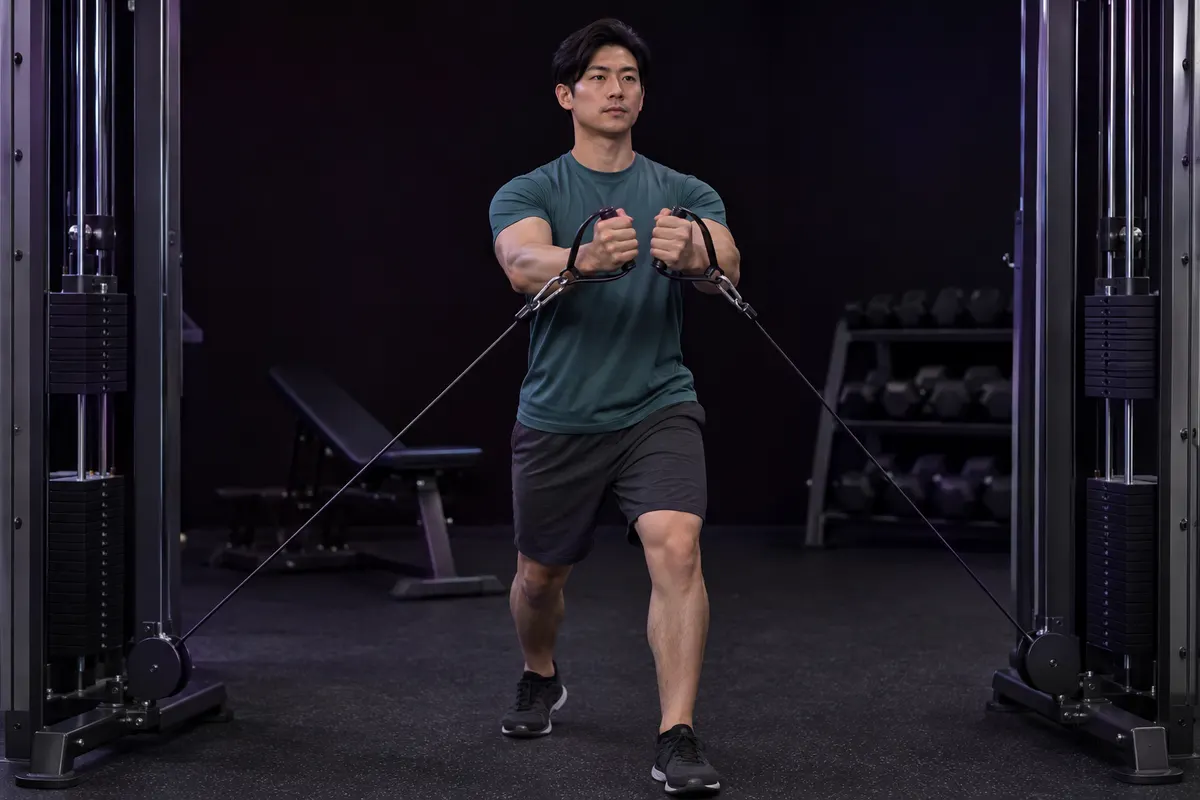
Low-to-high cable fly: each cable runs straight from its low pulley, and the hands meet at about chest to chin height.
Low to high cable fly cues:
- Set both pulleys at the lowest point and take a handle in each hand.
- Take one step forward, so the cables pull your arms slightly behind your body. Split your stance for balance.
- Palms forward or up, slight bend in the elbows.
- Sweep the hands up and together, finishing between chest and chin height.
- Lower slowly until you feel the stretch across the upper chest again.
Watch for: turning it into a front raise by lifting the hands overhead, or bending the elbows into a press.
7. Incline dumbbell fly
Same angle and path as the incline cable fly, with dumbbells. The stretch at the bottom is heavy, but the load fades to almost nothing at the top, so stop the rep when the dumbbells are about a forearm apart. Dumbbell steps are large relative to fly loads, so progress in reps first. It is the best fly for a gym without cables.
8. Decline (feet-elevated) push-up
The decline push-up as shown in FitArchive’s exercise library.
With your feet on a bench or step, a push-up becomes an incline press relative to your body. Keep the body in one straight line, hands slightly wider than shoulder width, and lower until your chest nearly touches the floor. To progress, add reps, a pause at the bottom, a backpack with weight, or deficit handles for a deeper stretch.
Best incline bench angle
| Angle | What happens | Use it for |
|---|---|---|
| 0° (flat) | Most middle and lower chest activity | Overall chest size |
| 15° to 30° | Upper chest activity rises; 30° was the peak in a 30-person EMG study | Upper chest presses and flys |
| 45° | Still trains the upper chest (the growth trial used 44°), with more front delt | If it feels comfortable |
| 60° and up | Front delts dominate; chest performance drops | Shoulder pressing, not chest |
Start at about 30 degrees, measure the notch once with a phone, and keep it the same.
Incline dumbbell vs barbell press
| Incline dumbbell press | Incline barbell press | |
|---|---|---|
| Range of motion | Longer (hands go below the bench) | Shorter (bar stops at the chest) |
| Load | Lower; dumbbells were 17% lighter than barbells in a flat-press study | Higher |
| Progression steps | Often 2 to 2.5 kg per dumbbell | As small as 0.5 to 1 kg with change plates |
| Side-to-side balance | Each arm works on its own | A stronger side can take over |
| Safety near failure | Finish with reps in reserve and lower the weights under control; use assistance when needed | Needs safeties or a spotter |
The 2011 comparison found similar pectoral EMG across barbell, dumbbell and Smith presses; it did not measure long-term muscle growth or establish hypertrophy equivalence. Choose dumbbells for the deeper stretch and shoulder freedom, or the barbell for heavier loads and easy tracking. Many lifters do one of each per week.
How many sets for upper chest per week?
- Total chest sets: 10 to 20 hard sets a week is a sensible general range. A 2026 meta-regression of 67 studies found more weekly volume produced more growth, with diminishing returns.
- Upper chest share: make about half of those sets upper-biased (incline presses, incline flys or low-to-high flys). If the upper chest lags, shift to two-thirds or more for a block rather than adding sets on top.
- Frequency: 2 sessions per chest is a good default. In full-body or high-frequency plans, use 1 to 2 sets per exercise; in a twice-a-week plan, 3 to 4 sets for the main press.
- Reps: 6 to 12 for presses, 10 to 20 for flys.
- Effort: 0 to 3 reps in reserve. Keep presses at 1 to 3 RIR and take flys and machine work closer to failure.
- Rest: 2 to 3 minutes after heavy presses, 60 to 90 seconds after flys.
Triceps and front delts also work on every press, so count those sets toward them at half credit, as our guide to counting weekly sets per muscle explains.
Sample upper chest workout
Two sessions a week, 14 total chest sets, 11 upper-biased (8 incline sets plus 3 low-to-high fly sets). That suits a block for a lagging upper chest; for a half-and-half split, swap the low-to-high fly for a flat cable fly (8 of 14).
| Day | Exercise | Sets × reps | RIR | Rest |
|---|---|---|---|---|
| Upper A | Incline dumbbell press (30°) | 3 × 6–10 | 1–2 | 2–3 min |
| Upper A | Flat machine or barbell press | 3 × 6–10 | 1–2 | 2–3 min |
| Upper A | Incline cable fly | 2 × 10–15 | 0–1 | 90 s |
| Upper B | Incline barbell or Smith press | 3 × 6–10 | 1–2 | 2–3 min |
| Upper B | Low-to-high cable fly | 3 × 12–20 | 0–1 | 60–90 s |
Dumbbell-only version (10 sets, 8 upper-biased): day 1, incline dumbbell press 3 × 8–12 (1–3 RIR, 2–3 min rest) and flat dumbbell press 2 × 8–12 (1–3 RIR, 2 min). Day 2, single-arm incline dumbbell press 2 × 8–12 each side (1–3 RIR, 2 min) and incline dumbbell fly 3 × 10–15 (1–2 RIR, 90 s).
At home with no bench (10 sets, 6 upper-biased), twice a week: decline push-up 3 × 8–20 (1–3 RIR, 90 s rest), then standard push-up or dumbbell floor press 2 × 8–20 (1–3 RIR, 90 s). If decline push-ups are too hard, start with standard push-ups. Once every set reaches 20 clean reps, add a 2-second pause at the bottom, then a loaded backpack, and drop back to 8 to 12 reps.
By level: beginners, on each upper day, do 2 incline-press sets and 1 to 2 flat-press sets (6 to 8 weekly chest sets), using the table’s reps, RIR and rest. Add flys once technique is steady. Intermediate lifters can use the full table.
Eight-week checkpoint: compare your incline press log at week 8 with week 1. If load or reps at the same RIR have not risen, check sleep and food first, then add 2 upper-biased sets a week.
How to progress: use double progression. When every set reaches the top of the rep range at your target RIR, add the smallest load step. FitArchive’s Upper/Lower · 4 days and Push/Pull/Legs · 6 days templates include incline pressing; our 4-day upper/lower split and split comparison show where it fits in a full week.
Common upper chest mistakes
- Flaring the elbows to 90 degrees. Keep them about 45 to 60 degrees from the torso.
- Losing the shoulder blade set. If the shoulders roll forward at the top, the front delts take over.
- Half reps at the top. The stretched bottom of the rep is the part most worth keeping.
- Changing the bench angle every week. Different angles are different lifts for logging; keep one and progress it.
FAQ
What is the best incline angle for the upper chest? About 30 degrees is a practical starting point: in a 30-person EMG study, upper chest activity peaked there. A comfortable 45-degree incline still trains the upper chest (the growth trial used 44 degrees) with more front-delt work.
Is incline dumbbell or barbell press better for upper chest? No growth trial has compared them. Chest EMG was similar across dumbbell, barbell and Smith presses in one acute study. Dumbbells give a deeper stretch; the barbell is easier to load and progress. Use the one you can progress, or both.
Can you isolate the upper chest? Not fully, since it is part of one muscle, but you can bias it. A 44-degree Smith incline press grew the upper chest more than flat pressing in an 8-week trial, and low-to-high and incline flys follow the upper fibres.
Why is my upper chest not growing? Often because most chest sets are flat or total weekly sets are low. Move about half of your chest work to an incline, log every set, and check that your reps or loads rise over 6 to 8 weeks.
Do push-ups work the upper chest? Feet-elevated (decline) push-ups put your body at an incline relative to your arms, which shifts more of the work toward the upper chest. Regular push-ups train the whole chest, like a flat press.
How often should I train upper chest? Twice a week works well for most people. More sessions are fine if you split the same weekly sets across them, with 1 to 2 sets per exercise.
Track your upper chest work in FitArchive
Every exercise above is in FitArchive’s library, each with a short demo clip. Each set records weight, reps and reps in reserve, with your last session shown beside it. The Progress screen counts weekly hard sets for chest, with half credit to triceps and front delts, against editable MEV, MAV and MRV landmarks, so you can see if you are inside the 10 to 20 range. FitArchive counts upper and lower chest work as one muscle, so log the angle in the exercise you pick (keep “incline dumbbell press” separate from the flat one) to see the split. A free suggested next load tells you when to add weight; Plus adds Smart load, which accounts for exercise order. For the rest of an upper body that looks wider, see our best side delt exercises and best lat exercises.
Get FitArchive free on iPhone or Android, or try the web demo. Logging and your full history are free, with no ads.