The best lat exercises are vertical pulls, led by the lat pulldown and the pull-up, because they load the lats through a full range from a deep overhead stretch. Single-arm cable pulldowns and one-arm dumbbell rows with the elbow driving toward the hip come next. Grip width matters far less than most lists claim: EMG studies found lat activity similar across wide, medium and narrow grips. For a wider back, do 10 to 20 hard sets of lat work a week and pair it with side delt training.
This guide covers how we ranked nine lat exercises, setup cues and demo clips, lat pulldown vs pull-up, wide vs close grip pulldowns, width vs thickness, weekly sets, a sample lat workout and common mistakes.
The 9 best lat exercises at a glance
| Rank | Exercise | Tension in the stretch | Stability | Easy to progress | Evidence | Best for |
|---|---|---|---|---|---|---|
| 1 | Lat pulldown (pronated, medium-wide grip) | High | Very good | Very good | Several EMG studies; strength outcome in two partials trials | Most lifters’ main lat lift |
| 2 | Pull-up | High | Medium | Low to medium | EMG studies | Strength-to-bodyweight, home with a bar |
| 3 | Single-arm cable pulldown | Very high | Good | Medium | Not tested directly | Deepest overhead stretch |
| 4 | One-arm dumbbell row | Medium to high | Good | Medium | Not tested directly | Dumbbell-only training |
| 5 | Neutral or close-grip pulldown | High | Very good | Very good | Narrow overhand grip tested; neutral not | Shoulder and elbow comfort |
| 6 | Chin-up | High | Medium | Low to medium | EMG studies | More biceps, easier than pull-ups for many |
| 7 | Cable pullover / straight-arm pulldown | High | Good | Medium | One EMG study | Lat work without biceps fatigue |
| 8 | Seated cable row (close, neutral grip) | Medium | Very good | Very good | Not tested directly | Lats plus upper back in one lift |
| 9 | Machine high row | Medium | Very good | Very good | Not tested directly | A stable pull between rows and pulldowns |
“Tension in the stretch” means how much the exercise loads the lats with the arm reaching overhead or forward, where the lats are longest.
How we ranked them
We weighed five things:
- Tension at long muscle lengths. The lats are longest with the arm overhead. Training at long lengths produced more growth in some trials, such as seated versus lying leg curls in a 12-week study (about 14% vs 9% whole-hamstring growth). In the upper body, a 2025 trial in 30 trained lifters found lengthened partial reps and full reps gave similar gains, including lat pulldown strength. So we reward a full overhead stretch but don’t demand partials.
- Stability. Supported, fixed-path exercises let you take sets closer to failure with less body English.
- Ease of progression. Cable stacks and machines progress in small steps; bodyweight pull-ups need added weight or extra reps.
- Joint comfort. Grip choices that hurt your elbows or shoulders get swapped.
- Evidence. For the lats, almost all data are EMG (muscle activity) studies. We use them to settle grip and setup questions, not to claim one exercise grows more. No trial has compared lat growth between, say, pulldowns and rows.
Lat width vs back thickness
“Back width” mostly means the lats, seen from the front or back. “Thickness” refers more to the mid-back muscles between the shoulder blades (traps and rhomboids), trained hardest by rows with the elbows out. In practice the split is fuzzy: rows train the lats too, especially with the elbows close to the body, and pulldowns train the mid-back.
Two other things change how wide you look: side delts, which sit at the outer edge of the shoulders (see our best side delt exercises), and body fat around the waist. Lat training alone won’t produce a V-taper if the other two pull the other way.
1. Lat pulldown
The lat pulldown as shown in FitArchive’s exercise library.
The pulldown gives a full overhead stretch, a thigh pad to lock you in, and small load steps. It is also the lift two lengthened-partials trials used to test pulling strength, so it has more research around it than any other lat exercise.
Setup and cues:
- Set the thigh pad so your legs are locked in and your feet are flat.
- Take an overhand grip a little wider than shoulder width. A grip width about 1.5 times your shoulder width is a good default.
- Start each rep with straight arms and let the bar lift your shoulders up slightly, so the lats are stretched.
- Pull the elbows down and slightly back toward your sides until the bar reaches your upper chest. Lean back about 10 to 20 degrees, no more.
- Return slowly to a full stretch before the next rep.
Pull to the front, not behind the neck. A 2024 EMG study of 14 trained men found front pulldowns gave greater overall excitation of the main pulling muscles than behind-the-neck pulldowns.
Watch for: swinging back to 45 degrees, which turns it into a row; stopping the bar at eye level; cutting off the top stretch.
2. Pull-up
The pull-up as shown in FitArchive’s exercise library.
The pull-up loads the lats heavily: in a 2010 EMG study of 25 adults, average lat activity was 117% to 130% of a maximal test contraction across pull-up, chin-up and a rotating-handle version. It ranks second only because it is harder to progress: most people can’t do enough reps at first, and adding load means a dip belt.
Cues: start from a dead hang with the shoulders active, not shrugged to the ears; drive the elbows down toward the hips; bring the chest toward the bar; lower all the way. If you can’t do 5 clean reps, use a band-assisted or machine-assisted pull-up, or the pulldown, and log it as its own exercise.
3. Single-arm cable pulldown
The single-arm lat pulldown as shown in FitArchive’s exercise library.
Working one arm at a time lets you reach further overhead and slightly across your body, which gives the lats the deepest stretch on this list. Many lifters also find it the easiest way to feel the lats. Kneel or sit facing a high pulley with a D-handle, reach up and slightly across, then pull the elbow down to your side along an arc toward the hip. Stay square; don’t twist to finish the rep.
4. One-arm dumbbell row
The one-arm dumbbell row as shown in FitArchive’s exercise library.
The best lat exercise if you only have dumbbells. Bracing one hand and knee on a bench makes it stable, and you can let the dumbbell hang forward at the bottom for a stretch.
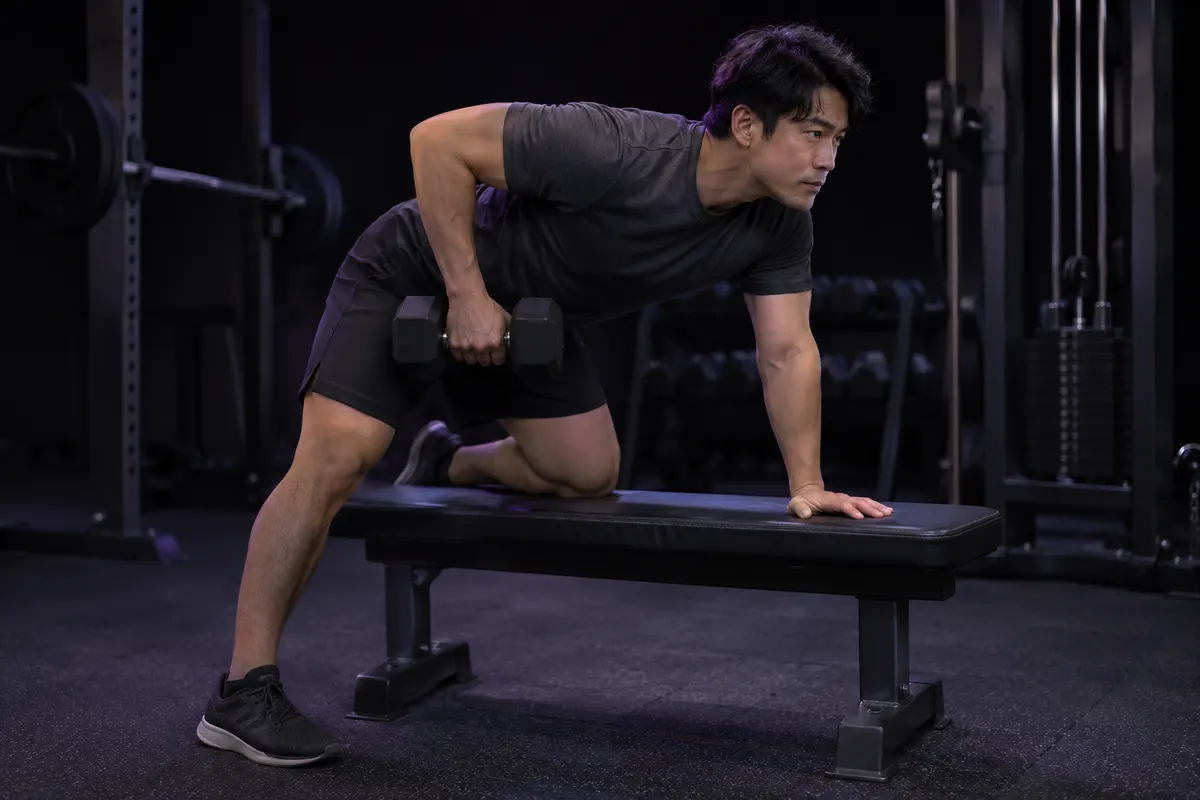
One-arm dumbbell row: back flat, elbow close to the body, dumbbell pulled toward the hip rather than the chest.
Cues:
- One knee and the same-side hand on a flat bench, back flat and roughly parallel to the floor.
- Let the dumbbell hang slightly forward of the shoulder at the bottom.
- Pull the elbow back toward your hip in an arc, keeping it close to your body. Rowing to the chest with the elbow flared shifts the work to the upper back.
- Lower slowly back to the forward stretch.
5. Neutral or close-grip pulldown
The same pulldown with a V-handle or narrow neutral bar. In a 2014 study of 15 men, narrow and medium overhand grips allowed slightly higher 6RM loads than a wide overhand grip; the study did not test neutral grips. Treat the neutral grip as a comfort option: many lifters find it easier on the shoulders and elbows. Lean back slightly and pull the handle to your upper chest, elbows close to your sides.
6. Chin-up
A pull-up with the palms facing you. It recruits more biceps, and in the 2010 EMG study more chest, than the pull-up, while the pull-up got more lower trap. Many people can do a few more chin-ups than pull-ups. A 2013 comparison found chin-ups used more biceps and lower-back muscle activity than lat pulldowns during the lifting phase. Use it as your vertical pull if pull-ups bother your shoulders, or alternate the two.
7. Cable pullover and straight-arm pulldown
The cable pullover as shown in FitArchive’s exercise library.
With the elbows almost straight, the shoulder does all the moving, so the lats work without the biceps tiring first. A 2022 study of 15 trained men compared pullovers and pulldowns at five shoulder angles and found lat activity depended mainly on the shoulder angle, not on the exercise. The pullover is a good second lat exercise, or a pre-fatigue before pulldowns.
Cues: stand facing a high pulley with a rope or straight bar, hinge slightly at the hips, arms overhead with a soft bend. Sweep the hands down in an arc to your thighs, keeping the elbows fixed. Return until you feel the stretch under your armpits.
8. Seated cable row (close, neutral grip)
The seated cable row as shown in FitArchive’s exercise library.
With a close neutral handle and the elbows tucked, the seated row trains the lats along with the upper back. Reach forward at the start to stretch the lats, then row the handle to your lower ribs while sitting tall. Avoid rocking back and forth to move the weight. It ranks lower for width only because the stretch is smaller than overhead pulls; for overall back size, it belongs in most programs.
9. Machine high row
A chest-supported machine where you pull down and back on an angle, between a row and a pulldown. The chest pad removes cheating, and the angle gives a decent stretch with the arms reaching up and forward. Use single-arm mode if the machine has it, and drive the elbows toward your hips.
Lat pulldown vs pull-up
| Lat pulldown | Pull-up | |
|---|---|---|
| Load | Any load, small steps | Your bodyweight, plus a belt to add more |
| Lat activity | High | High (117–130% of a maximal test in one study) |
| Who it suits | Beginners, high-rep sets, anyone heavier | Anyone who can do 5+ clean reps |
| Core and grip demand | Lower | Higher |
| Progression | Add weight or reps | Add reps, then weight; assistance to start |
No trial has compared them for lat size. The pulldown is easier to load in the 8 to 15 rep range, which is why it ranks first. If you can do 6 to 12 pull-ups, they are just as good.
Wide vs close grip pulldown
Most “wide grip for width” advice doesn’t hold up:
- In the 2014 grip study, lat activity over the whole rep was similar with narrow, medium and wide grips (1, 1.5 and 2 times shoulder width). The wide grip showed more lat activity only during the lowering phase, and it was the weakest grip.
- A 2010 study of 12 men found an overhand grip gave more lat activity than an underhand grip, regardless of width.
- A 2025 study of 40 experienced lifters compared seven pulldown variations and found no significant differences in back muscle activity, apart from the rear delts with one grip.
Our rule: a medium overhand grip by default, a neutral close grip for comfort. “Lower lat” and “upper lat” grip claims have no growth data behind them.
How many sets for lats per week?
- Weekly hard sets: 10 to 20 for the lats is a sensible general range. A 2026 meta-regression of 67 studies found growth kept rising with weekly volume, with diminishing returns. Rows count toward both the lats and the upper back.
- Frequency: 2 sessions a week is a good default. With 3 or more back sessions, use 1 to 2 sets per exercise; with 2, use 3 to 4 sets on the main pull.
- Reps: 6 to 12 for pull-ups and heavy pulldowns or rows, 10 to 15 for single-arm cable work and pullovers.
- Effort: 0 to 3 reps in reserve. Leave 1 to 2 in reserve on rows and pull-ups, where form breaks first; take pullovers and machine work closer to failure.
- Rest: 2 to 3 minutes after heavy pulls, 60 to 90 seconds after pullovers.
Biceps work on every pulldown, row and chin-up, so count those sets toward them at half credit (our guide to counting weekly sets per muscle explains the rule).
Sample lat workout for back width
Two pull days a week, 15 lat-focused sets. Unilateral exercises count once: 3 sets each side is 3 sets for each lat, not 6.
| Day | Exercise | Sets × reps | RIR | Rest |
|---|---|---|---|---|
| Pull or Upper A | Lat pulldown (medium overhand grip) | 3 × 8–12 | 1–2 | 2 min |
| Pull or Upper A | One-arm dumbbell row | 3 × 8–12 each side | 1–2 | 90 s |
| Pull or Upper A | Cable pullover | 2 × 12–15 | 0–1 | 60–90 s |
| Pull or Upper B | Pull-up (or assisted) | 3 × 6–10 | 1–2 | 2–3 min |
| Pull or Upper B | Single-arm cable pulldown | 2 × 10–15 each side | 1 | 90 s |
| Pull or Upper B | Seated cable row (close grip) | 2 × 8–12 | 1–2 | 2 min |
Dumbbells only (10 sets): day 1, one-arm dumbbell row 3 × 8–12 each side (1–2 RIR, 90 s rest) and dumbbell pullover 2 × 12–15 (0–1 RIR, 60–90 s). Day 2, chest-supported dumbbell row 3 × 10–12 (1–2 RIR, 90 s) and one-arm row 2 × 10–15 each side (1 RIR, 90 s). Add pull-ups if you have a bar.
Home with a bar or bands (16 sets):
| Day | Exercise | Sets × reps | RIR | Rest |
|---|---|---|---|---|
| Home A | Pull-up, or band-assisted pull-up | 3 × 5–10 | 1–2 | 2–3 min |
| Home A | One-arm dumbbell row or seated band row | 3 × 10–15 each side | 1–2 | 90 s |
| Home A | Band straight-arm pulldown | 2 × 12–20 | 0–1 | 60 s |
| Home B | Kneeling band pulldown | 3 × 10–15 | 1–2 | 90 s |
| Home B | Inverted row on a low bar or rings | 3 × 8–12 | 1–2 | 90 s |
| Home B | Band straight-arm pulldown | 2 × 12–20 | 0–1 | 60 s |
Anchor bands to a door anchor on the hinge side of a closed door, or to a fixed overhead bar or beam; never to furniture that can move, and replace bands with nicks or tears. To progress assisted pull-ups, move to a lighter band once every set reaches 10 reps. For band pulldowns and rows, use a heavier band or kneel further from the anchor once every set reaches 15, and slow the lowering to 3 seconds when you run out of bands.
How to progress: use double progression: when every set hits the top of the rep range at your target RIR, add the smallest step. For pull-ups, add reps until you reach about 12, then add weight. FitArchive’s Upper/Lower · 4 days, Push/Pull/Legs · 6 days and Calisthenics · bar & bodyweight · 3 days templates all include vertical pulls; our 4-day upper/lower split and training frequency guide show how to fit them into a week.
Common lat training mistakes
- Shortening the top of the rep. Let the arms straighten and the shoulders rise at the start of each pulldown; the stretch is part of the exercise.
- Pulling with the hands. Think of the hands as hooks and drive the elbows toward your hips. Lifting straps can help if grip gives out first.
- Leaning far back or pulling behind the neck. Past about 20 degrees it becomes a row, and front pulls showed more overall excitation.
- Only training rows for width. Rows help, but include at least one vertical pull or pullover each session.
- Swapping grips every week. Each grip is its own exercise for logging; keep one for a block so progress is clear.
FAQ
What is the best exercise for lat width? The lat pulldown or pull-up, because both load the lats through a full overhead stretch. Single-arm pulldowns give an even deeper stretch. No trial has shown one vertical pull growing the lats more than another, so pick the one you can progress.
Is the lat pulldown or pull-up better? Neither has been shown to grow the lats more. Pulldowns load in small steps; pull-ups suit anyone with 6 or more clean reps.
Does a wide grip make your back wider? Not that research can show. EMG studies found lat activity similar across wide, medium and narrow overhand grips, and the wide grip allowed the least load. Pick the grip you can progress comfortably.
Do rows build lat width? Partly. Rows with the elbows close to the body and pulled toward the hip train the lats well; rows with the elbows flared train the upper back more. Most width programs combine a vertical pull with a row.
Why can’t I feel my lats? Start each rep from a full stretch, drive the elbows rather than the hands, and try single-arm pulldowns or straight-arm pullovers, which take the biceps out. Feeling a muscle is not required for it to grow, but it helps many people fix their form.
How many sets for lats per week? About 10 to 20 hard sets, spread over 2 or more sessions, with reps of 6 to 15 and 0 to 3 reps in reserve. Beginners can start below that range and add sets only when recovery and progress justify it.
Track your lat training in FitArchive
FitArchive’s library has every exercise above, from the lat pulldown and pull-up to the single-arm pulldown, cable pullover and machine high row, each with a short demo clip. Each set records weight, reps and reps in reserve, with your last session shown next to it, and assisted pull-ups have their own entries, so a band or machine never muddies your bodyweight pull-up numbers. The Progress screen counts weekly hard sets for lats, upper back and biceps against editable MEV, MAV and MRV landmarks, with warm-ups left out, so you can see whether your back is inside the 10 to 20 range. A free suggested next load tells you when to add weight; Plus adds Smart load, which accounts for exercise order. For more upper body guides, see our best upper chest exercises and lengthened partials.
Get FitArchive free on iPhone or Android, or try the web demo. Logging and your full history are free, with no ads.