The best side delt exercises are lateral raise variations, because the side delt’s main job is lifting the arm out to the side and presses barely load it. Ranked by growth evidence, setup-dependent tension in the stretched position, stability, ease of progression and joint comfort, the single-arm cable lateral raise comes first, then the dumbbell lateral raise and the machine lateral raise. But the only growth trial that compared two of them found cable and dumbbell raises built the side delts about equally, so doing 10 to 20 hard sets a week matters more than which raise you pick.
This guide covers the ranking method, eight lateral raise variations with setup cues and demo clips, cable vs dumbbell lateral raises, whether presses and upright rows count, weekly sets, a sample side delt workout and the common mistakes.
The 8 best side delt exercises at a glance
| Rank | Exercise | Tension in the stretch | Stability | Easy to progress | Growth evidence | Best for |
|---|---|---|---|---|---|---|
| 1 | Single-arm cable lateral raise | High | Good | Medium | Yes (2025 trial) | Your main side delt lift |
| 2 | Dumbbell lateral raise | Low | Medium | Low to medium | Yes (2025 trial) | Any gym or home |
| 3 | Machine lateral raise | Medium (machine-dependent) | Very good | Good | Not tested | Beginners, high-effort sets |
| 4 | Lean-away lateral raise | Setup-dependent | Medium | Medium | Not tested | Shifting where the rep is hardest |
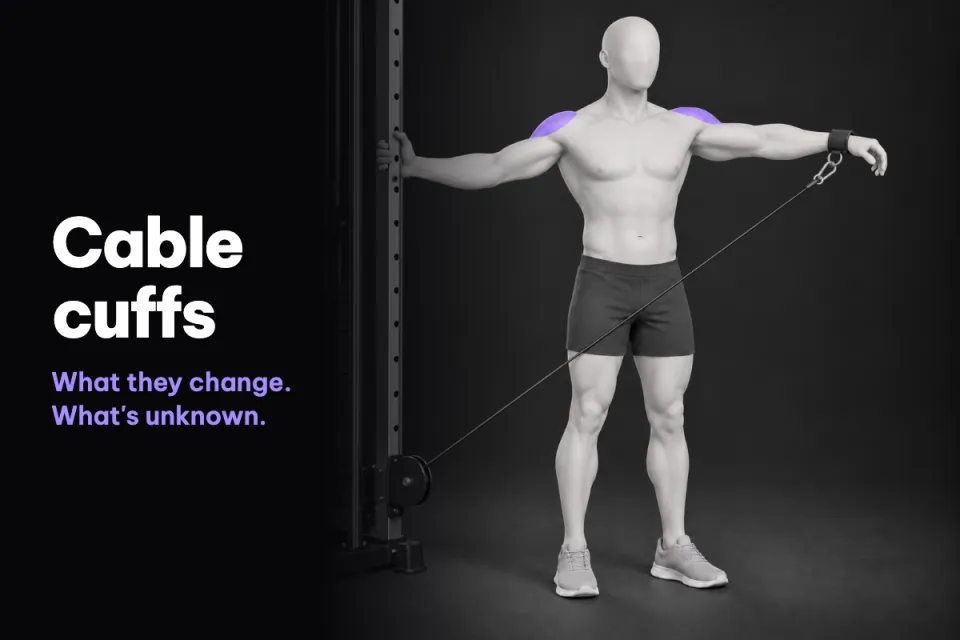
| 5 | Cuffed cable lateral raise | High | Good | Medium | Not tested | When grip or forearms limit you |
| 6 | Side-lying dumbbell lateral raise | High at the bottom, none at the top | Very good | Low | Not tested | A dumbbell-only stretch option |
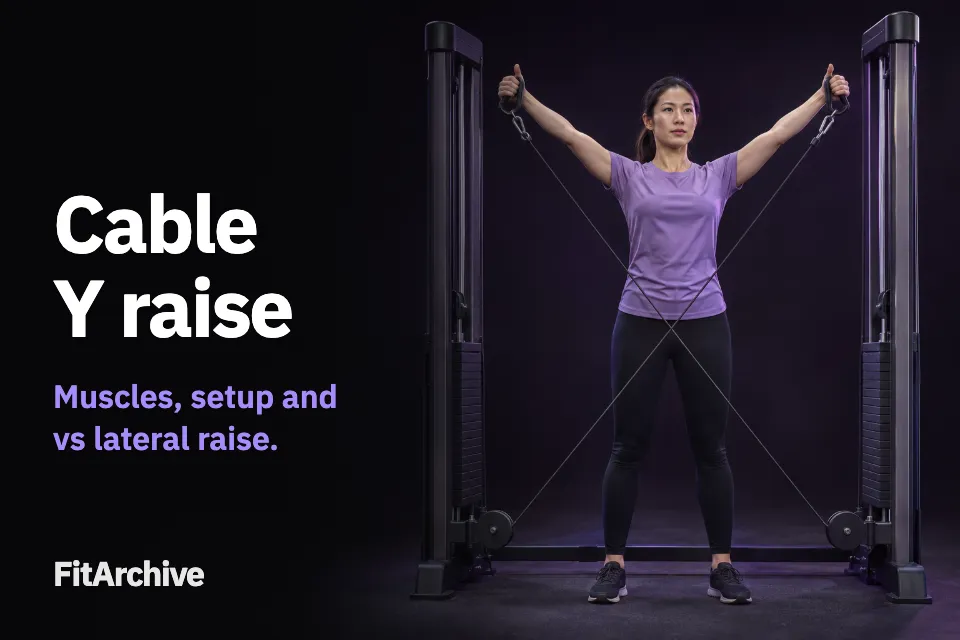
| 7 | Cable Y raise | Medium | Good | Medium | Not tested | Variety, overhead finish |
| 8 | Chest-supported lateral raise | Low | Very good | Medium | Not tested | Stopping the swing |
“Tension in the stretch” means how much the exercise loads the side delt with the arm down by your side, where the muscle is longest. “Growth evidence” means a training study that measured side delt size, not just muscle activity.
How we ranked them
We scored each exercise on five things, in this order of weight:
- Direct growth evidence. A training study that measured side delt size beats muscle-activity (EMG) data, which beats reasoning. EMG shows how hard a muscle works during a rep, but it does not reliably predict which exercise grows more. Only one growth trial compares side delt exercises, and it found cable and dumbbell raises similar, so putting cables first is a practical preference, not a growth claim.
- Tension at long muscle lengths, which depends on setup. Several training studies found more growth when a muscle is loaded in its stretched position. Overhead triceps extensions (about 20% vs 14% growth in a 12-week trial) and seated leg curls (about 14% vs 9% in another) are examples. Newer trials of lengthened partial reps in trained lifters and a 297-person multi-site trial found partial reps in the stretch roughly equal to full reps, so we treat this as a tiebreaker, not a law. No study has tested it on the side delts.
- Stability. The less you have to balance or brace, the more of each set goes to the target muscle and the less to swinging.
- Ease of progression. A 2 kg jump on an 8 kg dumbbell is a 25% increase. Exercises with small steps are easier to progress week to week.
- Joint comfort. Most raises are easy on the shoulder at sensible loads. Anything that pinches gets swapped, whatever its rank.
Where there is no study, we say so.
1. Single-arm cable lateral raise
The cable lateral raise as shown in FitArchive’s exercise library.
With a low pulley set across the body, the cable pulls from the side rather than straight down, so the side delt can already be working with your arm by your hip. How much depends on pulley height, your distance from the stack and arm position. With a dumbbell, gravity does almost nothing there. It ties with dumbbells on the one growth trial, so it ranks first as a practical preference, not by much.
Setup and cues:
- Set the pulley at its lowest point, with a single D-handle.
- Stand side-on to the stack and take the handle in the far hand, so the cable runs across the front of your body. Some lifters prefer it behind the body; pick one and keep it the same each week.
- Hold the frame with your free hand. Keep a slight bend in the elbow and keep that angle fixed.
- Lead with the elbow and lift the arm out to the side until it reaches about shoulder height.
- Lower over 2 to 3 seconds until the hand is back in front of your hip and the stack is just off the pin.
Watch for: stepping too far from the stack, so the weight lands on the pin between reps; leaning away mid-set to cheat the weight up; letting the shoulder shrug toward the ear.
2. Dumbbell lateral raise
The dumbbell lateral raise as shown in FitArchive’s exercise library.
The dumbbell raise is hardest near the top and almost free at the bottom. That looks worse on paper, yet a 2025 trial in 24 trained adults found dumbbell and cable raises grew the side delts by similar amounts, about 3.3% to 4.6% over 8 weeks, with each arm doing one version. It needs no machine, works at home, and is the easiest raise to start with.
Setup and cues:
- Stand tall with a dumbbell in each hand at your sides, palms facing in, a slight bend at the elbows.
- Lean very slightly forward from the hips. This puts the arm in line with the shoulder blade, and most lifters find it more comfortable.
- Raise the arms out to the sides, leading with the elbows, until they reach about shoulder height.
- Keep the thumbs level with or slightly above the pinkies. A 2020 EMG study of 10 competitive bodybuilders found raising with the upper arm rotated outward increased front and side delt activity, while turning it inward (the “pour the jug” cue) increased upper trap, rear delt and triceps activity instead.
- Lower under control. Don’t let the dumbbells crash against your thighs.
Watch for: swinging from the hips on the first rep, and jumping 2 kg at a time. If your gym’s dumbbells go up in big steps, add reps first (see double progression).
3. Machine lateral raise
The machine lateral raise as shown in FitArchive’s exercise library.
The machine holds your torso in place, so it is the easiest raise to push close to failure without the set turning into a swing. The resistance profile depends on the machine’s cam, so some models load the bottom well and some don’t. No study has tested a machine raise for growth, but the stability makes it a good main lift for beginners and a good second exercise for everyone. For the broader trade-off, see free weights vs machines.
Setup and cues: set the seat so the pivot lines up with the shoulder joint; press the pads with the forearms or elbows, not the hands; lift to about shoulder height, pause briefly and lower slowly. A single-arm version, if your machine allows it, lets you brace with the free hand.
4. Lean-away lateral raise
Hold a post or the cable frame with one hand and lean your body away from it, then raise the other arm. With a dumbbell, leaning away shifts peak resistance toward greater shoulder abduction; it is not automatically a lengthened-position exercise. With a cable, bottom-range resistance depends on pulley height, distance and arm position. Treat it as a way to change where the rep is hardest, not as a stretch upgrade.
Cues: lean 15 to 30 degrees, keep the body still, and keep the torso angle the same every rep and every week so the log stays comparable. No study has tested it for side delt growth.
5. Cuffed cable lateral raise
The cuffed cable lateral raise as shown in FitArchive’s exercise library.
Swap the handle for a cuff around the wrist or forearm and your grip leaves the exercise. Many lifters find it smoother, and it suits anyone whose forearms tire before their shoulders. No trial has compared cuffs with handles, so treat it as a comfort choice. Log it as its own exercise, because moving the cuff changes the lever and the load. Our cable cuffs guide covers setup in detail.
6. Side-lying dumbbell lateral raise
The side-lying dumbbell lateral raise as shown in FitArchive’s exercise library.
Lie on your side on a flat or slightly inclined bench and raise the top arm from in front of your hips up to about vertical. Gravity now pulls hardest at the start, with the arm low and the side delt lengthened, and the load fades to almost nothing at the top. Loads are very light, so progress in reps rather than weight. Stop before the arm reaches vertical, where the set rests.
7. Cable Y raise
Two crossed low cables, arms raised diagonally up and out into a Y. It trains the side and front delts plus the muscles that rotate the shoulder blades upward. There is no growth study on it, so keep a lateral raise as your main exercise and use the Y raise for variety. Setup and the lower trap evidence are in our cable Y raise guide.
8. Chest-supported lateral raise
Lie chest-down on an incline bench set at about 30 to 45 degrees and raise the dumbbells out to the sides. The bench makes swinging impossible, which is its whole point. Because the arms move slightly behind the body’s plane, the rear delts share more of the work. Use it if you can’t stop cheating on standing raises.
Cable vs dumbbell lateral raise: which is better?
| Cable lateral raise | Dumbbell lateral raise | |
|---|---|---|
| Hardest part of the rep | Depends on pulley height and position; can load the bottom | Near the top |
| Growth in the 2025 trial | About equal | About equal |
| Load steps | Stack steps (often 2.5 to 5 kg) | Dumbbell steps (often 1 to 2.5 kg) |
| Needs | Cable station | A pair of dumbbells |
| Unilateral by default | Yes | No (can be done one arm at a time) |
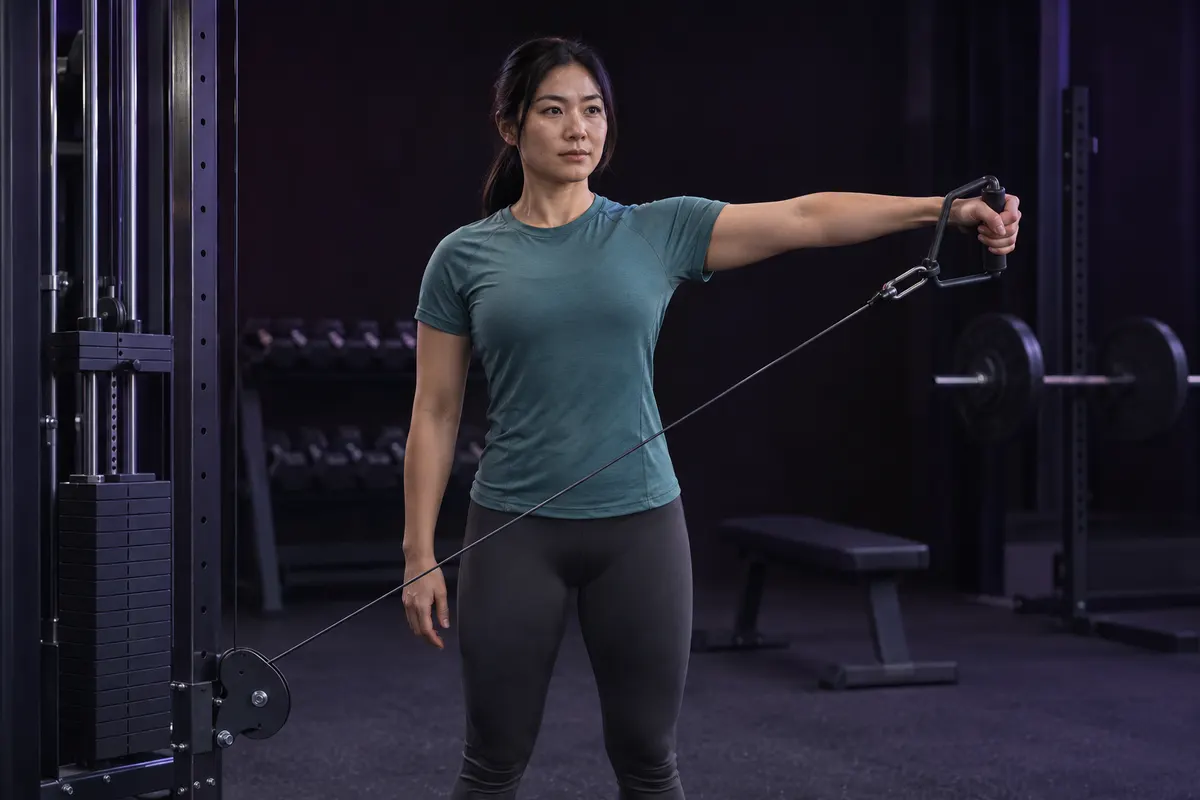
Single-arm cable lateral raise: the cable crosses the body, so the side delt works from the very start of the rep.
The Larsen 2025 trial is the most useful side delt study available: 24 trained men and women, 8 weeks, two sessions a week: 4 sets per arm per session in the first week, then 5 sets per session for the remaining 7 weeks, taken to failure in the 12 to 16 rep range, one arm on cables and the other on dumbbells. Side delt thickness rose 4.6% and 3.3% at the two measured sites with cables and 3.9% and 3.4% with dumbbells. The authors’ Bayesian analysis gave moderate to extreme support for no difference. So pick the one you can progress and do consistently. If you have both, using cables on one day and dumbbells on the other covers both resistance profiles.
Do shoulder presses and upright rows count?
The seated dumbbell shoulder press as shown in FitArchive’s exercise library.
Partly. Overhead presses train the front delts hardest and the side delts as helpers. A 2022 EMG study in eight competitive bodybuilders found the behind-the-neck barbell press produced more side delt activity than the front press. That is activity, not growth, and the behind-the-neck position needs good shoulder mobility, so it is not a reason to switch. A common, conservative way to count it is half a set for the side delts per hard set of pressing; our guide to counting weekly sets per muscle explains the rule.
Upright rows with a wide grip (hands about shoulder width or wider, elbows stopping around shoulder height) also train the side delts with heavier loads. Cable versions are smoother. If any upright row pinches the front of your shoulder, drop it; a lateral raise does the same job.
How many sets for side delts per week?
- Weekly hard sets: 10 to 20 direct sets per week is a sensible general range. A 2017 meta-analysis and a 2026 meta-regression of 67 studies both found more weekly sets produced more growth, with diminishing returns. Beginners can start near 8 to 10; experienced lifters with a lagging side delt can work toward the top of the range.
- Frequency: spread the sets over 2 to 3 sessions. The more often you train them, the fewer sets per exercise: 1 to 2 sets per exercise in a full-body plan, 3 to 4 in a once-or-twice-a-week shoulder slot.
- Reps: 10 to 20. Side delts are small and raises are light, so higher reps keep the load manageable.
- Effort: 0 to 3 reps in reserve (RIR). Most sets should end 1 to 2 reps short of failure, with clean form.
- Rest: 60 to 90 seconds is usually enough for raises.
Sample side delt workout
This fits into an upper/lower or push/pull/legs week. It provides 8 direct side-delt sets, or 10 with the optional raises, plus 2 shoulder-press sets. Counting the press at half credit gives 9 or 11 equivalent sets:
| Day | Exercise | Sets × reps | RIR | Rest |
|---|---|---|---|---|
| Upper A | Single-arm cable lateral raise | 3 × 12–15 each side | 1–2 | 60 s |
| Upper A | Seated dumbbell shoulder press | 2 × 8–12 | 1–2 | 2 min |
| Upper B | Machine lateral raise | 3 × 12–20 | 0–1 | 60–90 s |
| Upper B | Lean-away cable lateral raise | 2 × 12–15 each side | 1–2 | 60 s |
| Lower day (optional) | Dumbbell lateral raise | 2 × 15–20 | 1–2 | 60 s |
Dumbbells only, at home (8 direct sets plus 2 press sets): dumbbell lateral raise 3 × 12–20 and side-lying lateral raise 2 × 12–15 each side on day 1; chest-supported lateral raise 3 × 12–15 and dumbbell shoulder press 2 × 8–12 on day 2. Raises: 1–2 RIR, 60–90 seconds rest; presses: 1–2 RIR, 2 minutes rest. If your next dumbbell is too big a jump, swap in a band lateral raise (stand on the band, raise to shoulder height): once every set reaches 20 reps, shorten the band or move to the next band, and drop back to 12 reps.
How to progress: pick a rep range, such as 12 to 15. When every set reaches 15 at your target RIR, add the smallest load step you have. If that step is too big, stay at the weight and add a set over the next few weeks instead. FitArchive’s Upper/Lower · 4 days and Push/Pull/Legs · 6 days templates already include lateral raises you can swap for any variation above; our 4-day upper/lower split shows the full week.
Common side delt mistakes
- Going too heavy. If you need a hip swing to start the rep, the traps and momentum are doing the work. Drop the weight 20% and control the lowering.
- Shrugging. Think “arms long, shoulders down”. Raising well above shoulder height also shifts more work to the traps.
- Bending the elbows more each rep. It shortens the lever and makes the weight feel lighter, which flatters your log.
- Training them once a week, last, when tired. Two shorter slots usually give better sets than one long one.
- Changing setup between weeks. A cable raise in front of the body and one behind it are different lifts on paper. Keep one, or log them separately.
FAQ
Cable or dumbbell lateral raises for side delts? Either works. The only growth trial comparing them found side delt growth about equal over 8 weeks. Cables can load the bottom of the rep, depending on setup; dumbbells are easier to get to. Use whichever you can progress consistently, or one of each per week.
How do I grow my side delts faster? Do more direct, hard sets: work up to 10 to 20 a week across 2 to 3 sessions, with reps of 10 to 20 taken within 0 to 3 reps of failure. Track the numbers so you know you are adding reps or load over time.
Can you build side delts with just dumbbells or at home? Yes. Dumbbell raises held up as well as cables in the 2025 trial. Add a side-lying raise for more tension in the stretch, and use bands if your dumbbells jump in big steps.
Can I train side delts every day? You can, but you don’t need to. Two or three sessions a week split the same weekly sets into better-quality sets. More frequent sessions may help distribute fatigue, but they do not require a higher weekly set total.
Should lateral raises go above shoulder height? Raising a little higher is not dangerous for most people, but the traps and the muscles that rotate the shoulder blades take over more of the work. Stopping at about shoulder height keeps the focus on the side delts. A Y raise is the better choice if you want an overhead finish.
Track your side delt sets in FitArchive
FitArchive’s exercise library has every raise above, including the cable, dumbbell, machine, cuffed, side-lying and chest-supported lateral raises, each with a short demo clip. Each set records weight, reps and reps in reserve, with your last session shown next to it, so you know what to beat. The Progress screen counts weekly hard sets for your side delts against editable MEV, MAV and MRV landmarks, leaving warm-ups out, so you can see whether you are below 10 sets or creeping past what you recover from. A free suggested next load tells you when to add weight; Plus adds Smart load, which also accounts for exercise order. For the other muscles that make the upper body look wider, see our best lat exercises and best upper chest exercises.
Get FitArchive free on iPhone or Android, or try the web demo. Logging and your full history are free, with no ads.