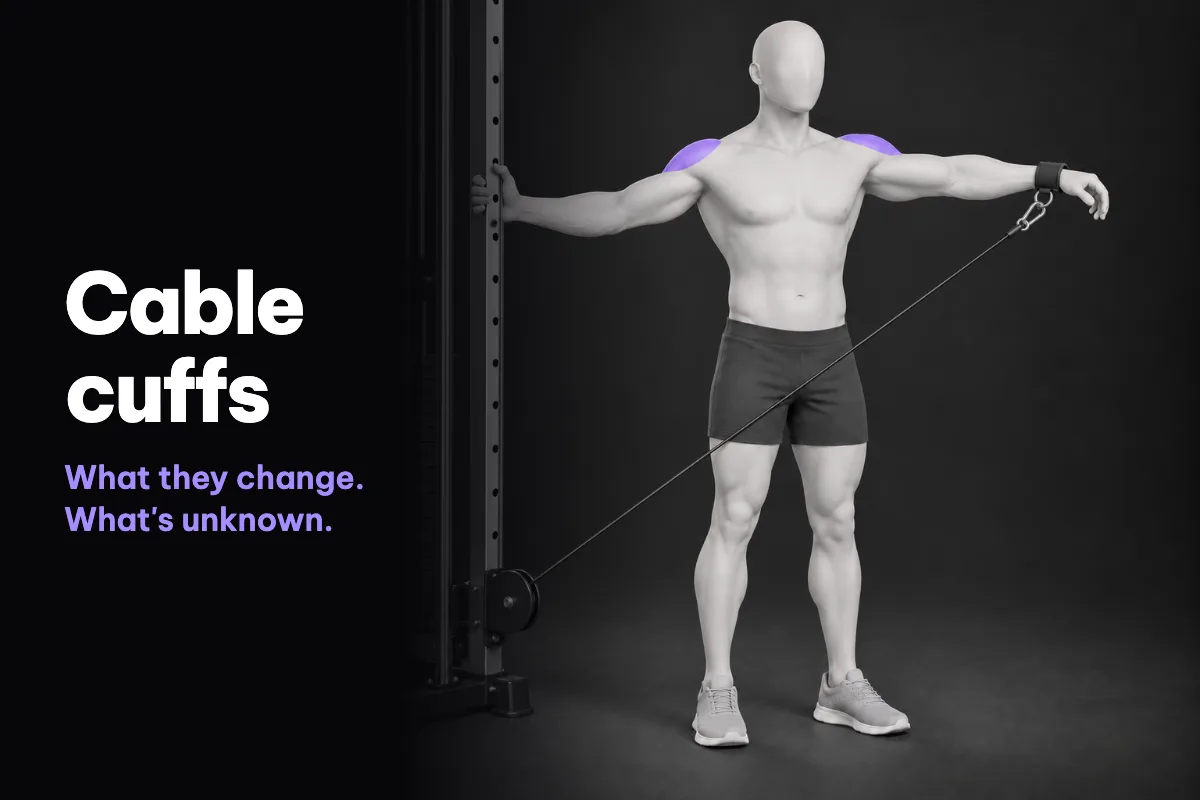
A cable cuff is a padded strap that goes around your wrist or arm and clips to the cable, so you don’t have to hold a handle. Cuffs remove your grip from the exercise, and many lifters find them more comfortable on lateral raises and triceps extensions. We found no trial comparing cuffs with handles, so there is no evidence yet that they build more muscle. They’re a cheap thing to try if a handle is what’s limiting you.
What does a cuff actually change?
Three things, and all of them come from the setup rather than from research on cuffs:
- Grip. You aren’t squeezing anything, so your forearm can’t tire first.
- Lever length. A cuff above the wrist puts the load closer to the shoulder or elbow. The same weight on the stack feels lighter. Move the cuff and your numbers will change.
- Line of pull. The strap can rotate around your arm, so the cable path can feel smoother than a fixed handle.
Lifters also report less elbow discomfort on triceps work. That is a report from users, not a finding. If something hurts, change the exercise and get qualified advice. This article is general information, not medical guidance.
What the evidence says
| Question | What we found | How strong |
|---|---|---|
| Cuff vs handle | No trial found | None |
| Cable vs dumbbell lateral raise | Larsen et al. 2025: 24 trained people, 8 weeks, one arm each. Lower side delt grew about 4.6% with cables and 3.9% with dumbbells, upper about 3.3% and 3.4% | Moderate support for “about equal” |
| Overhead vs arms-down cable triceps | Maeo et al. 2023: 21 adults, 12 weeks, one arm each. Whole triceps grew about 20% overhead and 14% arms-down | Moderate, one trial, not a cuff study |
The lateral raise result is worth a second look. Cables are often sold as better because of how the resistance feels through the rep, yet in that trial they did about the same as dumbbells. A cuff could still help you, but “it feels better” and “it grows more” are separate claims.
How to set up a cuffed lateral raise
- Set the pulley low, at about hand height or below.
- Put the cuff on the wrist of the working arm and clip it to the cable. Stand side-on, with the cable crossing in front of or behind your body. Pick one and keep it.
- Hold the machine with your free hand so your trunk stays still.
- Raise your arm out to the side, stopping around shoulder height, then lower it under control.
- Use a light weight first. It will feel different from a handle.
How to set up a cuffed triceps extension
- Set the pulley high.
- Put the cuff on your wrist. One arm at a time is the usual setup.
- Brace yourself. Hold the machine with your free hand and stand close. Some lifters also rest their forehead against the upright or pulley housing.
- Keep your upper arm still and straighten the elbow, then let it bend back under control.
Bracing is the point of this setup. Triceps extension is an elbow exercise, so your balance shouldn’t be what ends the set. No trial has tested this for growth. It’s practical reasoning.
If you want the overhead version from the Maeo trial, face away from the stack with the cable coming from above and behind you.
How to log cuffed exercises
Log the cuffed version as its own exercise, not as your handle exercise. The load isn’t comparable, so 10 kg with a cuff above the wrist doesn’t tell you much about 10 kg with a handle. Keep the cuff in the same position from week to week, and note it if you move it.
Example log (invented numbers, not a recommendation):
| Week | Exercise | Sets | Note |
|---|---|---|---|
| 1 | Cuffed cable lateral raise | 5 kg × 15, 14 at 1 RIR | Cuff at wrist |
| 2 | Cuffed cable lateral raise | 5 kg × 15, 15 at 1 RIR | Same position, fair to compare |
| 3 | Cuffed cable lateral raise | 7.5 kg × 15, 15 at 1 RIR | Cuff moved up the arm, new starting point |
Common mistakes
- Comparing cuff loads with handle loads. They are different exercises for logging purposes.
- Moving the cuff between sessions. It changes the lever, so your progress numbers stop meaning much.
- Buying cuffs because of a growth claim. Buy them if your grip or comfort is the problem.
- Letting the strap dig in. Pad it or move it if it bruises, and stop if the discomfort stays.
Logging cuffed work in FitArchive
FitArchive has separate entries for the cuffed cable lateral raise and cuffed triceps extension, so your handle numbers stay clean. Each set stores weight, reps and RIR, and your weekly sets per muscle count them like any other set. For more on choosing exercises by muscle length, see our guide to lengthened partials. You can try it with sample data in the demo.