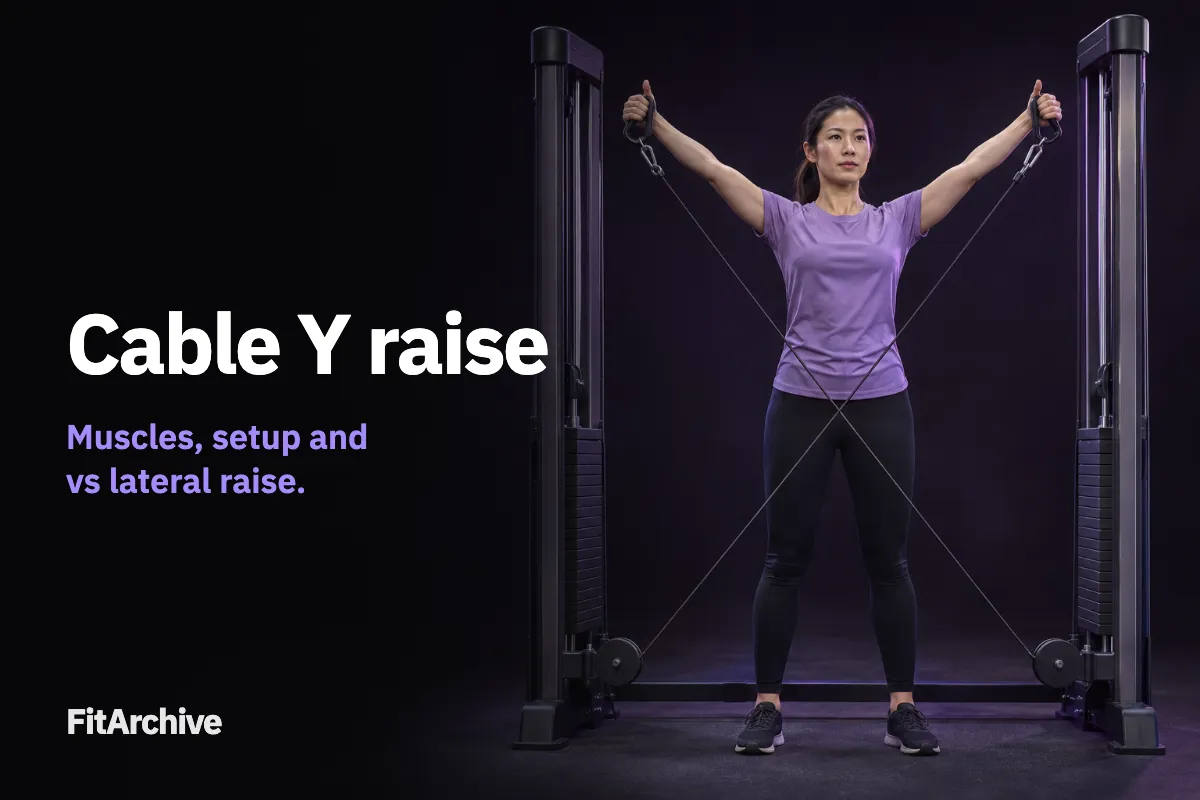
A cable Y raise is a shoulder exercise where you stand between two low pulleys with the cables crossed in front of you, then raise both arms diagonally up and out into a Y, finishing above shoulder height. It mainly trains the side and front delts, along with the traps and serratus, which rotate the shoulder blades upward as the arms go overhead. It is often sold as a lower trap exercise, but that evidence comes from the prone Y raise, a different exercise done lying face down. No study has tested the cable Y raise itself, and none has compared it with a lateral raise for growth.
This guide covers the setup, the single-arm version, what it trains, how it compares with the cable lateral raise, and how to program it.
How to do a cable Y raise
The cable Y-raise as shown in FitArchive’s exercise library.
- Set both pulleys to the lowest setting with a single handle on each.
- Cross the cables. Take the right cable in your left hand and the left cable in your right hand, so they cross in front of your hips. Step back a little so the stacks lift before the first rep.
- Thumbs up, slight bend in the elbows. Keep that elbow angle the whole set.
- Raise your arms diagonally up and out into a Y, about 30 to 45 degrees in front of your body (the natural line of the shoulder blade) and above shoulder height.
- Ribs down, no leaning back. Let the shoulder blades rotate up naturally rather than shrugging hard.
- Lower slowly along the same diagonal until your hands cross again.
Common mistakes:
- Leaning back and swinging, which turns it into a front raise with momentum.
- Shrugging the shoulders toward the ears.
- Raising straight in front (a front raise) or straight out to the side (a lateral raise) instead of the Y diagonal.
- Going too heavy, so the elbows bend more each rep.
Single-arm cable Y raise
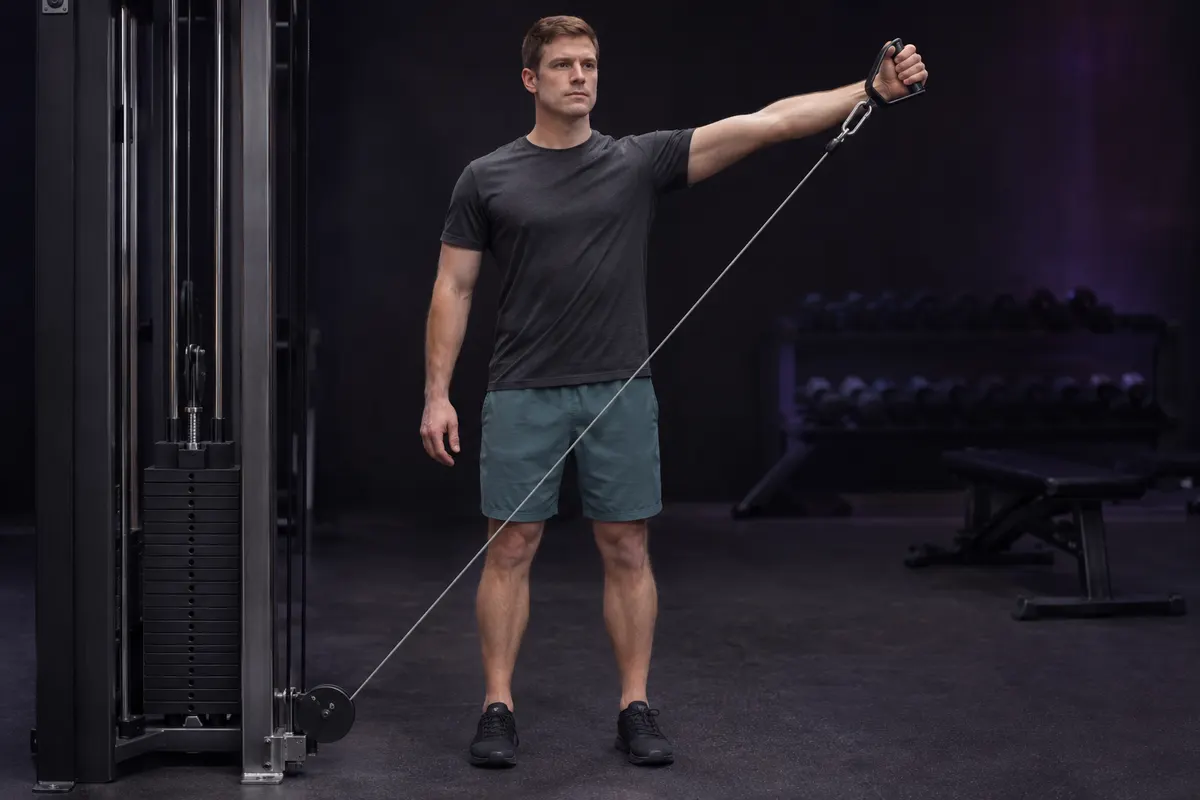
Single-arm version: one low pulley, the working arm crosses in front of the body.
Stand side-on to one low pulley and take the handle in the far hand, so the cable crosses in front of your body. Raise that arm up and out into the Y line, with your free hand on the frame. The single-arm version is easier to learn and lets you focus on one side; the load still moves in your stack’s steps. A seated version on a bench between the pulleys removes any help from the hips.
What muscles does the cable Y raise work?
- Side delts: the main target, as the arm lifts out to the side.
- Front delts: help, because the raise is a little in front of the body.
- Traps (upper, middle and lower) and serratus anterior: rotate the shoulder blades upward as the arm goes overhead.
Is it good for the lower traps? That is the most common claim, and it is weaker than it sounds. The evidence comes from physiotherapy EMG studies of the prone Y raise, done lying face down on a bench:
- A 2003 study of 30 people found a prone overhead arm raise in line with the lower traps gave the most lower trap activity of 10 exercises.
- A 2023 study of 32 people called the prone Y the reference exercise for the lower traps, with other exercises 29 to 33% lower.
- But a 2011 study of 18 people found that in women, a prone row and a modified prone cobra beat a prone V-raise for lower trap activity.
Lying face down, gravity pulls straight down on an arm raised overhead. Standing at a cable, the pull comes from low and across. That changes which muscles work hardest, and small changes in setup or cueing shift trap activity in Y raises, as a 2023 study found with different shoulder-blade cues. So the cable Y raise likely works the lower traps, but nobody has measured how much.
Cable Y raise vs cable lateral raise
| Cable lateral raise | Cable Y raise | |
|---|---|---|
| Path | Out to the side, to about shoulder height | Diagonally up and out, above shoulder height |
| Main target | Side delts | Side delts, plus the upper-rotating shoulder blade muscles |
| Growth research | Yes | None |
| Load | Usually a little heavier | Lighter |
For side delt growth, the lateral raise has the better evidence. A 2025 trial in 24 trained adults found dumbbell and cable lateral raises grew the side delts about equally (+3.3% to 4.6% over 8 weeks). Nothing similar exists for the Y raise. A sensible approach: keep a lateral raise as your main side delt exercise, and use the Y raise for variety or if you like the overhead finish. Our cable cuffs guide covers lateral raise setups in more detail.
Is the cable Y raise push or pull? Neither, really. It is a raise. Put it on shoulder days, push days or pull days, wherever it fits your week.
Dumbbell and other alternatives
- Incline dumbbell Y raise: lie chest-down on an incline bench and raise the dumbbells into a Y. This is the closest free-weight version. For cable vs dumbbell trade-offs, see free weights vs machines.
- Band Y raise, with a band anchored low.
- Cable or dumbbell lateral raise, for side delts.
- Face pull or reverse pec deck, for the rear delts and upper back, or the Kelso shrug for the muscles between the shoulder blades.
Sets, reps and programming
- Load: light. Most people use far less than on a lateral raise.
- Reps: 12 to 20, controlled. Lighter loads can build muscle when sets are taken close to failure; see how many reps to build muscle.
- Sets: 2 to 3, once or twice a week.
- Effort: stop 0 to 2 reps short of failure, but keep the Y path. When your form drifts toward a front raise, the set is over.
- Progress: add reps before weight. Cable stacks jump in big steps for a light exercise, so stay at a weight until you clear the top of your rep range with good form.
Track your cable Y raises in FitArchive
FitArchive has the cable Y-raise and the incline Y-raise in its exercise library, each with a short demonstration clip, next to the cable lateral raise and face pull. It counts the Y raise as side delt work, with some credit to the upper back. Log the single-arm version under the same exercise with a note, or add it as your own exercise if you want a separate history. Each set records weight, reps and RIR, and the Progress screen shows weekly hard sets for your side delts and upper back, so you can see if your shoulders get enough work. For another cable exercise explained the same way, see Keenan flaps.
Get FitArchive free on iPhone or Android. Logging and your full history are free, with no ads.