Creatine monohydrate is one of the most researched sports supplements. Taken alongside resistance training, it gives a small extra gain in strength and lean mass on average. The usual amount is 3 to 5 g a day, at any time of day; a loading phase is optional. In healthy adults, studies at these doses have not found kidney damage, and the best current trial found no effect on hair. It is not a substitute for training, and people with kidney disease, on regular medication, pregnant or under 18 should ask a clinician first.
Creatine comes up constantly on social media, usually as either a miracle or a danger. This guide tests the popular claims against the studies, says how strong each piece of evidence is, and shows how to check in your own training log whether it is doing anything for you. It is general information, not personal medical advice.
What is creatine?
Creatine is a compound your body makes from amino acids, mainly in the liver and kidneys, and also gets from food. About 95% of it is stored in skeletal muscle, mostly as phosphocreatine, which helps regenerate energy quickly during short, hard efforts such as a set of squats. According to the International Society of Sports Nutrition (ISSN) position stand, a normal diet supplies about 1 to 2 g a day and leaves muscle stores roughly 60 to 80% full. Supplementing raises muscle creatine and phosphocreatine by about 20 to 40%.
It is not a steroid or a hormone. The ISSN review of common misconceptions addresses that question directly.
Which foods contain creatine?
Meat and fish. The ISSN position stand gives about 1 to 2 g of creatine in a pound (about 450 g) of uncooked beef or salmon, and the misconceptions review puts a 6 oz (about 170 g) serving of meat at about 0.7 g. The ISSN describes creatine as found mainly in red meat and seafood, and vegetarians tend to have lower muscle stores.
By that arithmetic, getting 5 g a day from food alone would take well over a kilogram of raw meat or fish a day. That is why lifters who want the studied amount use a supplement.
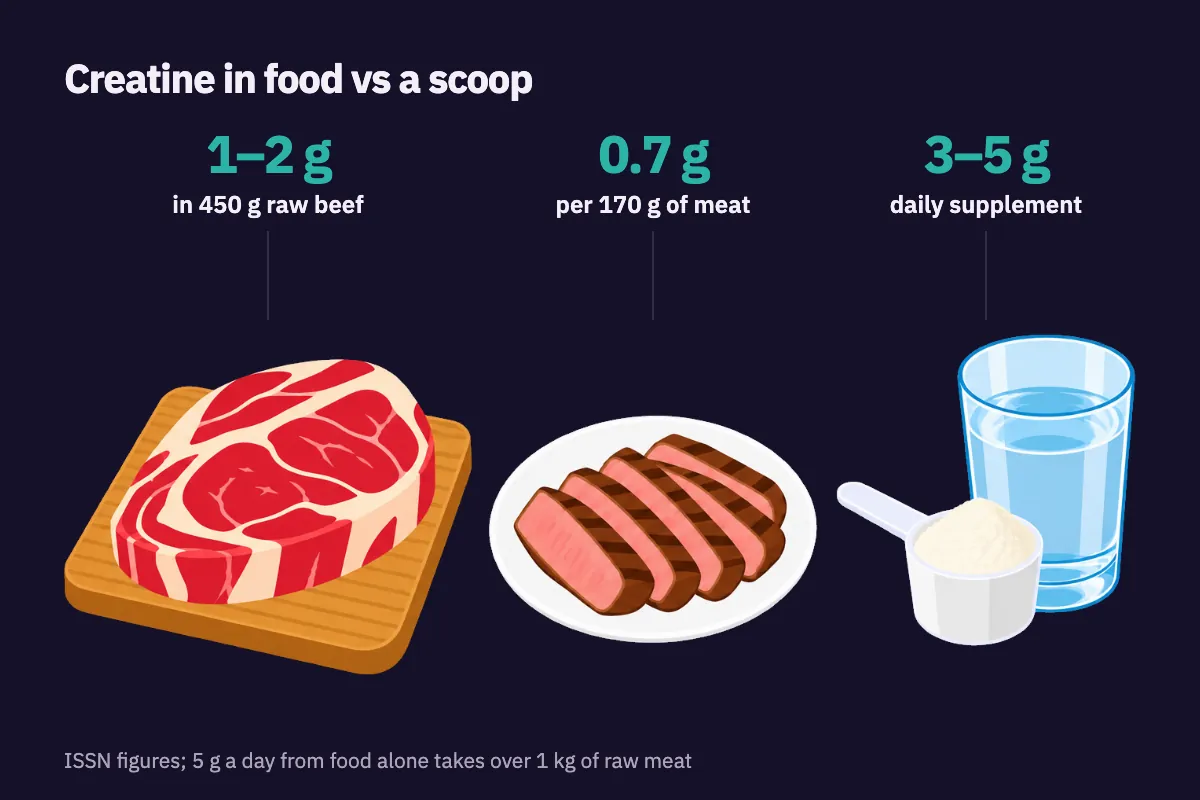
Food alone rarely reaches the studied daily amount.
What creatine does and doesn’t do
| Claim | What the research shows |
|---|---|
| Increases strength | Yes, a small effect. Meta-analyses of 53 trials on upper-body and 60 trials on lower-body strength found effect sizes of about 0.3 and 0.24 for short efforts under 3 minutes. |
| Adds lean mass with lifting | Yes, on average. A 2022 meta-analysis of 35 trials found about 1.1 kg more lean mass when creatine was combined with resistance training. Part of early lean mass gain is water. |
| Builds muscle directly | A small effect. A 2023 meta-analysis of 10 trials using MRI, CT or ultrasound found about 0.10 to 0.16 cm more muscle thickness. |
| Works without training | Not for lean mass: the 2022 meta-analysis found no effect without exercise. |
| Helps endurance running or swimming | Little support. A meta-analysis of 100 studies found effects mainly in repeated short, high-intensity tasks. |
The pattern is consistent: creatine helps you do a little more work in hard sets, and over weeks that adds up to a slightly better result. It does not replace a program with progressive overload, enough protein and sleep.
How much creatine should you take, and when?
The ISSN position stand describes two approaches:
- No loading: 3 to 5 g a day. Muscle stores rise gradually and fill in about 3 to 4 weeks.
- Loading: about 0.3 g per kg of body weight a day (roughly 20 g, split into four servings of about 5 g) for 5 to 7 days, then 3 to 5 g a day.
For example, 0.3 g/kg works out to about 18 g a day at 60 kg and about 21 g a day at 70 kg. These are arithmetic examples of the ISSN rate, not personal advice.
Timing matters little. A 2021 review on creatine timing found no consensus on the best time; some studies favour taking it after training, but the authors say their limitations prevent firm conclusions. Taking it at a time you will remember every day matters more. Creatine monohydrate is the form with by far the most research behind it.
If you stop, the ISSN notes muscle stores take about 4 to 6 weeks to return to baseline.
Is a loading phase necessary?
No. The misconceptions review explains that 3 to 5 g a day reaches the same muscle stores, just more slowly; one classic study saw a similar increase of about 20% after 28 days at 3 g a day as after a short loading phase. Loading gets you there in about a week. The trade-off is that loading at about 20 g a day typically adds 1 to 3 kg of body weight within days, mostly water. If you do not need the effect quickly, skipping the loading phase is simpler.
Creatine myths: kidneys, hair loss, bloating, acne and women
Does creatine damage your kidneys?
In healthy people at the usual doses, the evidence says no. A 2026 meta-analysis of 20 randomized trials found creatine raised blood creatinine by about 0.13 mg/dL but did not change urea or estimated kidney filtration (eGFR). A 2025 meta-analysis also found no significant change in filtration rate.
The confusion comes from creatinine, a normal breakdown product of creatine that labs use as a proxy for kidney function. Taking creatine (or eating a lot of meat) can raise it without any kidney damage, so tell your doctor you take creatine before a blood test. The often-cited 1998 case involved a man with long-standing kidney disease on an immunosuppressant. The 2026 authors still call for trials longer than one year, so long-term data are thinner than short-term data.
Does creatine cause hair loss?
The worry comes from a 2009 study of 20 college rugby players in which DHT, a hormone linked to male-pattern hair loss, rose 56% after a week of loading and stayed 40% above baseline after two more weeks. It did not measure hair, and the misconceptions review notes the values stayed within normal clinical limits and the result was not replicated.
A 2025 randomized trial then tested it directly: 45 resistance-trained men took 5 g of creatine or a placebo for 12 weeks (38 finished). There were no differences in DHT, the DHT-to-testosterone ratio, hair density or hair thickness. It was short, small and men only, and several authors have industry ties, but it is the most direct evidence so far, and it does not support the claim. If you are already losing hair and worried, a dermatologist can give you advice for your situation.
Does creatine make you bloated or “watery”?
Short term, often a little. The ISSN reports early studies of loading found about 0.5 to 1 L of fluid retention, and weight gain is the only side effect it describes as consistently reported. Yet several training studies lasting 5 to 10 weeks found no increase in total body water. Expect the scale to move up a bit, especially with loading.
Does creatine cause acne?
We found no controlled trial showing that it does, and no good evidence either way. If your skin changes after starting a product, check the full label, since many products contain more than creatine, and ask a doctor or dermatologist.
Does creatine work for women?
Research in women is smaller. The 2022 lean mass meta-analysis found about 1.46 kg more lean mass in men but a smaller, not statistically significant 0.29 kg in women. A 2021 review of creatine in women concluded it appears effective for strength and exercise performance before menopause. The misconceptions review notes there are no human studies on creatine during pregnancy.
Who should check with a clinician first?
Ask a doctor or pharmacist before taking creatine if you:
- have kidney disease or have been told your kidney function is reduced;
- take regular medication, especially medicines that affect the kidneys;
- are pregnant or breastfeeding;
- are under 18;
- have any ongoing medical condition.
Creatine gummies and product quality
Supplements are not usually tested like medicines before sale, and quality varies. The ISSN notes creatine is stable as a dry powder but breaks down into creatinine in liquids, faster when the product is acidic and warm. Whatever the format, check that the label states grams of creatine monohydrate per serving, count how many gummies or scoops that takes, and prefer products tested by an independent third-party program such as NSF Certified for Sport or Informed Sport. Plain powder is the format used in almost all the research.
How to tell whether creatine works for you
Average effects are small, so a feeling after a week or two is not reliable. Use your log:
- Write down the start date and whether you loaded.
- Keep the program the same for at least 4 to 8 weeks, so creatine is the main thing that changed.
- Compare reps at the same load and the same RIR on a few main lifts, not just the heaviest set.
- Ignore the first week of body weight. A jump of 1 to 3 kg after loading is mostly water.
These are invented log entries, not expected results:
| Week | Bench press | RIR | Estimated 1RM |
|---|---|---|---|
| 0 (note: started creatine 5 g/day) | 80 kg × 8 | 2 | 106.7 kg |
| 4 | 80 kg × 9 | 2 | 109.3 kg |
| 8 | 82.5 kg × 8 | 2 | 110.0 kg |
A trend like this shows progress, but not how much was creatine; you would likely have progressed somewhat anyway. Your log cannot separate the two. What it can do is stop you from crediting or blaming creatine for a single good or bad session. The one-rep max guide explains the estimate.
Common mistakes with creatine
- Expecting a big change. The average effect is small and adds to training; it does not replace it.
- Changing program, diet and supplement at once. Then nothing in your log can tell you what helped.
- Not telling your doctor before blood tests. A higher creatinine reading can be misread.
- Buying on price per tub instead of per gram. Check grams of creatine per serving, especially with gummies.
Tracking a creatine trial in FitArchive
FitArchive is a free, private training log that works in your browser. You can add a note to the workout where you start creatine so the date is in your history, and log each set’s weight, reps and RIR. The Progress screen shows estimated 1RM per exercise and weekly hard sets per muscle, so you can look at the trend across weeks rather than a single session. If the numbers stall, the plateau guide helps you check for other causes. You can look around first in the demo with sample data.