To log food and workouts together, keep both in one dated record: each working set with load, reps and effort, and each meal with what you ate, how much, and where the numbers came from. Review the two side by side over a week, not a single day. One meal does not explain one hard set by itself.
FitArchive’s current public product page describes a workout log, meal logging against calorie and macro targets, and a bodyweight trend view. Those are the verified features behind this workflow. The article does not assume an unreleased food database or promise that a chart diagnoses performance changes.
Why log food and training in the same place?
Separate apps and notebooks make it hard to see the same day from both sides. When the records share dates, you can answer practical questions: was the food log complete on the days training felt hard? Did bodyweight drift while the training log stayed flat? Were there gaps in both records during a busy week?
Self-monitoring has a track record in nutrition research. A systematic review of self-monitoring in weight loss found a consistent association between monitoring diet, exercise or weight and weight loss, though the authors rated the level of evidence as weak because of study limitations. That is a reason to treat logging as a useful habit, not a guarantee of any particular result.
What should a food and exercise journal include?
Keep each side small enough that you will fill it in every day.
Training side, one row per set: exercise and variation, load with its unit, reps done, and reps in reserve (RIR) or another effort estimate. Add rest or a note when something changed. Our workout log template has a copyable layout, and the per-set RIR guide explains the effort column.
Food side, one entry per meal or item: what you ate, how much, and the source of any calorie or macro number (a package label, a database entry, or your own estimate). If you track targets, note the calories and protein you logged for the day.
Bodyweight, optional: one reading under the same conditions each time, for example after waking and using the bathroom, before eating.
Here is an illustrative day, with no invented calorie or nutrient totals:
| Record | Useful fields | What remains uncertain |
|---|---|---|
| Training | Row: 40 kg × 10 @ 2 RIR; normal rest; same machine | RIR is an estimate. |
| Packaged lunch | Product name, label serving size, amount eaten, label nutrients | The amount eaten may differ from the label’s default serving. |
| Dinner without a label | Dish and portion description; source of any nutrient estimate | Recipe and serving size can vary substantially. |
| Bodyweight | Morning reading, same scale, same conditions | One reading can move for reasons unrelated to long-term change. |
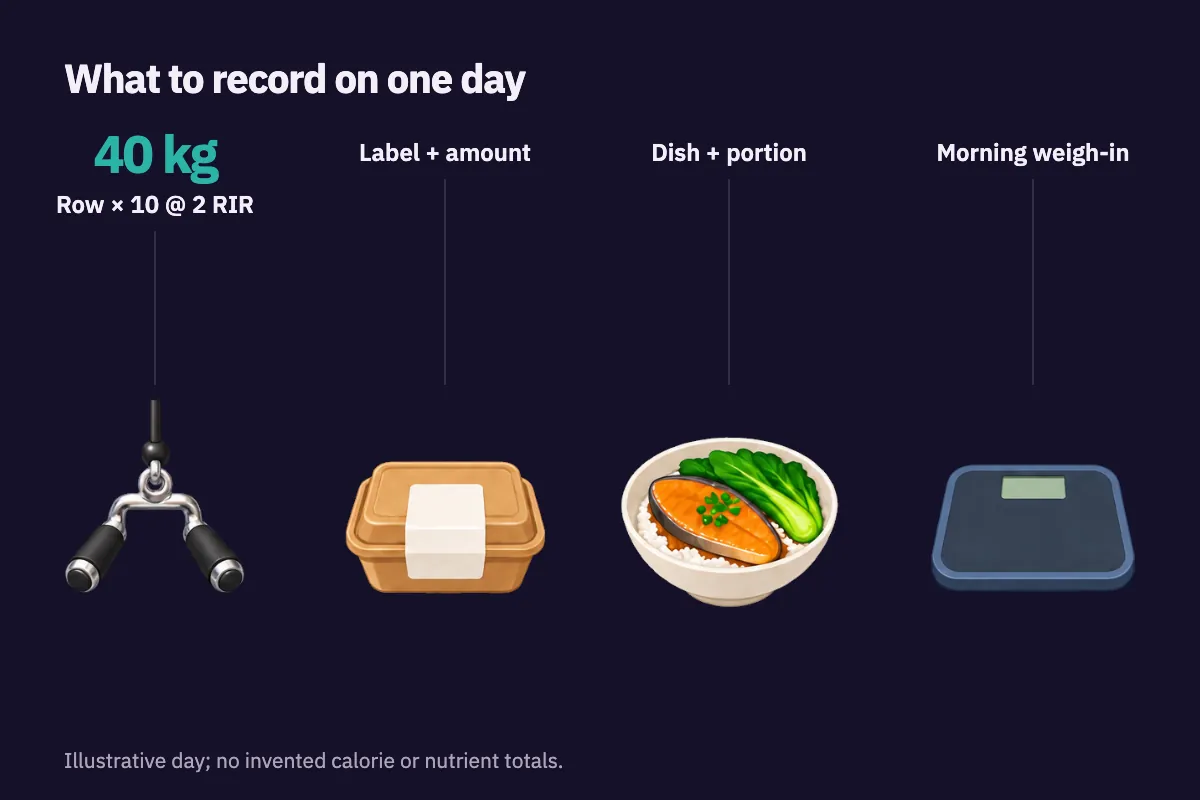
Note where each number came from, not just the number.
How accurate is food logging?
Less accurate than the decimal places suggest. In a well-known study comparing self-reports with measured intake and expenditure, participants with obesity who described themselves as resistant to dieting under-reported their food intake by an average of about 47% and over-reported physical activity. That was a specific group in a 1992 study, so the figure should not be applied to you, but it shows that memory-based logs can drift a long way from reality.
Labels and databases have limits too. The FDA’s serving-size guide explains that label values usually describe one stated serving, which may not match the amount eaten. For foods without a package label, USDA FoodData Central is a documented food-composition source, but an entry still needs to match the food and portion. Do not invent an exact macro count for an unmeasured mixed dish.
Practical ways to keep the error smaller:
- Log soon after eating, not from memory at night.
- Weigh or measure the foods you eat most often, at least for a while, so your estimates improve.
- Record the source next to each number, so you know which entries are firm and which are guesses.
- Mark estimates as estimates. An honest “about one bowl” is more useful than a precise-looking number you cannot justify.
Should you weigh food raw or cooked?
Either can work, as long as the weight matches the entry you choose. Cooking changes weight, mostly through water: meat tends to lose water and get lighter, while rice and pasta absorb water and get heavier. FoodData Central lists many foods separately in raw and cooked forms, so pick the entry that describes the state you weighed. Logging cooked chicken against a raw entry, or dry rice against a cooked entry, builds a consistent error into every day.
Can one meal explain a bad workout?
Rarely on its own. A hard session can reflect sleep, stress, rest between sets, technique, the order of exercises, or ordinary day-to-day variation, as well as food. The ISSN position stand on nutrient timing treats meeting total daily protein intake, ideally spread across the day, as a primary emphasis for exercising people. That puts the weight on patterns across days rather than on any single pre-workout meal.
If you suspect food is affecting training, write the question down and check it across several comparable sessions. “On the three days I trained after skipping lunch, the first working set had fewer reps at similar RIR” is a pattern worth testing. “I ate pizza and my bench felt heavy” is a single anecdote.
How to review a week, not a headline
At the end of a week, ask three questions:
- Are the training entries comparable? Same exercises, setup and rest. If not, note the difference first. The rest between sets guide explains why rest matters for comparisons.
- Is the food log reasonably complete? Missing days or meals make any total unreliable.
- What is the bodyweight trend? Use consistent conditions and look at the direction over a week or more rather than treating one reading as a verdict. Research on day-to-day body-mass variability illustrates why a single point can move for reasons unrelated to long-term change, although that study involved one individual and should not be generalized numerically.
Then compare with earlier weeks. If training has stalled for several weeks while the food log is complete, the strength plateau audit is a better next step than blaming a single meal. Over longer periods, track progressive overload across several sessions rather than session to session.
Common mistakes
- Drawing causal conclusions from one day. “I ate X, therefore set Y was hard” needs far more evidence than one pairing.
- Precise numbers for unmeasured food. A homemade stew logged to the gram looks accurate but is not.
- Mixing raw and cooked weights across days for the same food.
- Logging only good days. Gaps make weekly averages misleading.
- Reading a single weigh-in as progress or failure. Look at the trend.
- Tracking when it does more harm than good. If food logging makes you anxious or you have a history of disordered eating, it may not be the right tool for you; a registered dietitian or doctor can help you decide. This article is not medical or dietary advice.
Keeping both logs in FitArchive
You can do all of this in a notebook. FitArchive lets you keep food and training in the same app, with meals logged against calorie and macro targets and a bodyweight trend view; a sample-data demo is available before you enter your own history.