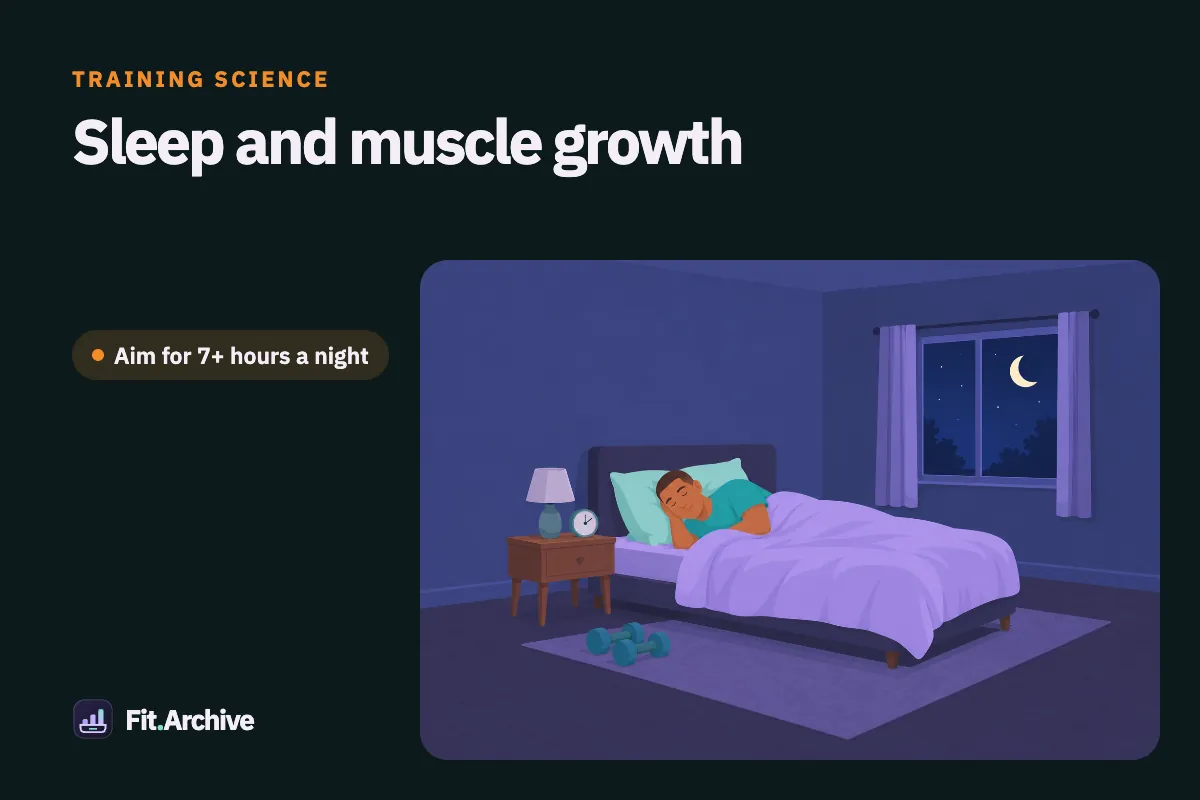
Sleep experts advise adults to sleep 7 or more hours a night on a regular basis, and that is a sensible target for lifters too. Short sleep reliably makes training performance worse, and lab studies show it lowers muscle protein synthesis within a night or a few nights. What nobody has shown yet is how much less muscle you actually build over months by sleeping 6 hours instead of 8. Treat sleep as part of recovery, not as a growth switch.
Two claims go around social media. One says you “grow in your sleep”, so anything under 8 hours wastes your training. The other says sleep is overrated and hard training beats everything. This guide checks both against the studies, says how strong the evidence is, and shows what to do after a short night.
How much sleep do you need to build muscle?
There is no lifting-specific sleep number. The best general guide is the joint consensus statement of the American Academy of Sleep Medicine and the Sleep Research Society: adults should sleep 7 or more hours per night regularly for good health. The panel added that more than 9 hours may be appropriate for young adults, people recovering from sleep debt and people who are ill.
For lifters under 18, the AASM pediatric consensus recommends 8 to 10 hours per 24 hours for teenagers aged 13 to 18. Teenagers who train hard often sleep less than that because of school and late screens.
So “how much sleep to build muscle” has a practical answer: the same 7 or more hours that supports health in general. Nobody has run a trial showing that 9 hours builds more muscle than 7.5.
Sleep and muscle growth: what the studies show
Most of the evidence measures short-term signals inside the muscle, not muscle size after months of training.
| Study | Who and how long | What was compared | Main finding |
|---|---|---|---|
| Lamon et al. 2021 | 13 healthy young adults (7 men, 6 women), crossover | One night with no sleep vs a normal night | Muscle protein synthesis 18% lower the next afternoon; cortisol 21% higher, testosterone 24% lower |
| Saner et al. 2020 | 24 young men, 5 nights | 4 h vs 8 h in bed; a third group had 4 h plus interval training | Myofibrillar protein synthesis lower with 4 h; kept at normal levels in the group that exercised |
| Leproult and Van Cauter 2011 | 10 young men, 1 week | 5 h in bed per night | Daytime testosterone about 10 to 15% lower |
| Nedeltcheva et al. 2010 | 10 adults with overweight, 14 days of dieting | 5.5 h vs 8.5 h sleep opportunity | Fat-free mass loss 2.4 kg vs 1.5 kg, so more of the weight lost came from lean tissue with short sleep |
| Borba et al. 2024 | Adults around 40, 16 sessions over about 5 weeks | Habitual short sleepers (about 5.8 h a night) vs about 7.3 h, both training | Both groups gained reps and estimated arm muscle area; the authors found no effect of the shorter sleep |
How to read this:
- The lab signals all point the same way. Less sleep lowered protein synthesis and nudged hormones in a catabolic direction within days. In the dieting study, short sleep also meant more lean mass lost.
- These studies are tiny and short. Most had 10 to 24 people for one night to two weeks, often with total or severe sleep loss (0 to 5 hours), which is harsher than the 6-hour nights most lifters have.
- The one training study found no harm, but it had 12 people per training group, lasted about five weeks and estimated muscle from tape and skinfold measures. That is not strong enough to say short sleep is fine.
- Exercise seems to protect the muscle signal somewhat. In Saner’s study, the sleep-restricted men who did interval training kept normal protein synthesis. That is one study, but it fits with the idea that training still works on short sleep, just perhaps less well.
The often-quoted idea that sleep debt raises cortisol, lowers testosterone and IGF-1, and so tips muscle towards breakdown comes from a 2011 paper by Dattilo and colleagues. It was published as a hypothesis, a proposed mechanism, not a trial. Later studies such as Lamon’s support parts of it, but the long-term muscle outcome still has not been tested directly in people who lift.
Does short sleep hurt your workouts?
Here the evidence is clearer. A 2022 meta-analysis by Craven and colleagues pooled 227 performance outcomes from 69 publications, comparing 6 hours or less of sleep with more than 6 hours. On average, performance dropped by about 7.6% after sleep loss, across strength, power, endurance and skill tasks. Some details matter for lifters:
- Waking up early hurt more consistently than going to bed late. Consistent drops appeared with total sleep deprivation and with “late restriction” (waking earlier than normal), not with a delayed bedtime.
- Time awake mattered. Performance fell by roughly 0.4% for every hour awake before the task.
- Morning tasks were largely unaffected, while afternoon and evening tasks dropped consistently.
- About 89% of participants were men, so the results may not apply equally to women.
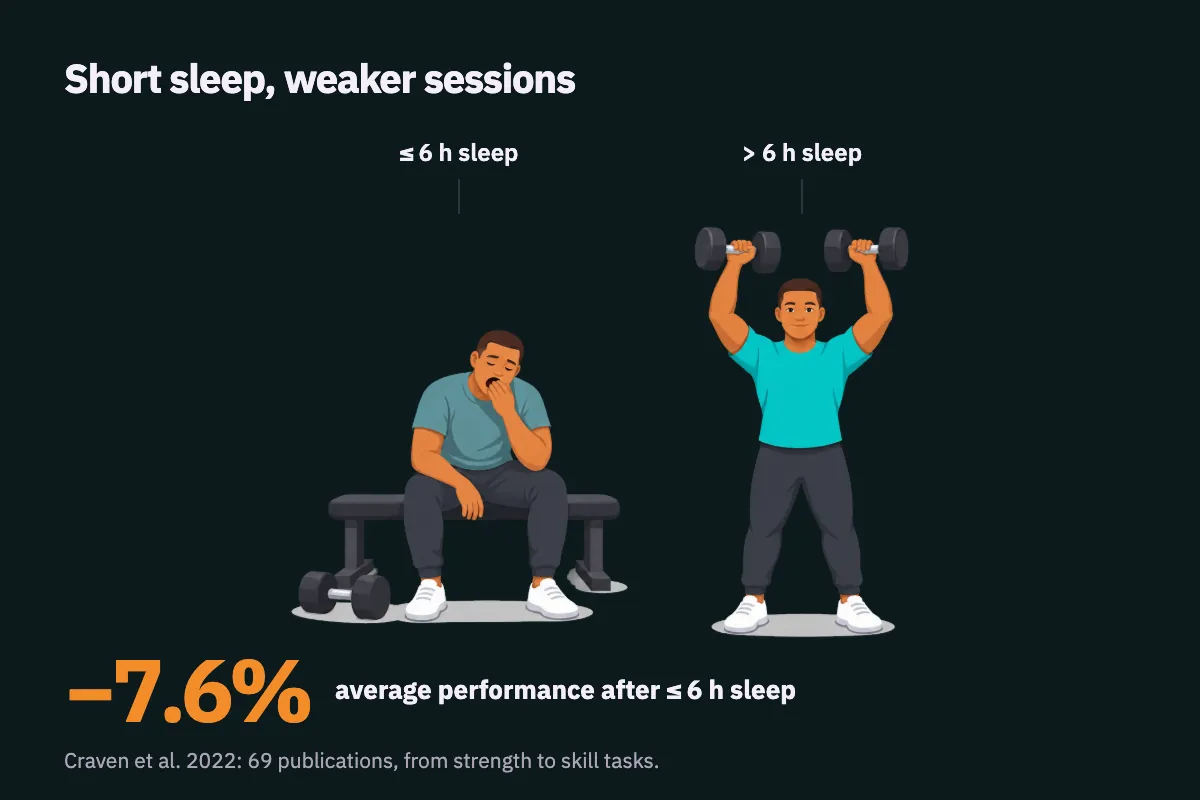
Pooled across 69 publications; morning sessions were largely unaffected.
An earlier systematic review of 17 studies by Knowles and colleagues focused on resistance exercise. One night with no sleep had little effect on muscle strength, but several consecutive nights of short sleep could reduce force in multi-joint lifts such as squats and bench presses, not in single-joint exercises. The authors rated all studies as moderate or weak quality.
Can more sleep help? In a small sleep-extension study, 11 college basketball players aimed for 10 hours in bed for 5 to 7 weeks. They slept about 111 minutes more per night, sprinted faster and shot more accurately. There was no control group, and it was basketball, not lifting, so treat it as a hint.
Is 6 hours of sleep enough to build muscle?
You can almost certainly still build muscle on 6 hours. Training works in short sleepers, and the one direct training study found gains in both groups. What remains unknown is whether you build less muscle over a year than you would on 7.5 to 8 hours.
What the evidence does support:
- One short night is a minor problem. Expect a slightly worse session, especially later in the day, not lost muscle.
- Several short nights in a row cost more. Strength in compound lifts drops more, and you may get fewer quality reps, so fewer effective sets over a week.
- Habitual 6 hours is below the adult recommendation, which matters for health beyond the gym.
- Short sleep during a diet is the riskiest mix for keeping muscle, based on the dieting study above.
Does going to bed late matter?
Total sleep matters more than the clock time you fall asleep. A late bedtime with a late wake-up can still give you 7 to 8 hours. The problem is a late bedtime followed by an early alarm, which is exactly the “late restriction” pattern that hurt performance most in the meta-analysis. If your schedule is fixed by work or class, moving bedtime earlier is usually the only way to add sleep.
What to do after a bad night’s sleep
- Train anyway, but adjust expectations. Use your planned loads and stop at your usual RIR, even if that means fewer reps. Do not chase a personal best.
- Train earlier if you can. Morning sessions were the least affected in the meta-analysis.
- Keep the session shorter if you feel flat. Finishing your main sets and skipping extras is fine. If tiredness builds over weeks, a planned rest day or deload may help more than pushing through.
- Use caffeine with care. The Knowles review lists caffeine and training with others as ways to keep effort up when sleep is short, but caffeine late in the day can shorten the next night’s sleep.
- Do not judge your progress from one session. One bad workout after a short night is not a plateau.
If short sleep is a pattern, the fix is usually outside the gym: a regular bedtime and wake time, and less screen time late. Talk to a doctor if you snore loudly, wake gasping, feel very sleepy during the day or have insomnia for weeks. Ask a clinician before trying sleep supplements or medication, especially if you take other medicines, are pregnant or are under 18. This article is general information, not medical advice.
How to log sleep next to your training
You do not need a sleep tracker to see whether sleep affects your lifting. A one-line note on each session is enough. These are invented example entries, not targets:
| Session | Sleep note | Bench press working sets | What it tells you |
|---|---|---|---|
| Monday | Slept about 7.5 h | 60 kg × 8, 8, 7 at 1 to 2 RIR | Normal baseline |
| Thursday | Slept about 5 h, alarm 2 h early | 60 kg × 7, 6, 6 at 1 to 2 RIR | Lower reps, same effort: likely the short night |
| Next Monday | Slept about 7.5 h | 60 kg × 9, 8, 8 at 1 to 2 RIR | Progress continues |
Without the Thursday note, that session looks like a strength drop. With it, you can ignore it when you track progressive overload. Over a few months, the notes also show whether your short-sleep sessions are frequent enough to matter.
Common mistakes
- Blaming every bad session on sleep. Check the rest of your log too: shorter rest, a calorie deficit or a new exercise can explain a drop.
- Ignoring sleep completely. If a third of your sessions follow 5-hour nights, your training data are mostly “tired” data.
- Cutting sleep to fit in more training. A 5 a.m. session after 5 hours in bed may give you fewer quality sets than a shorter session later on a full night.
- Testing a one-rep max after a short night. Strength tests are the most sensitive to sleep loss in compound lifts.
- Treating sleep as the main driver of growth. Hard sets, enough protein and consistency over months still do most of the work. Our guide on how long it takes to build muscle covers realistic rates.
Logging sleep notes in FitArchive
FitArchive has no sleep tracker, but each workout has a notes field, and every set stores weight, reps and RIR. Add a short note such as “slept about 5 h” when a night was short, so the Progress screen’s estimated 1RM and weekly hard sets are easier to read later. The demo shows the layout with sample data.