For building muscle, how much protein and food you eat across the day matters far more than the exact minutes before or after a workout. A sensible default is a normal meal with carbohydrate and protein about 1 to 3 hours before training, and a meal with a good serving of protein within a few hours after. There is no 30-minute deadline: studies that compared protein timing found the effect mostly disappears once total daily protein is equal.
Two claims are popular on social media: you must drink a shake within 30 minutes of your last set, and training on an empty stomach is either dangerous or a fat-loss trick. This guide checks both against the research and lists Vietnamese meals that fit before and after training.
Is there an anabolic window after a workout?
The “anabolic window” is the claim that muscles can only use protein for a short time after training, often said to be 30 to 60 minutes. The main studies:
| Study | What it looked at | Main finding |
|---|---|---|
| Aragon and Schoenfeld 2013 | Narrative review of nutrient timing research | The importance, and even the existence, of a narrow window depends on when and what you ate before training |
| Schoenfeld, Aragon and Krieger 2013 | Meta-analysis of 23 studies (525 people) on muscle size and 20 studies on strength | A small to moderate effect of timing on muscle size disappeared once the analysis accounted for other factors; total protein intake was the strongest predictor |
| Schoenfeld et al. 2017 | 21 trained men, 10 weeks, full body 3 days a week | 25 g of protein taken just before or just after training gave similar gains in strength and muscle |
How strong is this? The meta-analysis pooled small trials, and in many of them the “timed” group also ate more protein in total. Once that was accounted for, timing stopped mattering. The direct trial was short, small and only included young trained men. The honest summary: the window is wide, likely several hours, and it gets narrower mainly if you trained without eating for many hours beforehand.
What the ISSN says about nutrient timing
The International Society of Sports Nutrition (ISSN) position stand on nutrient timing is a widely cited summary. Its main points for lifters:
- Total daily protein comes first, ideally spread evenly through the day.
- Per meal, about 20 to 40 g of high-quality protein (roughly 0.25 to 0.40 g per kg of body weight) every 3 to 4 hours is the pattern most linked with muscle protein synthesis.
- Protein after training works well, from immediately after up to about 2 hours, but the size and timing of your meal before training changes how urgent that is.
- Most of its carbohydrate advice targets long, hard sessions and refilling muscle glycogen within a few hours, such as for athletes training twice a day.
Several of its authors disclose ties to supplement companies, which is worth knowing. For daily amounts, see our guide to protein per day for building muscle.
When to eat before and after a workout
This is a sensible default, not a rule. Adjust it to your schedule and stomach.
| Timing | What to eat | Why |
|---|---|---|
| 2 to 3 hours before | A normal meal with carbohydrate and protein | Enough time to digest; you start the session fed |
| 30 to 60 minutes before | A small, easy snack if you are hungry, such as a banana or yogurt | Takes the edge off hunger without feeling heavy |
| During training | Water | For a typical lifting session of about an hour, most people do fine without food |
| Within a few hours after | A meal with 20 to 40 g of protein and some carbohydrate | Covers the “window” and counts towards your daily total |
| After training fasted | Protein soon after, not hours later | The window is narrower after a long fast |
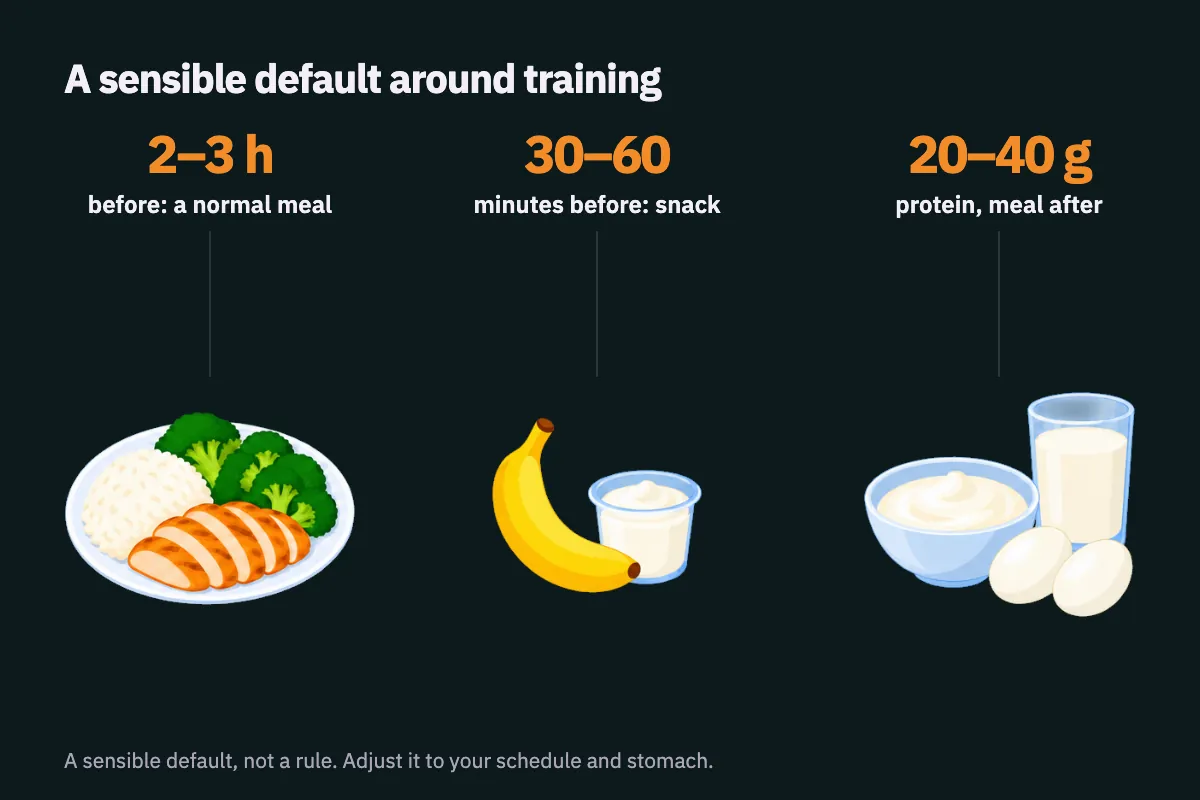
Most people already cover both meals with lunch or dinner.
If you eat lunch at noon and train at 3 pm, lunch is your pre-workout meal. If you train at 6 pm and eat dinner at 8 pm, dinner is your post-workout meal. Most people already cover both.
Pre workout meal ideas with Vietnamese food
These numbers are FitArchive recipe estimates for the stated weights, built from USDA ingredient data and rounded. Street and restaurant portions vary with the amount of bread, rice or noodles, how much meat goes in, how much oil is used, and the sauces.
| Food (recipe weight) | kcal | Protein | Carbs | Fat | Fits best |
|---|---|---|---|---|---|
| Bánh mì trứng (218 g: 90 g bread, 2 eggs, 8 g oil) | 464 | 23 g | 48 g | 20 g | 2 to 3 hours before |
| Xôi gà (253 g) | 361 | 21 g | 38 g | 13 g | 2 to 3 hours before |
| Xôi đậu xanh (240 g) | 316 | 7 g | 52 g | 9 g | 2 to 3 hours before; little protein |
| Cháo gà (393 g) | 372 | 26 g | 42 g | 10 g | 1 to 2 hours before; easy to digest |
| Banana (118 g, one medium) | 105 | 1 g | 27 g | 0 g | 30 to 60 minutes before |
| Plain yogurt (100 g) | 61 | 4 g | 5 g | 3 g | 30 to 60 minutes before |
Fat and fibre slow digestion, so leave more time after bigger, oilier meals. With only 30 minutes to go, a banana or yogurt sits easier than a full packet of xôi. For more dishes, see the Vietnamese food calorie table and the bánh mì calorie guide.
Post workout meal for muscle gain
After training, aim for a meal with a decent serving of protein and some carbohydrate. Options from the same FitArchive data:
| Food (recipe weight) | kcal | Protein | Carbs | Fat |
|---|---|---|---|---|
| Cơm gà (518 g: 200 g rice, 120 g chicken with skin) | 655 | 39 g | 64 g | 26 g |
| Phở bò (785 g: 200 g noodles, 80 g lean beef, 450 g broth) | 418 | 38 g | 57 g | 4 g |
| Two hard-boiled eggs (100 g) | 155 | 13 g | 1 g | 11 g |
| Greek yogurt, nonfat (170 g) | 100 | 17 g | 6 g | 1 g |
| Whole milk (244 g, one cup) | 149 | 8 g | 12 g | 8 g |
Cơm gà and phở bò each land inside the 20 to 40 g protein range. Eggs, yogurt or milk work as a snack if dinner is hours away. The phở calorie guide explains why a restaurant bowl can differ a lot from this estimate, mostly through broth fat and the amount of meat.
For muscle gain, the post-workout meal is just one convenient place to put a protein serving. A meta-analysis by Morton and colleagues of 49 trials found that extra protein stopped adding to muscle gains at around 1.6 g per kg of body weight per day in total. If your day already reaches that, the exact timing of one meal adds little.
For weight loss, the meal after training still counts towards the day’s calories; training does not “earn” an extra large meal. Keep protein in it, and see our guide to body recomposition, bulking and cutting for how calorie balance fits with training.
Is it OK to work out on an empty stomach in the morning?
For most healthy adults, lifting fasted is not dangerous, but it may cost some reps:
- In a 2019 randomized crossover trial, 16 trained men who normally ate breakfast did squats and bench presses to failure 2 hours after either a carbohydrate breakfast or water only. Without breakfast they completed fewer total reps: about 58 versus 68 in the squat and 38 versus 40 in the bench press.
- A 2018 meta-analysis of 46 studies found that eating before exercise improved longer aerobic performance, but not shorter efforts. Most of those studies were cycling or running, not lifting.
Two limits matter. The breakfast trial only included regular breakfast eaters, so people used to training fasted might be less affected. And we found no long-term trials showing that lifting fasted builds less muscle when total food and protein are equal. The evidence is limited and mostly about performance on the day.
A practical approach for early sessions:
- With 1 to 2 hours, have a small meal such as cháo gà or half a bánh mì trứng.
- With 20 to 30 minutes, a banana, yogurt or glass of milk is enough for many people.
- If you prefer to train fasted, that is a reasonable choice. Eat a meal with protein soon after rather than waiting until lunch.
- If you feel dizzy, shaky or nauseous when training fasted, eat something first. People with diabetes or other medical conditions, and anyone on medication that affects blood sugar, should ask their doctor about exercising without eating.
Afternoon and evening workouts: what about sleep?
For an afternoon session, lunch is usually your pre-workout meal, with a small snack an hour before if the gap is long. For evening sessions, the question is whether training late hurts sleep.
A 2019 meta-analysis of 23 studies found that evening exercise did not harm sleep overall in healthy adults. The exception was vigorous exercise ending within about an hour of bedtime, which may delay sleep and shorten it. If you train late, finish an hour or more before bed.
Protein before bed is also popular. The ISSN notes that 30 to 40 g of casein before sleep raises muscle protein synthesis overnight. In a 12-week trial of 44 young men, a 27.5 g protein drink every night before sleep led to larger strength and muscle gains than a placebo. But the drink was added on top of the usual diet, so that group also ate more protein in total; the study does not show that bedtime itself mattered. A normal dinner with protein after an evening workout does the same job for most people. Sleep itself matters for recovery too; see our guide to sleep and muscle growth.
Common mistakes with pre and post workout meals
- Rushing a shake in the changing room while eating too little protein the rest of the day.
- Eating a large, oily meal right before training. Leave more time or eat lighter.
- Skipping food all day, then training late. Long gaps before and after training are where timing starts to matter.
- Treating a post-workout meal as free calories when the goal is weight loss.
- Buying special products you do not need. Ordinary meals such as cơm gà, phở, eggs or milk do the job. Our guide on what to eat to build muscle covers the rest of the day.
- Judging a meal plan from one workout. Compare several sessions, as in the progressive overload guide.
This is general information, not personal advice. If you have a medical condition, are pregnant, are under 18 or have a history of disordered eating, ask a doctor or registered dietitian.
Logging workout meals in FitArchive
FitArchive is a free, private training and food log that works in your browser, including offline. You can log Vietnamese dishes such as bánh mì trứng, cơm gà or phở bò from about 263 recipe estimates, pick a small, regular or large size, and set the rice or noodles to less or more. Daily calories and protein sit next to your workouts, where each set records weight, reps and RIR, so you can see whether a fasted morning lines up with a weaker session. The demo shows the layout with sample data.