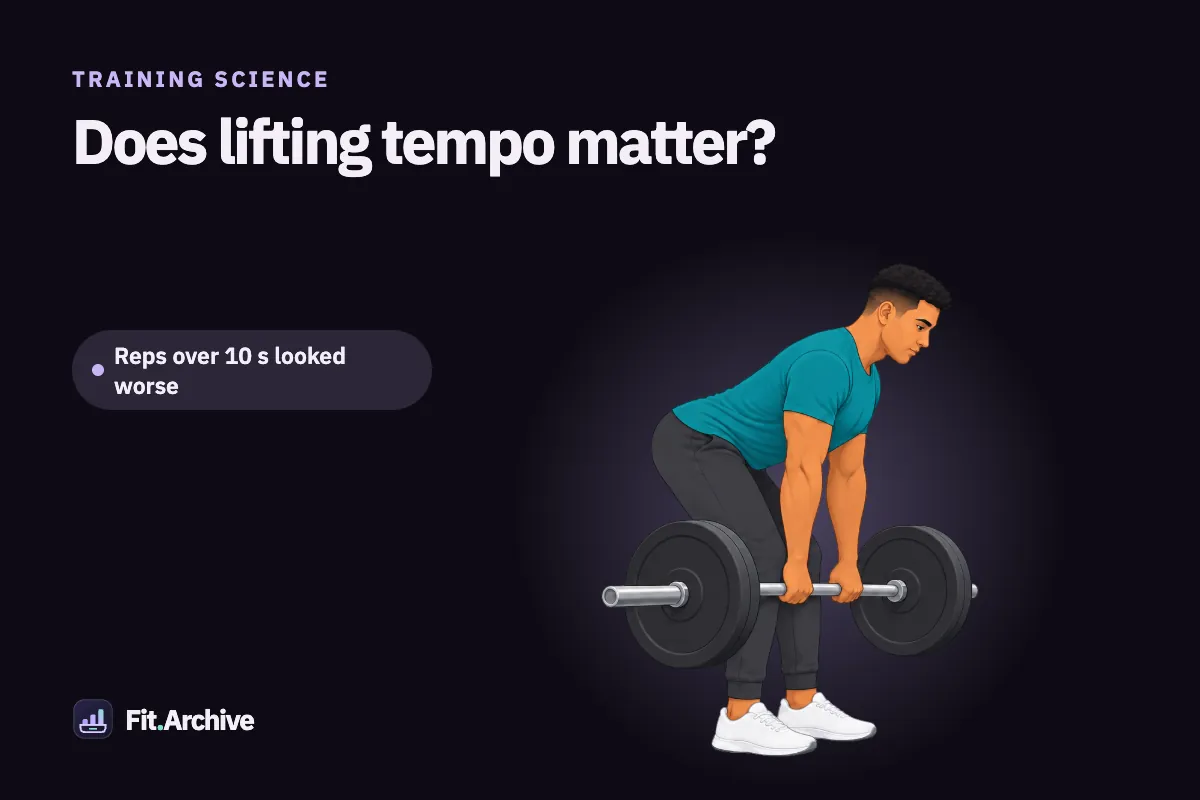
For muscle growth, the speed of your reps matters less than social media suggests. A meta-analysis of 8 studies found similar growth with repetition durations from about 0.5 to 8 seconds when sets were taken to failure, while very slow reps of more than 10 seconds appeared worse. The lowering (eccentric) phase does matter, and eccentric-focused training may give a small edge, but you do not need to count seconds. Lower the weight under control, lift it with intent, and keep your tempo consistent so your log compares like with like.
Tempo is a favourite topic in fitness videos: “slow down the negative to double your gains” or “aim for 40 to 70 seconds of time under tension per set”. This article checks those claims against the research, explains how to read tempo notation such as 3-1-1-0, and shows how to log it so a tempo change is not mistaken for lost strength.
What is lifting tempo?
Tempo is how long each phase of a repetition takes. It is usually written as four numbers, in seconds, for example 3-1-1-0 or 3/1/1/0. A 2021 review by Wilk and colleagues describes the common convention:
- Eccentric: lowering the weight, or the phase where the muscle lengthens under load.
- Pause at the bottom: the transition between lowering and lifting.
- Concentric: lifting the weight, where the muscle shortens.
- Pause at the top: the transition before the next rep.
An X means “as fast as possible” with control. The first number is always the eccentric, even for exercises such as pull-ups or deadlifts that start with the lift. That is a common source of confusion.
These are examples of how to read notation, not recommendations:
| Tempo | What it means | Seconds per rep | 8 reps take about |
|---|---|---|---|
| 2-0-1-0 | 2 s down, no pause, 1 s up, no pause | 3 | 24 s |
| 3-1-1-0 | 3 s down, 1 s pause at the bottom, 1 s up | 5 | 40 s |
| 2-0-X-0 | 2 s down, lift as fast as you can | about 3 | about 24 s |
| 4-0-10-0 | 4 s down, 10 s up (a “super slow” style) | 14 | 112 s |
What is time under tension?
Time under tension (TUT) is the total time a set lasts: reps multiplied by seconds per rep. It sounds like a direct measure of the training stimulus, but the evidence does not support chasing a target number. The 2026 ACSM position stand, an overview of 137 systematic reviews, listed time under tension among the variables that did not consistently change strength or muscle growth outcomes.
One reason: slowing every rep makes the set harder in a different way. You lift less weight and complete fewer reps. The Wilk review notes that changing tempo alters the number of reps you can do, the time under tension and the maximum load you can lift. The “40 to 70 seconds per set” figure you may see online is a gym rule of thumb, not a research finding.
Does lifting slower build more muscle?
The clearest evidence comes from a 2015 meta-analysis by Schoenfeld, Ogborn and Krieger. It included 8 studies of at least 6 weeks in which sets were taken to muscular failure:
- Muscle growth was similar for repetition durations from 0.5 to 8 seconds.
- Training at very slow, deliberate durations of more than 10 seconds per rep appeared inferior for growth, although the authors noted few controlled studies on that point.
One example of the “super slow” problem: in a 6-week study of 34 untrained women, a slow-speed group lifted for 10 seconds and lowered for 4 seconds at about 40 to 60% of their 1RM. A group using normal speed (1 to 2 seconds each way) with heavier loads of about 80 to 85% 1RM had the greatest overall muscle fibre response. The slow-speed group did respond better than a group using similar light loads at normal speed, so slow reps are not useless, just not better than ordinary heavy training.
The Wilk review concluded that neither slow nor fast tempos alone are clearly better for growth, and that a slower eccentric paired with a faster concentric looks most favourable. It also stated plainly that the results are not conclusive and that longer studies are needed.
Eccentric vs concentric: which builds more muscle?
Researchers have compared training with only eccentric actions against training with only concentric actions, often on special machines:
- A 2009 meta-analysis by Roig and colleagues of 20 randomized trials found eccentric training at higher intensities increased total strength and muscle girth more than concentric training, with a trend toward more muscle cross-sectional area. The advantage seemed to come from the heavier loads people can handle while lowering. Strength gains were also quite specific: eccentric training mostly improved eccentric strength.
- A 2017 meta-analysis by Schoenfeld and colleagues of 15 studies found average muscle growth of 10.0% with eccentric training and 6.8% with concentric training. The difference was not statistically significant, and the authors concluded both actions are effective and both belong in a program.
- The 2026 ACSM overview listed eccentric overload, meaning heavier loads during the lowering phase, among the factors that enhanced muscle growth.
What this means for normal lifting: every ordinary rep already has an eccentric and a concentric phase. You do not need special eccentric-only training to benefit. The practical point is simply not to waste the lowering phase by dropping the weight. Heavier or slower eccentrics are also a common cause of extra soreness when they are new; see our muscle soreness guide.
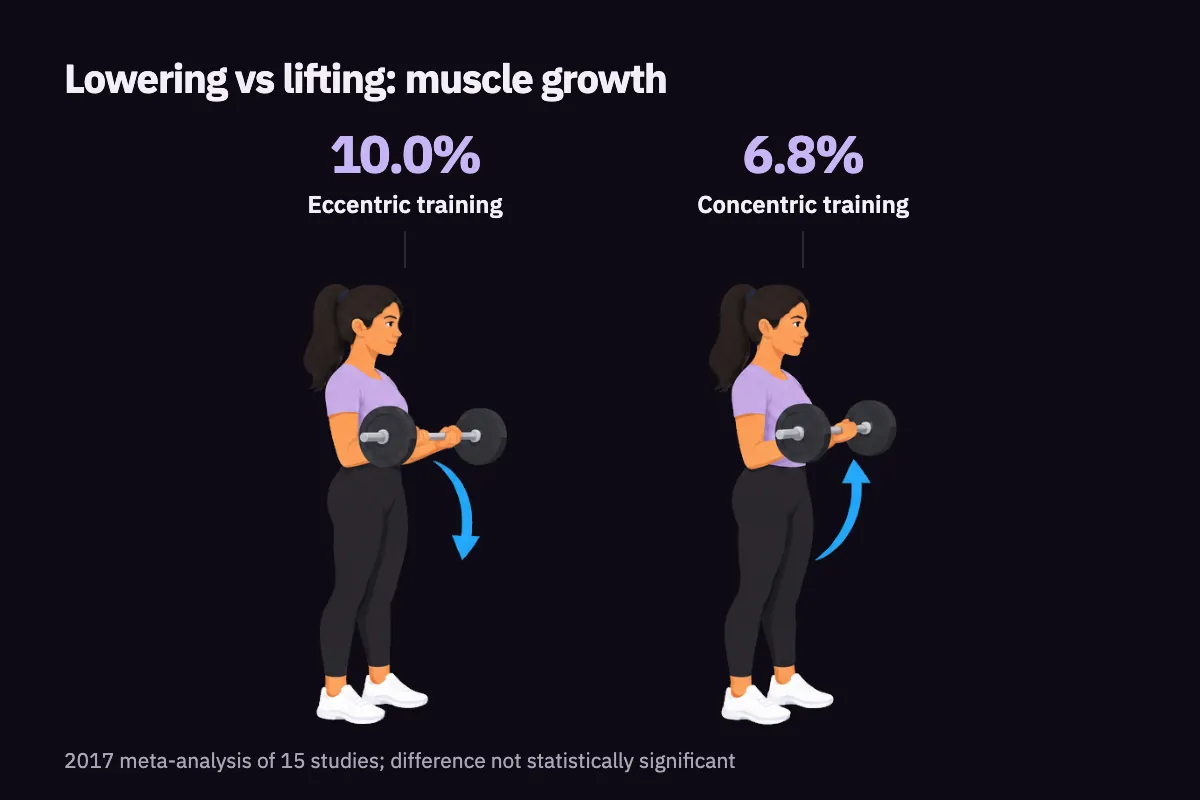
Both phases build muscle; just do not drop the weight on the way down.
Should you count seconds on every rep?
For most lifters aiming at muscle growth, no. A controlled lowering of roughly one to three seconds and a lift done with intent covers the range that worked in studies. Counting can still help in a few situations:
- Learning an exercise. A slower eccentric and a short pause make it easier to feel position and depth.
- Keeping sessions comparable. If your reps get faster and bouncier over time, rep counts can rise without you getting stronger.
- Following a specific program or rehab plan. If a coach or clinician prescribes a tempo, follow it.
Effort still matters more than speed. A set at 2-0-1-0 that ends 1 to 3 reps short of failure is a hard set; a slow set that ends far from failure is not. Our guides on reps for muscle growth and training to failure vs leaving reps in reserve cover that side.
How to log tempo consistently: an example
Tempo changes how many reps you can do, so it changes your rep totals and any estimated 1RM. These are invented log entries, not suggested loads. The estimated 1RM uses kg × (1 + (reps + RIR) / 30):
| Week | Squat | Tempo | Effort | Estimated 1RM |
|---|---|---|---|---|
| 1 | 100 kg × 8 | 2-0-1-0 | 2 RIR | 133 kg |
| 4 | 100 kg × 6 | 3-1-1-0 | 2 RIR | 127 kg |
| 7 | 100 kg × 8 | 3-1-1-0 | 2 RIR | 133 kg |
Week 4 looks like a drop, but the lifter added a slower lowering and a pause. Compared within the new tempo, weeks 4 to 7 show clear progress. Without the tempo noted, the chart would suggest lost strength.
How to keep tempo readable:
- Write the tempo once at the start of the workout, for example “squat and RDL at 3-1-1-0”.
- Keep the same tempo for an exercise for a whole block, so session-to-session comparisons are fair.
- Mark the week you change tempo, and compare only within the same tempo afterwards.
- Keep recording RIR. It tells you whether a slower set was actually hard.
Common mistakes
- Counting slow reps but stopping far from failure. Long sets are not automatically hard sets.
- Using super slow reps for everything. Studies suggest reps over about 10 seconds are worse for growth.
- Dropping the weight on the way down. You lose a useful part of each rep and some control over the bar.
- Comparing numbers across different tempos. Fewer reps at a slower tempo is not a strength loss.
- Counting the first number as the lift. In standard notation, it is the lowering.
For more on comparing sessions over time, see the progressive overload guide.
Logging tempo in FitArchive
FitArchive is a free, private training log that works in your browser and offline; your data stays on your device unless you sign in to sync. It records the weight, reps and RIR of each set, and every workout has a notes field where you can write the tempo you used. The Progress screen shows an estimated 1RM per exercise, so a note like “switched to 3-1-1-0 this week” explains any step in the line. Try it with sample data in the demo.