The mind-muscle connection means deliberately focusing on the muscle you are training while you lift, which researchers call an internal focus. One 8-week study found more biceps growth with that focus, but not more quadriceps growth. Focusing on the muscle raises its electrical activity at light to moderate loads, not at heavy ones. On heavy lifts, focusing on moving the weight (an external focus) produces more force. And more muscle activity on a sensor is not the same thing as more muscle growth.
The popular claim on social media goes something like “if you cannot feel it, it is not growing”, often paired with “light weight and a squeeze beats heavy ego lifting”. This guide tests both parts against the research and shows how to use each kind of focus where it actually helps.
What does mind-muscle connection mean?
It is the idea that paying close attention to a target muscle, feeling it stretch and squeeze through each rep, makes that muscle do more of the work. In research terms, that is an internal focus: attention on your body, such as “squeeze your biceps”.
The opposite is an external focus: attention on the result or on something outside your body, such as “curl the bar to your chin”, “push the floor away” on a squat or “push the bar to the ceiling” on a bench press.
Most lifters use both without thinking about it. The research question is which focus helps which goal.
Does the mind-muscle connection build more muscle?
Only one long-term trial has measured muscle growth directly. In Schoenfeld and colleagues’ 2018 study, 30 untrained college-aged men trained three times a week for 8 weeks, doing 4 sets of 8 to 12 reps per exercise. Half were told to focus on contracting the target muscle; the other half focused on getting the weight up.
| Outcome | Internal focus (“squeeze the muscle”) | External focus (“get the weight up”) |
|---|---|---|
| Elbow flexor (biceps) thickness | Up 12.4% | Up 6.9% |
| Quadriceps thickness | Similar to external | Similar to internal |
| Isometric elbow flexion strength | Higher, not statistically significant | Lower |
| Isometric knee extension strength | Lower | Higher, not statistically significant |
So the mind-muscle connection helped biceps growth, but not quadriceps growth, in beginners over two months. Why only the arms is unclear; one plausible guess is that it is easier to focus on a small muscle like the biceps than on the legs. Either way, this is one study with 15 people per group, untrained men and a short duration, and it has not been repeated in trained lifters.
What EMG studies show, and why EMG is not hypertrophy
Most other mind-muscle research uses surface EMG, sensors on the skin that pick up a muscle’s electrical activity.
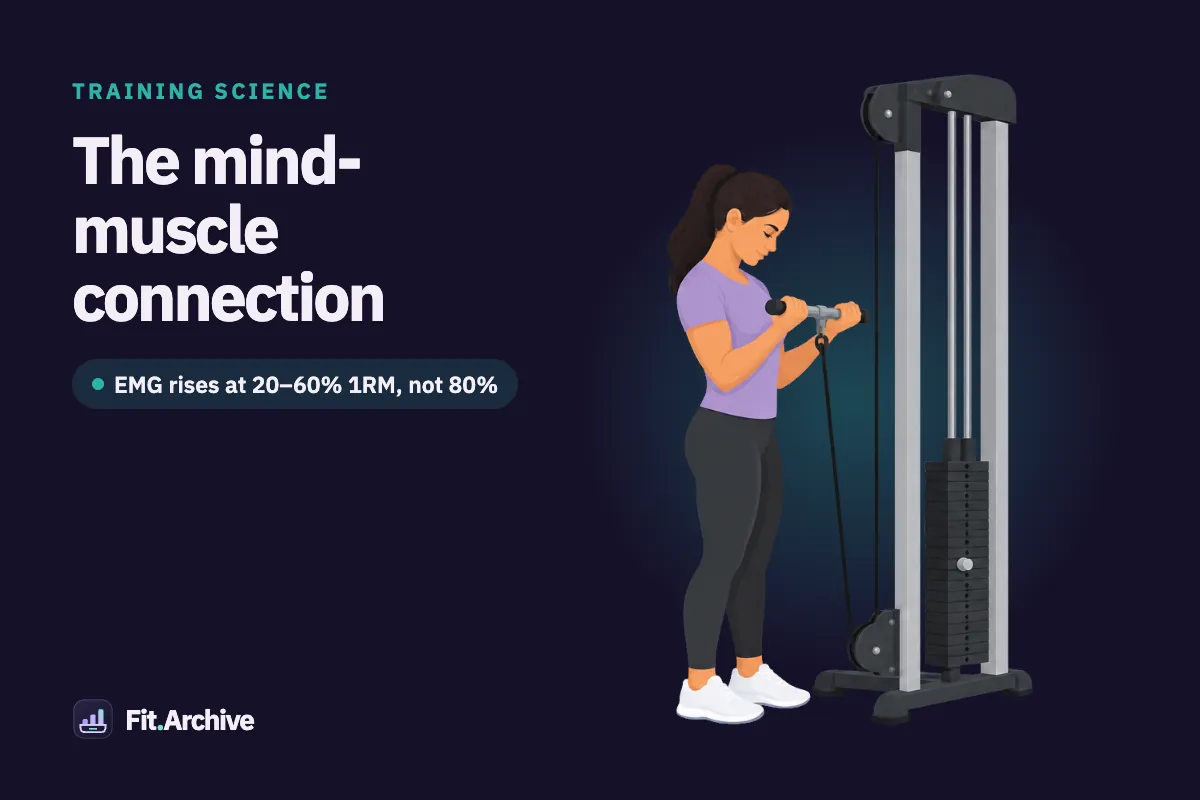
- In a 2016 study of 18 trained men on the bench press, focusing on the chest or on the triceps raised that muscle’s activity at 20% to 60% of one-rep max, but not at 80%. The authors suggested a threshold somewhere between 60% and 80% of 1RM.
- In a 2017 follow-up on push-ups, focusing on the chest raised chest activity by about 9%. Focusing on the triceps did not reliably raise triceps activity, but men with more years of training were better at it. That suggests the skill improves with practice.
These results fit gym experience: it is easy to “feel” a muscle on a light set of flyes and much harder during a heavy triple.
But a higher EMG reading does not prove more growth. A 2017 paper by Vigotsky and colleagues explains that larger surface EMG signals do not necessarily mean more motor units are recruited, and that a muscle’s “hypertrophic potential” cannot be inferred from EMG. One elbow flexion study even found that an external focus produced more force with less biceps EMG than an internal focus. So “this exercise lights up the muscle more” in a video is a hint at most, not evidence that it builds more muscle.
Mind-muscle connection vs heavy weights: what helps performance?
For lifting the most weight or doing the most reps, the evidence favours an external focus:
- In an isometric mid-thigh pull study of 18 trained athletes, they produced 9% more force with an external focus than with an internal focus.
- A 2021 meta-analysis of 10 studies on strength found an external focus increased strength in the moment. Over a full training program, there was no significant overall difference between focus types, but for lower-body exercises, training with an external focus led to larger strength gains.
- A companion meta-analysis on muscular endurance found people did more reps to failure with an external focus than with an internal focus.
- A 2019 systematic review of 16 weightlifting studies concluded that an external focus generally made movement more efficient.
So “mind-muscle connection vs heavy weights” is a false choice. Heavy and light loads can both build muscle when sets end close to failure; see how many reps build muscle. The focus that suits each is different.
How to use internal and external focus
These are example cues, not prescriptions:
| Exercise type | Typical load and reps | Focus that fits | Example cue |
|---|---|---|---|
| Isolation for small muscles: curls, lateral raises, cable flyes, triceps pushdowns | Moderate, about 8 to 20 reps | Internal | “Squeeze the biceps at the top” |
| Machine work for a muscle you struggle to feel, such as lats on a pulldown | Moderate | Internal, practised over weeks | “Pull with your elbows, feel the lats” |
| Heavy compound lifts: squat, deadlift, bench press, overhead press | Heavy, about 1 to 6 reps | External | “Push the floor away”, “drive the bar up” |
| Sets taken close to failure on any exercise | Any | External usually helps you squeeze out the last reps | “Move the weight” |
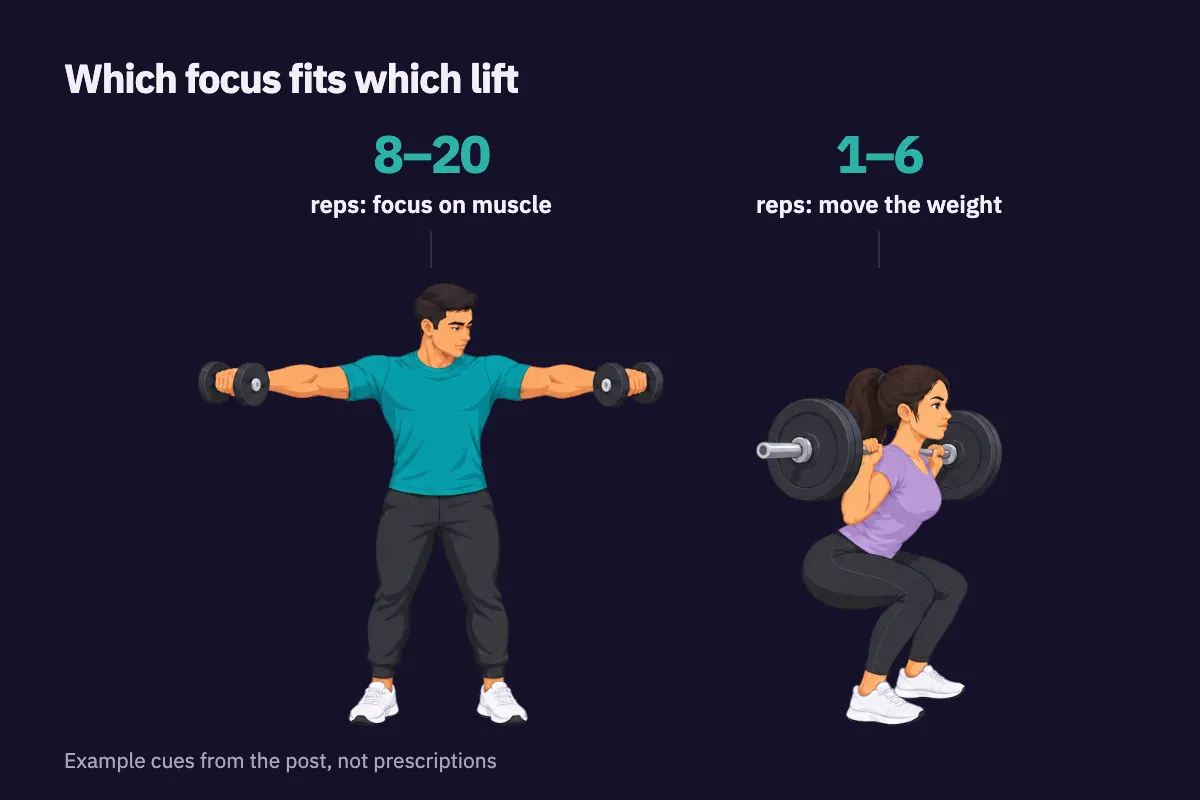
Feel the muscle on lighter isolation work; think about moving the weight on heavy lifts.
A practical pattern: use your warm-up sets and lighter isolation work to practise feeling the target muscle, then switch to outcome cues for heavy working sets. This mirrors the research: internal focus pays off when the load is not heavy, which is also where most isolation exercises sit.
If you cannot feel a muscle, is it not growing?
No. Feeling a muscle burn or pump during a set, or being sore afterwards, does not measure growth. Researchers judge growth by muscle size over weeks; you can judge it by whether you lift more weight or more reps at the same effort over time. If your lat pulldown keeps going up, your lats are working, whether or not you feel them. Soreness is a poor guide too, as our guide on muscle soreness explains.
Common mistakes
- Going so light to “feel it” that sets end far from failure. A set that stops 8 reps short of failure is probably too easy to count, whatever you felt. Keep most sets within a few reps of failure; see training to failure vs RIR.
- Thinking about the muscle on a near-maximal lift. On a heavy squat or deadlift, an internal focus may cost force. Use outcome cues.
- Judging exercises by pump, burn or EMG videos. None of them is a direct measure of growth.
- Changing your cue and your load at the same time. If both change, you cannot tell which one made the difference in your log.
- Slowing every rep to feel more. Very slow reps can cut the load you can use. Our lifting tempo guide covers what speed research shows.
How to test it with your own log
You cannot measure muscle thickness at home, but you can track performance. For one isolation exercise, write the cue you used in the workout note, keep the same load range and reps in reserve, and watch whether reps or weight rise over 6 to 8 weeks. These are invented example entries:
| Week | Cable curl working sets | RIR | Workout note |
|---|---|---|---|
| 1 | 20 kg × 12, 11, 10 | 1 to 2 | Cue: squeeze biceps, 1 s pause at top |
| 4 | 20 kg × 14, 13, 12 | 1 to 2 | Same cue |
| 8 | 22.5 kg × 12, 11, 11 | 1 to 2 | Same cue, weight increased |
That will not prove the cue caused the progress, but it keeps the cue constant so other changes are easy to spot when you track progressive overload.
Tracking cues and progress in FitArchive
FitArchive logs each set’s weight, reps and RIR and has a notes field for each workout, where you can record the cue you used. The Progress screen shows estimated 1RM per exercise and weekly hard sets by muscle, so you can judge an exercise by what you lift over time rather than how it feels on the day. Try it with sample data in the demo.